Allagash abductions
Illustrations
AI-generated illustration — not actual footage or evidence; an interpretive depiction based on the documented account
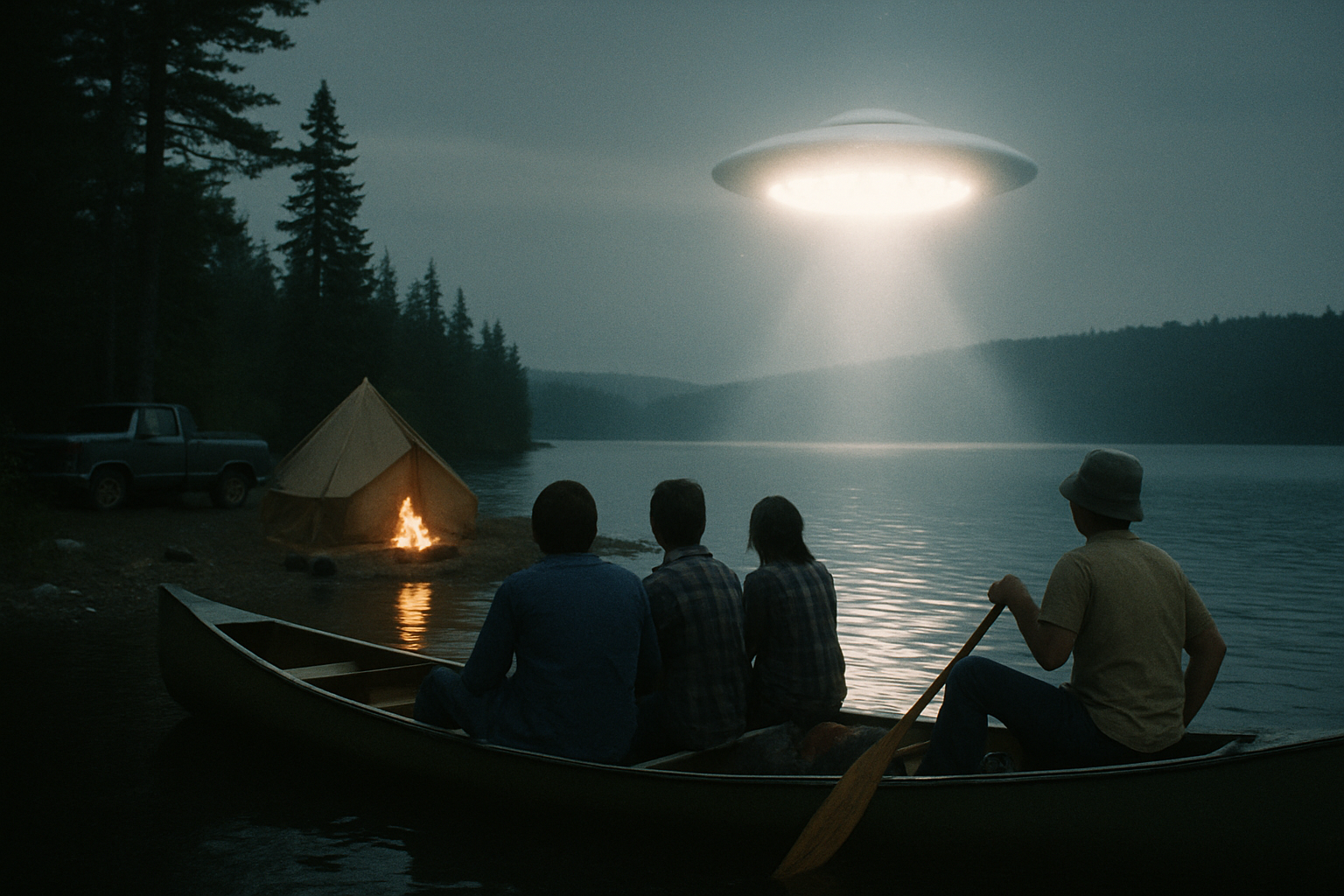
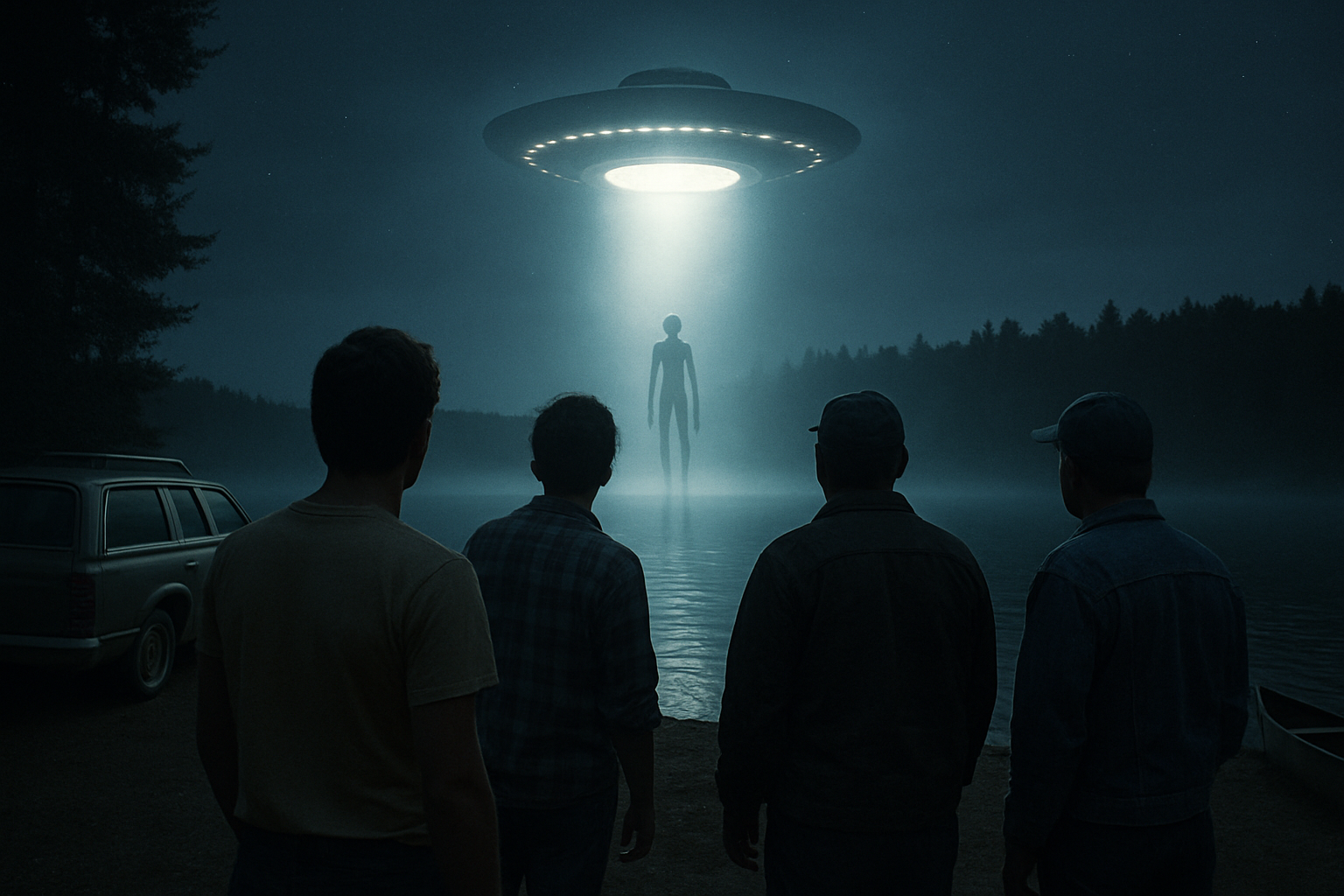
The Allagash abductions is an alleged multiple-witness alien-abduction case said to have taken place in August 1976 on the Allagash Wilderness Waterway in northern Maine, United States.[2][4] Four young art students—identical twins Jack and Jim Weiner, Charlie Foltz, and Chuck Rak—reported that, while night-fishing in a canoe on Eagle Lake, they saw a large glowing sphere hovering over the trees, signalled to it, and were engulfed by a beam of light, afterward finding that more time had passed than they could account for.[5][4] The men say they had no clear memory of an abduction at the time; the abduction narrative emerged more than a decade later, after Jim Weiner began suffering vivid nightmares and the group consulted the UFO investigator Raymond E. Fowler, who arranged hypnotic-regression sessions in which all four described broadly similar experiences of being examined aboard a craft.[2][5] Fowler presented the case in his 1993 book *The Allagash Abductions: Undeniable Evidence of Alien Intervention*, and it was dramatized on the television series *Unsolved Mysteries*.[2][4] Because the core account depends on hypnotically recovered memory—a technique many psychologists regard as prone to producing false memories—and because one of the four men, Chuck Rak, said in 2016 that the abduction memories were not real, the case is generally regarded as disputed rather than established.[2][3]
Background
In the summer of 1976, four men in their early twenties set out from the Boston area for a roughly two-week canoe-and-camping trip in the wilderness of northern Maine.[4] The group consisted of identical twins Jack and Jim Weiner, Charlie Foltz, and Chuck Rak; the four were art students at the Massachusetts College of Art and Design in Boston.[4][5]
The trip followed the Allagash Wilderness Waterway, a protected ribbon of lakes, ponds and rivers in a remote, sparsely populated part of Maine.[4] According to later accounts the men left the Boston area on or about 20 August 1976 and worked their way north along the waterway over the following days.[4]
Fowler and other writers have emphasized the men's youth, artistic training—relevant because they later produced detailed drawings—and the remoteness of the location, away from significant artificial light, as part of the background to what they reported.[2][4]
The reported sighting
By the men's account, on the night of 26 August 1976 the group had reached Eagle Lake and made camp.[4] Because the area was extremely dark, they are said to have built a large bonfire on the shore to mark the campsite before paddling out onto the lake to fish for trout.[4][5]
The men described seeing a large, bright, glowing sphere hovering silently above the treeline on the far rim of the cove.[5] In the most commonly repeated version, Charlie Foltz flashed a light toward the object, after which it appeared to respond and move rapidly toward the canoe, projecting a cone-shaped beam of light down onto the water.[5][4]
According to the witnesses, the beam swept over the canoe and the next thing they clearly recalled was being on or near the lake, watching the object rise and depart.[5] The men have said they felt they had been out on the water for only about 15 to 20 minutes, yet their large bonfire—which they had expected to be still burning brightly—had unexpectedly burned down to coals, which they took as evidence that far more time had elapsed than they had perceived; the unaccounted-for interval has been described in various retellings as roughly two to three hours.[4][5] At the time, the men say, they did not interpret the episode as an abduction.[5]
Nightmares, hypnosis and investigation
The abduction narrative did not take shape until more than a decade after the trip.[2] In the late 1980s Jim Weiner, who had suffered a head injury and developed a seizure disorder, began experiencing recurring, vivid nightmares involving strange figures with large heads and large dark eyes performing examinations on him.[5][4] After raising the experiences at a medical conference on sleep and related disorders, the group was directed toward UFO researchers, and around 1988 the men contacted the veteran investigator Raymond E. Fowler.[5][2]
Fowler, a longtime UFO investigator who served as Director of Scientific Investigations for the Mutual UFO Network (MUFON), arranged for the four men to undergo hypnotic regression in separate sessions, conducted with a hypnotist and overseen by Fowler and other investigators, from about 1989 to 1991.[2][4] Under hypnosis, each man is reported to have described broadly similar experiences: being levitated from the canoe by the beam, taken aboard a craft, and subjected to physical examinations that they characterized as invasive and distressing, including the taking of skin and fluid samples.[5][4]
Supporters of the case point to several corroborating elements assembled during the investigation:
- Consistency of accounts. The four men are said to have independently produced broadly matching descriptions and drawings of the beings and the craft's interior.[4][5]
- Polygraph testing. Accounts of the case state that the men underwent and passed polygraph examinations, and that psychological evaluation found them to be stable.[4][1]
- Publication and broadcast. Fowler set out the case in detail in his 1993 book *The Allagash Abductions*, and it was later featured on the television series *Unsolved Mysteries*.[2][4]
Explanations and disputes
The Allagash case has never been the subject of any official government investigation and is widely treated as disputed rather than resolved.[2][3]
The principal point of contention is the reliance on hypnotic regression. Many psychologists and memory researchers hold that hypnosis does not reliably recover accurate memories and can instead encourage confabulation and false memories, particularly when an interviewer's expectations or a culturally familiar abduction narrative shape what is recalled.[2] Critics of Fowler's broader body of hypnosis-based abduction work—including the earlier Andreasson case—have raised the same objection, arguing that material recovered under hypnosis may reflect fantasy or suggestion rather than literal recollection.[2]
Other skeptical observations include:
- Cultural priming and suggestion. The imagery of large-headed, black-eyed "grey" beings was, by the late 1980s, a well-established part of popular culture, which skeptics argue could have shaped the recovered accounts.[2]
- Shared expectation among friends. Because the four were close companions discussing the same unusual night, sceptics suggest that a shared, mutually reinforced narrative could form without any single deliberate falsehood.[3]
- Substance use on the trip. In his later statements, Chuck Rak acknowledged that the group had used hashish during the fishing trip, which sceptics cite as relevant to the reliability of perceptions that night.[3]
Chuck Rak's 2016 statements. After a falling-out with the other three men, Rak publicly distanced himself from the abduction account in 2016. As reported by the Maine newspaper *The County*, Rak said the abduction did not happen and characterized his early support for the story as motivated by money, reportedly stating that the group had speculated the case "could go into the millions of dollars for each of us" but that they "made very little."[3] Importantly, Rak stopped short of calling the whole episode a hoax: he continued to maintain that the group had genuinely seen an unidentified object during the trip—both on the night of the alleged abduction and two nights earlier on Chamberlain Lake—while disowning the abduction narrative recovered under hypnosis.[3]
The other three men have stood by their accounts, and the case turns in part on a dispute over Rak's reliability after the group's falling-out.[3] Because the central experience has no independent physical evidence and rests on memories recovered years later, the case remains genuinely contested.[2][3]
Aftermath and significance
Raymond E. Fowler's 1993 book *The Allagash Abductions: Undeniable Evidence of Alien Intervention* established the case as one of the better-known American abduction narratives, and its dramatization on *Unsolved Mysteries* brought it to a wide television audience.[2][4] The case is frequently cited as a notable example of a multiple-witness abduction claim, in contrast to single-witness reports.[4][2]
At the same time, the Allagash case is regularly used in discussions of the limitations of hypnotically recovered memory, and is cited by skeptics as an illustration of how vivid, mutually consistent abduction accounts can emerge through suggestion rather than literal recollection.[2][4] Rak's 2016 reversal sharpened that debate without producing a consensus: the surviving accounts diverge on whether the abduction occurred, even as the participants broadly agree that they saw something unexplained during the trip.[3]
The episode has remained a fixture of UFO popular culture in Maine and beyond, revisited in books, documentaries, podcasts and anniversary coverage, and is often discussed alongside earlier New England abduction claims such as the Betty and Barney Hill case.[4][5]
Key quotes
“As reported by The County in 2016, Chuck Rak said the group had speculated the case "could go into the millions of dollars," but that they "made very little."
References
- 1.
- 2.
- 3.
- 4.
- 5.
Similar cases
Scored on agency / year proximity / region / tag overlap — same agency +3, near year +4, same region +2, shared tag ×2.