Coyame UFO incident (1974)
Illustrations
AI-generated illustration — not actual footage or evidence; an interpretive depiction based on the documented account
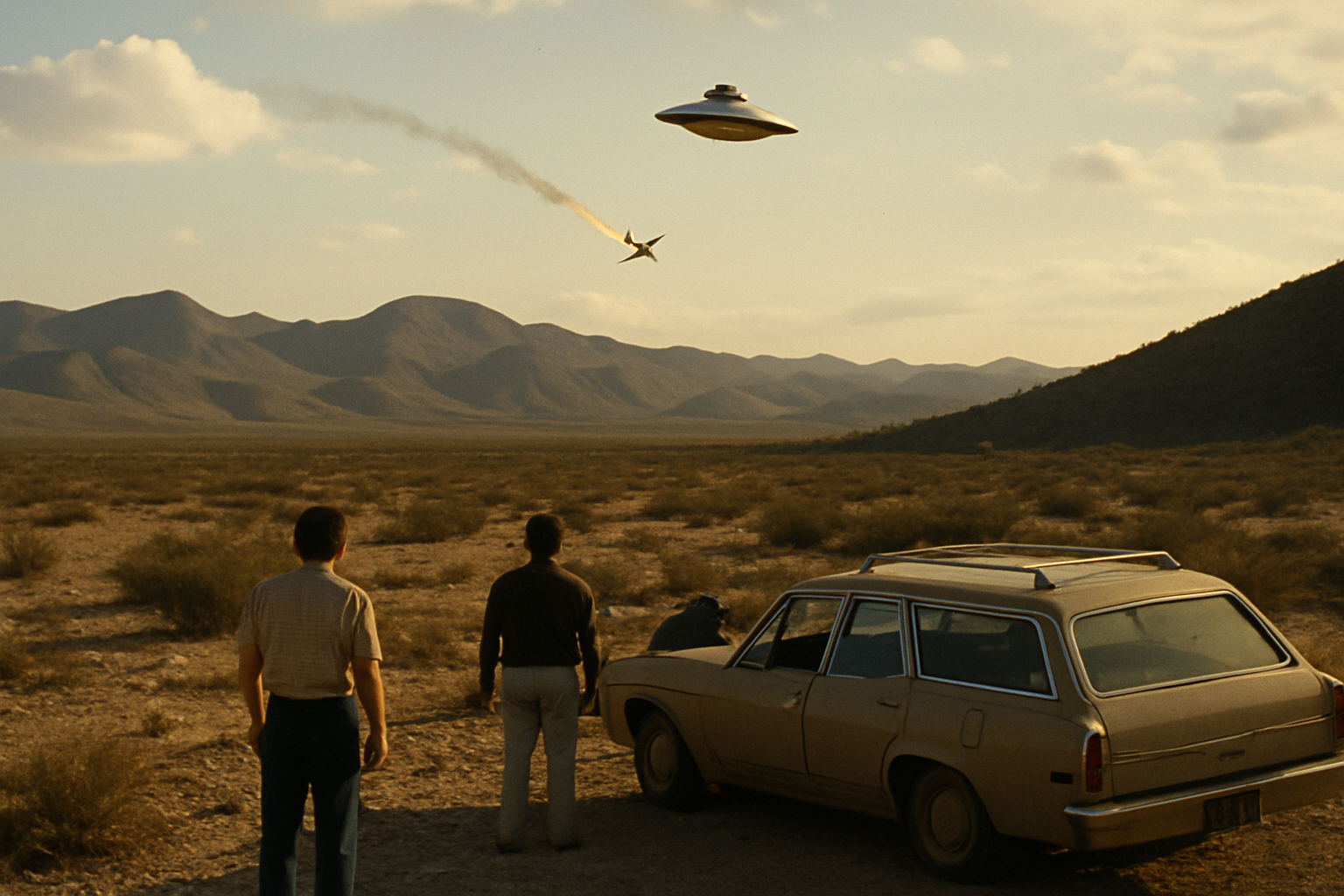
The Coyame UFO incident is an alleged mid-air collision between an unidentified flying object and a small civilian aircraft, said to have taken place on 25 August 1974 in the Chihuahuan Desert near the town of Coyame (formally Santiago de Coyame), in the Mexican state of Chihuahua, close to the United States border.[1] According to the account, U.S. military radar tracked a fast-moving object that crossed from the Gulf of Mexico into Mexican airspace, where its radar return merged with that of a light aircraft and both vanished; a U.S. team then allegedly crossed the border to recover a metallic disc, while a Mexican military convoy sent to secure the site was found dead.[2][3] The story rests entirely on an anonymous 1992 document and was later popularized by a 2005–2007 era cable-television treatment and by the books of investigators Noe Torres and Ruben Uriarte, who likened it to the 1947 Roswell incident.[5][4] No named witnesses, recovered material, or contemporaneous official records have ever been produced, and the case is widely treated as unverified and probably fictitious; historians have suggested the reports more plausibly trace to the 1974 crash and recovery of a Cessna involved in drug trafficking.[2][5][1]
Background
Coyame is a small town in northern Chihuahua, in the arid Chihuahuan Desert near the Río Conchos and roughly 120 km (about 75 miles) south of the Texas border crossing at Presidio/Ojinaga; it lies near coordinates 29°27′41″N 105°05′50″W.[5] The remoteness of the area, combined with the absence of any local press or official record of an aircraft crash on the alleged date, is central to both the appeal and the criticism of the story.[2]
The case is frequently compared to the 1947 Roswell episode in the United States, and to other claimed "crash-retrieval" cases, in which a craft is said to have crashed and been secretly recovered by the military.[5] Such cases characteristically depend on later testimony or documents rather than on physical evidence available at the time, and Coyame fits this pattern: the entire narrative surfaced nearly two decades after the supposed event.[3]
The alleged event
The narrative, as set out in the anonymous document and repeated in later retellings, runs as follows:
- On the night of 25 August 1974, U.S. radar stations reportedly detected an unknown object that entered North American airspace from over the Gulf of Mexico and turned inland over Mexico, with popular accounts citing very high speeds (figures such as roughly 2,000–2,500 mph appear in secondary retellings).[2][6]
- The object's radar return is said to have converged with that of a small civilian aircraft — described in some retellings as a light plane that had departed El Paso, Texas, bound for Mexico City — after which both signatures disappeared over the desert near Coyame.[2][5]
- Recovery parties allegedly found two debris fields the next morning: the burned remains of the aircraft, and, a short distance away, a partially buried metallic disc roughly 16 feet (about 5 metres) across.[5]
- According to the account, a Mexican military convoy dispatched to retrieve the material later went silent, and its personnel were subsequently found dead with no apparent injuries; the wreckage and disc are said to have then been taken by a U.S. team.[2][6]
These specifics — speeds, dimensions, the convoy deaths and the cross-border recovery — originate in the 1992 document and its derivatives rather than in any independently verified source.[3][2]
Origin of the story
The incident first reached UFO researchers in 1992, when a typed report dated 23 March 1992 and titled "Research Findings on the Chihuahua Disk Crash" was mailed anonymously to several investigators in the United States and Europe.[2][5] The document was addressed "To All Deneb Team Members" and signed only with the initials "JS," a person who was never identified.[2]
A copy reached Elaine Douglass, a researcher associated with the group Operation Right to Know, who passed it to the veteran crash-retrieval researcher Leonard (Len) Stringfield.[2][3] Stringfield reproduced the text in his self-published *UFO Crash/Retrievals: Search for Proof in a Hall of Mirrors, Status Report VII* (1994), while expressing open doubt about it; he noted that he published it "despite the risk of publishing a bunch of baloney" in the hope that the incident could be "verified or exposed."[3][2]
After lying largely dormant, the story was revived for television in the mid-2000s — including a History Channel *UFO Files* treatment titled "Mexico's Roswell" and a later *UFO Hunters* episode — and was developed at book length by Noe Torres and Ruben Uriarte, who published *Mexico's Roswell: The Chihuahua UFO Crash* (first edition 2007; later editions 2008) and *The Coyame Incident: UFO Crash Near Presidio, Texas* (2013).[5][4]
Investigation and skeptical analysis
Independent scrutiny has repeatedly highlighted the weakness of the evidence:
- No named witnesses. The pilot of the supposed aircraft, the officials who ordered the recovery, and the soldiers said to have died are all anonymous; critics note that almost nothing concrete is known about the alleged plane, "including the name of the pilot."[2]
- No documentary trail. No flight plan, civil-aviation accident record, or contemporaneous press report corresponding to the claimed crash has been located.[5]
- Anonymous, single-source provenance. The narrative descends from one unsigned 1992 document of unknown authorship; even Stringfield, who first published it, framed it as something to be verified or debunked rather than as established fact.[3][2]
Investigators Noe Torres and Ruben Uriarte reported interviewing large numbers of people in the Coyame region but found few if any first-hand witnesses to the specific events, and encountered conflicting local stories about unrelated incidents.[2][5] Researcher Kevin Randle, reviewing the case, concluded that the available material was too thin to support the dramatic claims while calling for more data, treating the story as unproven rather than confirmed.[2]
Explanations and disputes
Because no physical evidence survives, discussion has focused on whether the 1974 narrative reflects any real event at all, and if so what conventional cause might lie behind it:
- A fabrication or hoax. The most common assessment is that the anonymous 1992 document is unreliable and may be wholly invented; the absence of any corroborating witness or record is taken as strong reason for caution.[2][5]
- Conflation with an unrelated drug-running crash. Skeptics and some historians have suggested the story grew from memories of a genuine but mundane aircraft crash in the desert; the English-language Wikipedia treatment attributes the reports to the 1974 crash and military recovery of a Cessna involved in drug trafficking, and Mexico Unexplained separately notes a later (c. 1980) recovery operation north of Coyame after a failed drug run scattered cash and contraband across the desert.[1][5]
- A misremembered military mishap. Popular accounts note that a U.S. Pershing missile had gone off course and come down in the Chihuahuan Desert near the later supposed crash site in September 1967, prompting a cross-border U.S. recovery; some writers speculate that memories of such an event may have contributed to, or been blended into, the Coyame legend, though no direct link has been established.[5]
Proponents counter that the document is written in plausible military style and that a remote desert recovery could have escaped public record. Skeptics reply that internal plausibility is not evidence, and that an extraordinary cross-border recovery and the deaths of an entire convoy would be very difficult to conceal entirely.[3][2] Neither the Mexican nor the U.S. government has acknowledged any such event.[6]
Aftermath and significance
No wreckage, official report, or named participant has ever been produced, and the Coyame story remains unresolved and contested.[2][1] Despite this, it has become one of the better-known Latin American UFO narratives, sustained largely by books, podcasts, and cable-television documentaries rather than by archival documentation.[4][6]
The case is often cited as an example of how a single anonymous document can seed a durable modern legend:
- It illustrates the crash-retrieval genre's reliance on later testimony and unverifiable paperwork rather than recoverable physical evidence.[3]
- It is frequently invoked in discussions of how UFO claims propagate through secondary media, with details such as object speed and disc dimensions hardening into "facts" through repetition.[2][5]
In summary, the Coyame UFO incident is best understood as a disputed claim resting on a single 1992 source, lacking the corroboration that would allow it to be confirmed as either a genuine anomalous event or a definitively explained mundane one.[2][5]
Key quotes
“"Despite the risk of publishing a bunch of baloney, the full text of the report is reproduced herewith, hoping the incident can be verified or exposed." — Leonard Stringfield, on publishing the anonymous 1992 document in 1994
References
- 1.
- 2.
- 3.
- 4.
- 5.
- 6.
Similar cases
Scored on agency / year proximity / region / tag overlap — same agency +3, near year +4, same region +2, shared tag ×2.