Coyne (Mansfield) helicopter incident
Illustrations
AI-generated illustration — not actual footage or evidence; an interpretive depiction based on the documented account
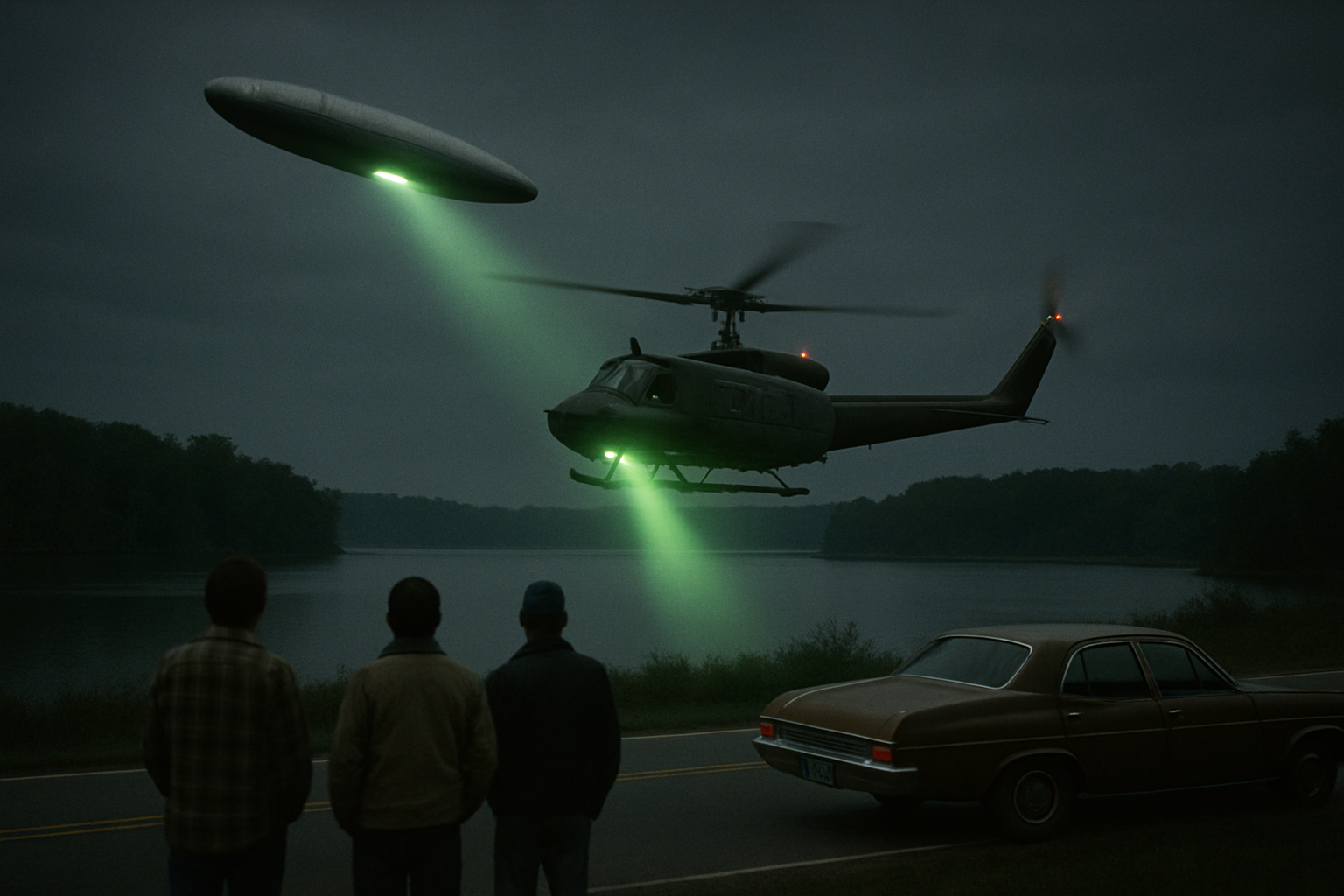
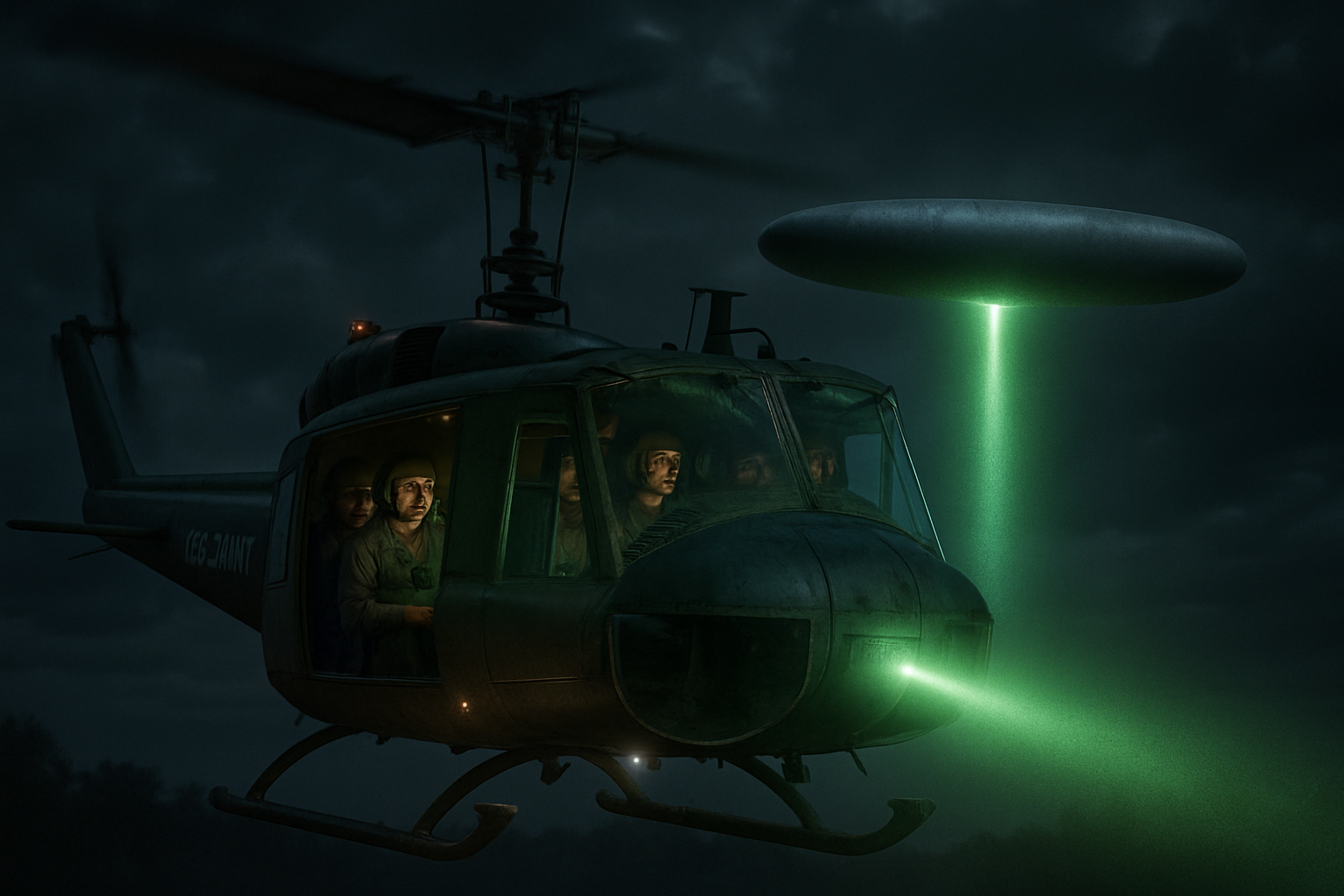
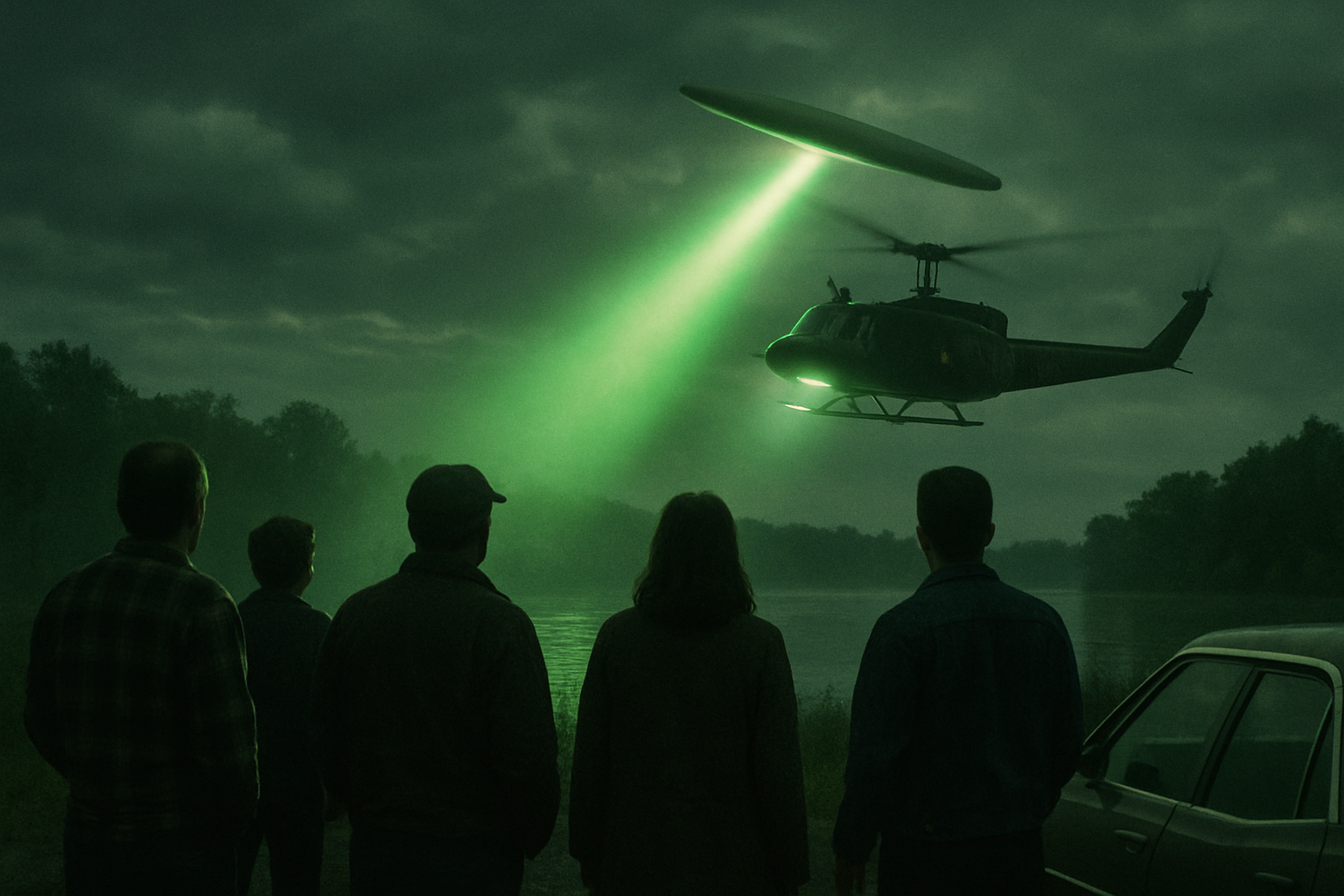
The Coyne incident, also known as the Mansfield helicopter incident, was a reported close encounter with an unidentified flying object on the night of 18 October 1973 near Mansfield, Ohio.[1][2] The four-man crew of a U.S. Army Reserve Bell UH-1H "Huey" helicopter — Captain Lawrence J. Coyne, First Lieutenant Arrigo Jezzi, Sergeant John Healey and Sergeant Robert Yanacsek — said that while flying at about 2,500 feet they were approached by a fast-moving red light that resolved into a cigar-shaped grey object, which paused over the helicopter and swept a green beam of light through the cockpit.[1][2] During the encounter the crew reported that their radio went dead, the magnetic compass spun erratically, and the aircraft climbed by more than a thousand feet even though the controls were set for descent and no pilot commanded a climb.[2][3] The case was corroborated in part by ground witnesses, and was investigated by researchers associated with the Center for UFO Studies (CUFOS), including J. Allen Hynek and Jennie Zeidman, who classified it as unexplained.[3][2] The skeptic Philip J. Klass argued that the object was a fireball associated with the Orionid meteor shower, an explanation that Zeidman and others disputed.[3][2] It is widely cited as one of the best-documented helicopter–UFO encounters on record.[4][1]
Background
On the evening of 18 October 1973, a Bell UH-1H Iroquois helicopter of the U.S. Army Reserve, based near Cleveland, Ohio, was returning home after the crew completed routine flight physicals at Columbus.[2][1] The aircraft had departed from the Port Columbus area and was flying north-northeast toward Cleveland in clear night conditions.[2]
The four men aboard were experienced military aviators and reservists. The aircraft commander was Captain Lawrence J. Coyne, aged 36, a pilot with about nineteen years of flying experience; the helicopter was being flown at the time by the co-pilot, First Lieutenant Arrigo Jezzi.[2][1] The other two crewmen were Sergeant John Healey, a flight medic who was a Cleveland police officer in civilian life, and Sergeant Robert Yanacsek, the crew chief.[2] Their professional standing and the consistency of their independent testimony would later be central to the case's reputation for credibility.[1][4]
The encounter
At approximately 11 p.m., while the helicopter cruised at about 2,500 feet above sea level near Charles Mill Lake, Sergeant Yanacsek noticed a single steady red light on the eastern or south-eastern horizon.[2][1] At first taken for an aircraft navigation light or a tower beacon, the light then turned toward the helicopter and closed rapidly.[2][1]
Fearing a collision, Captain Coyne took the controls and put the aircraft into a descent, first at about 500 feet per minute and then steepening to roughly 2,000 feet per minute; he also radioed the Mansfield control tower, but after an initial exchange the radio fell silent on both UHF and VHF frequencies.[2][3] The object continued to bear down on the helicopter until, just as the crew braced for impact, it decelerated sharply and came to a near-stop above and in front of them.[1][3]
The crew then described a large object filling much of the forward windscreen:
- Shape and structure. They reported a cigar-shaped or cylindrical, grey metallic object, smooth and largely featureless, with a slight dome on top.[2][3]
- Lights. A red light was at the leading end and a white light toward the rear; a green beam, likened to a searchlight, swung down from the object's lower side, passed over the helicopter's nose and up through the windshield, bathing the cockpit in green light.[2][3]
- Departure. After hovering for several seconds the object accelerated away to the west, then made a sharp turn to the north-west and was lost from view in the direction of Lake Erie.[3]
The most discussed physical anomaly was an apparent loss of control of the aircraft's altitude. Although the collective control was still set for a descent, the crew said the helicopter instead climbed — by various accounts from roughly 1,700 feet up to about 3,500 feet — at on the order of 1,000 feet per minute, "as if the object was dragging it upwards," before Coyne regained normal control.[2][4] The aircraft's magnetic compass was also reported to have malfunctioned, spinning rapidly during the event and afterward requiring replacement.[2][3]
Ground witnesses
The crew's account was supported by independent observers on the ground. A woman driving with several children on a road near the Charles Mill reservoir reported seeing both the helicopter and the brightly lit object, including the green glow, at about the same time.[2][1] In the published investigations these witnesses are commonly identified with a local family, and their statements were taken as corroboration that an unusual luminous object had been present over the area.[2]
Ground testimony was significant because it established that the lights were visible from outside the helicopter and were not confined to the crew's instruments or imaginations, and because the witnesses described the encounter from a different vantage point and broadly consistent with the airmen's account.[1][2]
Investigation and official response
The incident was reported through military channels and quickly attracted the attention of civilian researchers.[1] The case became closely associated with the Center for UFO Studies (CUFOS), founded by the astronomer and former U.S. Air Force consultant J. Allen Hynek.[2][3] The principal field investigator was Jennie Zeidman, who interviewed the crew and ground witnesses, reconstructed the timeline, and published a detailed monograph on the encounter, *A Helicopter-UFO Encounter Over Ohio*, through CUFOS in 1979.[3][2]
Zeidman's analysis emphasised the consistency of the four crewmen's independent recollections, the supporting ground testimony, and the physical effects on the aircraft — the radio failure, the spinning compass, and especially the uncommanded climb.[3] Both Zeidman and Hynek concluded that the report could not be explained by conventional means and classified it as unexplained.[3][2]
The case also received public recognition: the crew was given the National Enquirer Blue Ribbon Panel's award of US$5,000 for what the panel called the most scientifically valuable UFO report of 1973.[2] Aspects of the case were also revisited in scientific-style reviews of UFO physical evidence associated with the astrophysicist Peter A. Sturrock.[3]
Explanations and disputes
No conventional explanation has been universally accepted, and the case remains contested.[3][1]
The best-known skeptical explanation was advanced by the aviation writer Philip J. Klass, who argued that the crew had seen a bright fireball (bolide) associated with the Orionid meteor shower, which is active in mid-to-late October, and that the apparent climb of the helicopter resulted from the pilot's own control inputs rather than any external force.[3][2] On this view the dramatic red light and rapid approach were the natural appearance of a meteor passing through the sky.[3]
Investigators and other analysts raised several objections to the meteor hypothesis:
- Duration. Investigators argued that the object was in view for far longer than a meteor — on the order of minutes rather than the few seconds a fireball typically lasts.[3][1]
- Motion. Witnesses described the object decelerating and executing a hard, angular manoeuvre near its closest approach, behaviour inconsistent with a ballistic meteor.[3][2]
- Shape and lights. The crew reported a defined, structured object with distinct red and white lights and a steerable green beam, not a diffuse streak of light.[3][2]
- Trajectory. The reported path across the sky and the object's pause over the helicopter were difficult to reconcile with a single meteor.[3][1]
Proponents of an anomalous interpretation also pointed to the physical effects — the silenced radio, the spinning magnetic compass, and the uncommanded climb — as evidence that something more than an optical illusion had occurred.[3] Skeptics in turn questioned how reliably such effects could be reconstructed years after the event.[2]
Aftermath and significance
The Coyne incident became one of the most frequently cited UFO reports of the 1970s, partly because the witnesses were trained military aviators flying a familiar aircraft and partly because of the reported physical effects on the helicopter.[4][1] The Center for UFO Studies and other groups treated it as a benchmark "high-credibility" case, and it has featured prominently in books, articles and documentaries on the subject.[4][3]
Captain Coyne stood by his account in subsequent interviews, and in 1978 he testified about his encounter before a United Nations panel, urging more thorough investigation of UFO reports.[4] The case continues to be debated between those who regard it as a well-attested unexplained encounter and those who favour the meteor or misidentification explanations; in the absence of a recovered object or conclusive instrument data, it remains formally unexplained in the assessments of CUFOS and is presented in the wider literature as a leading example of a helicopter–UFO encounter.[3][2]
Key quotes
“as if the object was dragging it upwards
“The skeptic Philip J. Klass argued the crew had merely seen a bright fireball associated with the Orionid meteor shower.
References
- 1.
- 2.
- 3.
- 4.
Similar cases
Scored on agency / year proximity / region / tag overlap — same agency +3, near year +4, same region +2, shared tag ×2.