Lonnie Zamora incident (Socorro)
Illustrations
AI-generated illustration — not actual footage or evidence; an interpretive depiction based on the documented account
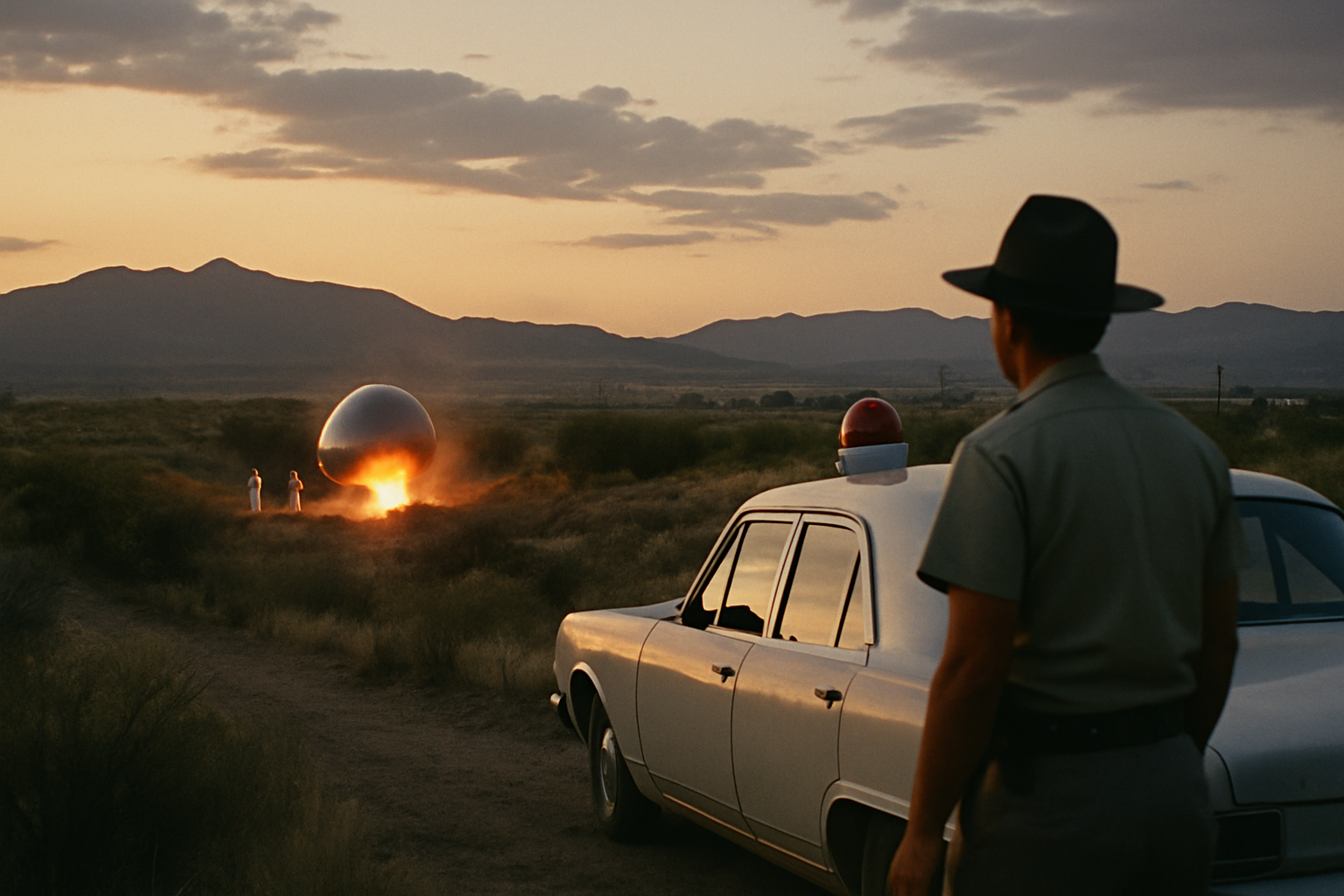
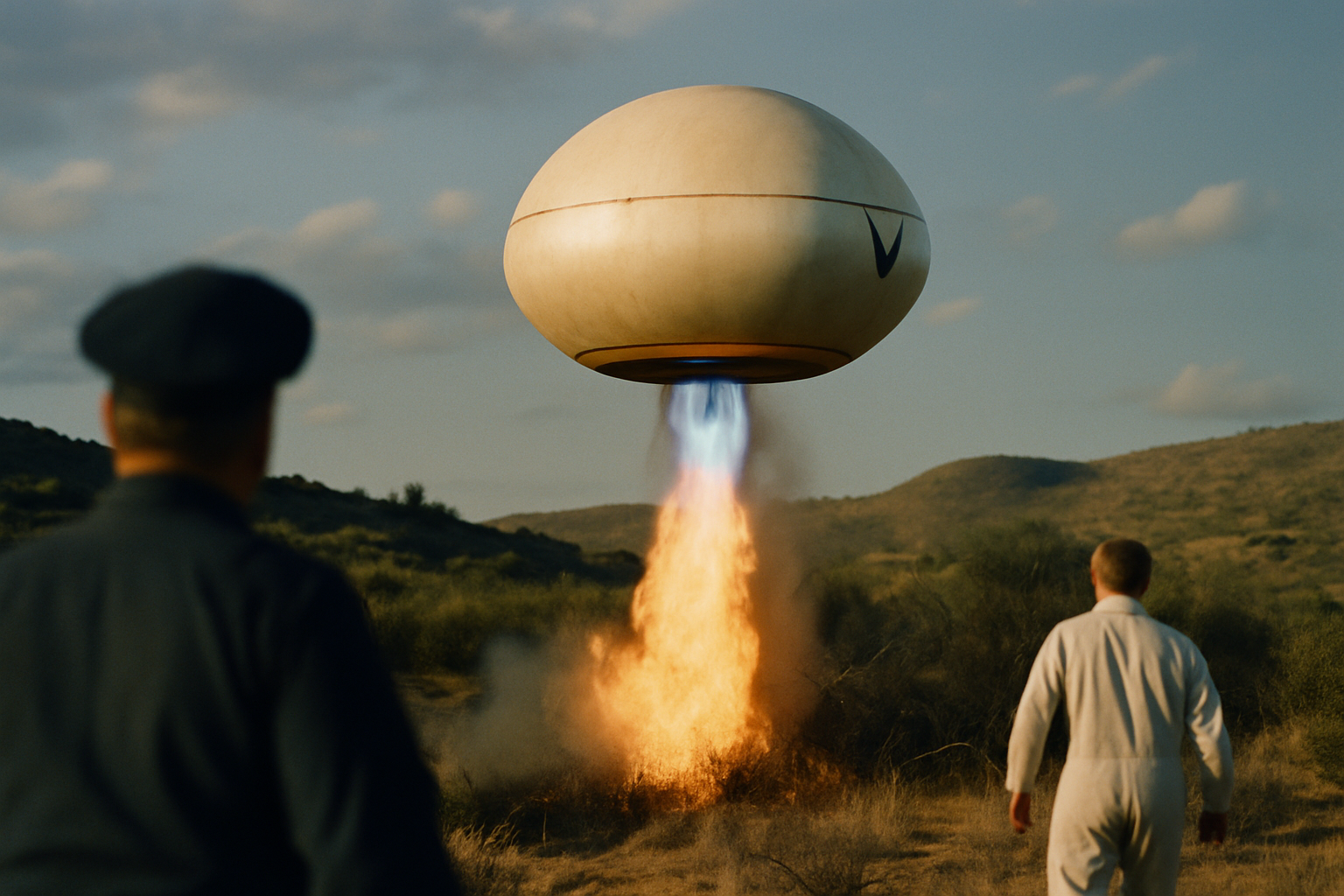
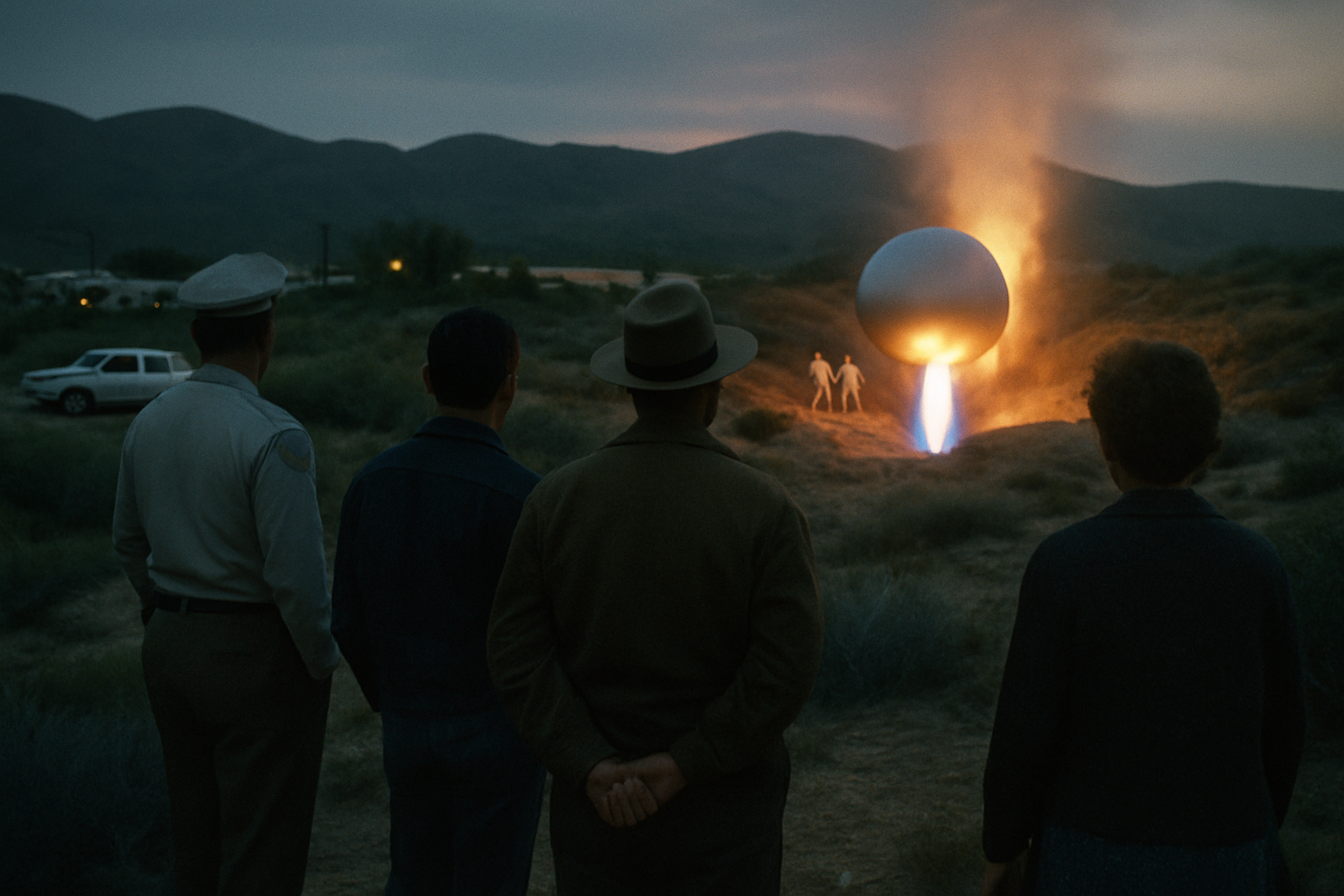
The Lonnie Zamora incident, also called the Socorro UFO landing, was a close-range sighting reported on April 24, 1964, near Socorro, New Mexico, in the United States.[1] At about 17:45, Socorro city police officer Lonnie Zamora broke off a pursuit of a speeding car after hearing a roar and seeing a flame in the sky to the southwest, and reported finding a shiny, aluminum-white, oval or egg-shaped object resting on legs in a gully, with one or two small figures in white coveralls beside it.[2][3] Moments later the object rose with a blue-and-orange flame and a loud roar and flew off at low level. Responding officers, including New Mexico State Police sergeant Sam Chavez, documented smoldering brush and shallow ground impressions at the site.[2] The U.S. Air Force's Project Blue Book investigated and ultimately classified the case as "unidentified," and it became one of the most-studied UFO reports on record.[1][2] Conventional explanations advanced over the following decades — including a classified test vehicle, an atmospheric phenomenon, and a hoax staged by local students — remain unproven and disputed.[3][4]
Background
Socorro is a small town in central New Mexico, home to the New Mexico Institute of Mining and Technology (New Mexico Tech) and lying near military and research sites including the White Sands Missile Range and Holloman Air Force Base.[1][3] In 1964 the United States was at the height of public interest in unidentified flying objects, which the U.S. Air Force tracked through Project Blue Book.[1]
Lonnie Zamora was a uniformed officer with the Socorro Police Department and was on patrol alone on the afternoon of the sighting.[2] His account is the central evidence in the case: he was the only witness to the object and its occupants at close range, although other officers later corroborated the physical traces he reported.[2][3]
The sighting
According to Zamora's report, at about 17:45 on April 24, 1964 he was chasing a speeding car south of Socorro when he heard a roar and saw a flame in the sky to the southwest, which he initially feared might be an exploding dynamite shack.[1] Diverting toward the noise over rough terrain, he came within roughly 150–200 yards of a smooth, aluminum-white, oval object resting in a gully.[2] Zamora variously likened it to an overturned car standing on end and to the letter "O," and said it appeared to stand on legs angled outward.[1][2]
- The figures — He reported briefly seeing one or two small figures in white coveralls near the object, describing them as roughly the size of small adults or large children, over an observation lasting only a second or two.[1][2]
- The insignia — He said the object bore a red marking a few inches across, which he sketched on the scene; Air Force summaries described it as a crescent or chevron-like symbol.[2]
- The departure — Zamora reported a loud roar and a blue-and-orange flame beneath the object as it rose to about the height of a car and then flew away rapidly at low altitude.[1][2]
New Mexico State Police sergeant Sam Chavez arrived within minutes in response to Zamora's radio call but did not see the object; he and other officers reported finding burned brush and ground impressions still present at the site.[2]
Investigation and official response
The sighting drew a rapid multi-agency response, including the FBI, Army personnel from the nearby White Sands range, and the U.S. Air Force's Project Blue Book.[2][5] Investigators documented scorched vegetation and what were described as four principal ground impressions consistent with landing-gear contact points; laboratory checks of soil samples were reported to find no foreign material, no abnormal radiation, and no chemical residues indicative of rocket propellants.[2]
Blue Book's scientific consultant, astronomer Dr. J. Allen Hynek, examined the case, and his correspondence appears throughout the file.[2] Blue Book chief Major Hector Quintanilla treated the report as credible while remaining unable to explain it. In a statement widely quoted from the case files, he called it "the best-documented case on record" and acknowledged that investigators had "been unable... to find the vehicle or other stimulus that scared Zamora to the point of panic."[2] The case was officially closed as "unidentified."[1][2]
Explanations and disputes
Because Zamora was a sole close witness and no firm cause was identified, the incident has attracted a range of conventional explanations, none of which is conclusively established.[3][4]
- Secret test vehicle — Skeptic David E. Thomas suggested Zamora may have seen a Surveyor lunar-lander prototype carried by a helicopter from nearby military ranges; Project Blue Book reported that it could not positively link any known test on that date to the event.[4][3]
- Atmospheric phenomenon — Critic Philip J. Klass at one point proposed an atmospheric effect akin to ball lightning, and later suggested the report might have been a hoax tied to local tourism interests.[1][3]
- Student hoax — A longstanding theory holds that students at New Mexico Tech staged the event. In a 1968 letter found in chemist Linus Pauling's papers, then-Tech president Stirling Colgate wrote that he had "a good indication of the student who engineered the hoax," but the claim was never substantiated and the method was never demonstrated.[4]
- Mirage — UFO skeptic Steuart Campbell argued the sighting was "almost certainly" a mirage, a view not widely accepted.[1]
Supporters of an anomalous interpretation note the physical traces, the speed of the official response, and Zamora's reputation as a sober, reluctant witness; skeptics emphasize that a single close witness and the proximity of military and university test programs leave room for a prosaic but undocumented cause.[3][4]
Aftermath and significance
The Socorro case became a touchstone in UFO research, frequently cited because the witness was a police officer, the response was prompt and well-documented, and the Air Force itself declined to explain it.[1][2] It is sometimes discussed in relation to Hynek's later close-encounter classification, straddling categories involving physical traces and reported occupants.[2]
Lonnie Zamora reportedly disliked the attention the case brought and largely avoided publicity in later years; he died on November 2, 2009.[1] A commemorative mural marking the sighting was painted in Socorro in 2012.[1] More than half a century on, the incident remains officially unresolved and continues to be debated by both researchers and skeptics.[1][4]
Key quotes
“"This is the best-documented case on record... we have been unable... to find the vehicle or other stimulus that scared Zamora to the point of panic." — Major Hector Quintanilla, chief of Project Blue Book
References
- 1.
- 2.
- 3.
- 4.
- 5.
Similar cases
Scored on agency / year proximity / region / tag overlap — same agency +3, near year +4, same region +2, shared tag ×2.