The Kelly–Hopkinsville Encounter (1955)
Illustrations
AI-generated illustration — not actual footage or evidence; an interpretive depiction based on the documented account
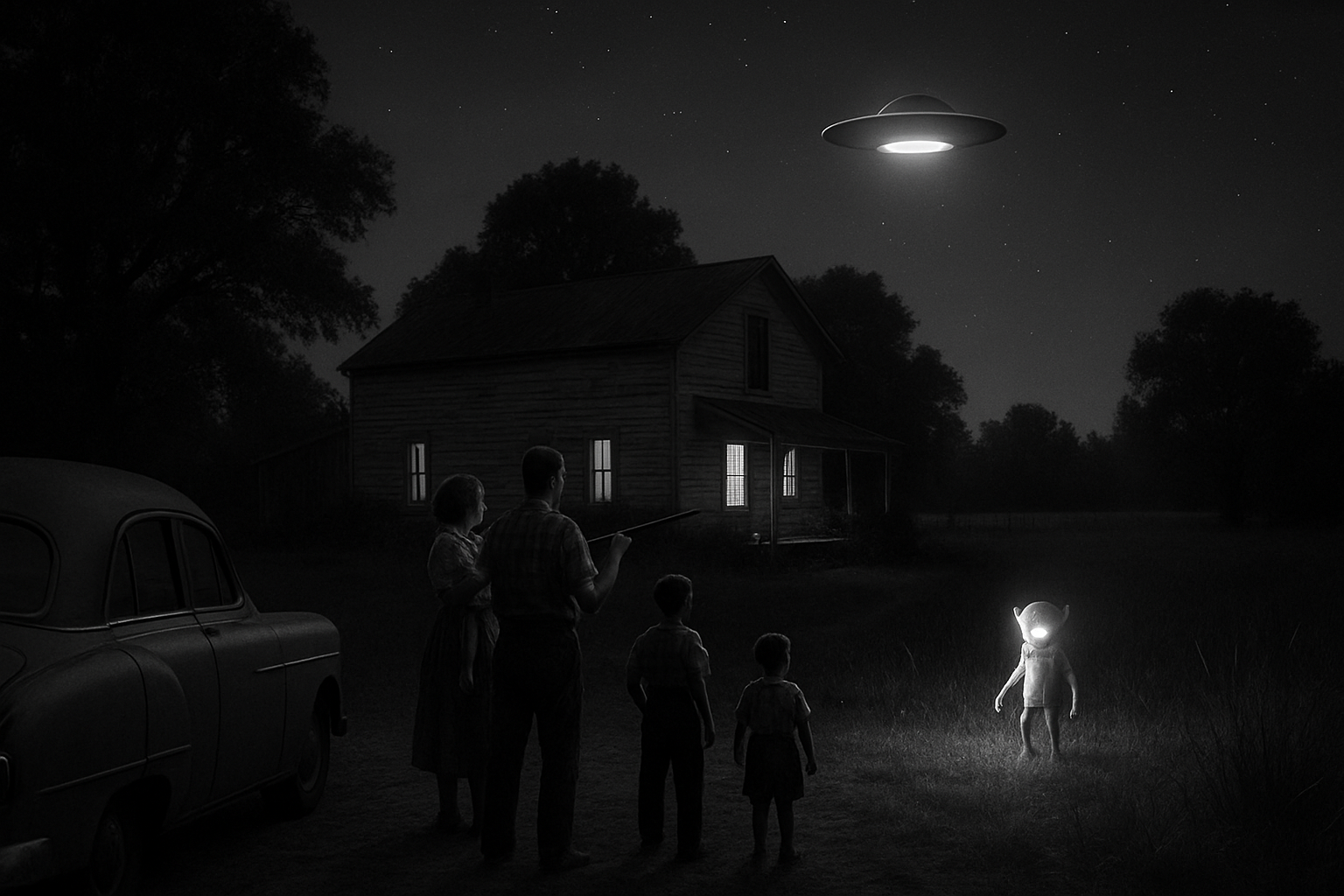
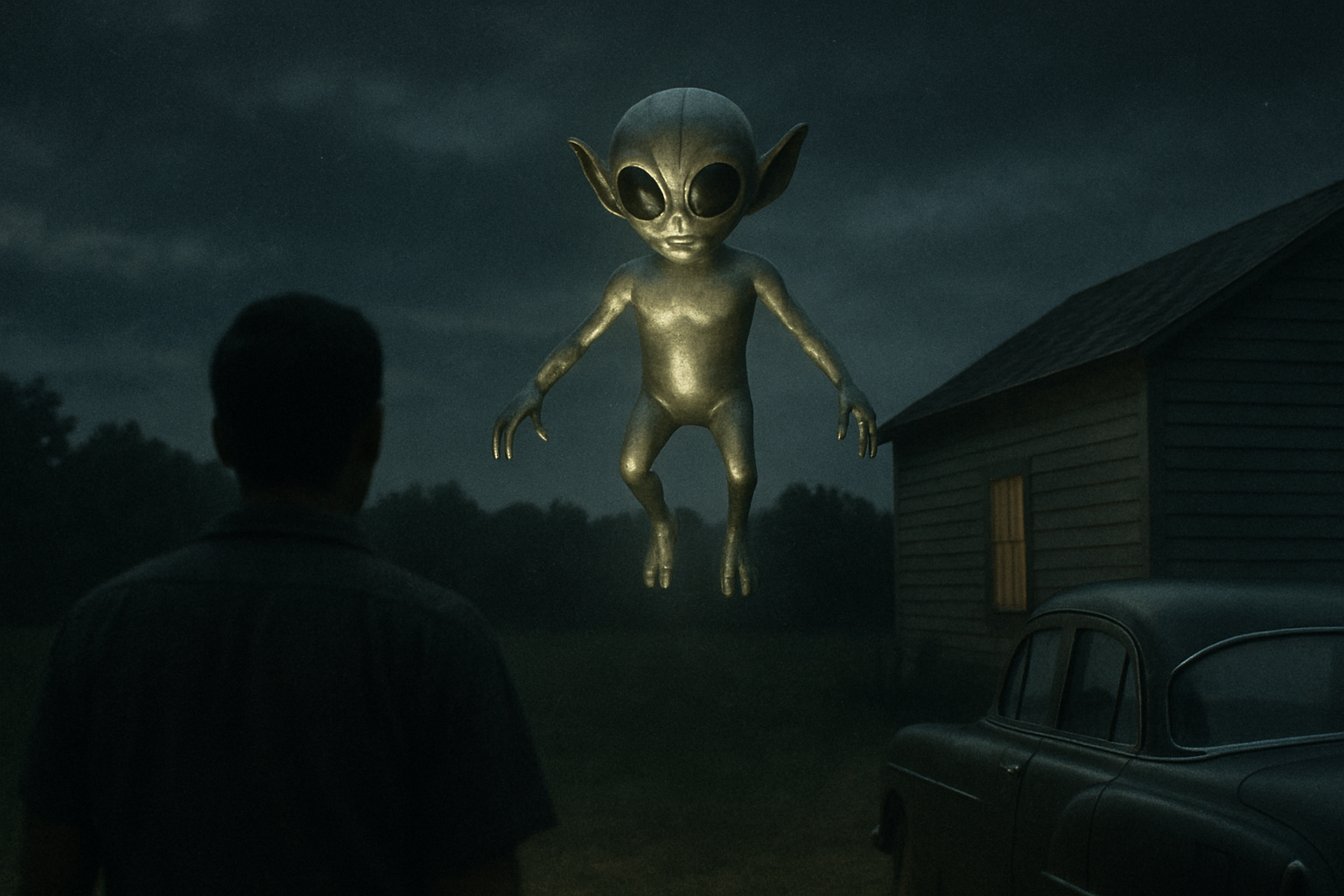
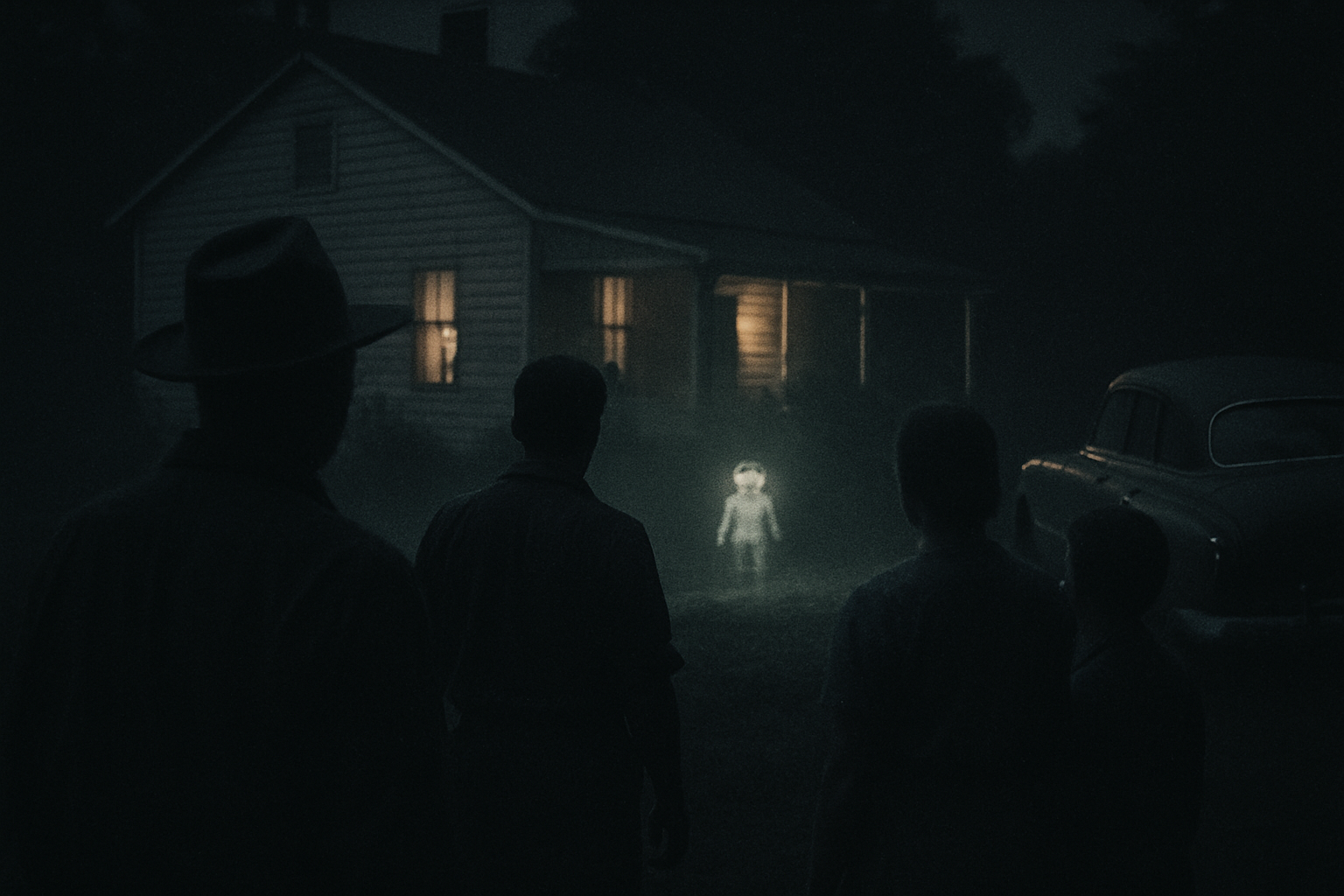
The Kelly–Hopkinsville encounter — also called the Hopkinsville Goblins case or the Kelly Green Men case — was a reported close encounter with small humanoid creatures on the night of August 21–22, 1955, at a rural farmhouse between the hamlet of Kelly and the city of Hopkinsville in Christian County, Kentucky.[1] Two families, totaling eleven people, told police that for several hours they had fired shotguns and rifles at short, glowing beings that repeatedly appeared at their windows and doors but seemed impervious to the gunfire.[2] City, state and military police responded but found no creatures, blood or landing traces, only shell casings and damaged windows.[1] The U.S. Air Force's Project Blue Book recorded the case as a hoax,[1] while skeptical investigators have most often attributed the sightings to misidentified great horned owls seen under conditions of fear and excitement.[3][2] The episode is frequently cited as an early and influential source of the phrase "little green men."[2]
Background
The farmhouse was occupied by Glennie Lankford, a widow of about 50, together with her children and two adult sons from a previous marriage, Elmer "Lucky" Sutton and John Charley "J.C." Sutton, along with their wives.[1] Visiting the household were Billy Ray Taylor, a 21-year-old itinerant carnival worker, and his wife.[2] Several of the adults present worked the traveling carnival circuit.[1]
Accounts agree the events began on the evening of Sunday, August 21, 1955, around 7 p.m.[2] Taylor said he had gone to a well behind the house and seen a bright, silvery object with a colored exhaust descend and settle in a gully near the property; the family initially dismissed his report.[2] About an hour later, the dog's barking drew Lucky Sutton and Taylor outside to investigate, setting off the confrontation.[2]
The encounter
When Sutton and Taylor went out, they reported seeing a small creature, roughly three and a half feet tall, approaching the house with an oversized round head, long arms reaching toward the ground, clawed hands and large eyes that "glowed with a yellowish light."[2] The men opened fire with a shotgun and a rifle; witnesses said the rounds seemed to have no lasting effect, with hits sounding "like shooting a tin can" and the figures flipping over or floating away rather than falling wounded.[3]
Over the following hours the household reported repeated appearances of one or more such beings at windows and in the yard, sometimes only a few feet away.[1] Glennie Lankford likened the creatures' shape to "a five-gallon gasoline can with a head on top and small legs."[2] Witnesses also described the beings as seeming to hover or float close to the ground and to react to gunfire by retreating rather than being injured.[3] At one point Taylor stepped onto the porch and said a claw-like hand reached down and touched his hair before others pulled him back inside.[2]
After several hours, the group decided the gunfire was useless and, around 11 p.m., drove to Hopkinsville to seek help.[2]
Police response and search
The families arrived at the Hopkinsville police station describing a siege by small creatures from a spaceship and saying they had "been fighting them for nearly four hours."[3] Police Chief Russell Greenwell, concerned about the gunfire, summoned a substantial response. Accounts list city police officers, state troopers, deputy sheriffs and military police from the nearby Army base at Fort Campbell, along with a photographer from the local newspaper.[1][2]
At the scene, officers found shell casings, holes in window screens and broken glass consistent with the reported shooting, but no creatures, no blood, no tracks and no marks suggesting a craft had landed.[2] Contemporary reports noted that the officers concluded there had been no heavy drinking.[2] Only one neighbor reported having heard the shots, apparently mistaking them for firecrackers.[3]
The police left after finding nothing further. According to the family, the creatures returned in the early morning hours — Lankford later described seeing one with "its claw-like hand on the screen" at her bedroom window before daybreak.[2] By the time officers returned the next day the house was empty; neighbors said the families had packed up and left.[1]
Investigation and media
The case drew immediate press coverage. Early newspaper accounts described only one or two creatures appearing at a time; the figure of "12 to 15" beings, which became the most widely repeated number, appears to have grown in later retellings.[3] Contemporary reports also referred to the beings as small, silvery or gray rather than green; the now-famous "little green men" label attached to the story only as it spread and was conflated with other accounts.[2]
The U.S. Air Force's Project Blue Book recorded the incident and classified it as a hoax, offering no further comment.[1] The civilian researcher Isabel Davis investigated the case in 1955–1956, finding the witnesses sincere but acknowledging the absence of physical evidence; her study was published years later.[2] Later writers, including the ufologist Allan Hendry, emphasized that what set the case apart was its long duration and the number of witnesses involved.[1]
Explanations and disputes
No physical evidence of extraterrestrial visitors was ever found, and the case remains disputed between an anomalous reading and conventional explanations.[1]
The most widely cited skeptical explanation is the misidentification of great horned owls. Investigator Joe Nickell of the Committee for Skeptical Inquiry noted that great horned owls are nocturnal, fly nearly silently, have large yellow eyes and round heads, stand roughly two-thirds of a meter tall, and aggressively defend their nests — features matching the witnesses' descriptions.[3] The French researcher Renaud Leclet independently argued the owls were the best explanation, citing "striking similarities" between the reported beings and the local birds.[3] The science writer Brian Dunning likewise concluded there were "too many similarities" between the reported creatures and an aggressive pair of local great horned owls.[1]
Other conventional factors have been proposed: a meteor — possibly from a shower active that night — may explain the bright object Taylor reported descending, and the intense fear and excitement of an extended nighttime confrontation may have shaped perceptions.[3] Some psychologists have suggested intoxication, though contemporary reports stated officials found no evidence of heavy drinking.[1]
Proponents of an anomalous interpretation counter that the witnesses appeared genuinely frightened and consistent, that they had little obvious motive to fabricate, and that the close range and number of observers are difficult to reconcile with a simple misidentification.[2] On the available record, the case is best read as unresolved: there is no physical proof of an extraterrestrial event, while the leading natural explanation remains plausible but unproven.[1]
Legacy
The Kelly–Hopkinsville encounter became one of the most discussed close-encounter cases of the 1950s and an enduring part of American UFO folklore.[1] It is frequently credited with helping popularize the phrase "little green men" as shorthand for aliens, even though the original witnesses described silvery or gray figures.[2] The community of Kelly has since embraced the story, and it is regularly revisited in popular media and local commemorations.[2] Among educators and skeptics, the episode is also used as a teaching example for distinguishing eyewitness testimony from verifiable evidence.[1]
Key quotes
“"Its eyes glowed with a yellowish light." — description of the first creature seen
“"[We had] been fighting them for nearly four hours." — the families to Hopkinsville police
“"Like shooting a tin can." — a witness on the sound of bullets striking the creatures
References
- 1.
- 2.
- 3.
Similar cases
Scored on agency / year proximity / region / tag overlap — same agency +3, near year +4, same region +2, shared tag ×2.