The Flatwoods Monster (1952)
Illustrations
AI-generated illustration — not actual footage or evidence; an interpretive depiction based on the documented account
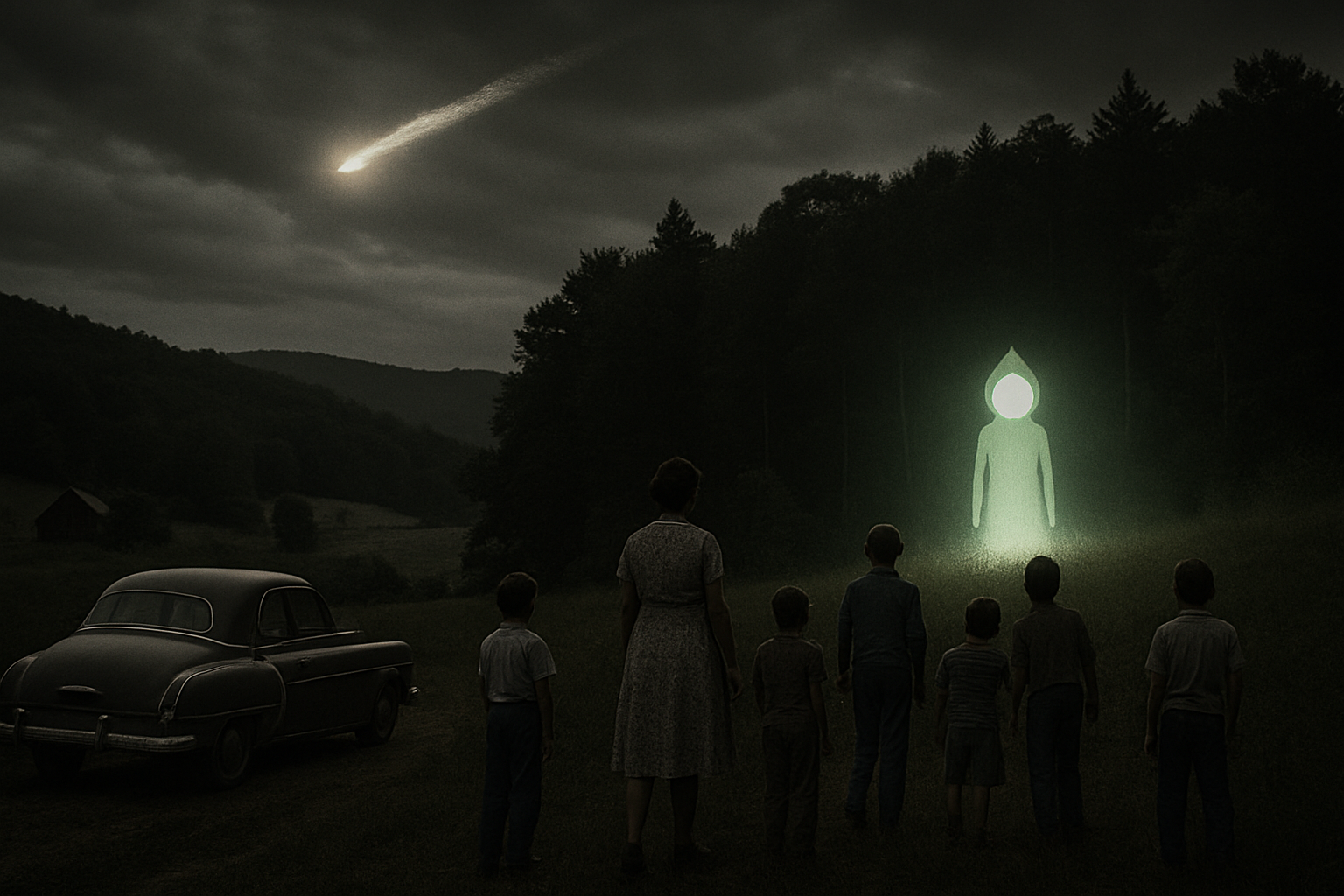
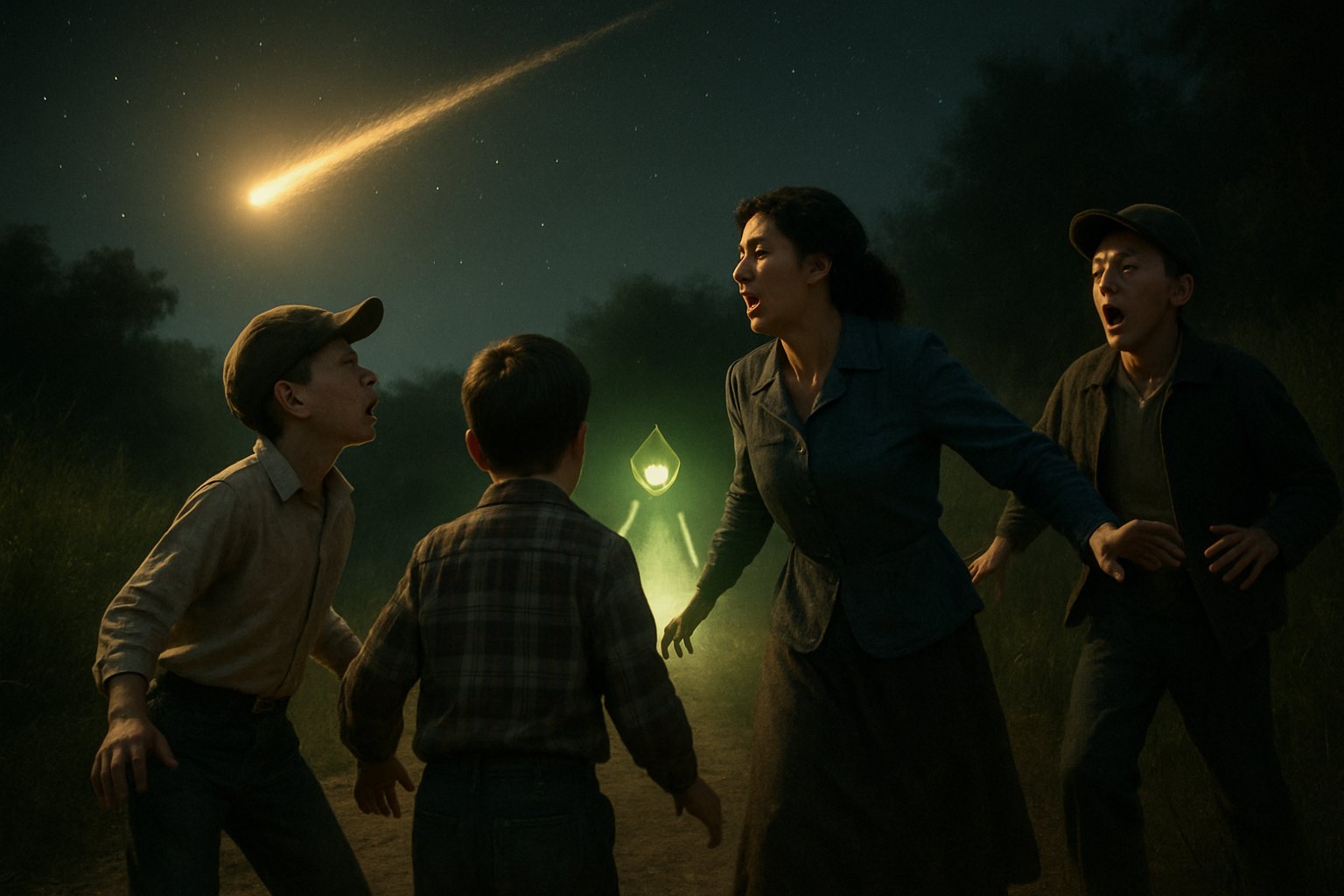
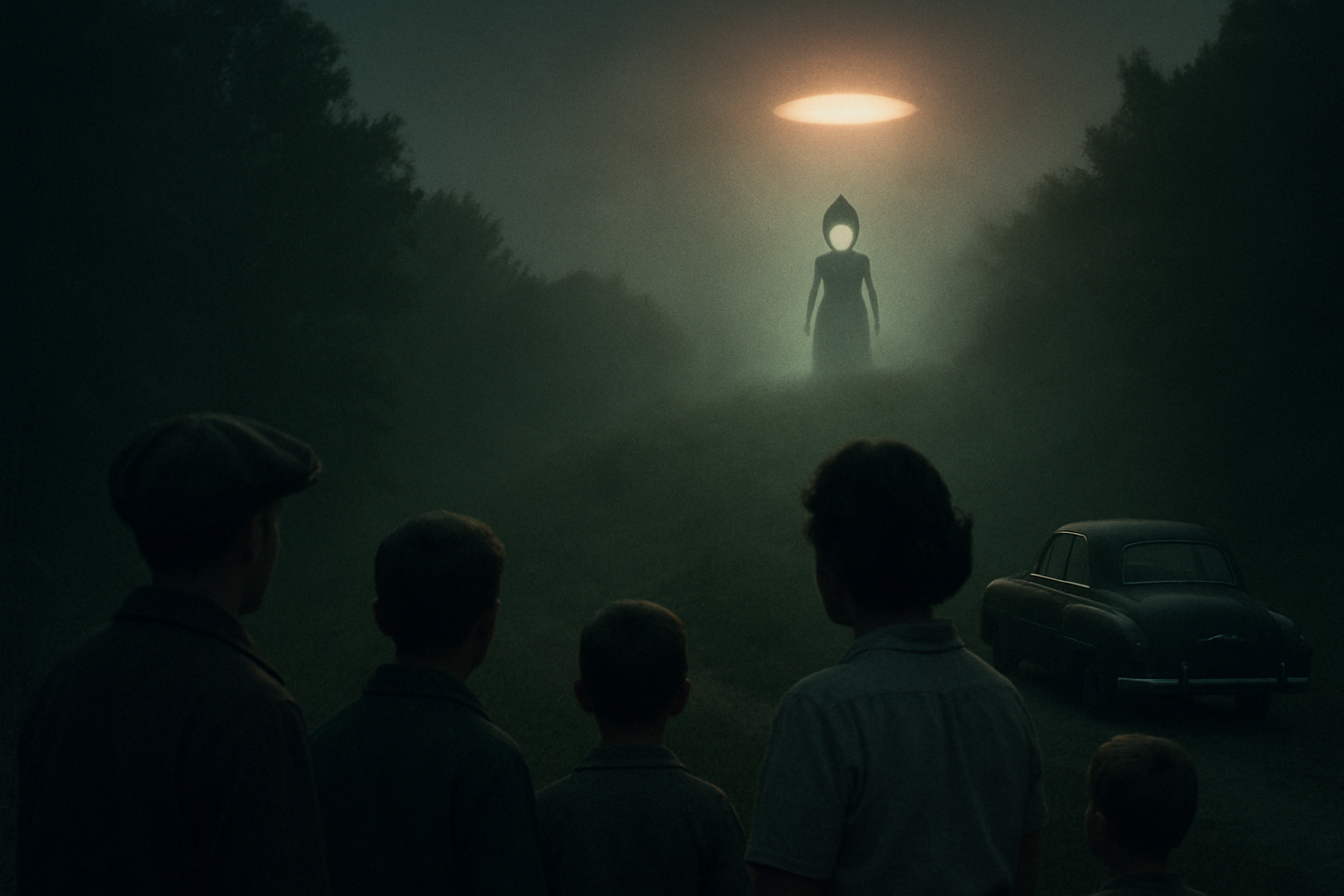
The Flatwoods Monster, also known as the Braxton County Monster, the Phantom of Flatwoods and the Green Monster, refers to a creature reportedly encountered on September 12, 1952, near the town of Flatwoods in Braxton County, West Virginia, United States.[1][2] That evening, several local children said they saw a bright object cross the sky and apparently come down on a nearby hilltop farm. A small group, including a mother and a teenage National Guardsman, climbed the hill to investigate and reported confronting a tall, glowing figure with a spade-shaped head that hissed and moved toward them before they fled.[1] The story spread rapidly through national newspapers and radio.[2] The U.S. Air Force, and later the skeptical investigator Joe Nickell, concluded that the aerial object was most likely a meteor and that the "monster" was best explained as a frightened barn owl seen in conditions of high anxiety.[3][1]
Background
The events took place in and around Flatwoods, a small community in Braxton County, in the hilly interior of West Virginia.[1] The sighting occurred during the height of the 1952 wave of unidentified-flying-object reports in the United States, a period of intense public and press interest in the subject.[2]
- The encounter is dated to September 12, 1952, at about 7:15 p.m., at dusk.[1]
- The principal location was the hilltop farm of a local landowner, G. Bailey Fisher.[1]
- Those involved were ordinary local residents: the May brothers (Edward, about 13, and Fred, about 12), their friend Tommy Hyer (about 10), Neil Nunley and Ronnie Shaver, the 17-year-old West Virginia National Guardsman Eugene "Gene" Lemon, and Kathleen May, mother of two of the boys, together with a dog.[1][2]
The encounter
According to the witnesses' accounts, the May brothers and Tommy Hyer first saw a bright object move across the sky and appear to land on the Fisher farm.[1] The boys ran to tell Kathleen May, who joined them with a flashlight; the group then climbed the hill to look for what had come down.[2]
- Near the top of the hill the witnesses reported a pulsing or pulsating red light.[1]
- When Eugene Lemon pointed his flashlight toward it, he and others described a tall "man-like figure with a round, red face surrounded by a pointed, hood-like shape."[1]
- The figure was said to make a hissing sound and to glide toward the group, at which point Lemon dropped his flashlight and everyone fled in panic.[1]
- Witnesses reported a pungent mist in the air, and several later experienced nausea and other symptoms.[1][3]
Descriptions of the figure varied considerably. It was commonly given as roughly ten feet tall, though accounts ranged from about 7 to 17 feet, with a dark body, a head likened to "the ace of spades," small claw-like hands, and a glowing red or orange-green face.[1][2]
Investigation and media response
Local authorities visited the site soon after. A sheriff and deputy searched the area but reportedly "saw, heard and smelled nothing" unusual.[1]
- The following day, A. Lee Stewart Jr. of the *Braxton Democrat* reported finding skid marks and an "odd, gummy deposit" in the field, which some enthusiasts interpreted as traces of a landed craft.[1]
- A skeptical account later noted that a local resident, Max Lockard, admitted driving his truck around the site hoping to see something, offering a mundane source for the tracks.[1]
- The story received heavy national coverage on radio networks and in newspapers across the country, and acquired nicknames including the Braxton County Monster, the Phantom of Flatwoods and the Green Monster.[2]
- UFO writers of the period, including Gray Barker and Ivan T. Sanderson, travelled to Flatwoods to gather accounts, helping cement the case in popular UFO and cryptid lore.[1]
Explanations and disputes
From early on, conventional explanations were proposed. The U.S. Air Force attributed the bright object in the sky to a meteor and suggested the "creature" was most likely an owl.[2]
The most detailed reconstruction was published by the Committee for Skeptical Inquiry investigator Joe Nickell in the *Skeptical Inquirer* around 2000. Combining contemporary meteor reports, the Project Blue Book file and on-site fieldwork, Nickell argued that:[3][1]
- The streak of light was the bright meteor reported the same evening across Maryland, Pennsylvania and West Virginia.[3]
- The pulsing red light on the hill matched one of three nearby aircraft navigation or hazard beacons.[3]
- The figure itself closely resembled a startled barn owl perched on a branch, with surrounding foliage giving the impression of a lower "skirt" and the bird's posture suggesting claw-like hands.[3][1]
- The reported nausea and other symptoms were consistent with fright, exertion and possible irritation from vapour, rather than evidence of an exotic encounter.[3]
Because the witnesses described their experience sincerely while the physical traces and symptoms admit ordinary explanations, the case is generally treated as explained by mainstream investigators, even as it remains a celebrated story in West Virginia folklore.[1][2]
Aftermath and significance
The Flatwoods Monster became one of the best-known American UFO and cryptid stories of the early 1950s and a lasting part of West Virginia's regional identity.[2]
- The town and county have embraced the legend, with local commemorations, museum displays and tourism tied to the creature.[4]
- The case is frequently cited alongside other West Virginia anomalies, such as the later Mothman reports, in popular and skeptical literature.[2]
- For skeptics it serves as a textbook illustration of how a real natural event (a meteor) combined with fear, darkness and a startled animal can produce a vivid and enduring monster account.[3]
Key quotes
“A tall man-like figure with a round, red face surrounded by a pointed, hood-like shape.
“(The officers) saw, heard and smelled nothing.
References
- 1.
- 2.
- 3.
- 4.
Similar cases
Scored on agency / year proximity / region / tag overlap — same agency +3, near year +4, same region +2, shared tag ×2.