Nash-Fortenberry UFO sighting
Illustrations
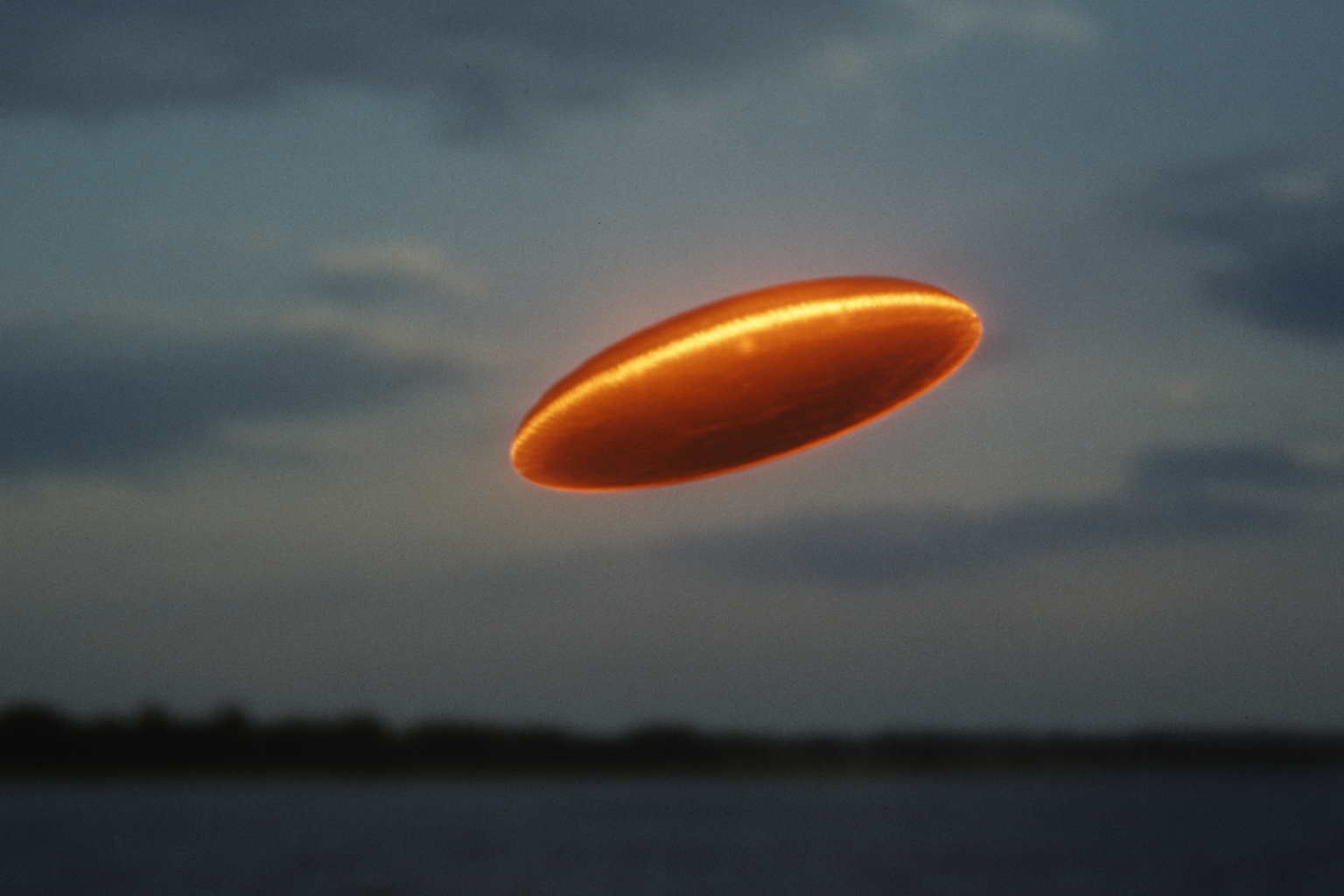
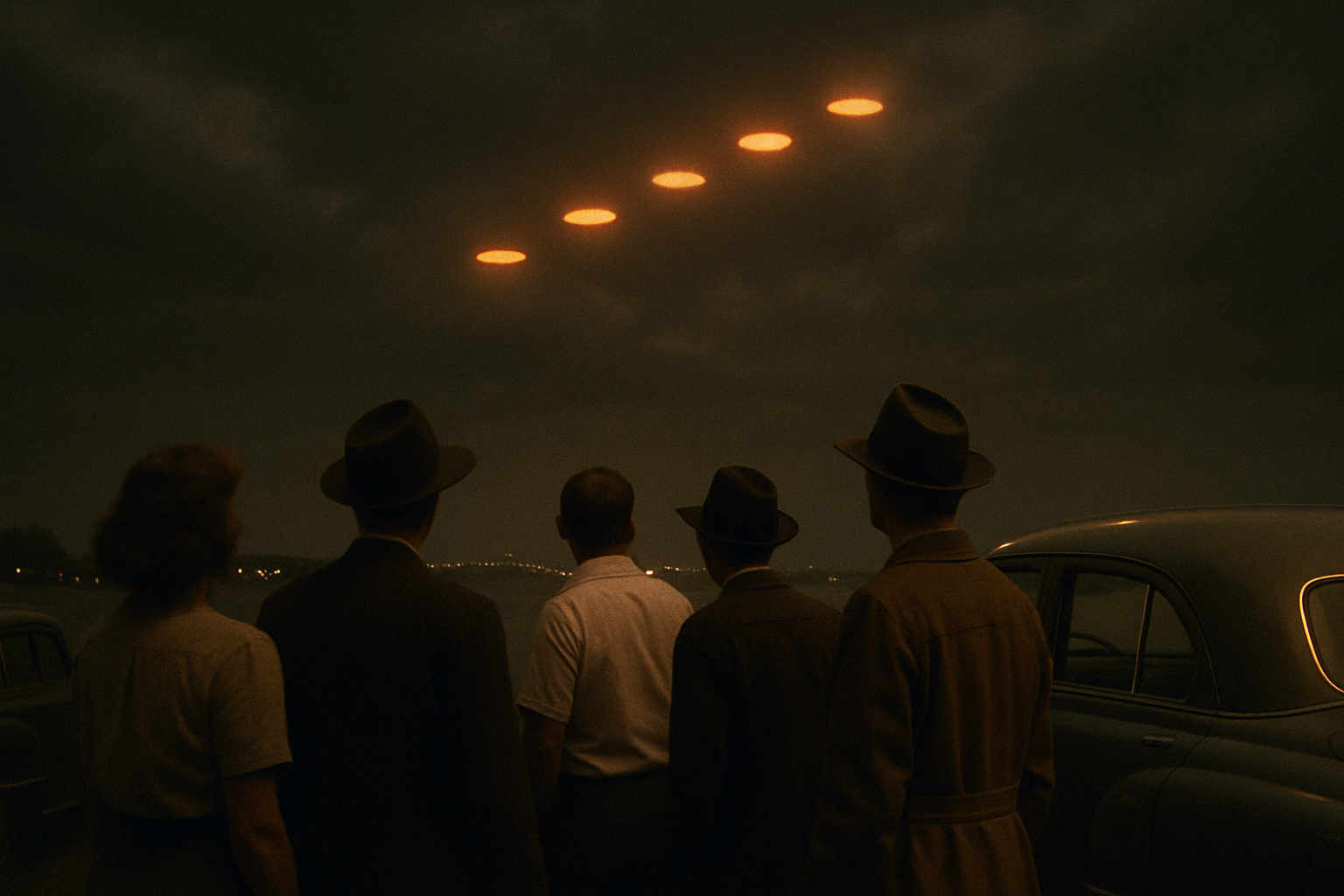
AI-generated illustration — not actual footage or evidence; an interpretive depiction based on the documented account
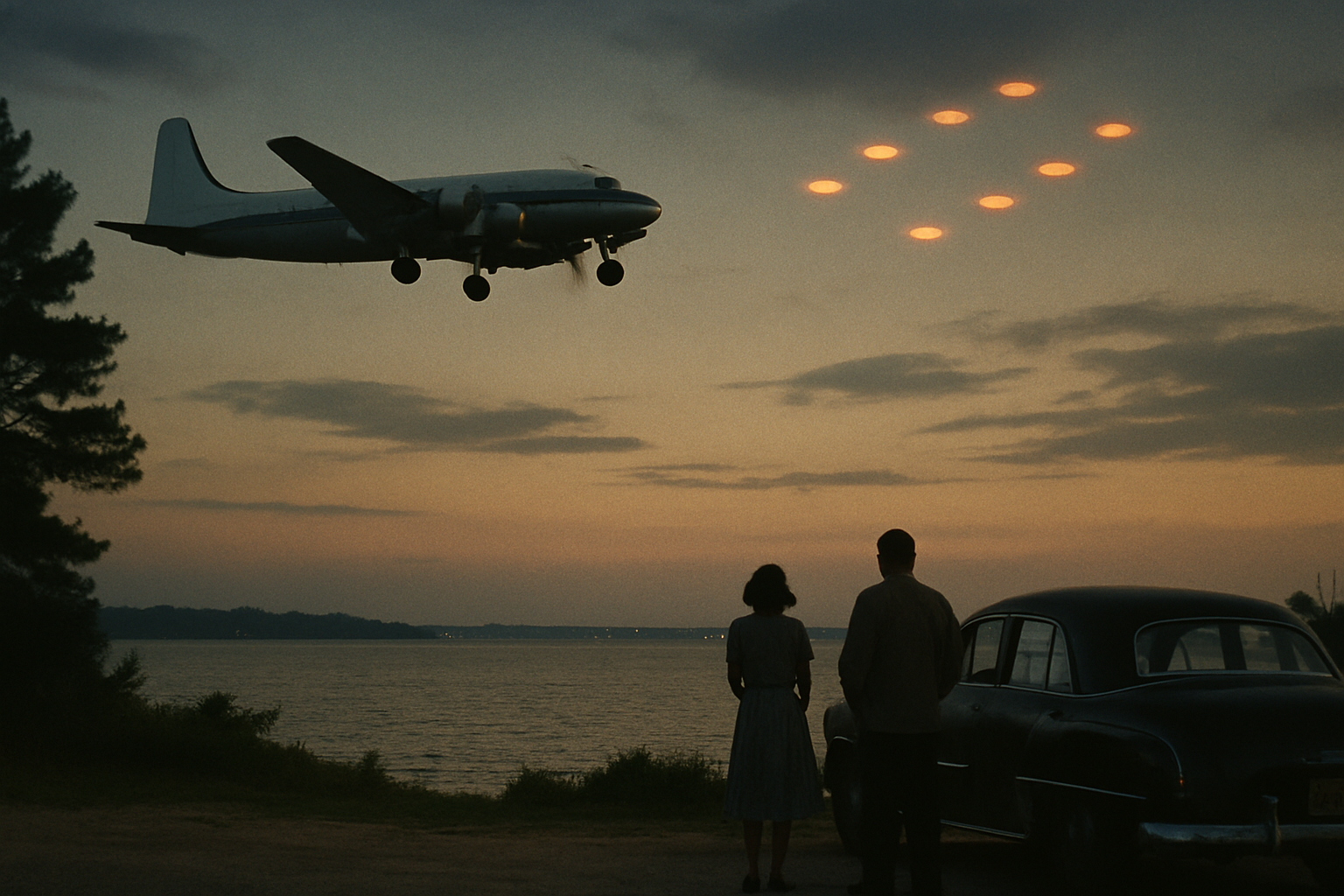
The Nash-Fortenberry UFO sighting was a reported observation of a formation of unidentified flying objects on the evening of 14 July 1952, made by two commercial pilots over Chesapeake Bay near Norfolk, Virginia.[1] First Officer William B. Nash and Second Officer William H. Fortenberry, crewing a Pan American World Airways Douglas DC-4 on a scheduled New York–Miami flight, reported seeing a group of glowing, red-orange, disc-shaped objects manoeuvring at high speed below their aircraft.[1][2]
The case became one of the better-known pilot sightings of the 1952 UFO wave because the two observers, looking down at the objects against a backdrop of known ground landmarks, attempted to derive measurements of the objects' size, altitude and speed.[2] The encounter was reportedly corroborated by several groups of ground witnesses, and the U.S. Air Force's Project Blue Book ultimately listed it as "Unknown."[1][4] Sceptical writers later proposed a range of conventional explanations.[1][5]
Background
The sighting occurred during the summer of 1952, a period of intense public and official interest in "flying saucers" in the United States that included the widely reported radar-visual sightings over Washington, D.C., later the same month.[1]
The aircraft was a Pan American World Airways Douglas DC-4 flying a scheduled service from New York to Miami, carrying ten passengers and a crew that included Captain F. V. Koepke, First Officer William B. Nash and Second Officer William H. Fortenberry.[2][4] On the evening in question the airliner was cruising at about 8,000 feet with the autopilot engaged, approaching the Norfolk area over Chesapeake Bay.[2] Both Nash and Fortenberry were experienced pilots, and they published a detailed first-person account of the incident in the October 1952 issue of *True* magazine under the title "We Flew Above Flying Saucers."[3]
The sighting
At about 8:12 p.m. EST on 14 July 1952, the two officers reported seeing a cluster of brilliant objects approaching from ahead and below, in the direction of Newport News.[2][3] According to their account the objects:
- Initially numbered six, with two more appearing later for a total of eight.[1][2]
- Were circular and disc- or coin-shaped, an estimated 100 feet in diameter and roughly 15 feet thick, glowing a uniform red-orange.[2][3]
- Glowed, in Nash's description, with "the fiery aspect of hot coals," and appeared far brighter than the scattered city lights below.[3]
- Flew at roughly 2,000 feet above the ground, well below the DC-4.[2]
The pilots described a sequence of sharp manoeuvres: the discs held a stepped echelon formation; flipped on edge in unison, briefly revealing dark, unlit undersides; reordered their formation while edgewise; and then reversed course by about 150 degrees, a change the pilots compared to "a ball ricocheting off a wall."[2][3] The objects then blinked out and reappeared, and finally climbed away to the west in a graceful arc before disappearing.[3] Using the apparent distance covered against ground landmarks, Nash and Fortenberry calculated minimum speeds on the order of 12,000 mph, and conservatively reported speeds "in excess of 1,000 mph" in their initial radio message.[2][4] The entire observation lasted only about 12 to 15 seconds.[2]
Report and investigation
The crew radioed a report to Norfolk shortly after the event, stating that they had observed unidentified objects in the vicinity of Langley Field and estimating an altitude of about 2,000 feet and a speed in excess of 1,000 mph.[2] U.S. Air Force investigators, including officers from the Office of Special Investigations, interviewed the pilots the following morning.[2]
The encounter was reportedly corroborated by other observers. Investigators are said to have received several additional reports of red discs in the same area within a short period, including an account from a naval officer and his wife describing a formation of red discs making abrupt directional changes.[2][4] A separate report attributed to a naval officer aboard the cruiser USS Roanoke described several red lights moving in a line in the same general direction around the same evening.[1] Because the observation was framed against fixed ground landmarks, UFO researchers have argued that it permitted comparatively precise estimates of the objects' size and motion, which is part of why the case is frequently cited.[1][2]
The case was studied within Project Blue Book and was eventually classified as "Unknown," meaning the Air Force could not match it to a conventional cause after ruling out, among other possibilities, military jets operating from nearby Langley.[1][2] It was also among the cases later cited in discussions of an Air Force motion study and the 1953 Robertson Panel review of UFO reports.[4]
Conventional explanations
Several sceptical investigators have proposed natural or mundane explanations for the sighting.
The Harvard astronomer and prominent UFO sceptic Donald H. Menzel, in *The World of Flying Saucers* (1963), suggested that the pilots may have seen ground lights distorted by atmospheric haze, or alternatively fireflies trapped between the panes of glass of the cockpit window, which can appear as small glowing points seeming to move against the outside scene.[1][5]
The Scottish writer Steuart Campbell, in *The UFO Mystery Solved* (1994), proposed that the observation was a mirage of the planet Venus, refracted and distorted by the atmosphere.[1]
Proponents of the sighting have disputed these explanations, arguing that neither static ground lights, insects nor a single planet readily accounts for a coordinated formation of multiple objects, their reported edge-flipping and reordering manoeuvres, or the abrupt reversal of direction the pilots described.[2][3] The Air Force's own "Unknown" classification reflects that no conventional cause was established to its satisfaction at the time.[1]
Significance
The Nash-Fortenberry sighting is regularly discussed in histories of the 1952 UFO wave and of early U.S. Air Force investigations, partly because of the professional standing of the witnesses and partly because the geometry of the observation lent itself to quantitative estimates.[1][2] Both pilots maintained their account publicly, most prominently through their *True* magazine article, and the report remained on the Blue Book record as one of the project's unexplained cases.[3][1]
The case continues to be referenced in surveys of pilot UFO reports and in the broader literature on the credibility and limits of eyewitness UFO testimony.[2][5]
Key quotes
“Nash described the objects as glowing with "the fiery aspect of hot coals, but of much greater glow."
“The pilots compared the objects' sharp 150-degree reversal to "a ball ricocheting off a wall."
References
- 1.
- 2.
- 3.
- 4.
- 5.
Similar cases
Scored on agency / year proximity / region / tag overlap — same agency +3, near year +4, same region +2, shared tag ×2.