Tremonton UFO film
Illustrations
AI-generated illustration — not actual footage or evidence; an interpretive depiction based on the documented account
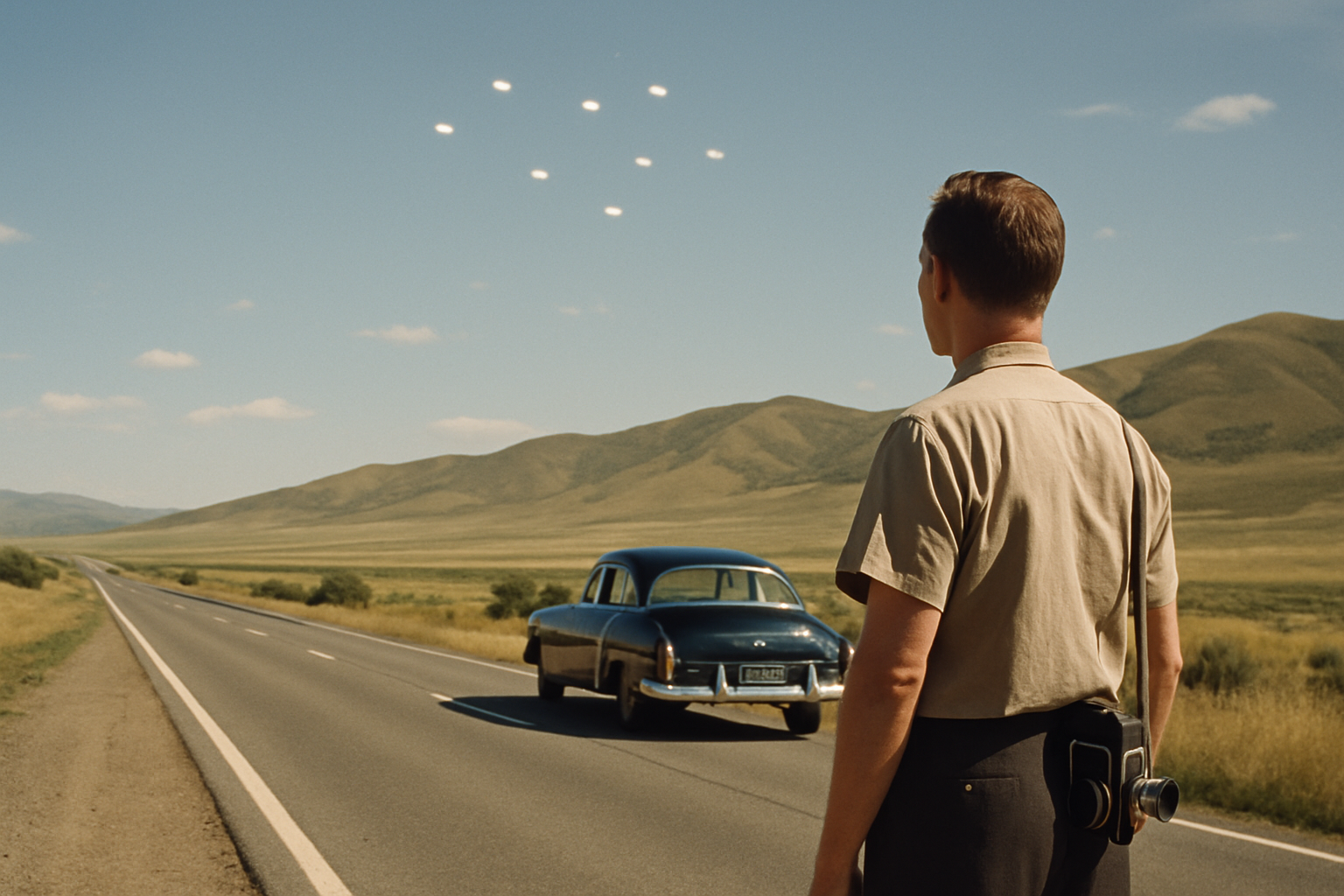
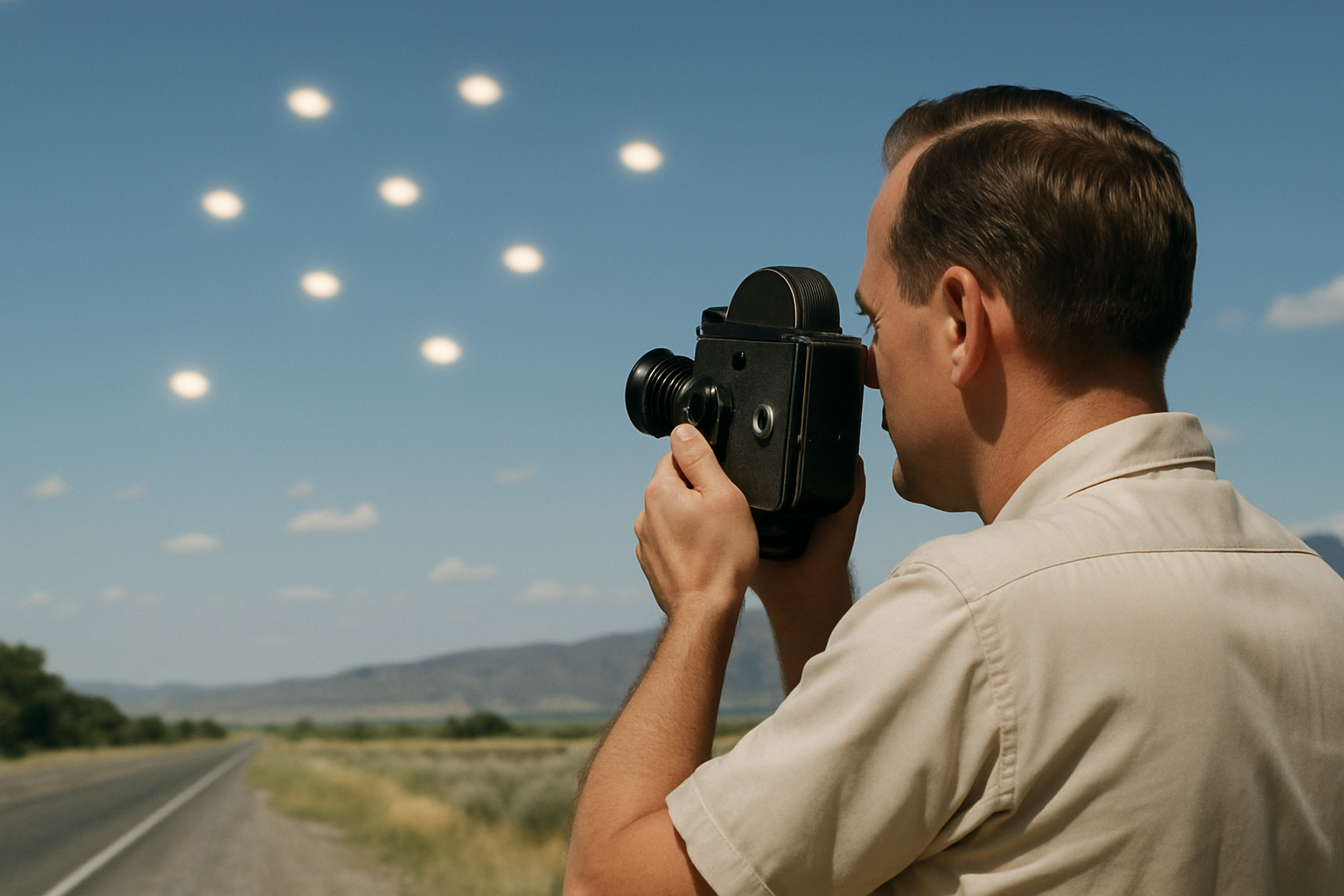
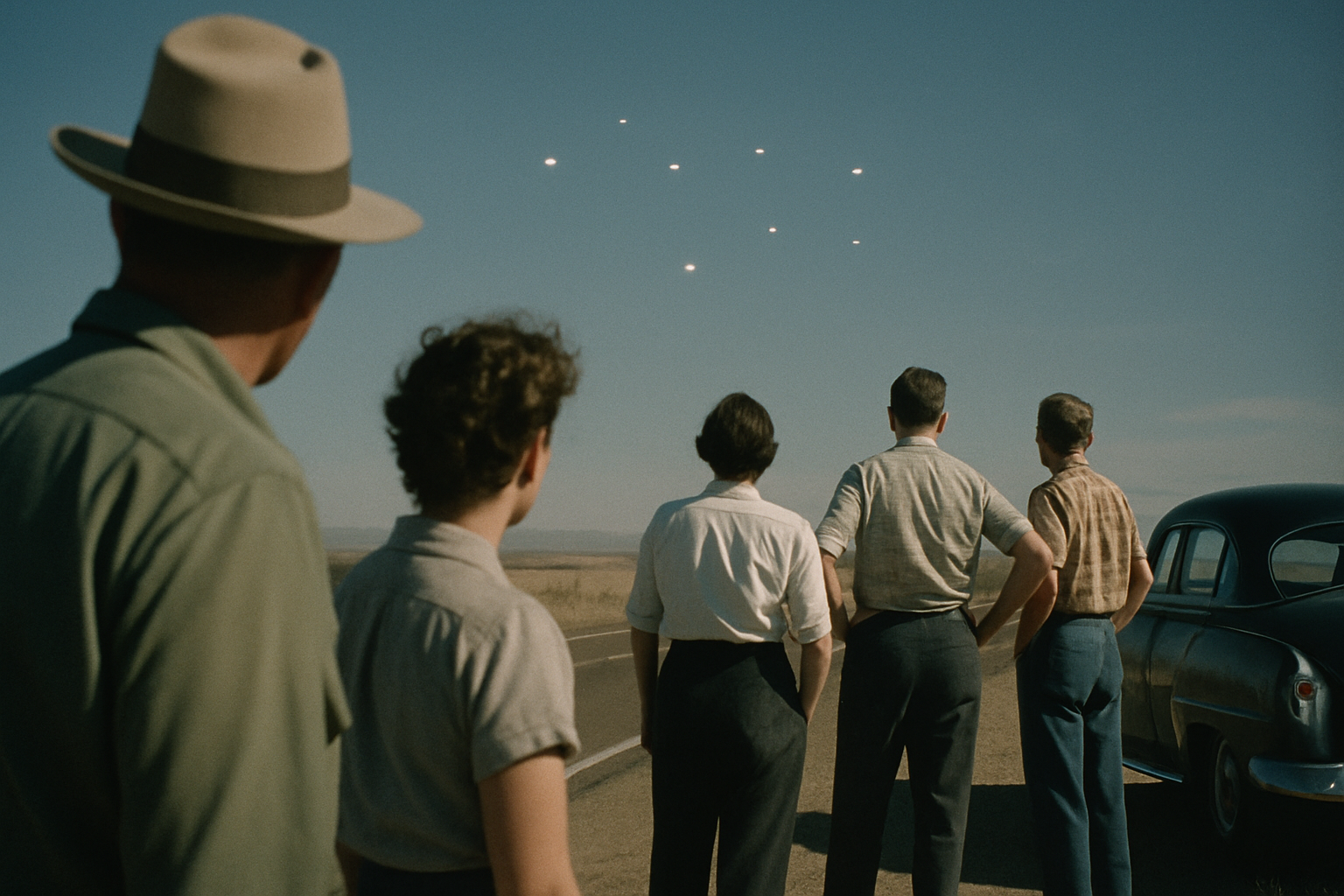
The Tremonton UFO film is a roughly one-minute colour motion picture of unidentified flying objects taken on 2 July 1952 near Tremonton, Utah, by Delbert C. Newhouse, a chief warrant officer and professional photographer in the United States Navy.[1][2] While driving with his family on a highway about seven miles from Tremonton at around 11:00 a.m., Newhouse said his wife noticed a cluster of bright objects overhead; he stopped the car, retrieved a Bell & Howell 16 mm camera from the trunk and filmed the objects as they milled and drifted across a clear sky.[1][2]
The footage became one of the most intensively analysed pieces of UFO film of the 1950s. The U.S. Navy's photo-interpretation laboratory reported, after about 1,000 hours of study, that the objects were not birds, balloons or aircraft and appeared to be "self-luminous."[3][1] The film, together with the 1950 Mariana film from Montana, was reviewed by the Robertson Panel, a CIA-convened scientific committee, in January 1953; that panel instead concluded the Tremonton objects were most probably seagulls reflecting sunlight.[3] The bird explanation was contested by later analysts, and the case is still cited as unresolved.[2][6] There is no separate English Wikipedia article on the film; it is treated mainly within the article on the Robertson Panel.[3]
Background and witness
The film was taken during the intense 1952 wave of UFO reports in the United States, the same summer as the widely reported radar-visual sightings over Washington, D.C.[6]
Delbert C. Newhouse was an experienced naval aerial photographer; sources credit him with roughly nineteen years of service and well over a thousand hours of aerial-photography experience, a background that investigators regarded as lending unusual credibility to his account.[1][3] On 2 July 1952 he was driving across the country with his wife and two children, on a highway in northern Utah a few miles from the town of Tremonton, when the sighting occurred.[1][2]
The sighting and filming
At about 11:00 a.m. Newhouse's wife, Norma, drew his attention to a group of bright objects in the sky.[1][2] According to Newhouse, when he first looked the objects were closer and lower, and he described their shape as resembling "two saucers, one inverted on top of the other."[1][2]
Newhouse stopped the car and took a Bell & Howell 16 mm movie camera fitted with a telephoto lens from the vehicle, then filmed the objects on Kodachrome colour film, adjusting the lens aperture during the sequence.[1][2] By the time he was filming, the objects had risen and appeared as bright points of light; he recorded an estimated ten to fourteen of them moving and milling, generally toward the west.[1][5] He reported no sound, exhaust, wing or wake.[1] Newhouse stated that one object broke away from the main group and travelled on a course opposite to the others, a detail he considered significant.[5]
The Robertson Panel and the seagull explanation
In January 1953 the CIA convened the Scientific Advisory Panel on Unidentified Flying Objects, generally known as the Robertson Panel, to assess whether UFO reports posed a national-security concern.[3][4] The Tremonton film and the 1950 Mariana film were the two pieces of motion-picture evidence the panel examined most closely.[3]
The panel acknowledged the Navy analysts' "evident enthusiasm, industry and extent of effort" but rejected their conclusion.[3] It judged that the Tremonton objects most probably showed seagulls soaring and turning in sunlight, whose bright "bluish-white" appearance could be produced by specular reflection, and it noted that the analysis had been performed on duplicate copies rather than the original film.[3] The panel recommended further tests with balloons and consultation with ornithologists to verify the bird hypothesis.[3] Some years later the Air Force is reported to have prepared an internal note promoting the seagull explanation.[6]
Several participants and later writers have noted that the Robertson Panel was also charged with reducing public preoccupation with UFOs; panel member Thornton Page recalled being told in a private session that the group's task was "to reduce public concern" by showing that reports could be explained conventionally.[4]
Assessment and legacy
The Tremonton film remains one of the most-discussed early UFO films, partly because the two official analyses reached opposite conclusions: the Navy laboratory found the objects unexplained and self-luminous, while the CIA's Robertson Panel favoured birds.[3][1] Critics of the seagull explanation, including Baker and later researchers, argued that the objects' brightness, formation and the reported reversal of one object were difficult to reconcile with a soaring flock, while supporters of the conventional view emphasised the limitations of analysing duplicate film and the known difficulty of judging the size and distance of bright, featureless points in the sky.[2][6]
Because no consensus identification was ever established, the film is generally described as unresolved or disputed rather than firmly explained or unexplained, and it is frequently cited in surveys of the Project Blue Book and Robertson Panel era.[6][3]
Key quotes
“Newhouse described the objects' initial shape as resembling "two saucers, one inverted on top of the other."
“After about 1,000 hours of study, the Navy photo-interpretation laboratory concluded the objects were "not birds, balloons or aircraft" and were "self-luminous."
“Photogrammetrist Robert M. L. Baker, Jr. wrote that the motion of the objects "is not exactly what one would expect from a flock of soaring birds."
References
- 1.
- 2.
- 3.
- 4.
- 5.
- 6.
Similar cases
Scored on agency / year proximity / region / tag overlap — same agency +3, near year +4, same region +2, shared tag ×2.