Chiles-Whitted UFO encounter
Illustrations
AI-generated illustration — not actual footage or evidence; an interpretive depiction based on the documented account
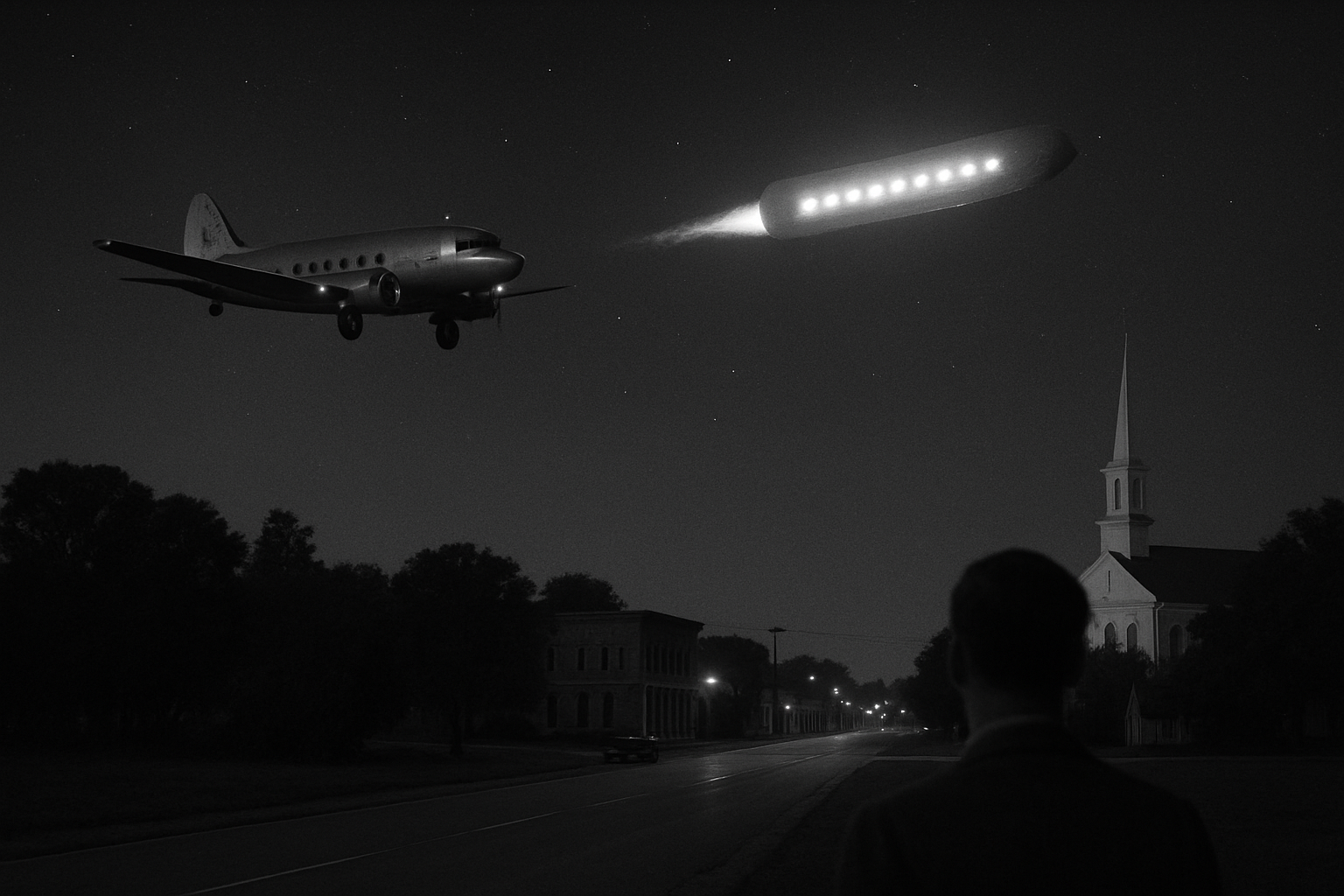
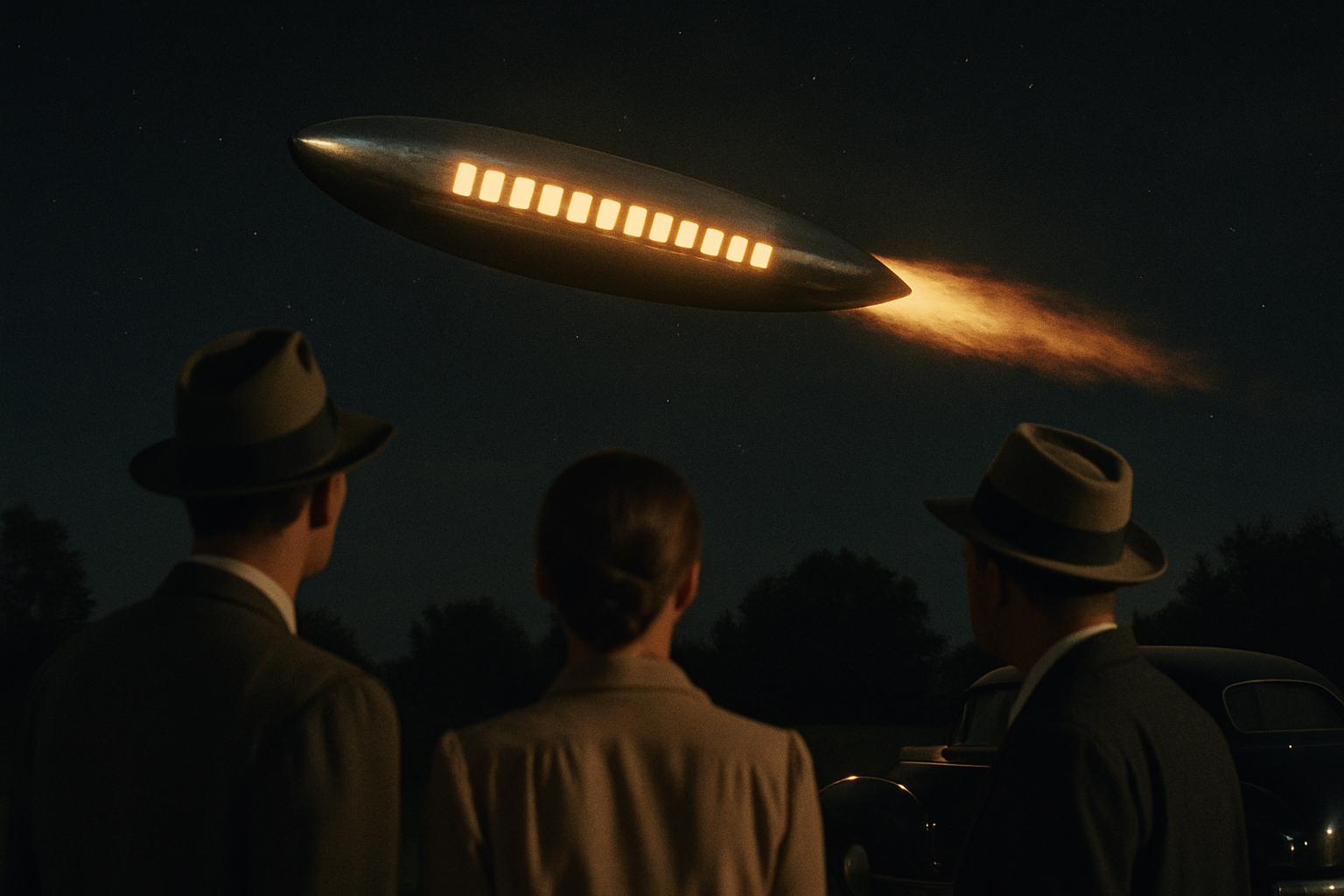
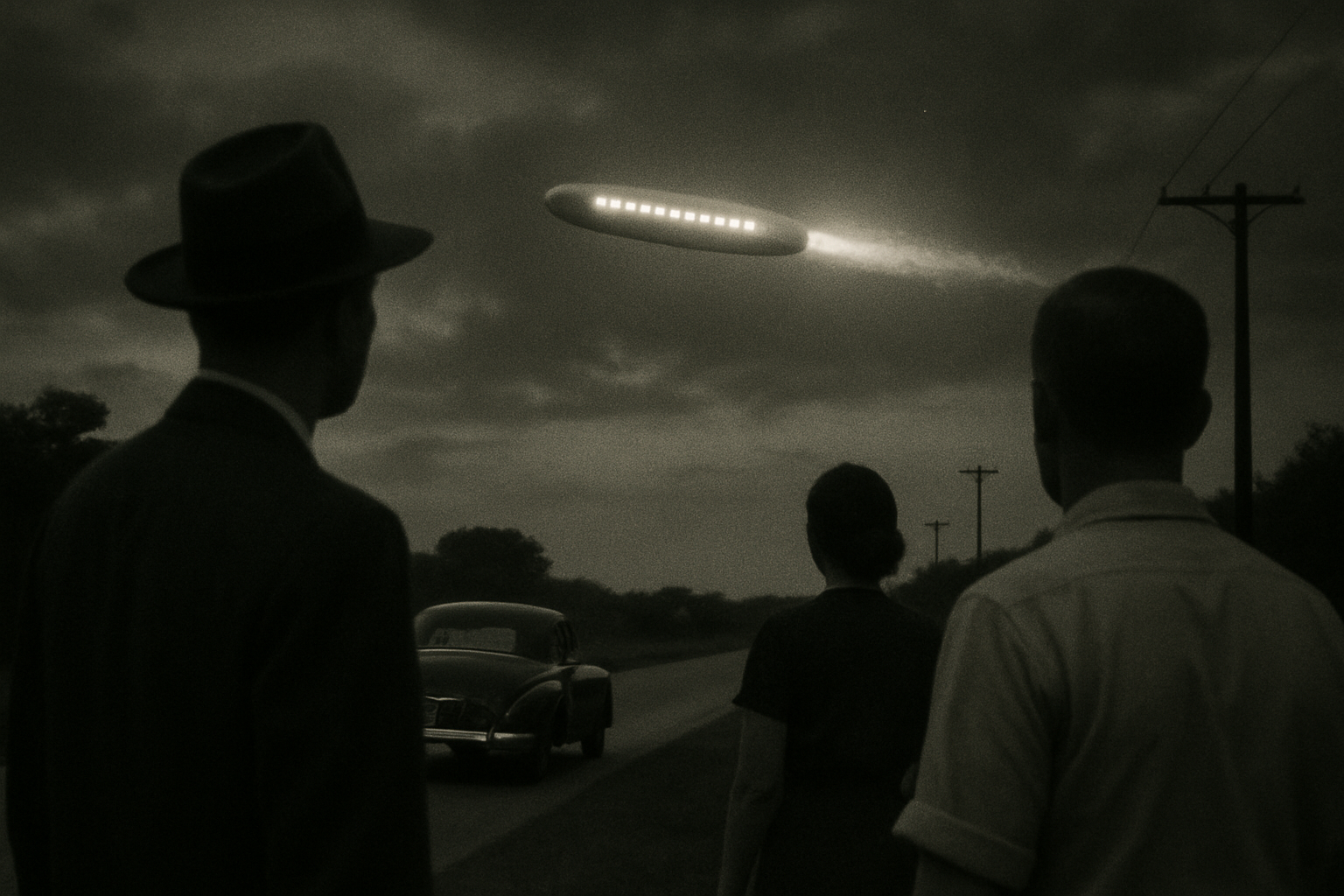
The Chiles-Whitted UFO encounter was a reported sighting of an unidentified flying object by two commercial airline pilots in the early morning of 24 July 1948 over Alabama.[1] Captain Clarence S. Chiles and First Officer John B. Whitted, flying an Eastern Air Lines Douglas DC-3 from Houston, Texas toward Atlanta, Georgia, said that near Montgomery a glowing, cigar- or torpedo-shaped object passed their aircraft, displaying two rows of bright "windows" and a long flame trailing from its tail.[1][2]
The case became one of the most influential early UFO reports because it reportedly prompted personnel in the U.S. Air Force's Project Sign to draft an internal "Estimate of the Situation" favouring an interplanetary origin for such objects.[2] After that document was rejected at the highest levels of the Air Force, official assessments shifted, and Project Blue Book eventually classified the sighting as a misidentified fireball meteor.[1][6] The meteor explanation remains the official conclusion but has been disputed by several investigators.[6]
Background
The encounter took place during the wave of UFO reports that followed Kenneth Arnold's widely publicised June 1947 sighting, a period in which the U.S. Air Force had established Project Sign to investigate "flying disc" reports.[1]
Clarence S. Chiles and John B. Whitted were both experienced pilots with wartime flying backgrounds, a fact that lent additional credibility to their report in the eyes of investigators.[2] On the night in question they were operating a scheduled Eastern Air Lines flight on a Douglas DC-3, a common twin-engine airliner of the era, carrying roughly 20 passengers en route from Houston, Texas, to Atlanta, Georgia.[2]
The encounter
At approximately 2:45 a.m. on 24 July 1948, while cruising at about 5,000 feet near Montgomery, Alabama, the two pilots reported seeing a brilliant object approaching from ahead and slightly above.[1][2] According to their accounts, the object:
- Was cigar- or torpedo-shaped, with no wings, and roughly 100 feet long, which Whitted compared in scale to a B-29 fuselage.[1]
- Showed two rows of windows through which a very bright light glowed, described as being as brilliant as a magnesium flare.[1]
- Emitted a bluish glow along its underside and a long orange-red flame or exhaust trailing from its rear.[3][1]
The sighting lasted only about 10 to 15 seconds before the object pulled up and disappeared.[1][2] The pilots reported no turbulence or physical effect on their aircraft. An awake passenger, Clarence L. McKelvie, said he saw a bright streak of light pass his window, though he did not see the detailed structure the pilots described.[1][2]
Investigation and the "Estimate of the Situation"
The report was taken seriously by Project Sign, and the incident is frequently cited as a catalyst for the project's internal "Estimate of the Situation." According to Edward J. Ruppelt, later the first head of Project Blue Book, the document concluded that the objects were interplanetary in origin.[4][2]
Ruppelt described the report as a thick, black-covered, Top Secret document. He wrote that Air Force Chief of Staff General Hoyt S. Vandenberg rejected the estimate in October 1948 on the grounds that the evidence was insufficient to support its conclusions; in Ruppelt's words, Vandenberg "wouldn't buy interplanetary vehicles."[4][2] The document was subsequently declassified and destroyed, and no copy is known to survive.[2][6]
A rival current of opinion within the Air Force instead suspected advanced Soviet aircraft or reconnaissance devices, reflecting Cold War anxieties of the period.[2] As official attitudes hardened, the more sceptical Project Grudge and, later, Project Blue Book moved toward conventional explanations.[1]
Explanations and disputes
The meteor explanation
The astronomer J. Allen Hynek, a scientific consultant to the Air Force, analysed the trajectory and concluded that the pilots had most likely seen a bright meteor or fireball entering the atmosphere at a shallow angle, which can give the illusion of a horizontally travelling, structured craft.[1] Harvard astronomer Donald H. Menzel, a prominent UFO sceptic, similarly argued that the pilots had misperceived an unusually bright meteor, noting that 24 July fell within a period of increased meteor activity associated with the Delta Aquariid stream.[5] In this reading, the "windows" were an illusion created by the fireball's fragmenting, glowing head.[5]
Project Blue Book formally listed the case as a fireball meteor in 1959, the conclusion that remains the official position.[1]
Criticism of the meteor explanation
The meteor hypothesis has been challenged. The atmospheric physicist James E. McDonald, who interviewed the pilots in the 1960s, argued that the reported characteristics were inconsistent with a meteor; he noted that the radiant of the Delta Aquariid stream lay far from the object's apparent point of origin.[6] Some commentators also point out that a brief meteor would not easily account for the close, structured appearance the pilots described, while sceptics counter that brief, dramatic fireballs are routinely misjudged as nearby solid objects (the so-called "airship effect").[2][6]
Aftermath and significance
Both pilots stood by their account in later years, and the case has remained a fixture in histories of early UFO investigation.[2] Its principal historical importance lies less in the object itself than in its role in the institutional debate over the extraterrestrial hypothesis: the rejection and destruction of the "Estimate of the Situation" is often cited as a turning point after which the U.S. Air Force adopted a markedly more sceptical public posture toward UFO reports.[2][6]
The encounter is frequently discussed alongside other prominent 1948 cases and is regularly referenced in surveys of the Project Sign, Project Grudge and Project Blue Book era.[1][7]
Key quotes
“According to Edward J. Ruppelt, the Project Sign estimate concluded that "they were interplanetary!"
“Ruppelt wrote that Chief of Staff General Vandenberg "wouldn't buy interplanetary vehicles."
References
- 1.
- 2.
- 3.
- 4.
- 5.
- 6.
- 7.
Similar cases
Scored on agency / year proximity / region / tag overlap — same agency +3, near year +4, same region +2, shared tag ×2.