Kenneth Arnold UFO sighting
Illustrations
AI-generated illustration — not actual footage or evidence; an interpretive depiction based on the documented account
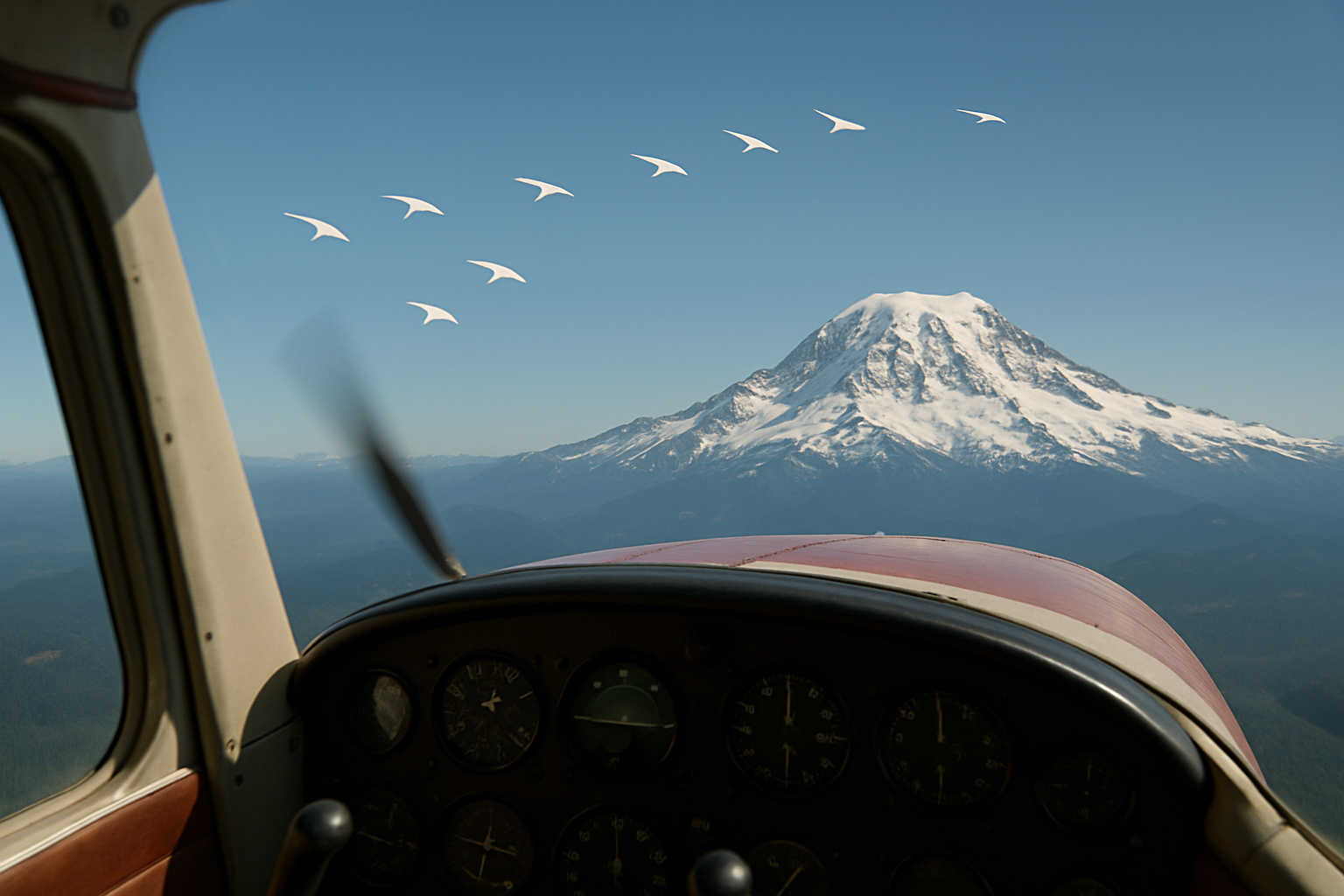

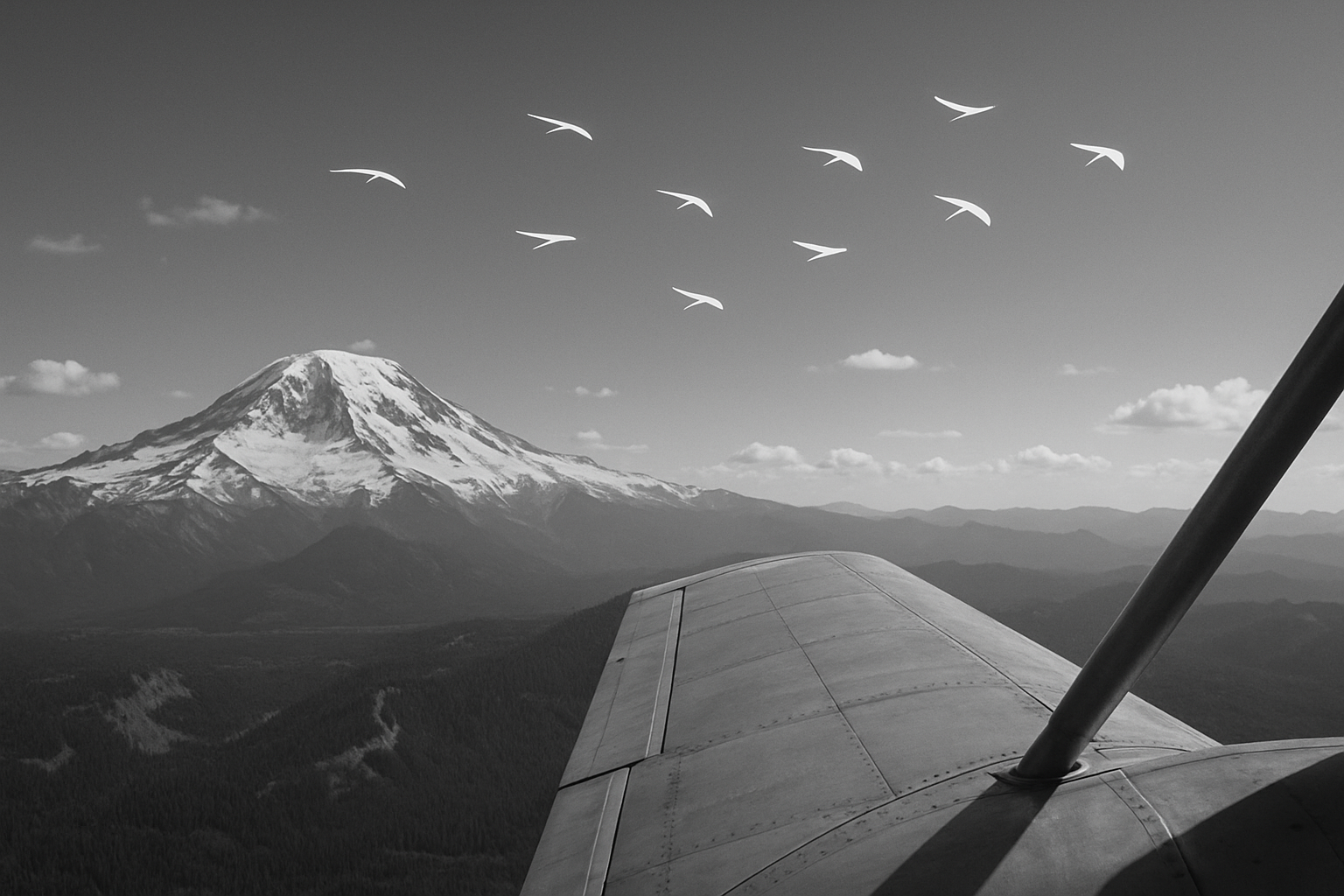
The Kenneth Arnold UFO sighting occurred on June 24, 1947, when civilian pilot Kenneth Arnold reported observing nine unusual objects flying in formation near Mount Rainier in Washington state.[1] Arnold, a respected businessman and experienced private pilot, was flying his CallAir A-2 aircraft from Chehalis to Yakima at about 9,200 feet when, around 3:00 p.m., he saw the objects moving at an estimated speed of well over 1,000 miles per hour.[1] His description of their erratic motion—"like a saucer if you skip it across water"—was widely reported and, through newspaper coverage, gave rise to the term *flying saucer*.[2] The incident is generally regarded as the first UFO report of the modern era and the trigger for the nationwide "flying disc" craze of 1947, even as official and skeptical investigators proposed conventional explanations such as a mirage.[1]
Background
Kenneth Arnold was a private pilot and a businessman who sold fire-suppression equipment, flying his own aircraft for work across the Pacific Northwest.[1] Contemporary reporters considered him a credible witness; one account noted that "Arnold had the makings of a reliable witness" as a respected businessman and experienced pilot.[1]
On June 24, 1947, Arnold was flying a CallAir A-2 from Chehalis to Yakima, Washington. He had reportedly made a brief detour to look for a U.S. Marine Corps transport plane that had crashed in the area, for which a reward had been offered.[1] The flight took him near Mount Rainier at an altitude of roughly 9,200 feet under clear skies.
The sighting
Around 3:00 p.m., Arnold reported seeing a series of bright flashes and then nine shiny objects flying in a diagonally stepped-down echelon formation between Mount Rainier and Mount Adams.[1]
Key features of his account included:
- Shape and appearance: the objects appeared thin and flat, rounded in front but chopped or bat-like in back; some descriptions likened them to discs or pie pans.[1] In several later interviews the objects were characterized as glowing bright blue-white.[2]
- Motion: Arnold said they weaved and flipped in unison, flashing in the sun, and moved "like the tail of a Chinese kite."[1]
- Speed: timing their passage between the two mountains—about 50 miles—he calculated a speed near 1,700 mph, though he publicly gave a more conservative figure of around 1,200 mph.[1]
Arnold famously compared the objects' movement to "a saucer if you skip it across water," a phrase describing their motion rather than their shape.[2]
Several other people reported similar sightings around the same time, including witnesses in the Yakima and Richland areas of Washington, which observers took as corroboration of Arnold's report.[1]
Origin of the term "flying saucer"
Arnold's account reached the public through Associated Press wire reporting, and journalists' phrasing rather than Arnold's own words coined the lasting label.[1] Reporters interpreted his "skipping saucer" simile as a description of the objects' shape, and headlines soon referred to *saucer-like aircraft* and *flying discs*; the popular term *flying saucer* spread within days.[2]
Arnold later expressed frustration that the story had outgrown his control, and clarified that he had described the way the objects moved, not a saucer-shaped craft.[1] The label nonetheless became a durable synonym for unidentified flying objects in the years that followed.[2]
Investigation and explanations
The U.S. Army Air Forces interviewed Arnold in the weeks after the sighting. Investigating officers reported that it was difficult to believe a man of his apparent integrity would fabricate such an account, regarding him as a sincere witness.[1] Despite this, the prevailing official assessment leaned toward natural phenomena, and the case was associated with a mirage explanation.[1]
A range of conventional explanations has been proposed over the decades:
- Mirage or atmospheric distortion: writer Steuart Campbell argued that temperature inversions over the Cascade valleys could have produced mirages of distant peaks, implying the "objects" were effectively stationary.[1]
- Meteors or a fireball: skeptic Philip J. Klass suggested a meteoric origin.[1]
- Birds: researcher James Easton proposed that the objects were American white pelicans, whose pale undersides and crescent profiles could flash in sunlight at altitude.[1]
- Clouds, snow, or window artifacts: astronomer Donald Menzel offered several explanations over the years, including blowing snow, orographic (wave) clouds, and water droplets on the aircraft's windows.[1]
Arnold himself initially considered that he might have seen test flights of military aircraft, but officials stated that no such flights matched the report.[2] No single explanation has been universally accepted, leaving the case formally disputed.
Aftermath and significance
Arnold's sighting received front-page coverage across the United States and is widely credited with launching the modern UFO era.[1] In the weeks that followed, hundreds of similar reports appeared in what became known as the 1947 "flying disc" craze, and the term *flying saucer* entered everyday language.[2]
The sighting preceded by days the July 1947 Roswell incident, in which the U.S. military first announced the recovery of a "flying disc" before describing the debris as a weather balloon, further intensifying public interest.[2] The wave of reports contributed to the U.S. Air Force establishing its first formal investigation, Project Sign, in 1948, which evolved into Project Grudge (1949) and ultimately Project Blue Book (1952–1969), a program that compiled more than 12,000 UFO reports.[2]
More than seven decades later, the Arnold sighting remains a foundational reference point in the history and popular culture of unidentified aerial phenomena.[1]
Key quotes
“(Arnold, describing the objects' motion) "like a saucer if you skip it across water."
References
- 1.
- 2.
Similar cases
Scored on agency / year proximity / region / tag overlap — same agency +3, near year +4, same region +2, shared tag ×2.