Mantell UFO incident
Illustrations
AI-generated illustration — not actual footage or evidence; an interpretive depiction based on the documented account
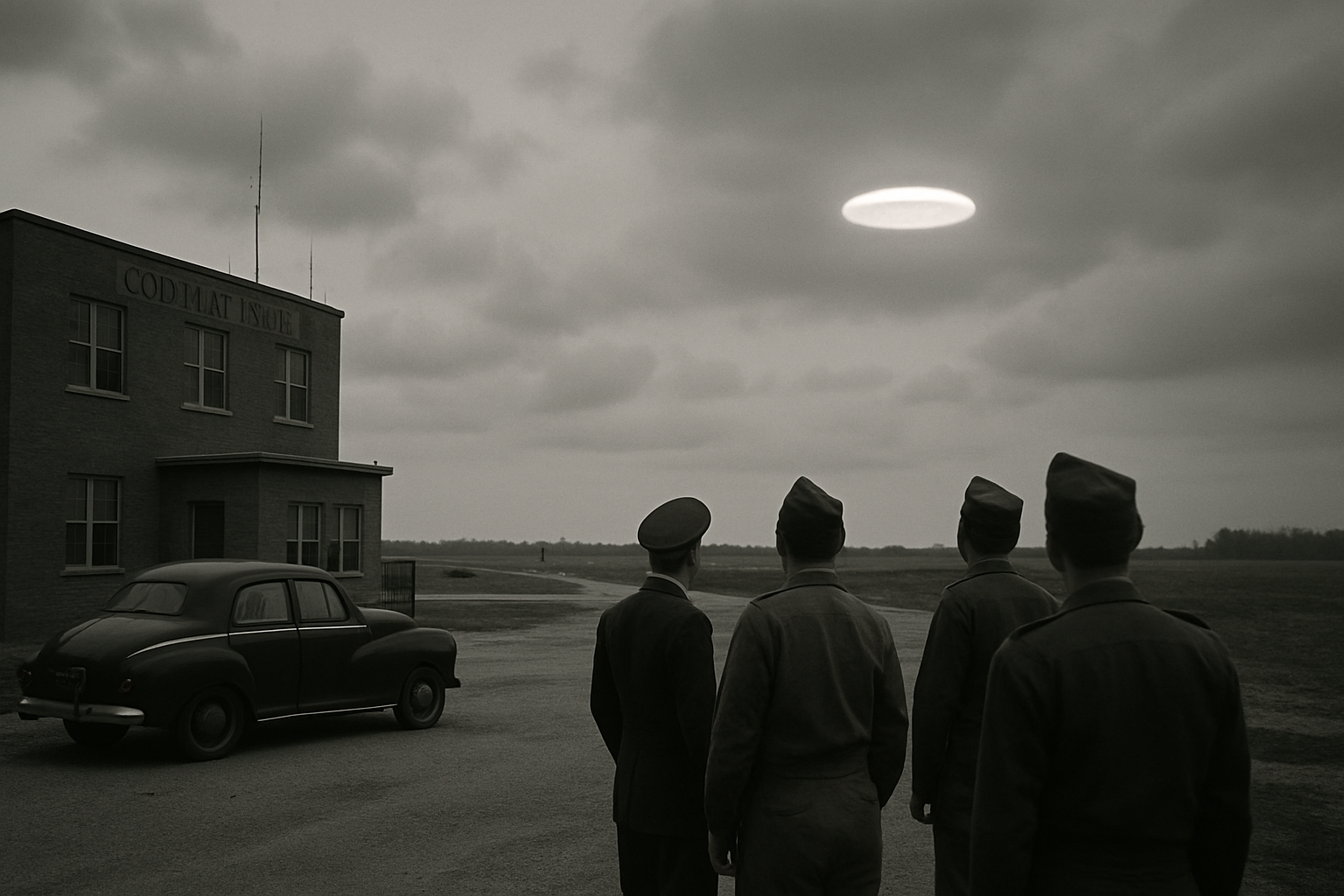
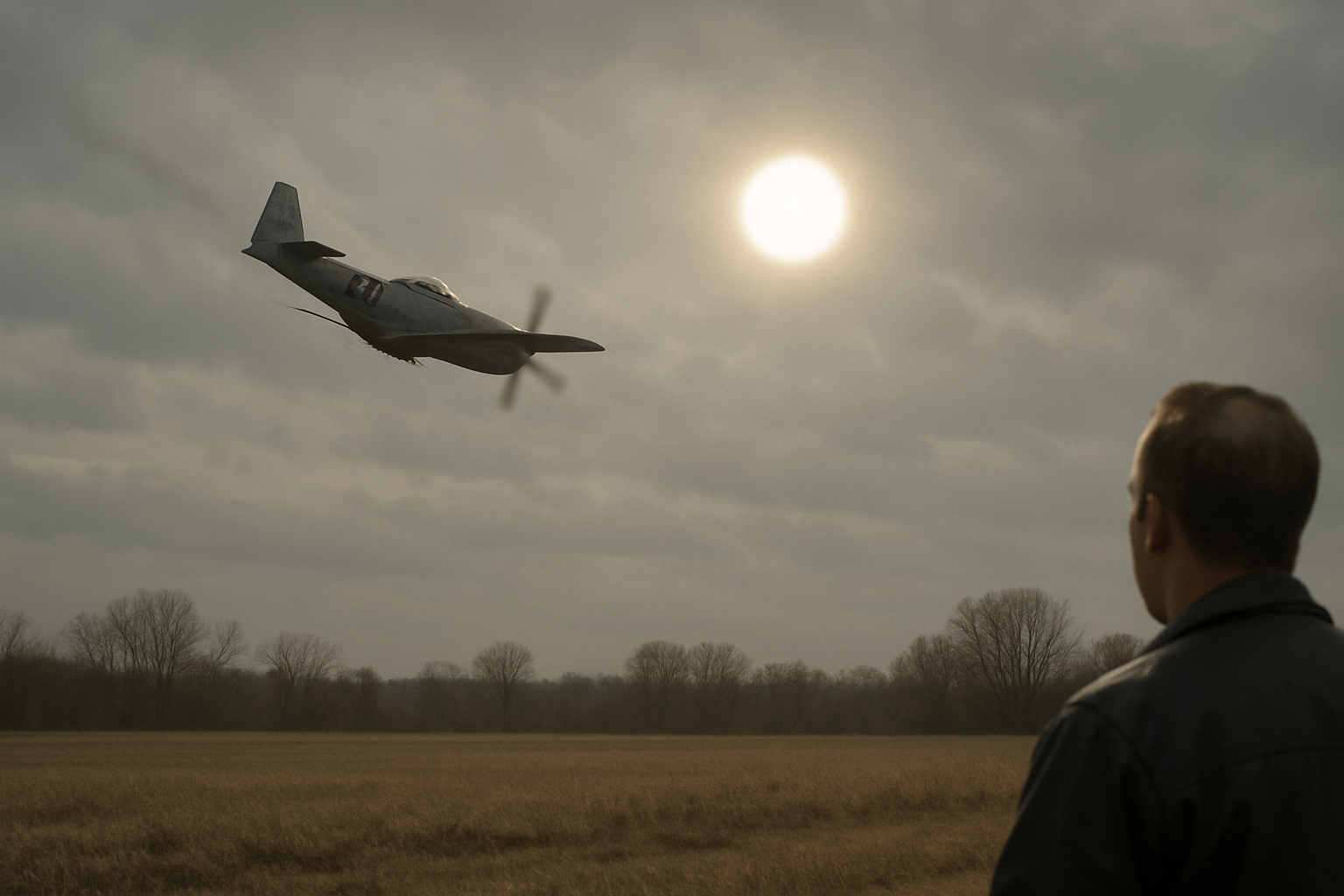
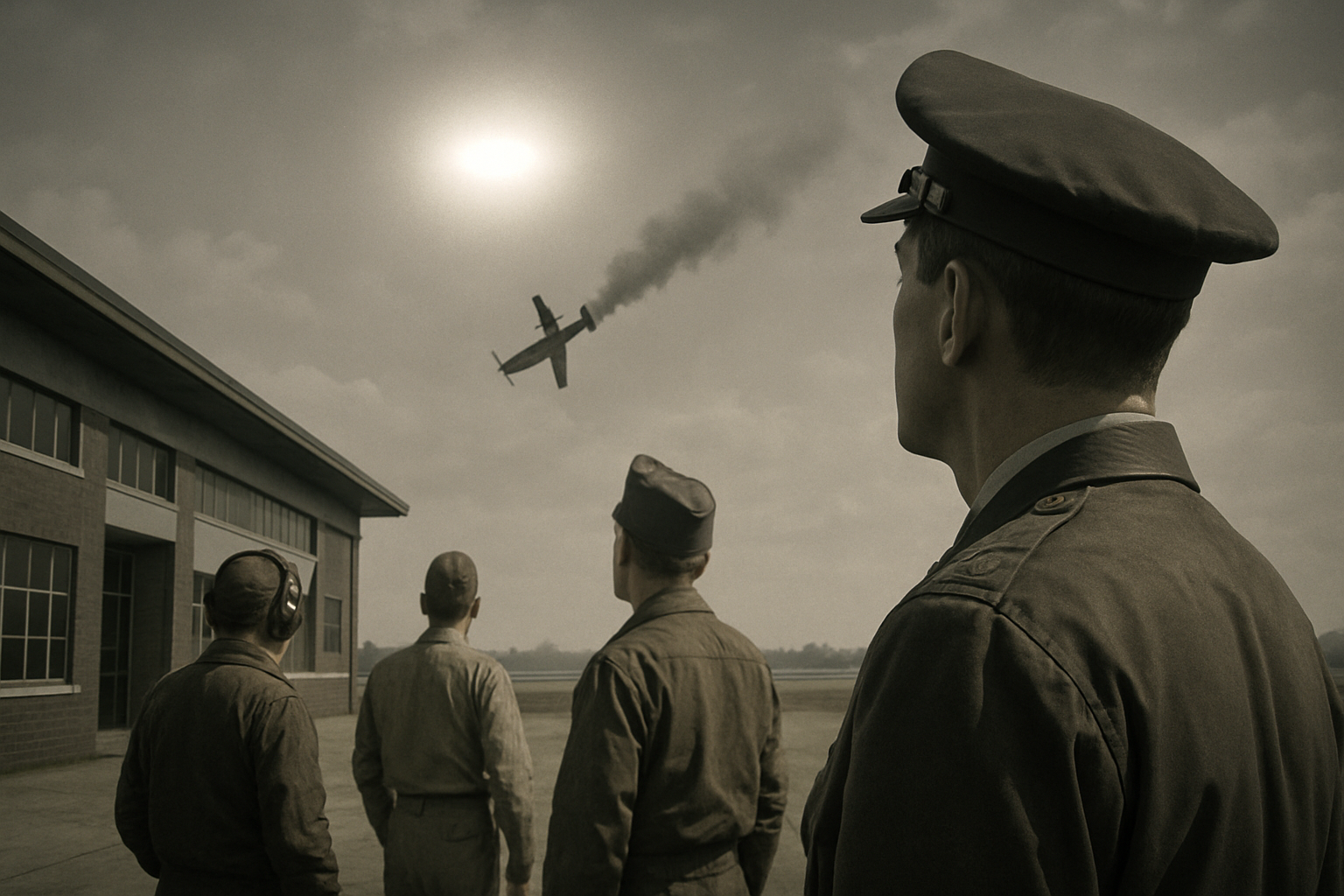
The Mantell UFO incident was the death of United States Air National Guard pilot Captain Thomas F. Mantell Jr. on January 7, 1948, after he pursued an unidentified object reported over Godman Army Airfield at Fort Knox, Kentucky.[1] Mantell, a 25-year-old World War II veteran flying an F-51D Mustang, climbed in pursuit of a large, bright object and crashed near Franklin, Kentucky, becoming the first pilot widely reported to have died while chasing a UFO.[3] The U.S. Air Force at first suggested the object was the planet Venus, but the explanation that came to be accepted, associated with the later Project Blue Book, is that it was a classified Navy Skyhook high-altitude balloon, and that Mantell lost consciousness from oxygen starvation at high altitude.[3][2] The case became one of the most publicized early UFO reports and helped shift American public perception of the phenomenon toward a possible threat.[3]
Background
In late 1947 and early 1948, the United States was experiencing a wave of reports of "flying discs" or "flying saucers," following the widely covered Kenneth Arnold sighting of June 1947.[1] The U.S. Army Air Forces had begun cataloguing such reports, and in early 1948 the newly independent U.S. Air Force established Project Sign, the first official program to investigate unidentified flying objects, which was later succeeded by Project Grudge and Project Blue Book.[3]
Thomas Francis Mantell Jr. was a decorated combat veteran. He had flown during the Normandy invasion in World War II and had accumulated thousands of flight hours; contemporary accounts credit him with roughly 2,867 flight hours.[2] At the time of his death he was a captain in Flight C of the 165th Fighter Squadron, Kentucky Air National Guard.[2]
The pursuit and crash
On the afternoon of January 7, 1948, a group of F-51D Mustangs of the 165th Fighter Squadron was en route over Kentucky on a training flight when the control tower at Godman Army Airfield received reports of an unusual aerial object.[2] State police and then the tower personnel observed a large, bright object in the sky; tower operators including Tech Sgt. Quinton Blackwell described it in terms such as an ice-cream cone or parachute, white and round on top with a conical shape beneath.[2]
- Godman's commanding officer, Col. Guy Hix, asked the passing flight to investigate the object.[2]
- Mantell led several aircraft in a climb toward it. Accounts of the altitudes vary: he is reported to have climbed past roughly 15,000 feet and on toward 22,000 feet and higher, while his wingmen, lacking sufficient oxygen equipment, broke off the climb.[1][3]
- By radio Mantell described the object as metallic and "of tremendous size," possibly a reflection of sunlight from a metallic surface.[2]
- Radio contact with Mantell was lost in the mid-afternoon. His F-51D crashed on a farm in southern Kentucky, near Franklin, and the wreckage was located later that afternoon.[1][3]
Mantell's wristwatch was reported to have stopped at about 3:18 p.m., consistent with the approximate time of the crash.[3] He was killed in the crash.
Investigation and official response
The crash was investigated under Project Sign, the Air Force's first UFO program, and was later revisited by Project Blue Book.[3] Investigators concluded that Mantell had lost consciousness from hypoxia while climbing to high altitude without adequate oxygen equipment, after which his aircraft entered an uncontrolled descent and crashed.[1][3]
As to the object itself, the Air Force offered more than one explanation over time:
- An early official suggestion was that Mantell had been chasing the planet Venus. This explanation was widely criticized as implausible, since Venus would have been difficult to see clearly in the afternoon sky and could not account for the visual descriptions.[3][2]
- The explanation that came to be favored is that the object was a Skyhook balloon, a then-classified U.S. Navy program of large polyethylene high-altitude research balloons. Such balloons could appear metallic and enormous when catching sunlight at very high altitude. Captain Edward J. Ruppelt, who headed the Air Force UFO investigation from 1951, is associated with the conclusion that a Skyhook balloon was the most likely cause.[3]
Because Project Skyhook was classified at the time, pilots and tower observers would not have known of it, which later writers cite to explain why the object went unidentified.[3]
Explanations and disputes
The Mantell incident remains a touchstone in UFO history, and several points are still debated.[1]
- Skyhook identification. The balloon explanation is the most widely accepted, but some accounts note that no surviving documentation conclusively ties a specific launched balloon to the object Mantell pursued, and that records of nearby launches have been cited only indirectly.[2] Skeptical and mainstream sources nonetheless regard a high-altitude balloon as the best fit for the descriptions.[3]
- Venus. The initial Venus explanation is generally rejected today, including by later Air Force analysts, as inconsistent with the observed object.[3]
- Rumors. In the period after the crash, numerous unsubstantiated rumors circulated, including claims of radioactive or unusual wreckage and that the aircraft had been damaged by some external force. These claims were not substantiated by investigators.[1]
In neutral terms, the consensus of official and skeptical analysis is that a mundane high-altitude balloon, combined with a fatal case of hypoxia, accounts for the event, while UFO proponents have continued to highlight the unexplained or disputed details.[3][1]
Aftermath and significance
Mantell's death received extensive national press coverage and is frequently cited as the first instance of a pilot dying while pursuing a UFO.[3] Commentators have argued that the case marked a turning point in American attitudes, introducing the idea that unidentified objects might pose a physical danger rather than being a mere curiosity.[3]
The incident became a standard reference point in subsequent UFO literature and in the official files of Project Sign and Project Blue Book.[3] Mantell himself is remembered as a decorated combat veteran of World War II.[2] More than seventy-five years later, the episode continues to be discussed in connection with the secrecy surrounding the Skyhook program and with the broader history of early Cold War UFO reports.[2]
Key quotes
“"It appears to be a metallic object or possible reflections of sun from a metallic object, and it is of tremendous size." — reported radio description by Capt. Mantell
References
- 1.
- 2.
- 3.
Similar cases
Scored on agency / year proximity / region / tag overlap — same agency +3, near year +4, same region +2, shared tag ×2.