The Lubbock Lights (1951)
Illustrations
AI-generated illustration — not actual footage or evidence; an interpretive depiction based on the documented account
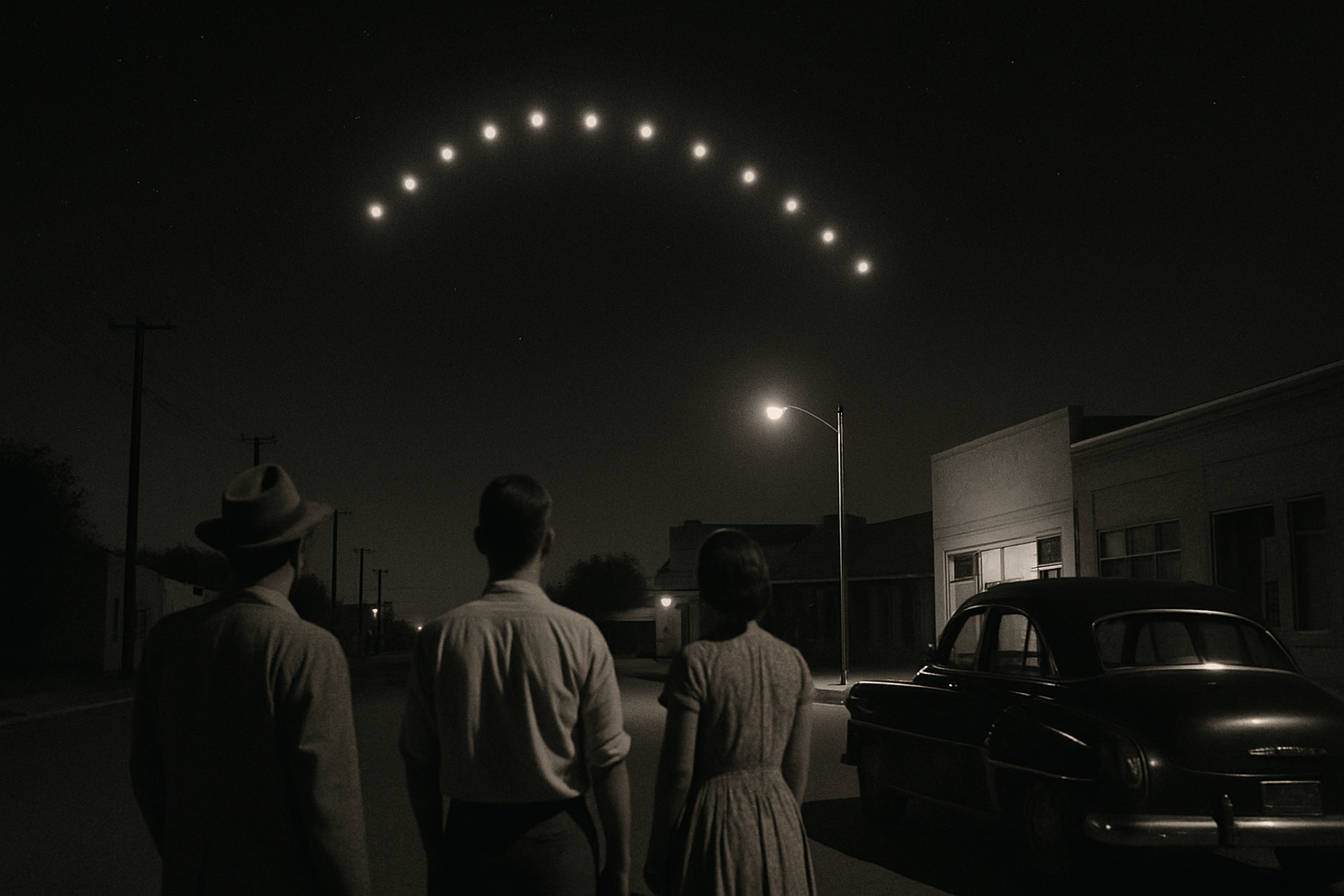
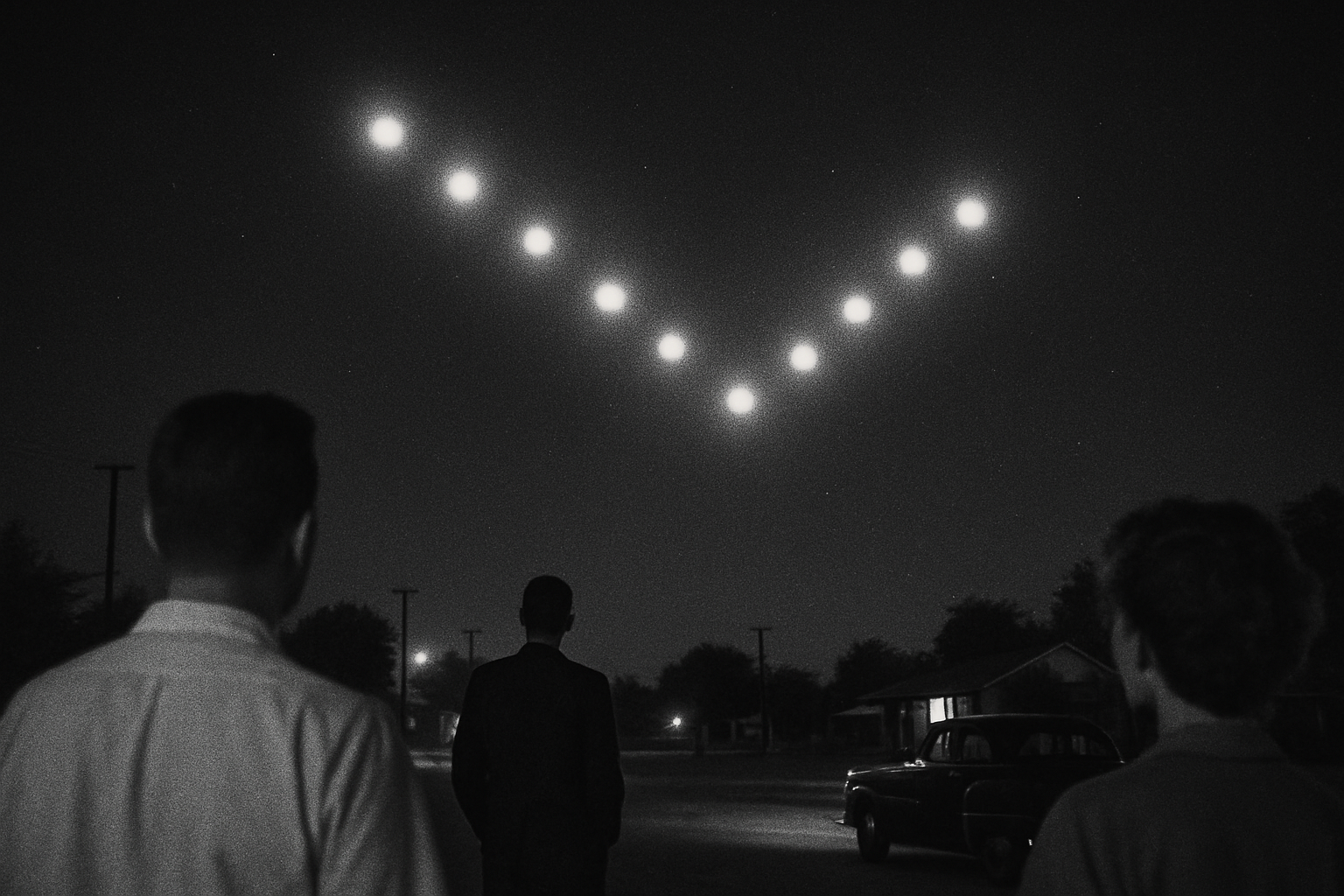
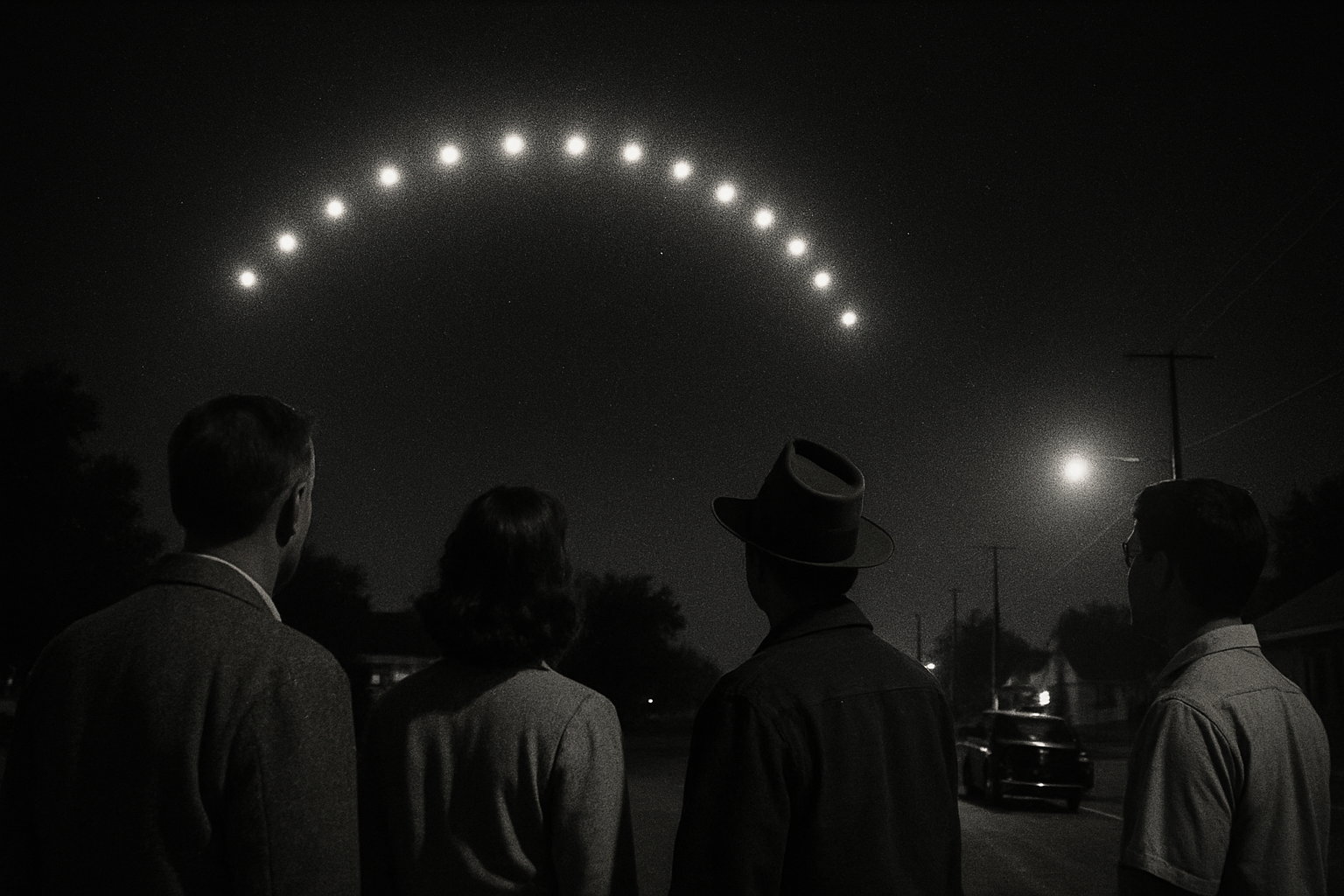
The Lubbock Lights were a series of sightings of unidentified flying objects that occurred over the city of Lubbock, Texas, between August and November 1951.[1] The case drew national attention because it combined the testimony of credentialed academic observers with photographic evidence — a rare combination for the early UFO era.[1] The first widely reported observation, on the evening of August 25, 1951, was made by three professors of Texas Technological College (now Texas Tech University), who watched a formation of bright lights race across the sky.[1] Days later a college student, Carl Hart Jr., took five photographs of a similar formation that were reprinted across the United States.[1] The United States Air Force investigated the reports through Project Blue Book; its director, Captain Edward J. Ruppelt, concluded that most of the sightings were consistent with birds reflecting the city's new vapour street lights, while acknowledging that the photographs were never proven either genuine or fraudulent.[2]
Background
In the summer of 1951 the United States was in the early years of the modern "flying saucer" phenomenon, which had begun with Kenneth Arnold's June 1947 sighting and the subsequent wave of reports across the country.[1] The U.S. Air Force tracked these reports through a sequence of official projects, culminating in Project Blue Book, which formally collected and analysed UFO cases.[2]
Lubbock, in the West Texas plains, had recently installed new mercury-vapour street lighting, a detail that would later feature prominently in the proposed explanations for the sightings.[2] The principal early witnesses were faculty members at Texas Technological College, whose technical training and willingness to be identified gave the reports unusual credibility for the period.[1]
The sightings
On the evening of August 25, 1951, around 9 p.m., three Texas Tech professors — geologist W. I. Robinson, chemical engineer A. G. Oberg, and petroleum-engineering department head W. L. Ducker — were sitting in a backyard when they saw a group of bright lights pass overhead.[1] They described seeing "20–30 lights, as bright as stars but larger in size," moving rapidly across the sky in a formation.[1]
The professors observed repeated flights over the following weeks and attempted rough measurements. According to one account, the lights crossed roughly 30 degrees of arc in about a second.[3] When one formation was estimated to be flying above clouds at an altitude of about 2,000 feet, the professors calculated a speed in excess of 600 miles per hour (about 970 km/h).[1]
Witnesses gave varying descriptions of the formation and colour:
- The objects were seen in "U"- and "V"-shaped arrangements, with counts ranging from about 8 to 30 lights.[3]
- During a later observation on September 5, witness Grayson Mead said the objects "appeared to be about the size of a dinner plate and they were greenish-blue, slightly fluorescent in color," and were "absolutely circular."[1]
- Professor Ducker reportedly logged a series of separate flights between August and November 1951.[3]
Separately, several residents reported a large, silent "flying wing"-shaped object passing over the city, which Ruppelt later considered in his investigation.[2]
The Hart photographs
On the night of August 30, 1951, Carl Hart Jr., a Texas Tech freshman, used a 35-mm Kodak camera to take five photographs showing roughly 18 to 20 white lights in a "V" formation flying overhead.[1] The pictures were among the few photographic records of the phenomenon and quickly became the most reproduced element of the case.[1]
The editor of the *Lubbock Avalanche-Journal*, Jay Harris, purchased the photographs, and they were reprinted across the country and in *Life* magazine.[1] The physics laboratory at Wright-Patterson Air Force Base examined the images in detail.[1]
The photographs were a point of contention even among the witnesses. The Texas Tech professors disputed Hart's images, saying the objects they had personally seen flew in a "U" formation rather than the "V" shown in the pictures.[1] A newspaper photographer attempted to reproduce comparable images by photographing birds against the street lights at night but reportedly could not do so.[1]
Investigation and official response
The case was investigated under Project Blue Book by Captain Edward J. Ruppelt, who travelled to Lubbock in late September 1951 to interview the professors, Hart, and other witnesses.[2]
Ruppelt's working conclusion was that many of the sightings could be explained by migrating birds — specifically plovers — reflecting the city's new vapour street lights.[2] Supporting observations cited at the time included:
- A local farmer, T. E. Snider, who reported seeing birds over a drive-in theatre on August 31, 1951, with their undersides lit by reflected light.[1]
- Joe Bryant and his wife, who said they identified plovers circling their home on August 25 by both sight and sound.[1]
Regarding the Hart photographs, Ruppelt stated that they "were never proven to be a hoax, but neither were they proven to be genuine."[1] He also noted that, officially, all of the sightings except a separate object picked up on radar were classified as unknowns.[2]
Explanations and disputes
The bird-and-street-light explanation was contested from the outset. J. C. Cross, head of Texas Tech's biology department, and a local game warden both rejected the plover hypothesis, with one account noting that such birds "never fly in flocks larger than three."[1][3]
Professor Mead argued that the objects were "too large for any bird" and moved too fast and too silently to be birds, saying that to have crossed the sky so quickly "they would have to have been exceedingly low to disappear quite so quickly."[1]
Ruppelt's own later writing on the case was notably ambiguous. He wrote that the lights "weren't birds, they weren't refracted light, but they weren't spaceships," and claimed they had been "positively identified as a very commonplace and easily explainable natural phenomenon" — yet said he could not reveal the explanation because he had promised anonymity to a scientist who had studied the phenomenon with instruments over several months.[2] Because this asserted explanation was never published, the natural-phenomenon claim has never been independently verified.[1]
Later commentators have proposed related conventional explanations, such as light reflecting off the bodies of birds (variously described as plovers or ducks) flying over the illuminated city, while noting that such theories struggle to account for the high speeds and large apparent sizes reported by some witnesses.[3]
Aftermath and significance
The Lubbock Lights became one of the best-known UFO cases of the early 1950s, in large part because of the credibility of the academic witnesses and the wide circulation of the Hart photographs.[1] The case featured prominently in Ruppelt's influential 1956 book, *The Report on Unidentified Flying Objects*, which helped shape public and official understanding of the UFO question.[2]
The episode is frequently cited as an example of the difficulty of reaching firm conclusions in UFO investigations: it combined multiple independent witnesses, photographic evidence, and an official inquiry, yet ended with conflicting accounts and an explanation that its own investigator declined to fully disclose.[1] The event remains a recurring subject in popular accounts of UFO history, including dramatised television treatments, and the surviving photographs are still debated by researchers.[1]
Key quotes
“"The [Hart] photos were never proven to be a hoax, but neither were they proven to be genuine." — Edward J. Ruppelt
“"These objects were too large for any bird... to have gone as fast as this, to be birds, they would have to have been exceedingly low to disappear quite so quickly." — Professor Mead
References
- 1.
- 2.
- 3.
Similar cases
Scored on agency / year proximity / region / tag overlap — same agency +3, near year +4, same region +2, shared tag ×2.