McMinnville UFO photographs
Illustrations
AI-generated illustration — not actual footage or evidence; an interpretive depiction based on the documented account
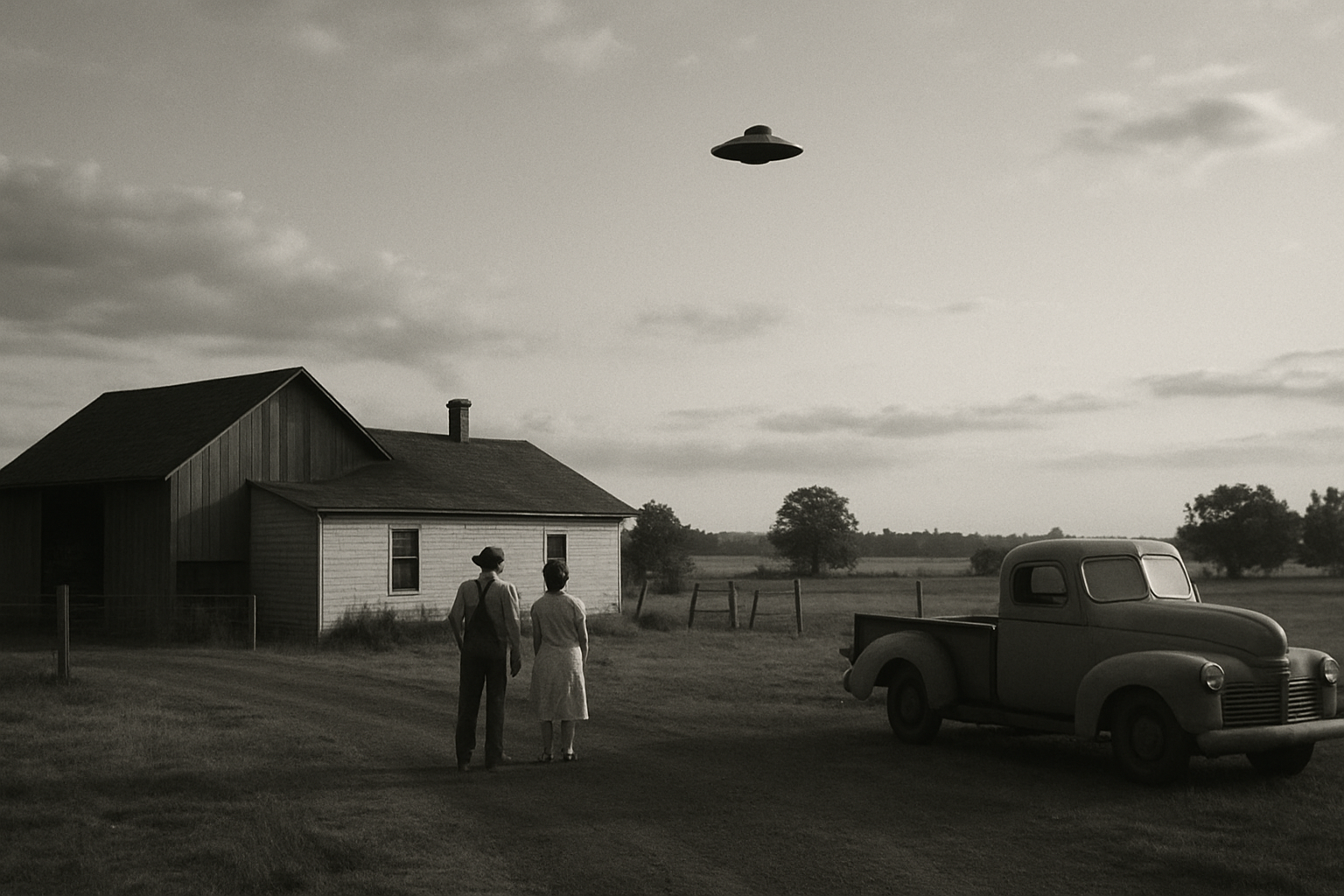
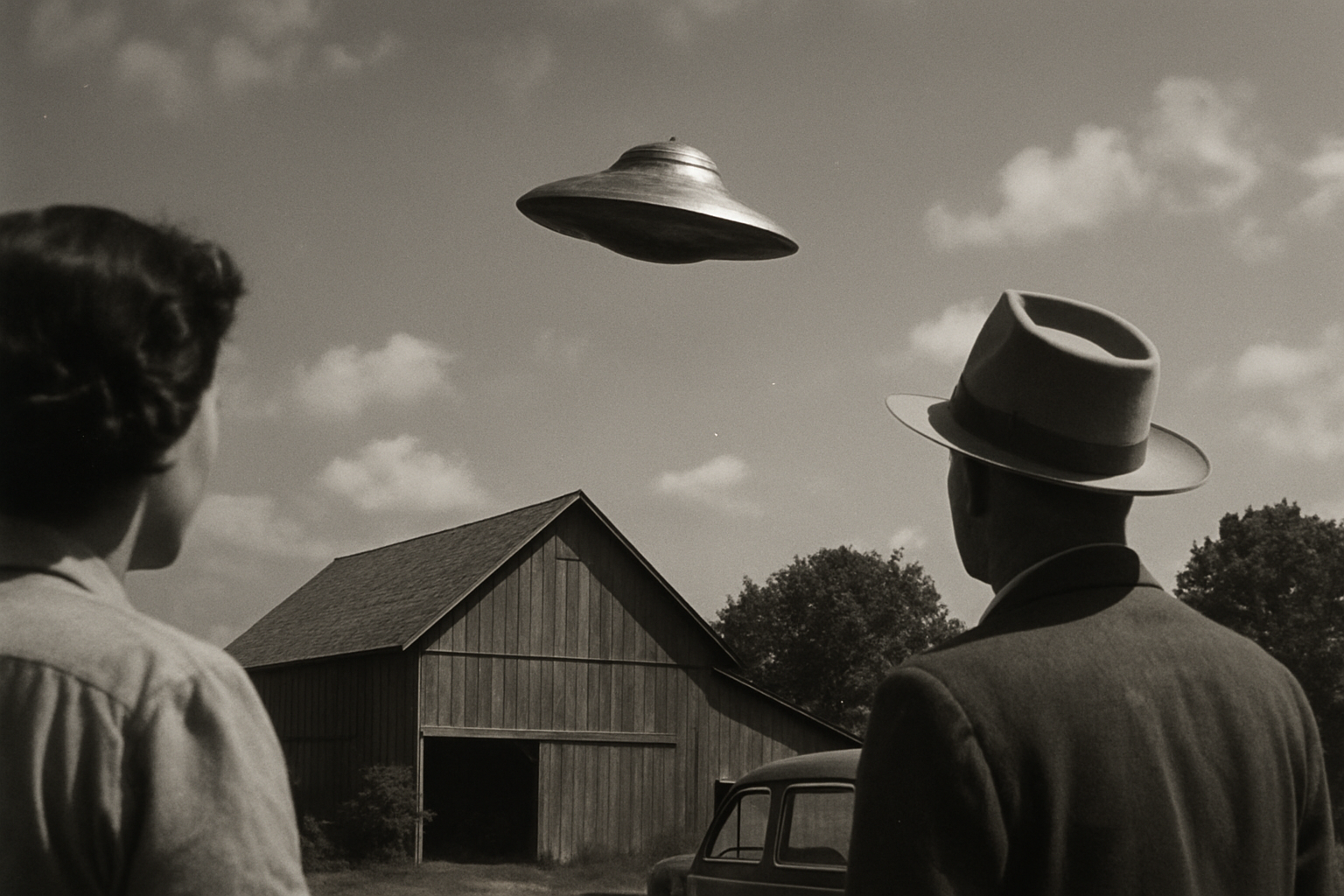
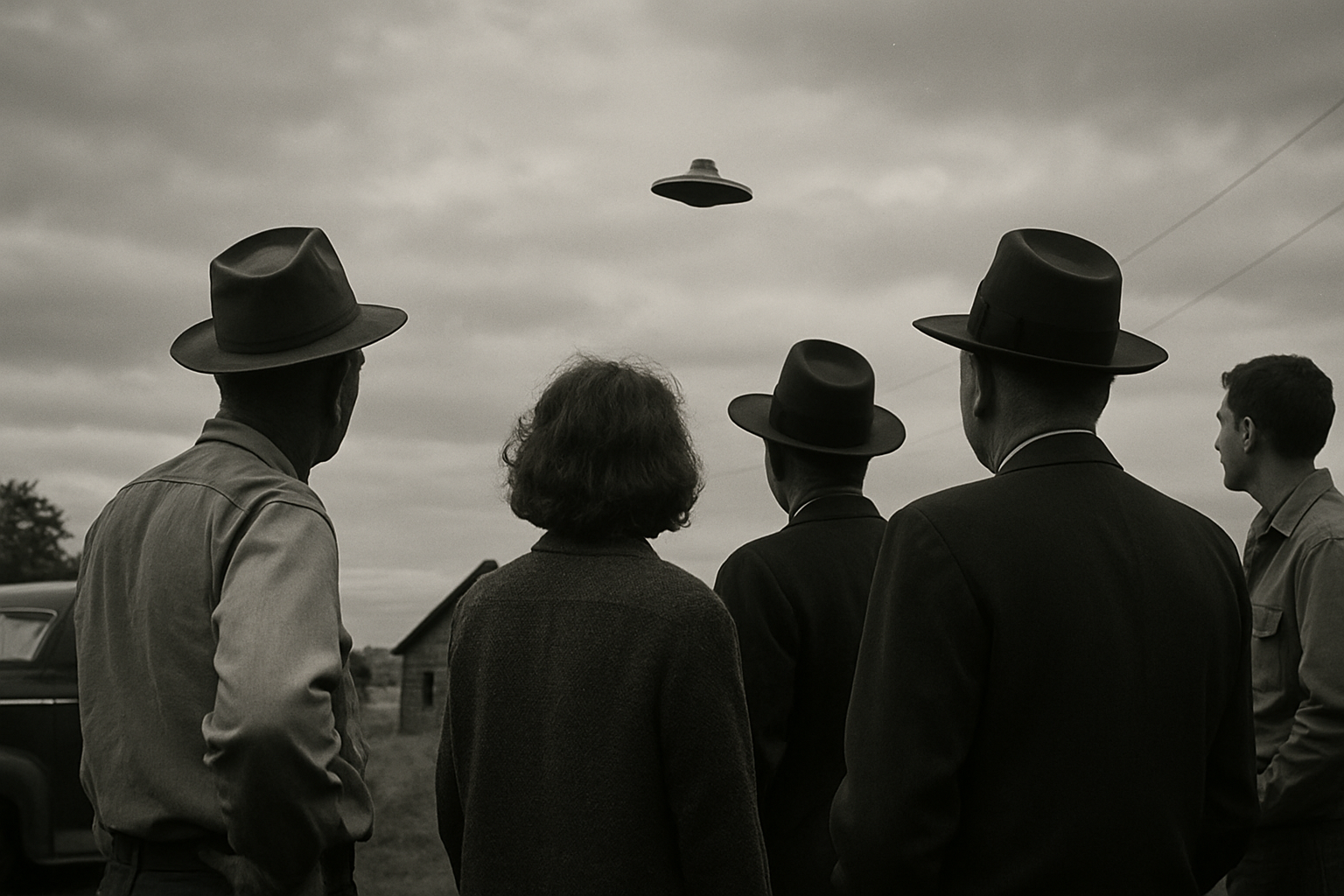
The McMinnville UFO photographs are a pair of black-and-white images taken on 11 May 1950 by Paul Trent, a farmer living near McMinnville in Yamhill County, Oregon.[1] Trent's wife Evelyn said she first saw a slow-moving, metallic, disk-shaped object approaching from the northeast while she was outside feeding rabbits; Paul retrieved a camera and took two photographs before the object sped away to the west.[1] The pictures were first published in the local newspaper, the *Telephone-Register*, on 8 June 1950 and were reproduced nationally, including in *Life* magazine on 26 June 1950.[1] They became among the most reproduced and debated UFO photographs of the twentieth century.[1]
A 1968 analysis by astronomer William K. Hartmann for the U.S. Air Force-funded Condon Committee found the photographs consistent with a genuine, large flying object, though Hartmann later withdrew that assessment.[1] Subsequent skeptical investigators argued that the object was a small model suspended from overhead wires or a vehicle mirror, while some ufologists continued to defend the images as authentic.[1][2] No single explanation has been universally accepted, and the case is generally classed as disputed.[1]
Background
In 1950 Paul and Evelyn Trent operated a small farm a few miles southwest of McMinnville, Oregon, in the rural Willamette Valley.[1] The sighting came during a period of intense public interest in "flying saucers" following the widely reported 1947 Kenneth Arnold sighting, also in the Pacific Northwest, and the wave of reports that followed.[1] The U.S. Air Force was at the time collecting such reports through Project Blue Book, the official program that catalogued unidentified flying object cases.[1]
According to the account later reconstructed by investigators, the events of 11 May 1950 began at roughly 7:30 p.m., when Evelyn Trent was walking back toward the farmhouse and noticed a metallic, disk-shaped object moving slowly across the sky.[1] She called to her husband, who first looked for a camera inside the house before locating one already loaded with film and taking two exposures in quick succession.[1]
The photographs and their publication
The two surviving photographs show a shiny, slightly domed disk against an overcast sky, framed near overhead utility wires and a garage in the foreground.[1] The Trents did not develop the film immediately, finishing the roll with family snapshots before the negatives were processed.[1] The images came to wider attention after they were displayed locally, and reporter Bill Powell of the McMinnville *Telephone-Register* examined the negatives and reported finding no evidence of tampering.[1]
The newspaper ran the story on 8 June 1950 under a headline announcing photographs of a flying saucer.[1] The pictures were quickly picked up by wire services and reproduced across the United States, and *Life* magazine published cropped versions on 26 June 1950, giving the case a national audience.[1] The original negatives were misplaced during the surrounding publicity and resurfaced only years later during a formal investigation.[1]
Investigation and official response
The most influential technical study was carried out in 1967-1968 by astronomer William K. Hartmann for the Condon Committee, the U.S. Air Force-funded review of UFO reports at the University of Colorado Boulder.[1] Hartmann recovered the negatives and performed photometric and geometric analysis. In the committee's published report he wrote that "all factors investigated, geometric, psychological, and physical, appear to be consistent with the assertion that an extraordinary flying object ... flew within sight of two witnesses."[1]
Hartmann nonetheless noted that the evidence did not exclude a hoax, observing that the object could plausibly have been a small model suspended from one of the overhead wires.[1] He drew attention to a lighting discrepancy: the distant background appeared illuminated as if by daylight rather than at the stated evening hour, hinting the photographs might have been taken in the morning.[1] After reviewing later skeptical research, Hartmann withdrew his earlier favorable assessment of the case.[1]
Explanations and disputes
Analysts have reached sharply differing conclusions. In 1975 optical physicist Bruce Maccabee examined the negatives and argued, on the basis of densitometric measurements, that the photographs were authentic and showed a distant object.[1] Skeptics including Robert Sheaffer and Philip J. Klass countered that the Trents' accounts contained inconsistencies and that the object was most likely a model or a vehicle mirror; one proposal noted its resemblance to side-view mirrors used on Ford vehicles.[1][2]
Researcher Joel Carpenter proposed in 2004 that the object was a truck mirror hung beneath the overhead wires and close to the camera, noting that Trent appears to have crouched low to exaggerate the object's apparent altitude.[2] In 2013 the French research group IPACO published a geometric study concluding that the object was a small model hanging from a thread, reporting a statistical detection of the suspension thread at a significance of about 2.38 sigma in the first photograph and over 2.5 sigma in the second.[2] A recurring skeptical argument is that when the two photographs are overlaid with the utility wires aligned, the object also aligns, implying it was fixed near the wires rather than far away.[2]
Aftermath and significance
The Trents maintained that their photographs were genuine for the rest of their lives; Evelyn Trent died in 1997 and Paul Trent in 1998.[1] The images remain among the most frequently reproduced UFO photographs and are still cited by both proponents and skeptics as a benchmark case, even though no explanation has gained universal acceptance.[1]
The sighting also became a lasting part of McMinnville's local identity. The town hosts an annual UFO Festival inspired by the Trent photographs, which has grown into one of the largest events of its kind in the United States.[1][3] The case continues to feature in documentaries and analyses of historic UFO photography.[1]
Key quotes
“"All factors investigated, geometric, psychological, and physical, appear to be consistent with the assertion that an extraordinary flying object ... flew within sight of two witnesses." — William K. Hartmann, Condon Committee report
References
- 1.
- 2.
- 3.
Similar cases
Scored on agency / year proximity / region / tag overlap — same agency +3, near year +4, same region +2, shared tag ×2.