Mariana UFO incident (Great Falls film)
Illustrations
AI-generated illustration — not actual footage or evidence; an interpretive depiction based on the documented account
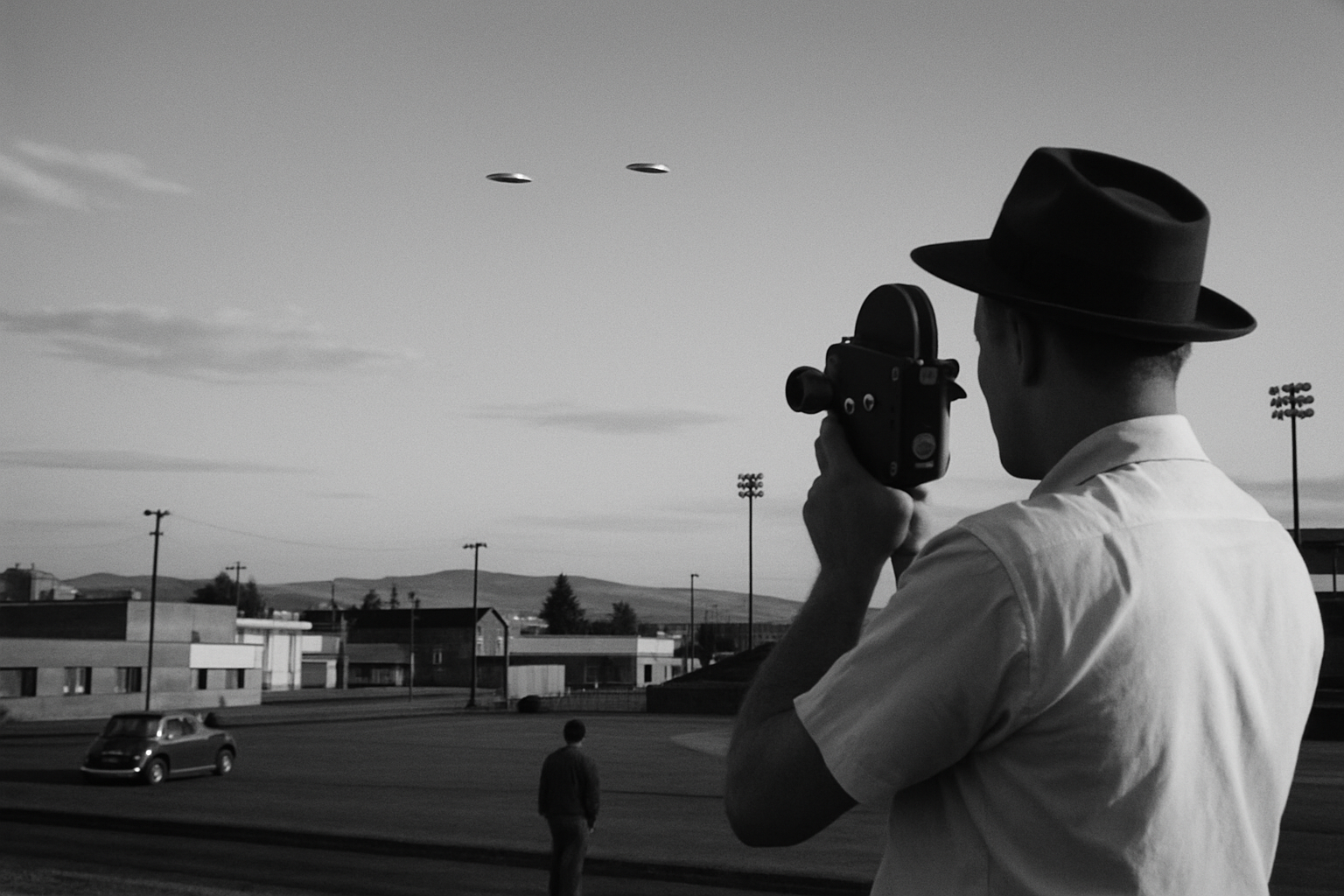
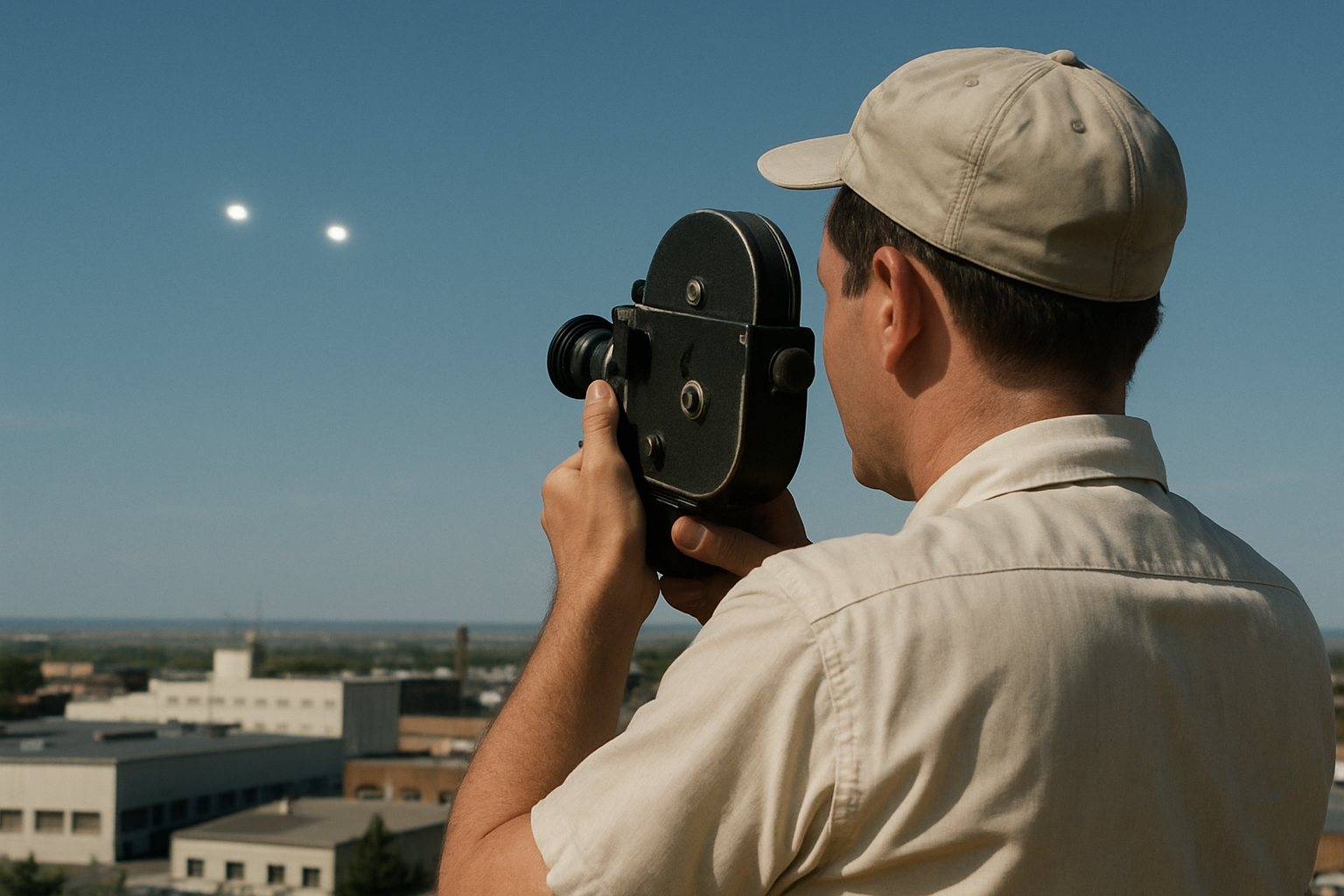
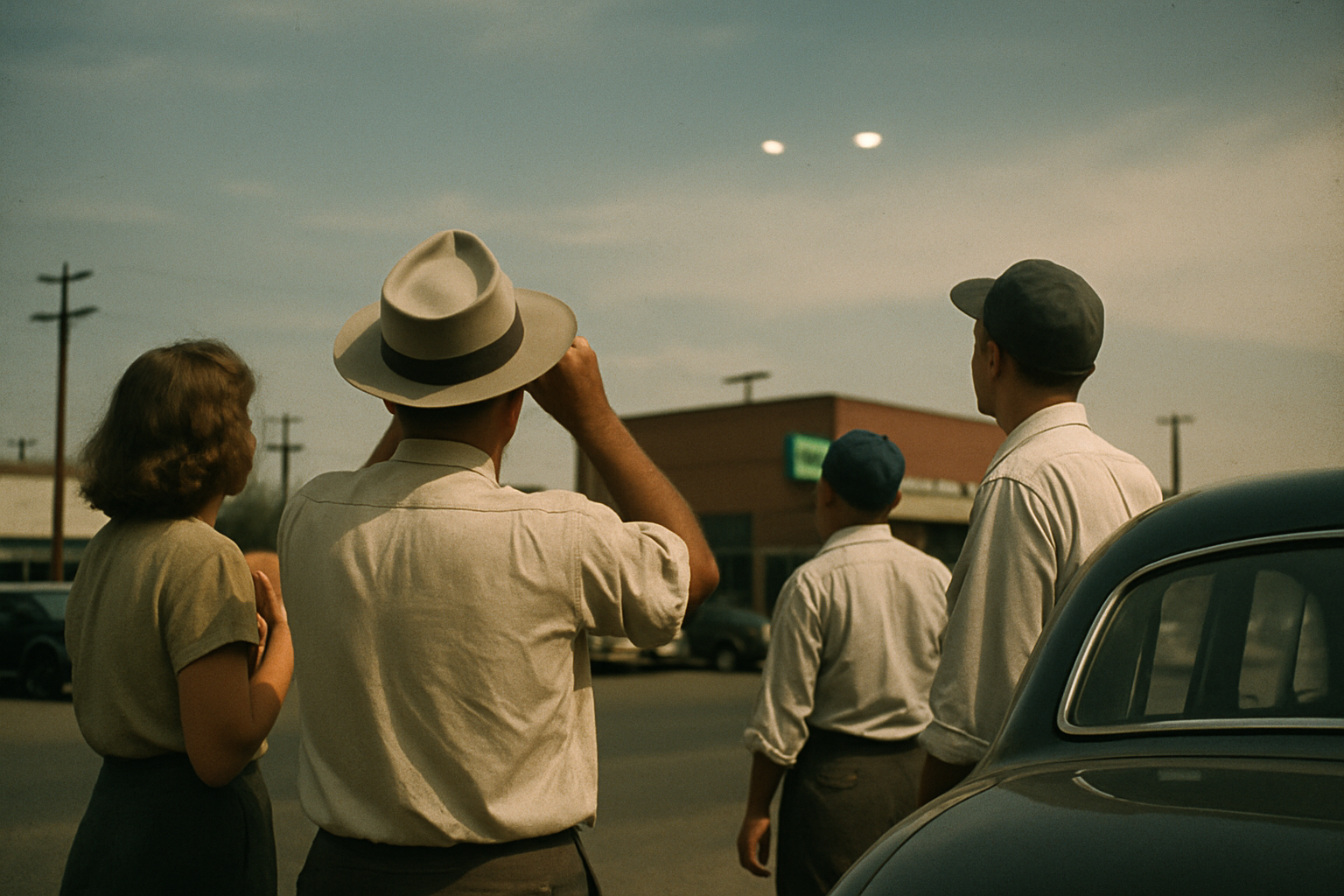
The Mariana UFO film (also known as the Great Falls film) is a short motion-picture sequence shot on August 15, 1950, in Great Falls, Montana, by Nicholas "Nick" Mariana, the general manager of the city's minor-league baseball team. It is often described as one of the earliest pieces of motion-picture footage of what would later be called an unidentified flying object (UFO).[1][2] Using a 16 mm color camera, Mariana recorded roughly 16 seconds of two bright, silvery objects moving across the sky; his 19-year-old secretary, Virginia Raunig, also witnessed the objects.[1][2]
The U.S. Air Force examined the film through Project Blue Book and related reviews. Its stated explanation changed several times: an initial conclusion that the objects were sunlight reflecting off two F-94 jet fighters was later set aside as "unidentified," then in effect restored by the CIA-convened Robertson Panel in 1953.[1][3] Independent studies by Robert M. L. Baker Jr. and, later, the University of Colorado's Condon Committee found the aircraft-reflection explanation difficult to sustain but could not positively identify the objects.[1][4] Mariana also alleged that the Air Force had returned his film with its clearest opening frames missing, a claim the service disputed and that was never conclusively resolved.[1][2]
Background
By 1950 the U.S. Air Force was already collecting and investigating reports of "flying saucers" and "unidentified flying objects," the effort that would be formalized as Project Blue Book.[1][3] Nick Mariana managed the Great Falls minor-league baseball club and habitually kept a 16 mm movie camera in his car.[1][2] Great Falls lay near Malmstrom Air Force Base (then Great Falls Air Force Base), and military aircraft, including Lockheed F-94 jet interceptors, operated in the area—a fact that would feature heavily in later explanations of what he filmed.[1][2]
The sighting and film
At about 11:25 a.m. on August 15, 1950, Mariana and Raunig were at the city's baseball stadium when, according to Mariana, a bright flash drew his attention to two bright, silvery objects moving across the sky.[1][2] He estimated the objects were roughly 50 feet across, about 150 feet apart, and traveling at several hundred miles per hour, appearing to rotate as they moved.[1] Mariana retrieved his camera and filmed the objects for roughly 16 seconds in color before they disappeared from view; Raunig reported watching them for only several seconds.[1][2]
Mariana said the footage initially showed the objects clearly as rotating disks. The film recorded only the moving lights and no sound, and it quickly drew local and then national attention as one of the first apparent motion pictures of a UFO.[1][2]
Investigation and official response
Mariana's film was forwarded to the Air Force, and personnel interviewed him before the footage was sent for technical analysis.[1][2] The service's first stated conclusion was that the objects were sunlight reflecting off two F-94 jet fighters known to be in the area.[1] After examination, analysts also reported being unable to find anything of an unusual or identifiable nature in the imagery.[1]
In 1952, Captain Edward J. Ruppelt, head of Project Blue Book, arranged a fresh review and persuaded Mariana to release the film again. This analysis discounted birds, balloons, and meteors, and Ruppelt later wrote that each light "appeared to be too steady to be reflections," recording the case as an "unknown."[3][1] The following year, however, the CIA-convened Robertson Panel reviewed the film among other cases and concluded the objects were most likely reflections of aircraft known to have been in the area, effectively reinstating a conventional explanation.[1][3] Over time the Air Force's filing of the case shifted between formulations such as "unidentified," "possible aircraft," and "aircraft."[2]
Missing-frames controversy
Mariana contended that when the Air Force returned his film, the opening frames—those he said most clearly showed the objects as spinning metallic disks with a visible notch or band—were missing.[1][2] He maintained that roughly the first three dozen frames had been removed during the military's handling of the footage, and some who had seen an earlier version supported his account.[1] The Air Force stated that only one damaged frame had been removed and denied excising the clearest imagery.[2] The discrepancy was never definitively resolved and remains central to disputes over the case.[1][2]
Independent analyses and explanations
The principal conventional explanation has been that the objects were sunlight glinting off two F-94 jets, though witnesses said they saw aircraft separately after the objects had passed, which critics argued weakened the reflection theory.[1][2] In 1955, Robert M. L. Baker Jr., then at Douglas Aircraft, conducted a detailed photogrammetric study of the film. His calculations indicated that it was very unlikely two aircraft could have maintained such constant reflections over the duration filmed, and he concluded that the images could not be explained by any presently known natural phenomenon.[4][2]
The University of Colorado UFO Project (the Condon Committee) re-examined the film in the late 1960s. Astronomer William K. Hartmann, who wrote up the case, concluded that "while it strains credibility to suppose that these were airplanes, the possibility nonetheless cannot be entirely ruled out," leaving the case formally inconclusive.[5] Other committee members disagreed about the strength of the evidence and about Mariana's missing-frames claim.[1]
Aftermath and significance
In January 1951 the columnist Bob Considine published a *Cosmopolitan* article, "The Disgraceful Flying Saucer Hoax," disparaging well-known sightings; Mariana sued for slander, and the suit was dropped in September 1955.[1] The film has since been preserved in U.S. National Archives holdings and is repeatedly cited in UFO histories and documentaries as a landmark early case.[1][2] Great Falls' identity as a site of repeated sightings was later acknowledged when the city's baseball franchise was renamed the Great Falls Voyagers in 2008.[1] Because its official classification shifted between "reflection," "unknown," and "aircraft," and because the missing-frames question was never settled, the Mariana film endures as a disputed, frequently revisited episode in the early history of UFO investigation.[1][3]
Key quotes
“"Next we studied each individual light and both appeared to be too steady to be reflections. We drew a blank on the Montana Movie—it was an unknown." — Edward J. Ruppelt
References
- 1.
- 2.
- 3.
- 4.
- 5.
Similar cases
Scored on agency / year proximity / region / tag overlap — same agency +3, near year +4, same region +2, shared tag ×2.