Incident at Exeter
Illustrations
AI-generated illustration — not actual footage or evidence; an interpretive depiction based on the documented account
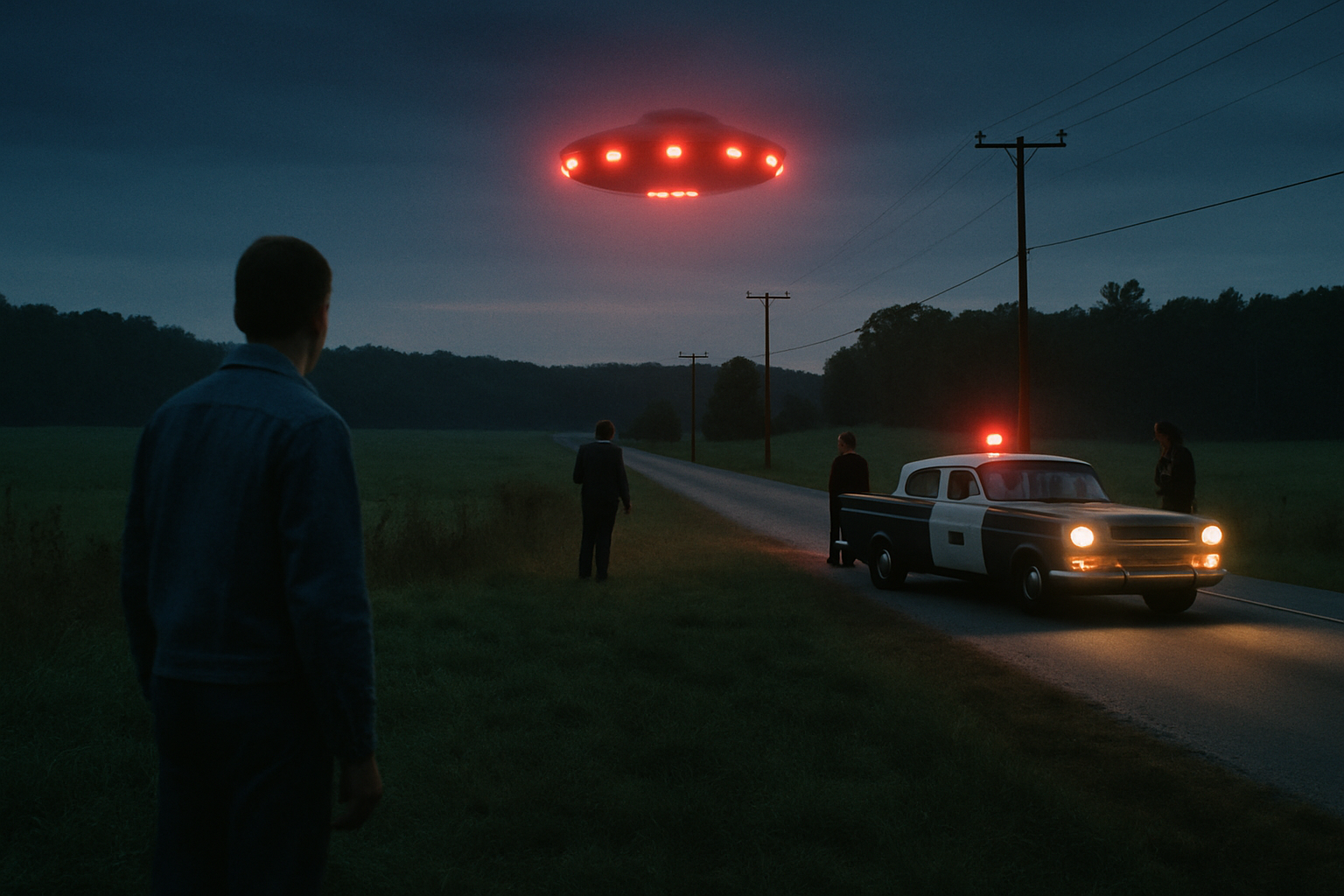
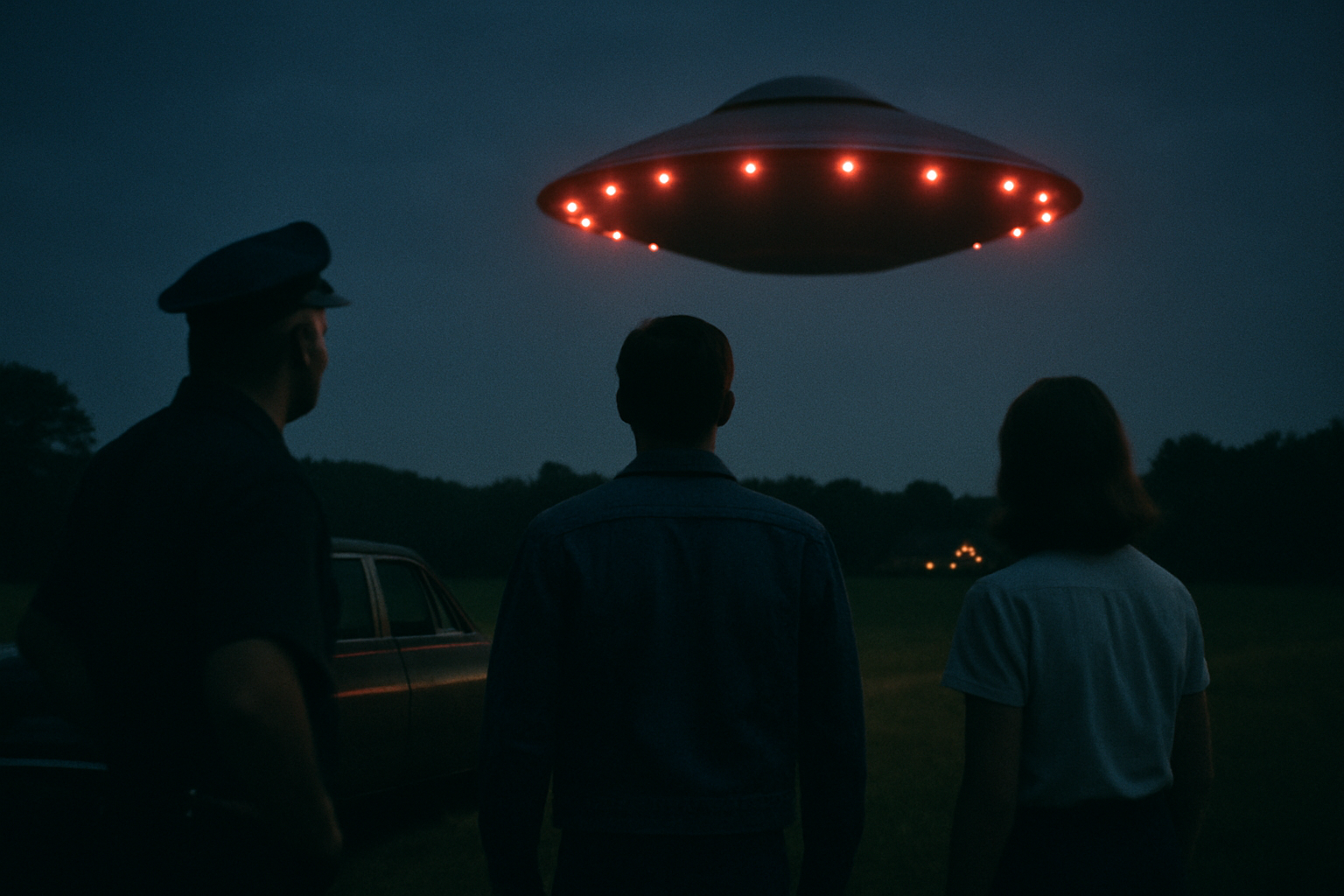
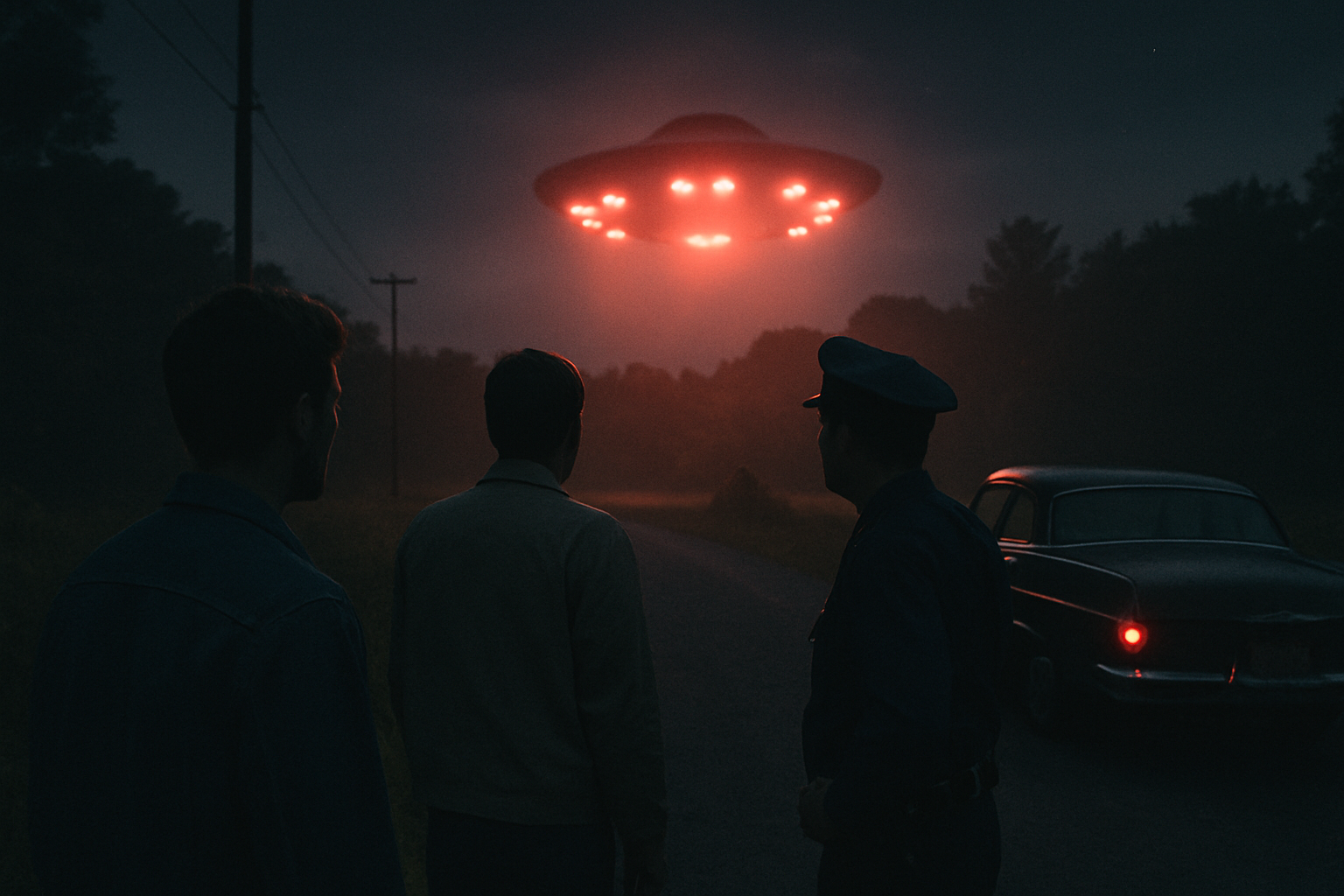
The Incident at Exeter was a series of widely publicized UFO sightings that occurred in the early morning of September 3, 1965, near the town of Kensington, New Hampshire, about five miles south of Exeter.[1][2] The first witness, 18-year-old Norman Muscarello, reported a large, silent object carrying a ring of pulsating red lights hovering at low altitude over open fields; two Exeter police officers who responded, Eugene Bertrand and David Hunt, said they too saw the object at close range.[1][2]
The case was investigated by the U.S. Air Force's Project Blue Book, which initially attributed the reports to a temperature inversion and to military aircraft operating nearby, but in January 1966 acknowledged that it had been unable to identify the object.[1] Journalist John G. Fuller documented the sightings in his 1966 bestseller *Incident at Exeter*, which made the case one of the most famous and best-documented UFO reports of the 1960s.[1] In 2011 skeptics Joe Nickell and James McGaha proposed that the witnesses had seen a KC-97 aerial-refueling aircraft, an explanation that supporters of the case dispute.[3][1]
Background
By 1965 the U.S. Air Force had been collecting and evaluating public reports of unidentified flying objects for nearly two decades, most recently through Project Blue Book, the service's investigative office based at Wright-Patterson Air Force Base in Ohio.[1] The Exeter area of southeastern New Hampshire lay near several active military installations, including Pease Air Force Base, and beneath airspace used for Strategic Air Command and NORAD operations.[1][3]
Norman Muscarello, the first witness, was an 18-year-old who had recently graduated from high school and was awaiting entry into the U.S. Navy.[2] On the night of the sighting he was hitchhiking home toward Exeter along Route 150 after visiting his girlfriend in Amesbury, Massachusetts.[1]
The sighting
Shortly before 2:00 a.m. on September 3, 1965, Muscarello reported that a brightly lit object rose from behind nearby trees and moved toward him, illuminating two houses and a field with intense red light.[1] He described an object ringed with five pulsating red lights that flashed in sequence, estimated it to be very large, and said it made no sound; frightened, he dove into a roadside ditch before running to a farmhouse for help.[1][2]
Unable to rouse help quickly, Muscarello flagged down a passing car and was driven to the Exeter police station, where night-desk officer Reginald Toland took his report.[1] Patrolman Eugene Bertrand, who earlier that night had encountered a motorist frightened by a similar object, drove Muscarello back to the field.[1] There Bertrand reported seeing a large, dark object with brilliant pulsating red lights rise from behind the trees; a second officer, David Hunt, arrived and also observed it.[1] The officers said the lights flashed in a rapid sequence and that the object moved silently, with no wings, tail, or sound of engines.[1] All three principal witnesses subsequently filed written reports.[1]
Investigation and official response
Project Blue Book personnel interviewed the witnesses, and the initial investigating officer wrote that he had been "unable to arrive at a probable cause of this sighting," describing the observers, especially the two patrolmen, as "stable, reliable persons."[1][4] Despite this, Air Force spokesmen publicly suggested the witnesses had seen stars and planets distorted by a temperature inversion, and Blue Book linked the reports to "Operation Big Blast," a Strategic Air Command/NORAD training exercise, noting that B-47 aircraft had been operating in the area.[1][2]
Bertrand and Hunt objected strongly. In a December 1965 letter to Blue Book they insisted the object "was not any type of conventional aircraft," that it was "absolutely silent" with no rush of air, and that it had no wings or tail; they also pointed out that their sighting had occurred well after the training exercise had ended.[1] In January 1966 the Air Force, in a letter signed by an officer of Project Blue Book, acknowledged that it had been "unable to identify the object" the witnesses observed on September 3, 1965, leaving the case officially classified as unidentified.[1]
Explanations and disputes
The Exeter sightings have been the subject of competing explanations. The Air Force's early appeal to a temperature inversion and to nearby military aircraft was rejected by the police witnesses and by later researchers, in part because the close-range, silent, low-altitude object they described did not match high-altitude bombers, and because the timing did not align with the cited exercise.[1]
In 2011, writing in *Skeptical Inquirer*, investigator Joe Nickell and retired Air Force major James McGaha argued that the five sequencing red lights matched the underside lighting of a KC-97 aerial-refueling tanker engaged in nighttime operations, with the inclined refueling boom accounting for the object's apparent shape and "floating leaf" motion.[3][1] Supporters of the case counter that experienced observers watched the object at close range for an extended period and that no routine aircraft was conclusively shown to be present, so the explanation remains contested.[1]
Aftermath and significance
Journalist John G. Fuller, then a columnist for *Saturday Review*, investigated the sightings, interviewed area residents, and published *Incident at Exeter* in 1966; the book became a bestseller and remains a primary narrative account of the case.[1] Because it featured multiple credible witnesses, including two police officers, and ended with an official Air Force concession that the object could not be identified, the case became a frequently cited example in UFO literature.[1]
The sighting later became a point of local civic pride. Beginning in 2010, the Exeter Area Kiwanis Club has organized an annual Exeter UFO Festival as a fundraiser for children's charities, drawing researchers and visitors and commemorating the 1965 events; the 2015 edition marked the fiftieth anniversary of the incident.[1][2] The incident continues to be referenced in discussions of the best-documented mid-1960s UFO reports.[1]
Key quotes
“"At this time I have been unable to arrive at a probable cause of this sighting. The three observers seem to be stable, reliable persons, especially the two patrolmen."
“The Air Force acknowledged it had been "unable to identify the object" the witnesses observed on September 3, 1965.
References
- 1.
- 2.
- 3.
- 4.
Similar cases
Scored on agency / year proximity / region / tag overlap — same agency +3, near year +4, same region +2, shared tag ×2.