Gorman Dogfight (1948)
Illustrations
AI-generated illustration — not actual footage or evidence; an interpretive depiction based on the documented account
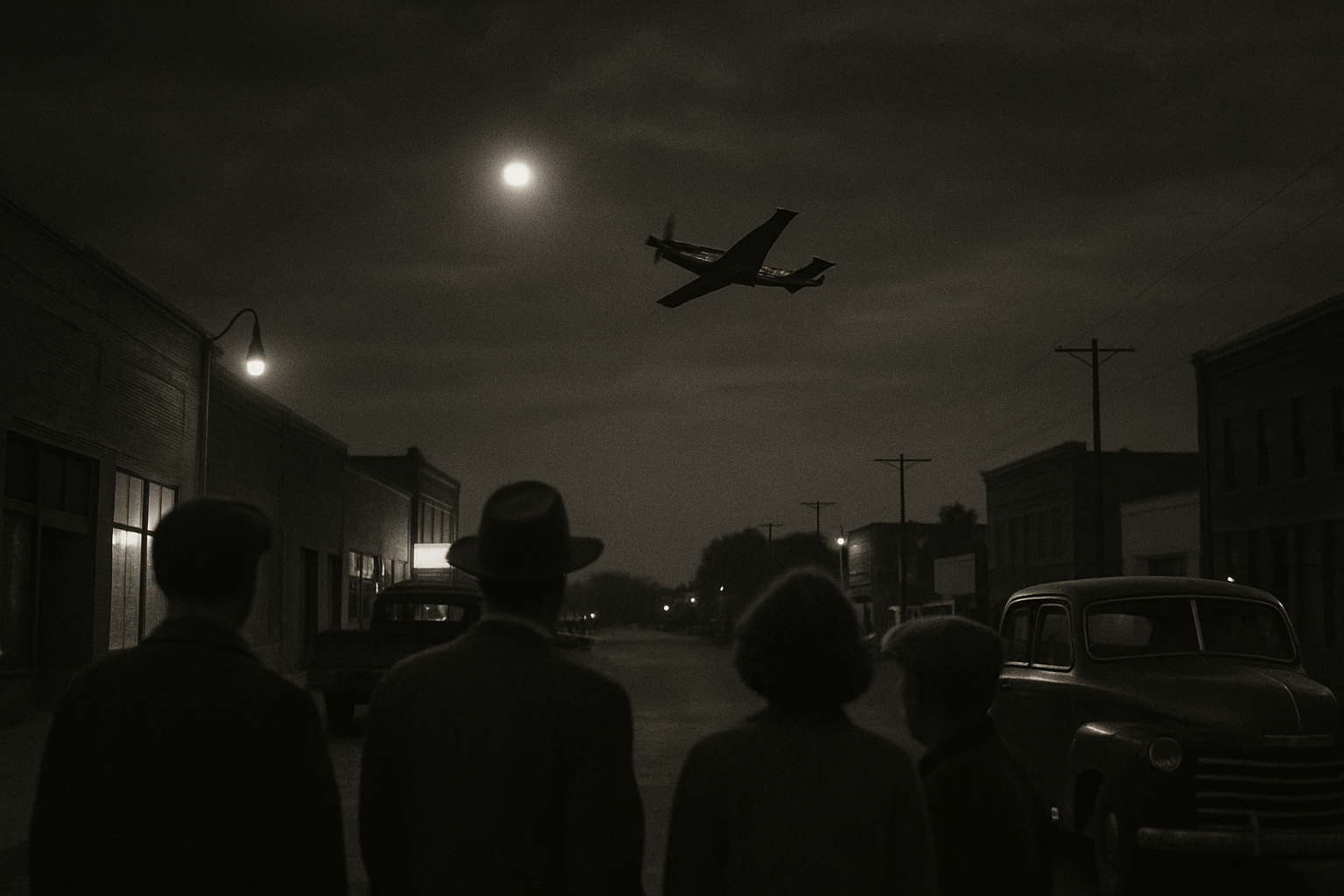
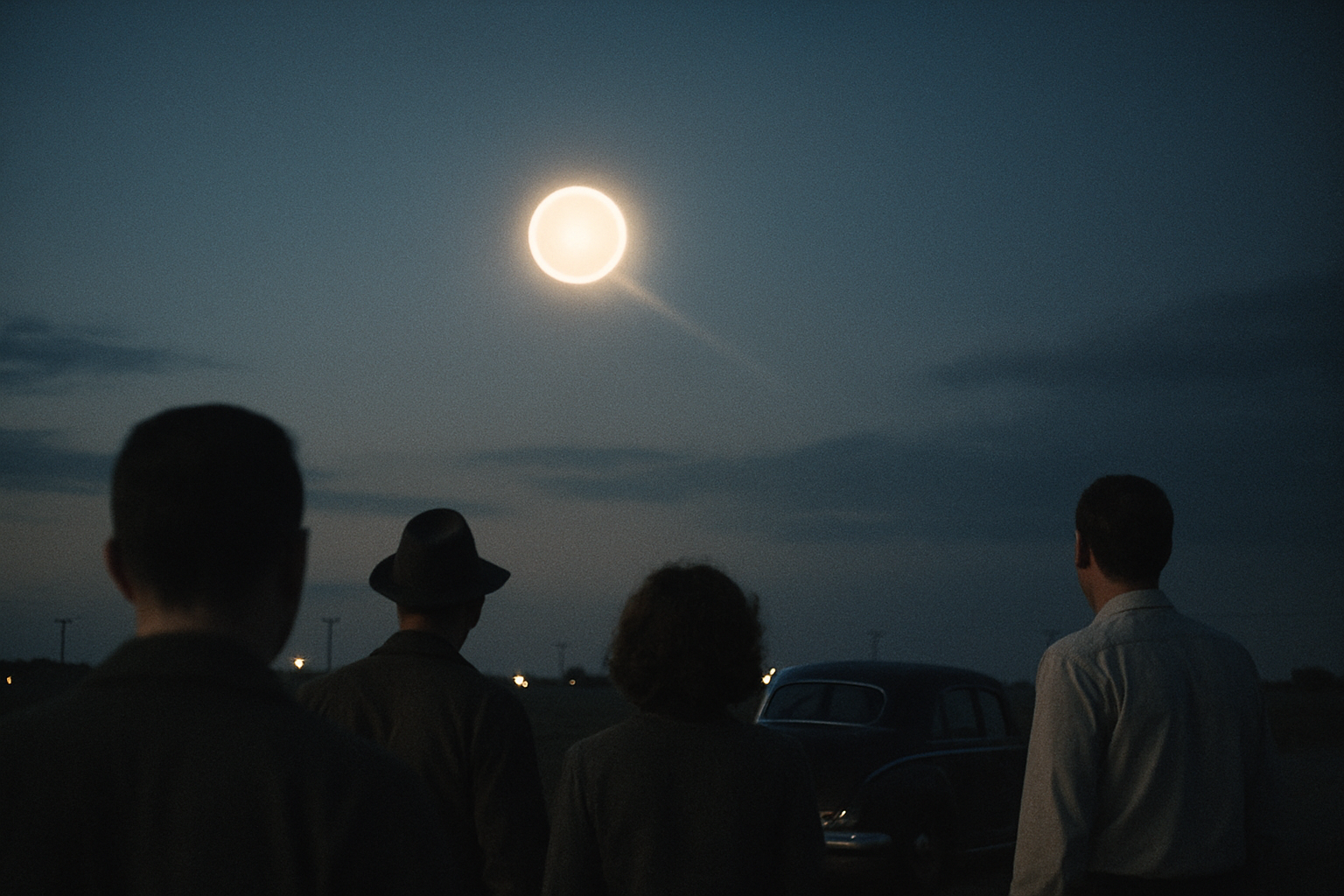
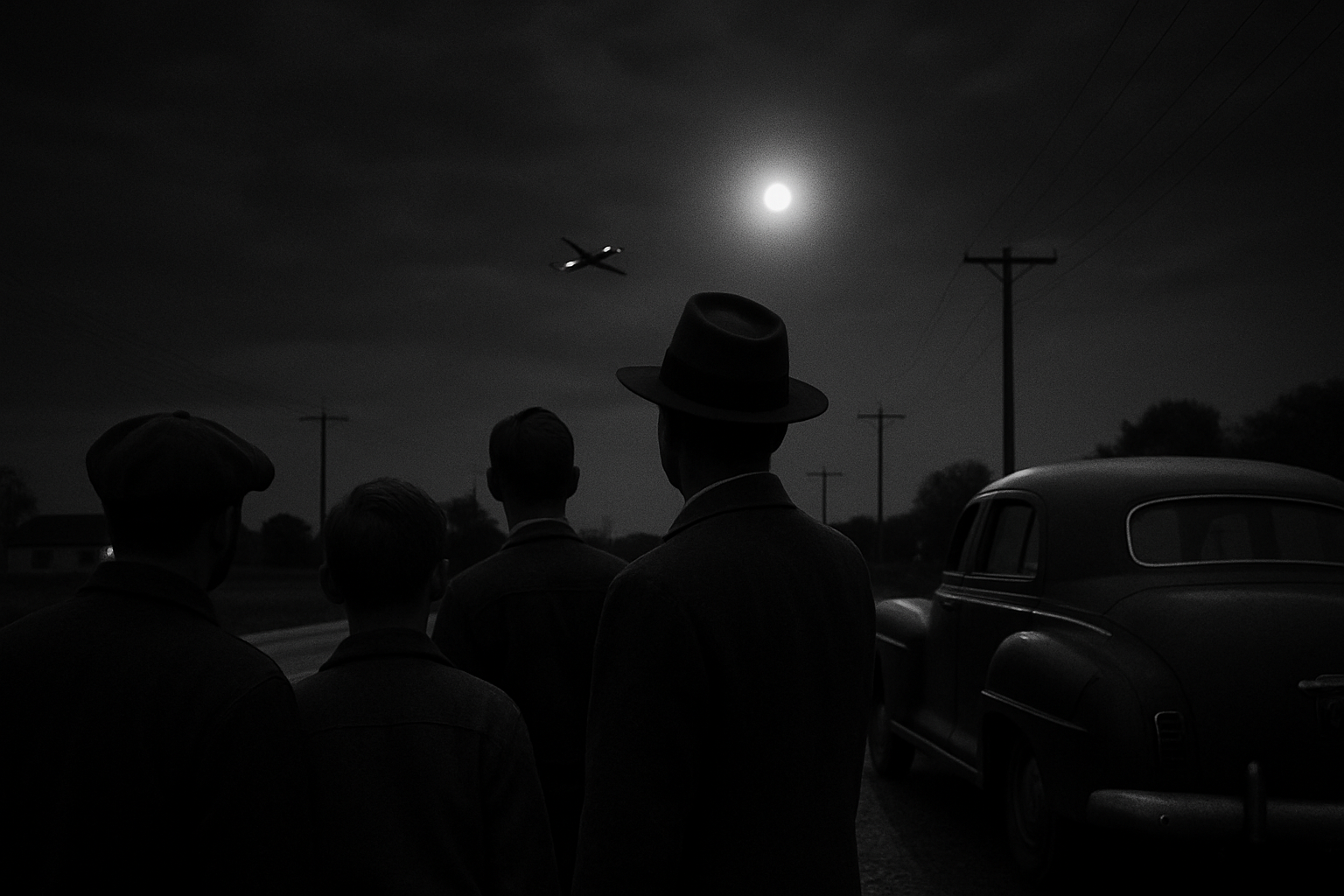
The Gorman dogfight was an aerial encounter with an unidentified flying object reported on the night of 1 October 1948 over Fargo, North Dakota.[1] Second Lieutenant George F. Gorman, a 25-year-old pilot of the North Dakota Air National Guard, was flying a P-51 Mustang when he observed a small, bright ball of light and pursued it for about 27 minutes, describing a series of climbs, dives and head-on passes that he could not match.[2] The case was investigated by the U.S. Air Force's Project Sign and ultimately attributed to a misidentified lighted weather balloon, possibly compounded by the bright planet Jupiter.[1] Together with the Mantell incident and the Chiles–Whitted encounter, it was regarded by Air Force officers such as Captain Edward J. Ruppelt as one of the "classic" UFO reports of 1948.[3]
Background
On the evening of 1 October 1948, George F. Gorman, a second lieutenant in the North Dakota Air National Guard and a former World War II fighter instructor, was returning from a cross-country flight with other Guard airmen.[2] While the other pilots landed at Fargo's Hector Airport, Gorman remained aloft in his P-51 Mustang to log additional night-flying time under clear, cloudless skies.[2]
The sky over Fargo was not empty. A Piper Cub light aircraft piloted by Dr. A.E. Cannon, carrying a passenger, was also airborne, and the Hector Airport control tower was staffed.[1] These additional observers would later become part of the record, because several of them reported seeing the same light that Gorman pursued.[2]
The encounter
At about 9:00 p.m., while flying near a lighted high-school football stadium, Gorman noticed what he took to be the taillight of another aircraft.[1] On checking with the tower he was told that the only other traffic was Cannon's Piper Cub, which Gorman could see well below him; the blinking light was something else.[2]
Gorman described the object as a "ball of light" roughly six to eight inches in diameter, with no discernible body around it.[1] He turned toward it and a prolonged series of maneuvers followed:
- He closed to within about 1,000 yards, whereupon the light became steady and pulled into a sharp left bank.[2]
- The object made head-on passes, on one occasion coming straight at him before breaking away only a few hundred feet from his canopy.[2]
- It out-turned and out-climbed his Mustang, at one point shooting up so steeply that Gorman's aircraft stalled at about 14,000 feet while attempting to follow.[2]
The pursuit lasted roughly 27 minutes before the light climbed away to the northwest and was lost from view.[1] In a sworn statement Gorman said he was "convinced that there was definite thought behind its maneuvers," and he told others, "I've never seen anything like it. If anyone else had reported such a thing I would have thought they were crazy."[2]
The object was not seen by Gorman alone. Tower controllers Lloyd D. Jensen and H.E. Johnson, as well as Cannon and his passenger, reported seeing a light moving at high speed, with Cannon describing it as travelling much faster than the P-51.[2]
Investigation and official response
The encounter became one of the cornerstone cases of Project Sign, the U.S. Air Force's first formal UFO study, and investigators traveled to Fargo to examine Gorman's aircraft and interview witnesses.[1]
A Geiger-counter survey of the Mustang reportedly showed it to be more radioactive than aircraft that had remained on the ground, a finding that briefly fed speculation about an "atomic-powered" object.[1] Investigators subsequently concluded that the reading was an artifact of high-altitude flight—aircraft flown at altitude receive less atmospheric shielding from cosmic radiation—and not evidence of anything unusual about the light.[1]
The Air Weather Service reported that a lighted weather balloon had been released over Fargo at about 8:50 p.m. that evening, roughly ten minutes before Gorman's sighting began.[2] Project Sign's analysts argued that Gorman had mistaken this slow-moving, illuminated balloon for an intelligently controlled craft, and that the dramatic "maneuvers" were optical illusions produced by the motion of his own fast-moving fighter against the apparently stationary light.[1] They further suggested that, in the later phase of the chase, Gorman may have confused the bright planet Jupiter for the object.[1] On this basis the case was officially classified as a misidentification.
Explanations and disputes
The official lighted-balloon explanation has been both defended and rejected, and the case remains contested in UFO literature.
- Supporting the conventional view: The 1969 *Condon Report* listed the incident among cases regarded as adequately explained, and UFO historian Jerome Clark later described it as "the most overrated UFO report in the early history of the phenomenon," considering the balloon explanation plausible.[4][5]
- Rejecting it: Atmospheric physicist James E. McDonald and writer Donald Keyhoe disputed the conclusion, arguing that a passive balloon could not account for the speeds, turns and head-on passes that Gorman and other witnesses described.[1]
- Gorman's own view: According to later accounts, Gorman told friends that he was never convinced he had spent 27 minutes dueling with a lighted balloon.[6]
Skeptical analysts note that an isolated point of light at night is notoriously difficult to judge for size, distance and motion, and that a pilot's own banking and diving can make a fixed light appear to weave and dart—an effect consistent with the optical-illusion argument.[1]
Aftermath and significance
Although the Air Force regarded the case as solved, the Gorman dogfight had an outsized influence on early official thinking about UFOs. Captain Edward J. Ruppelt, later head of Project Blue Book, wrote that the Gorman case—alongside the Mantell incident and the Chiles–Whitted encounter—was one of the 1948 reports that persuaded some Air Force intelligence specialists that UFOs might be real, an assessment reflected in Project Sign's now-famous (and later rejected) "Estimate of the Situation."[3]
The incident has remained a fixture of UFO histories and popular media. The 2019 History Channel dramatic series *Project Blue Book* loosely based its pilot episode, titled "The Fuller Dogfight," on the Gorman encounter.[1] Whether judged a textbook case of misperception or an unresolved sighting, the dogfight endures as one of the most frequently cited military-pilot UFO reports of the immediate post-war era.[4]
Key quotes
“"I am convinced that there was definite thought behind its maneuvers." — 2nd Lt. George F. Gorman, in his sworn statement
“"I've never seen anything like it. If anyone else had reported such a thing I would have thought they were crazy." — George F. Gorman
References
- 1.
- 2.
- 3.
- 4.
- 5.
- 6.
Similar cases
Scored on agency / year proximity / region / tag overlap — same agency +3, near year +4, same region +2, shared tag ×2.