Maury Island incident
Illustrations
AI-generated illustration — not actual footage or evidence; an interpretive depiction based on the documented account
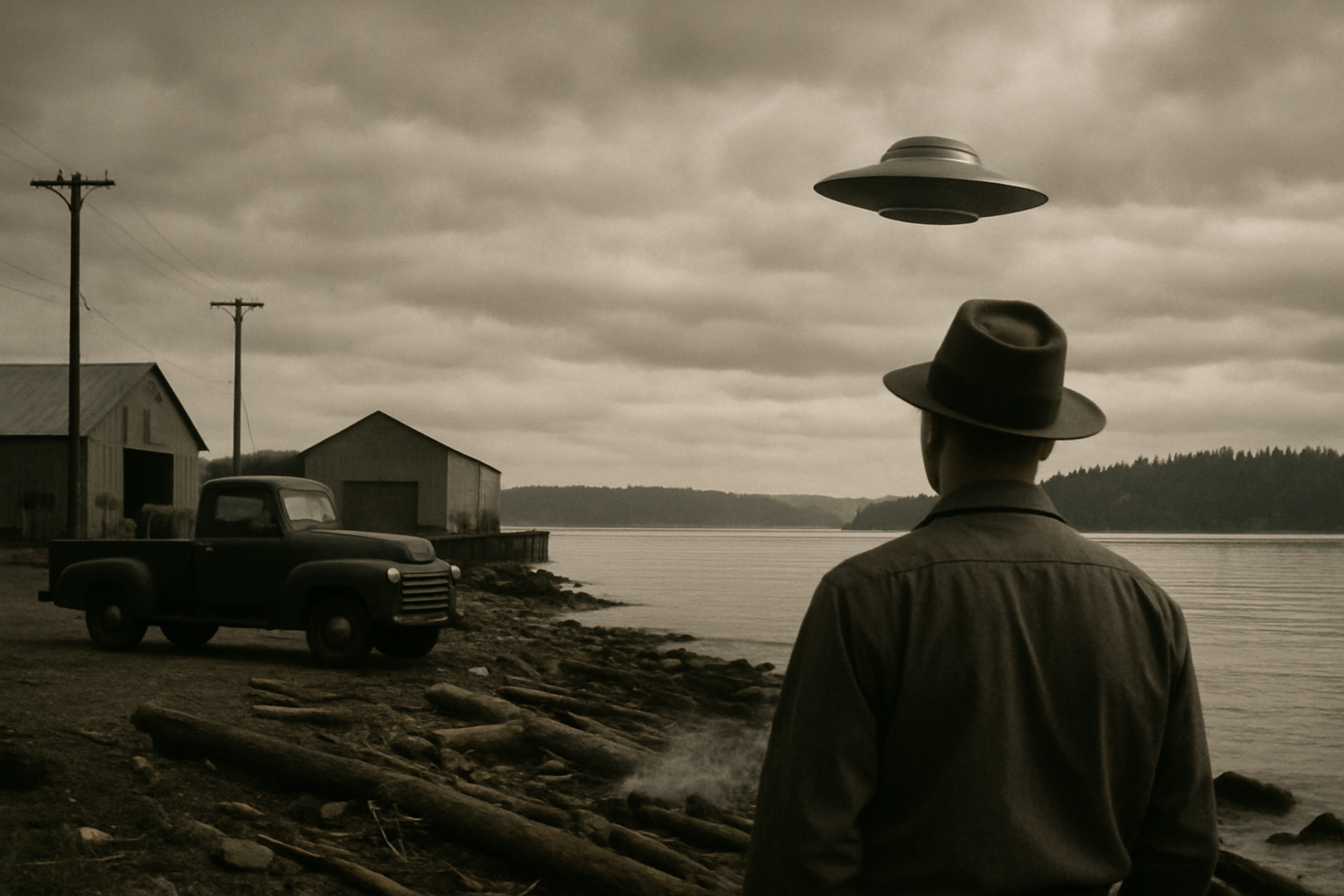
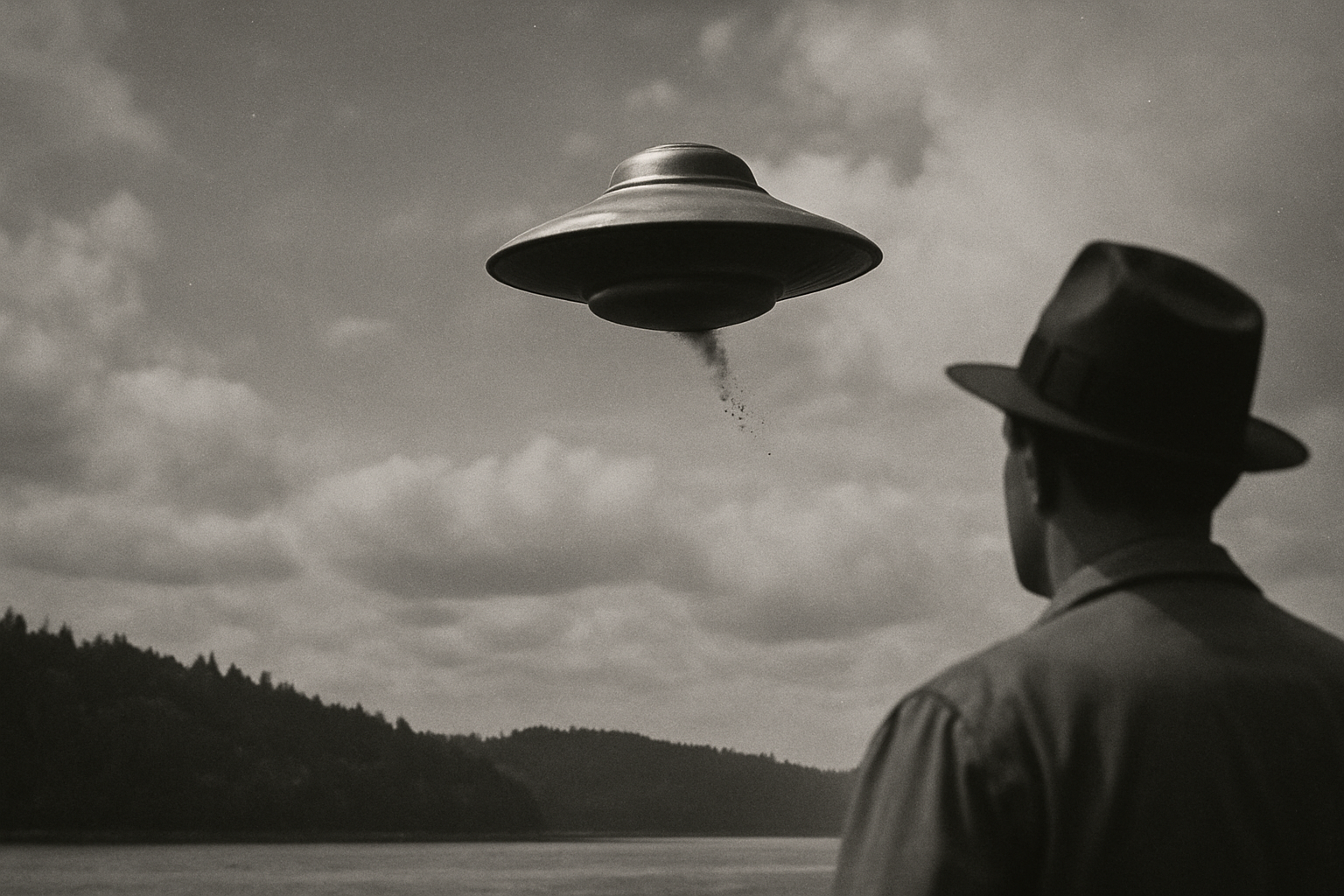
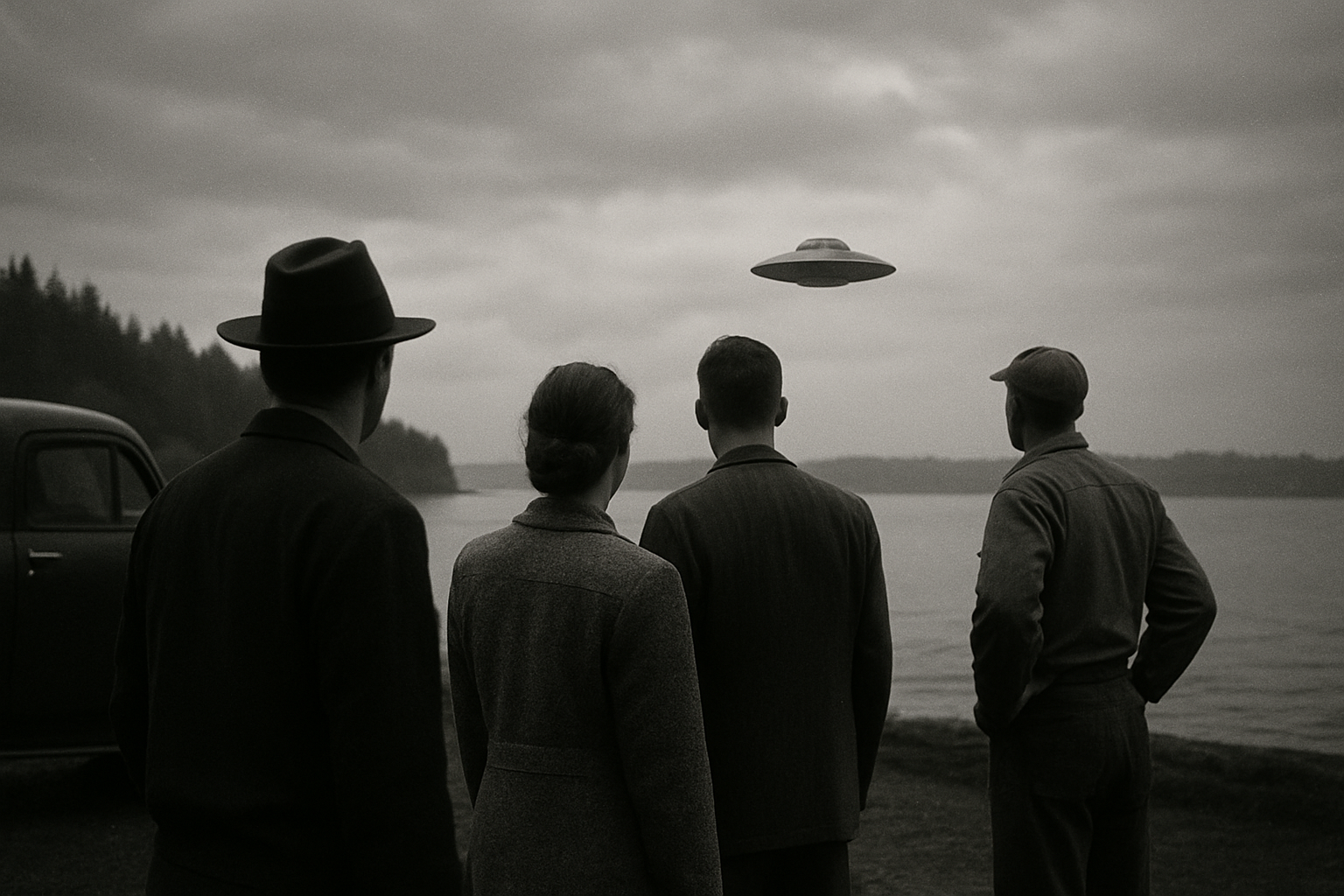
The Maury Island incident refers to claims made by Tacoma harbor patrolman Harold A. Dahl that on 21 June 1947 he witnessed six doughnut-shaped flying objects over Puget Sound near Maury Island, Washington, one of which rained down metallic fragments and slag-like debris onto his boat.[1][2] The episode is significant chiefly because it unfolded only days before pilot Kenneth Arnold's far more famous sighting of 24 June 1947, and because two U.S. Army Air Forces intelligence officers sent to investigate were killed when their B-25 bomber crashed near Kelso, Washington, on 1 August 1947.[1][3] After investigation, both the FBI and the Army Air Forces concluded that the affair was a hoax; Project Blue Book chief Edward J. Ruppelt later called it "the dirtiest hoax in UFO history."[1]
Background
In the summer of 1947 the United States experienced a wave of "flying saucer" reports. The term entered popular use after private pilot Kenneth Arnold described seeing nine fast-moving objects near Mount Rainier on 24 June 1947, a report that drew national attention.[3][1]
The Maury Island claims were said to predate Arnold's sighting by three days but only became public afterward. The two central figures were:
- Harold A. Dahl, who said he operated a harbor patrol boat salvaging logs in Puget Sound.[2]
- Fred L. Crisman, described as Dahl's partner in a log-retrieval arrangement connected to the Port of Tacoma, who said he visited the site the following day.[3][2]
Because Crisman had previously corresponded with Raymond A. Palmer, the Chicago editor of the science-fiction magazine *Amazing Stories* (and later founder of *Fate*), the story reached a publisher already interested in saucer reports.[1][3]
The claimed encounter
According to Dahl's account, on 21 June 1947 he was aboard a patrol boat with two crewmen, his teenage son, and the family dog near the eastern shore of Maury Island when he observed six large doughnut-shaped objects in the sky.[1][2] He estimated the craft to be roughly 100 feet across, hovering some 2,000 feet overhead, with one descending toward the water.[2]
Dahl said the lowered object began "spewing forth what seemed like thousands of newspapers" of a light, white metal, together with a large quantity of darker, lava-like or slag-like material that fell onto the boat and beach.[1][2] He claimed the debris:
Dahl further stated that the next morning he was approached by a man in a dark suit who warned him not to discuss what he had seen — an element that later commentators connected to the popular "men in black" motif in UFO folklore.[1] Crisman said he subsequently visited the site and collected fragments of the fallen material.[3]
Investigation and the B-25 crash
Palmer paid Kenneth Arnold to look into the reports, and Arnold travelled to Tacoma in late July 1947 to interview Dahl and Crisman.[1][3] Finding the matter beyond his expertise, Arnold contacted Army Air Forces intelligence, and two officers from the Fourth Air Force at Hamilton Field, California — First Lieutenant Frank M. Brown and Captain William L. Davidson — came to Tacoma to conduct interviews and collect samples.[1][2]
In the early hours of 1 August 1947, Brown and Davidson departed McChord Field in a B-25 Mitchell bomber bound for California. The aircraft caught fire and crashed near Kelso, Washington, killing both officers; the crew members who bailed out survived.[1][3] The deaths of two investigators so soon after the sighting fuelled rumours of a cover-up and intensified press interest in the case.[3]
Explanations and disputes
Both the FBI and the Army Air Forces investigated and concluded the affair was a hoax.[1][3] Key findings included:
- The "debris" was industrial slag. Investigators identified the recovered material as ordinary slag from a metal smelter rather than fragments of an aircraft.[2]
- The damage descriptions did not match the physical evidence.[2]
- A profit motive. FBI files indicated that Dahl and Crisman had approached media outlets "in the hope of building up their story through publicity to a point where they could make a profitable deal," tying the report to Palmer's magazine venture.[1][3]
- A retraction. Bureau records stated that Dahl was prepared to "say it was a hoax because he did not want any further trouble over the matter."[1]
Government officials reportedly considered prosecuting the men but decided the episode amounted to "a harmless joke that had mushroomed," and did not treat the officers' deaths as a direct result of the deception.[1] Even so, the case was never fully closed in popular accounts: Crisman maintained in a January 1950 issue of *Fate* magazine that the events had really happened, and Arnold included Maury Island in his 1952 book *The Coming of the Saucers*.[1] A later Washington State Senate resolution noted that the FBI had concluded Dahl never truly recanted his story.[1]
Aftermath and significance
Although the Maury Island incident was officially dismissed as a hoax, it occupies an early and influential place in UFO history.[1] Edward J. Ruppelt, who led the U.S. Air Force's Project Blue Book, characterised it as "the dirtiest hoax in UFO history."[1]
The case is frequently cited for two reasons:
- The "men in black" connection. Dahl's account of a dark-suited visitor warning him to stay silent is regarded as an early antecedent of the men-in-black theme later popularised in Gray Barker's 1956 book on the subject.[1]
- Conspiracy speculation. The fatal B-25 crash, occurring days after the sighting, became a recurring element in later conspiracy narratives despite the official ruling.[1][3]
The story remains a fixture of local heritage around Vashon and Maury Islands and Des Moines, Washington, where its anniversary has been marked with community events.[1][3]
Key quotes
“"The dirtiest hoax in UFO history." — Project Blue Book chief Edward J. Ruppelt, on the incident
“Dahl said the object began "spewing forth what seemed like thousands of newspapers" of light white metal.
References
- 1.
- 2.
- 3.
Similar cases
Scored on agency / year proximity / region / tag overlap — same agency +3, near year +4, same region +2, shared tag ×2.