The Roswell Incident (1947)
Illustrations
AI-generated illustration — not actual footage or evidence; an interpretive depiction based on the documented account
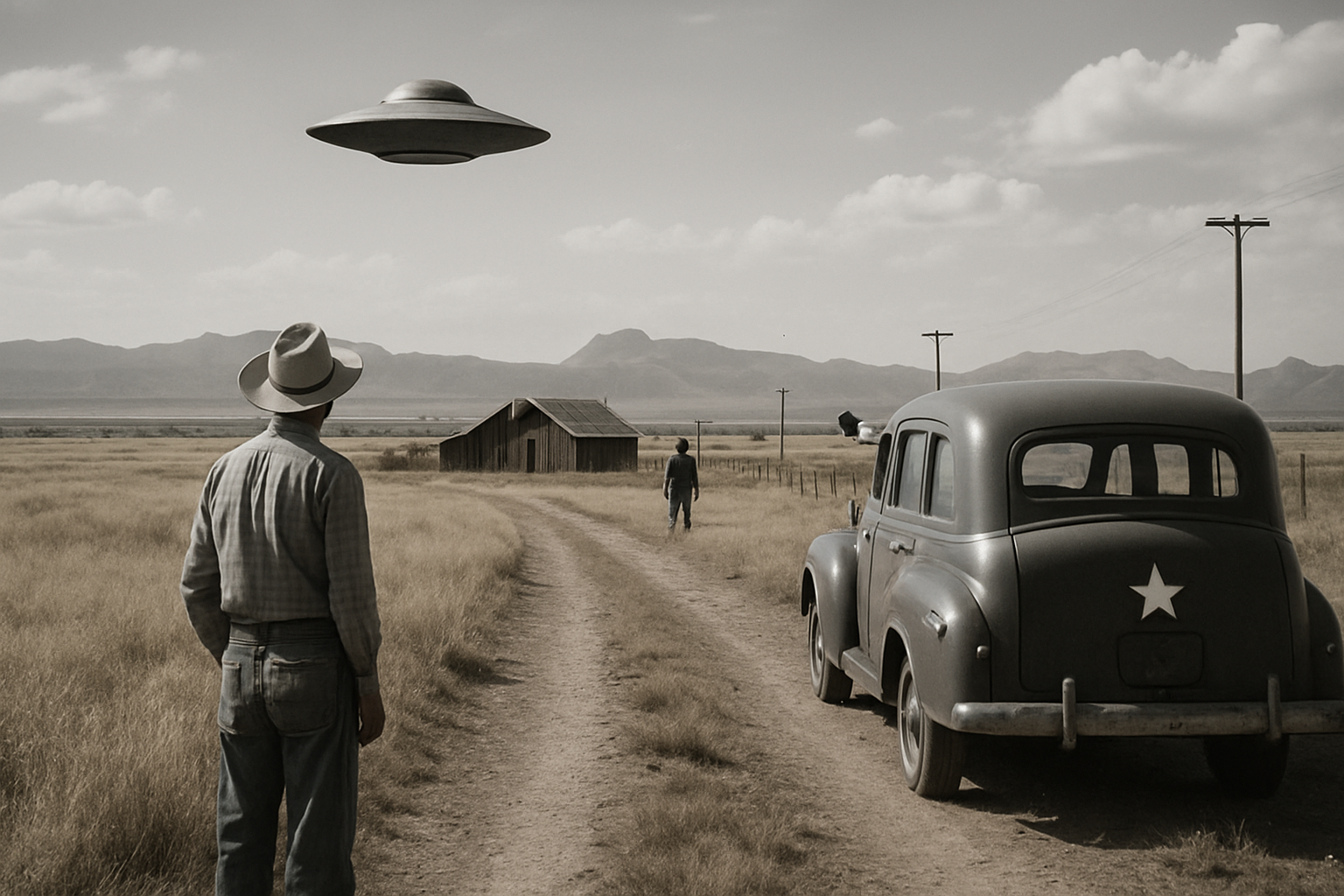
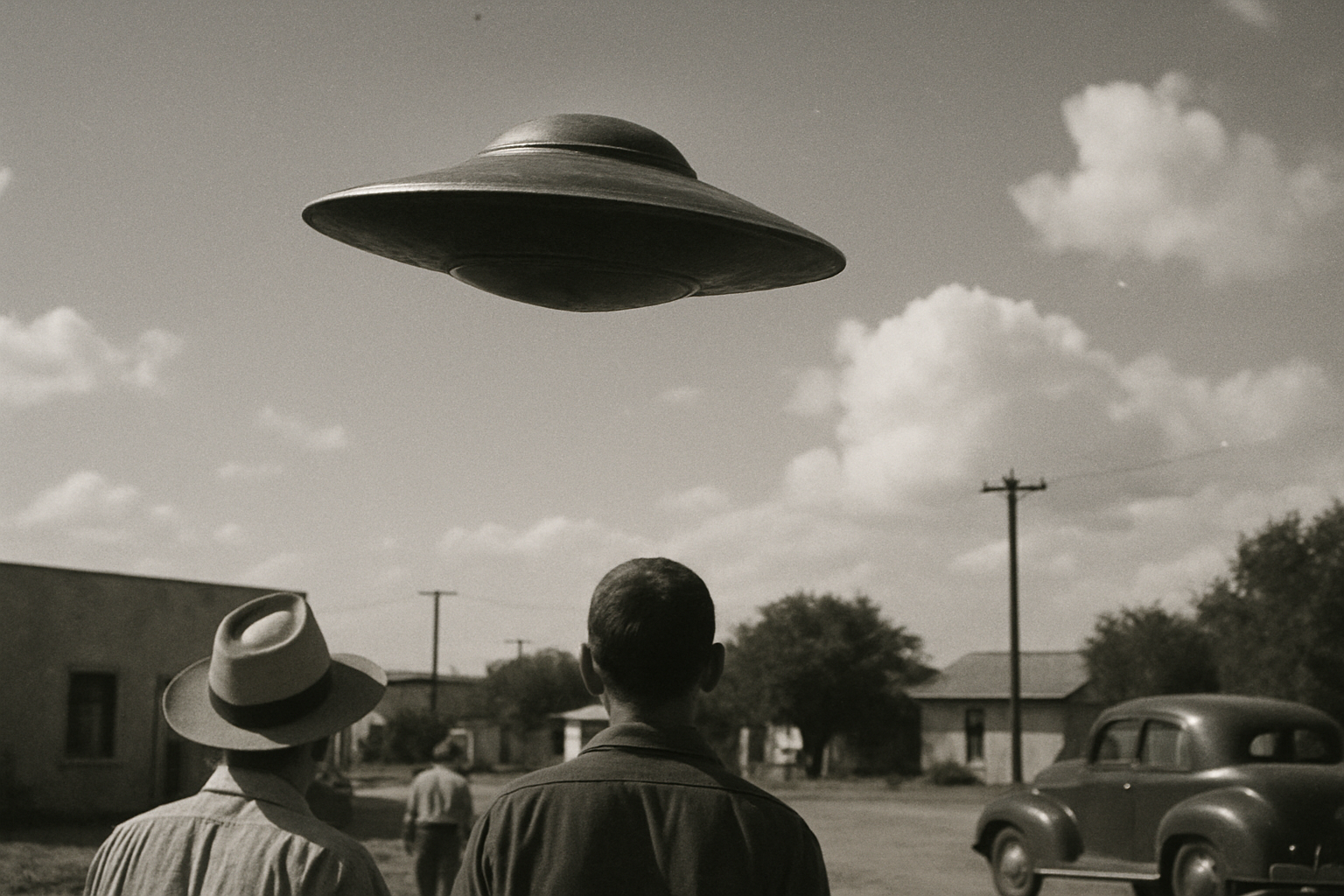
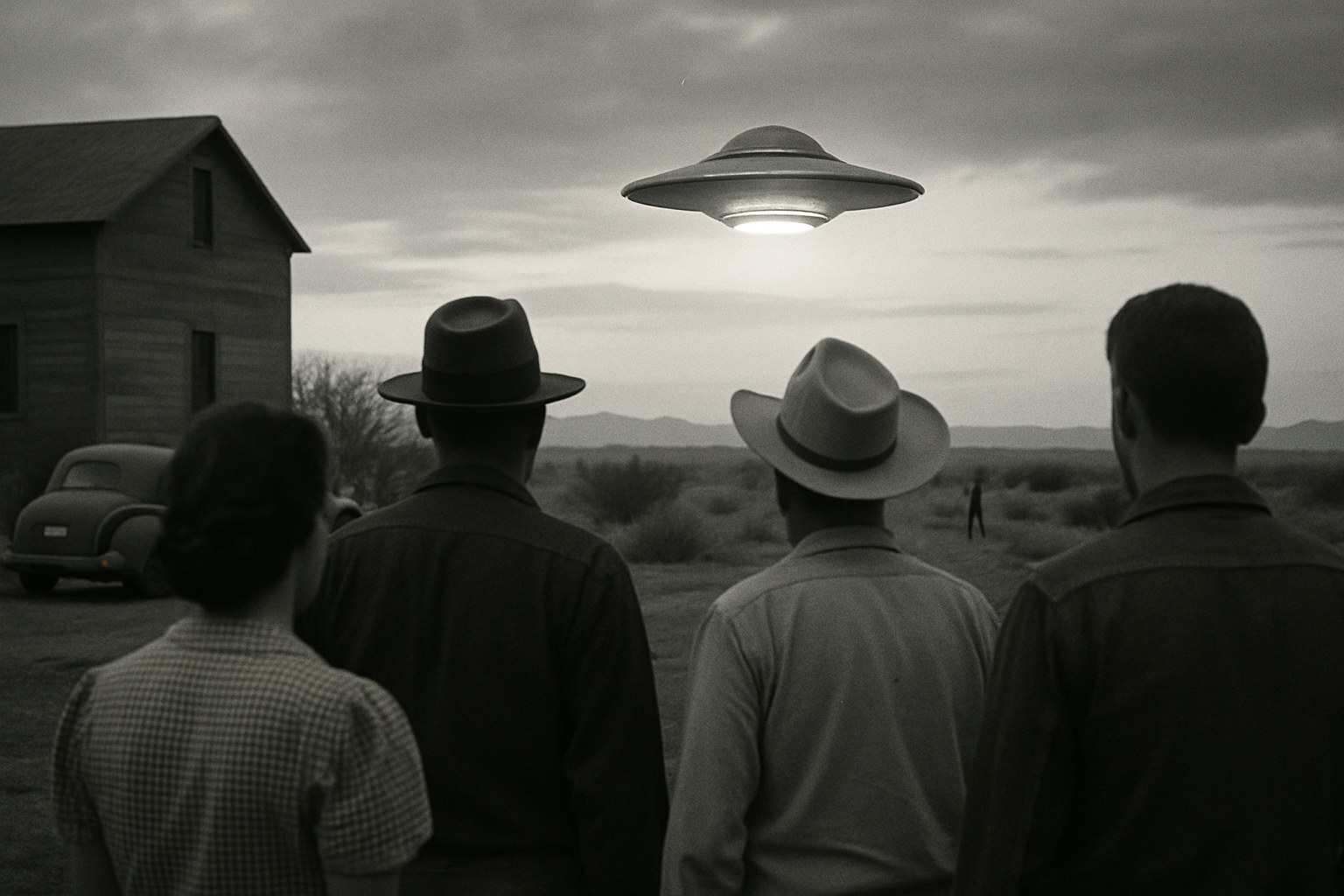
The Roswell incident refers to the July 1947 recovery of unusual debris on a ranch near Corona, New Mexico. On 8 July 1947 the Roswell Army Air Field (RAAF) publicly announced that its 509th Bomb Group had recovered a "flying disc"; within hours the U.S. Army Air Forces retracted the claim and identified the material as a weather balloon and radar reflector.[1] The story went dormant for roughly thirty years before re-emerging in the late 1970s to become the most famous UFO case in the world. Two U.S. Air Force reports in the 1990s attributed the debris to a then-classified Project Mogul balloon train, and the later "alien bodies" accounts to 1950s high-altitude dummy drops.[2][3]
Timeline
- 8 July 1947 — RAAF issues a press release announcing recovery of a "flying disc" near Roswell.[1]
- Hours later — the Eighth Air Force at Fort Worth revises the account to a weather balloon and radar reflector and shows the debris to the press.
- 9 July 1947 — national newspapers print the correction; public interest fades and the case stays dormant for about three decades.
- Late 1970s — later witness interviews revive the story and seed the modern Roswell mythology.
Evolution of the official account
The 1994–1995 U.S. Air Force study The Roswell Report: Fact vs. Fiction in the New Mexico Desert identified the 1947 debris as wreckage from Project Mogul, a classified programme of high-altitude balloon trains designed to detect Soviet nuclear tests by acoustic means.[2] Because Mogul was secret, the recovering personnel could not readily identify what they had found. A 1997 follow-up, The Roswell Report: Case Closed, addressed the later "alien bodies" narratives, suggesting some accounts conflated memories of 1950s anthropomorphic dummy drops used in high-altitude parachute research.[3] A 1995 U.S. Government Accountability Office search of federal records found no evidence of a recovered extraterrestrial craft.[4]
Open questions
- Chronology mismatch — the dummy-drop programme largely ran in the 1950s, years after 1947, complicating its use to explain the original "bodies" claims.
- Testimony reliability — many influential accounts are recollections recorded decades later, vulnerable to memory contamination and cross-influence.
- The 24-hour reversal — why the first release said "flying disc" at all, and how quickly it was corrected, remains the crux that sustains public doubt.
Assessment
On the declassified record, Project Mogul is the best-supported explanation for the physical debris.[2] Roswell endures less because the evidence points to extraterrestrials than because the first official statement and its same-day correction contradict each other — a tension that makes every later explanation hard to settle completely. It is best read as a case study in how secrecy can manufacture an enduring myth.[5]
Key quotes
“"RAAF Captures Flying Saucer on Ranch in Roswell Region" — Roswell Daily Record headline, 8 July 1947
References
- 1.RAAF press release and Roswell Daily Record front page ("RAAF Captures Flying Saucer") — Roswell Daily Record · 1947-07-08News
- 2.The Roswell Report: Fact vs. Fiction in the New Mexico Desert — U.S. Air Force · 1995Govt report
- 3.The Roswell Report: Case Closed — U.S. Air Force · 1997Govt report
- 4.Government Records: Results of a Search for Records Concerning the 1947 Crash Near Roswell (GAO/NSIAD-95-187) — U.S. Government Accountability Office · 1995Govt report
- 5.
Similar cases
Scored on agency / year proximity / region / tag overlap — same agency +3, near year +4, same region +2, shared tag ×2.