Ghost Rockets (1946)
Illustrations
AI-generated illustration — not actual footage or evidence; an interpretive depiction based on the documented account
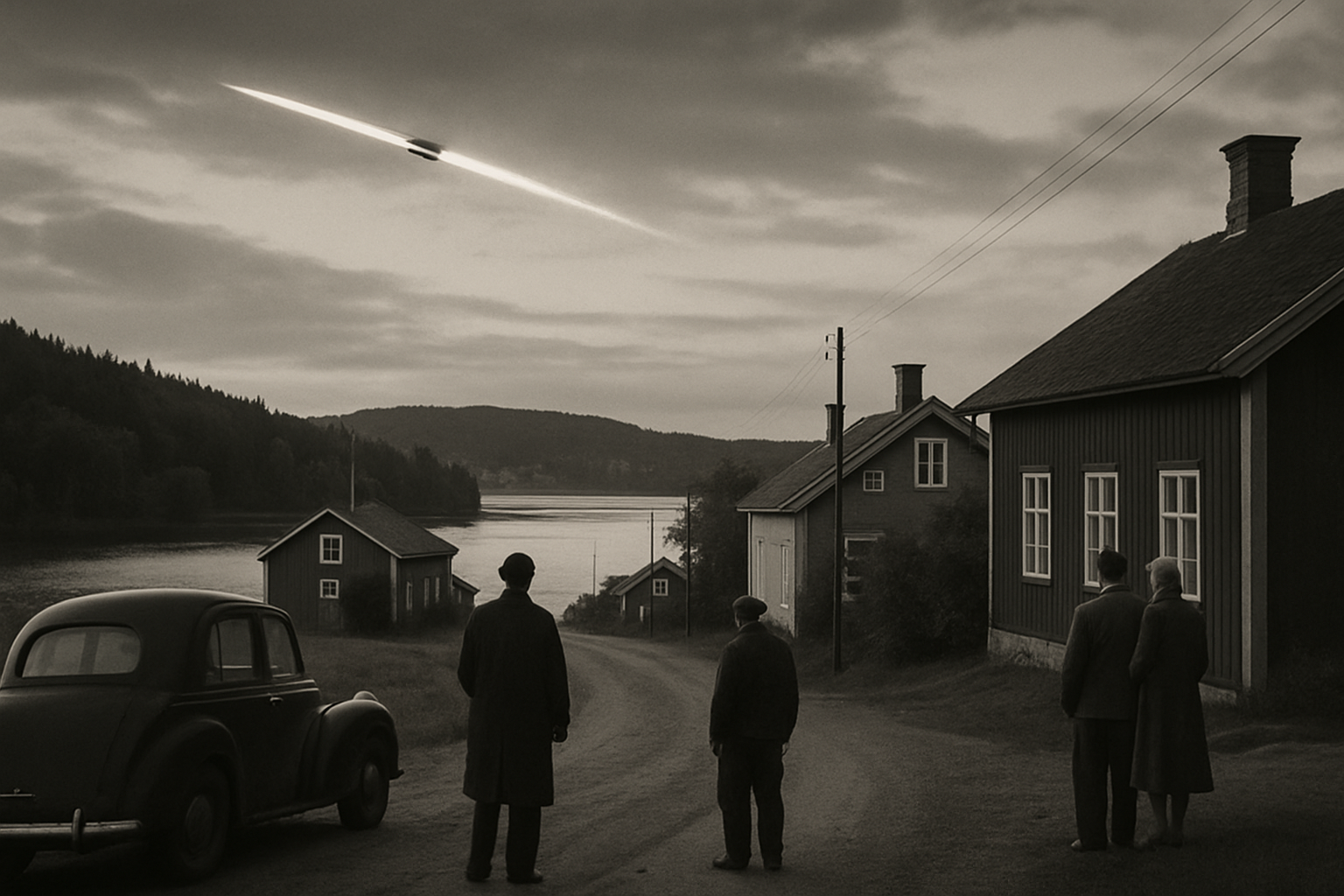
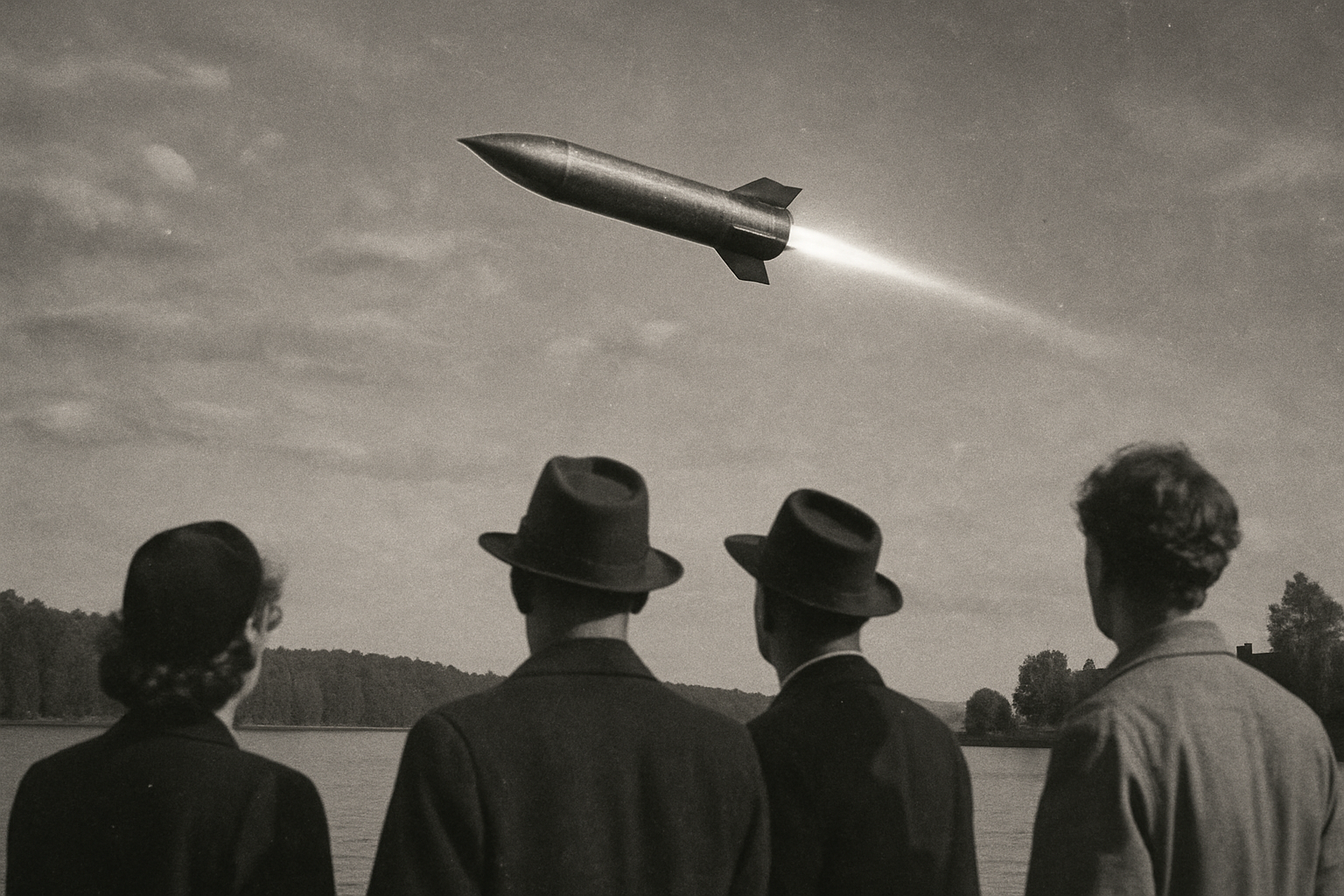
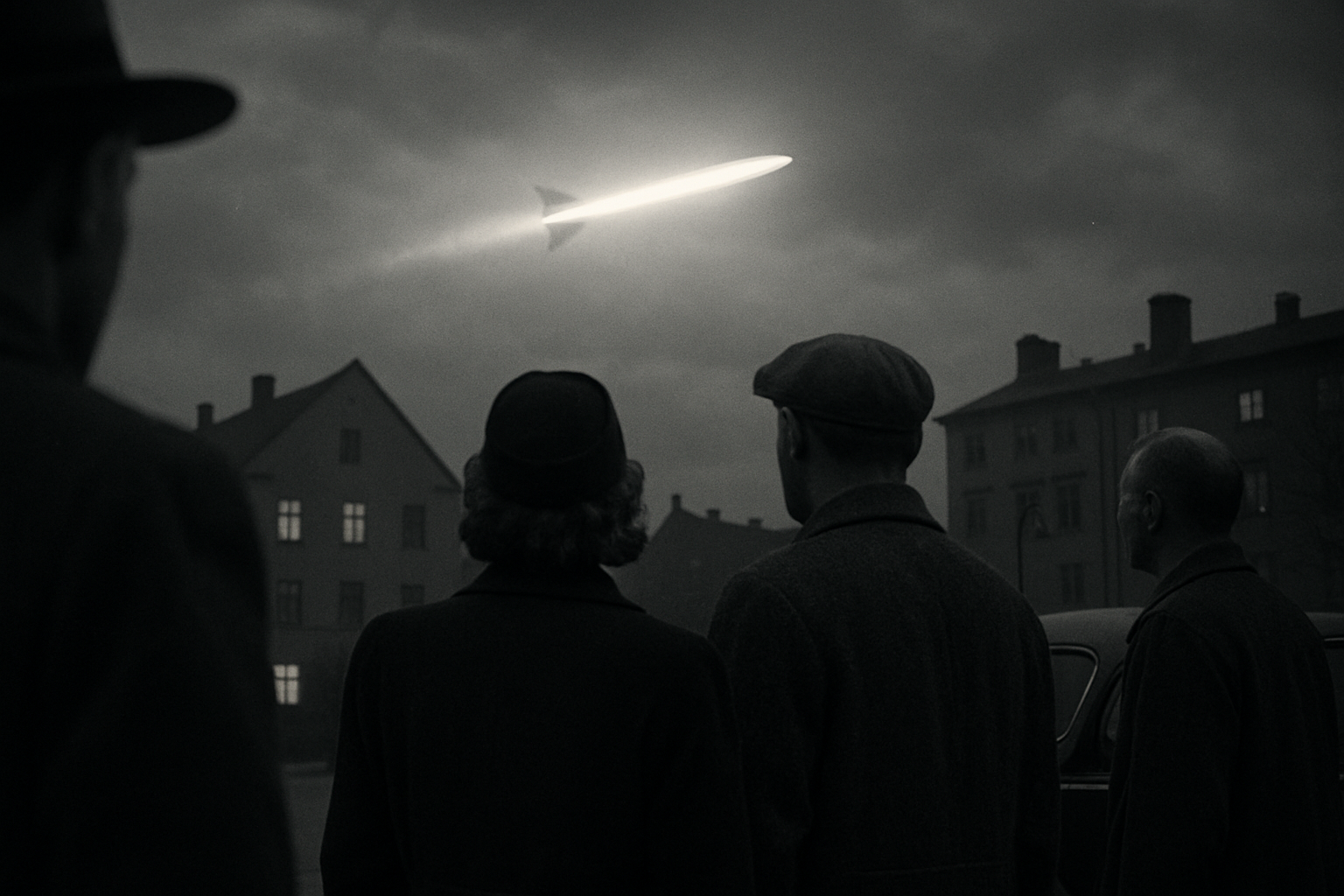
The ghost rockets (Swedish: *spökraketer*) were unidentified rocket- or missile-shaped objects reported over Sweden and the rest of Scandinavia in 1946.[1] The first reports came from Finnish observers on 26 February 1946, and sightings became widespread across Sweden, Norway, Denmark and Finland during a peak period from May to December of that year.[1] Approximately 2,000 reports were logged, of which about 200 were corroborated by radar returns.[1][3] Witnesses typically described fast, cigar- or rocket-shaped objects, sometimes with wings, frequently visible for only a few seconds and occasionally accompanied by a hissing or rumbling sound.[1] The Swedish military, alarmed against the backdrop of the early Cold War, established a committee to investigate; it attributed most sightings to meteors and other celestial phenomena, while a residue of cases could not be explained.[1][2] The episode drew the attention of the United States and Britain, and is often regarded as an immediate precursor to the American "flying saucer" wave of 1947.[1]
Background
In the spring and summer of 1946, with the Second World War only recently ended and Cold War tensions rising, observers across northern Europe began reporting strange objects crossing the sky.[1] The phenomenon took on military significance because Sweden lay close to the Baltic coast and to the former German rocket-development sites at Peenemünde, raising fears that a foreign power—chiefly the Soviet Union—might be testing captured German V-1 and V-2 missile technology over Scandinavian territory.[1]
- The first reports were made by Finnish observers on 26 February 1946.[1]
- Sightings spread through Sweden, Norway, Denmark and Finland, and similar reports later appeared in Greece, Portugal, Belgium and Italy.[1][3]
- The peak of activity ran from May to December 1946, with notable concentrations around 9–11 August, dates that coincided with the annual Perseid meteor shower.[1]
Because the objects were nicknamed *spökraketer* ("ghost rockets") in the Swedish press, the term came to describe the entire wave of sightings.[1]
Sightings and descriptions
Roughly 2,000 reports were logged over the course of 1946.[1][3] Witnesses described a range of appearances and behaviours:
- Fast-moving objects, often rocket- or cigar-shaped, sometimes described as having wings or fins.[1]
- Many were visible for only a few seconds; some slower, more sustained sightings were also reported.[1]
- Reports occasionally mentioned a hissing or rumbling sound, while others described the objects as silent and without an exhaust trail.[1]
Of the nearly 1,000 reports the Swedish Defence Staff had received by 29 November 1946, about 225 were judged to be observations of "real physical objects," and these had generally been seen in daylight.[1][3] About 200 sightings across the wave were corroborated by radar equipment, though the radar returns gave no clue as to the nature of the objects.[1][2]
Investigation and official response
The Swedish Defence Staff coordinated the investigation through a dedicated ghost rocket committee, and the Swedish National Defence Research Institute (FOA) examined physical debris recovered from alleged impact sites.[1][3]
Swedish findings
- Of the nearly 1,000 reports the Defence Staff had received by 29 November 1946, only about 225 were judged to be observations of "real physical objects"; the remainder were attributed to misperception and natural phenomena such as meteors.[1]
- Around 30 pieces of debris were examined by FOA; these were determined to be ordinary materials such as coke or slag, with no sign of artificial projectiles.[1][2]
- In a public statement of 10 October 1946, the Defence Staff cautioned that most observations were vague but added that "clear, unambiguous observations have been made that cannot be explained as natural phenomena, Swedish aircraft, or imagination on the part of the observer."[2]
The Lake Kölmjärv incident
The best-known crash report occurred on 19 July 1946, when witnesses reported a grey, winged, rocket-shaped object descending into Lake Kölmjärv in northern Sweden.[1] A three-week military search, led by Swedish Air Force officer Karl-Gösta Bartoll, found a disturbance on the lake bottom but recovered no wreckage.[1][3] Bartoll's report concluded that "there are many indications that the Kölmjärv object disintegrated itself," suggesting the object may have been made of a lightweight material such as a magnesium alloy that would disintegrate easily.[1][3]
International interest
The sightings attracted attention from the United States and Britain.[1] On 20 August 1946, the retired US generals James Doolittle and David Sarnoff arrived in Stockholm and were briefed on the radar-tracked incidents.[1][3] Sarnoff was later quoted in *The New York Times* (30 September 1946) as being "convinced that the 'ghost bombs' are no myth but real missiles."[1][2] In an internal US assessment, intelligence analysts noted that radar course-plotting had led some Swedish officers to point to Peenemünde as a possible launch site.[1]
Explanations and disputes
No single explanation has accounted for every report, and the case remains formally unresolved.[1]
- Astronomical phenomena. The official Swedish position attributed roughly 80% of sightings to meteors and other celestial events, supported by the clustering of reports around the August Perseid shower.[2][1] Critics note, however, that many sightings occurred outside meteor-shower periods and described behaviour—horizontal flight, manoeuvring, formation—inconsistent with meteors.[1]
- Soviet missile tests. A widely held wartime-era theory held that the Soviet Union was testing captured German V-1/V-2 technology, possibly from Peenemünde.[1] This view was undercut by the absence of any identifiable rocket wreckage and by the lack of recorded launches from Peenemünde after the war.[1][3]
- Misidentification and reporting effects. Sociological analyses have argued that wartime anxiety and intense press coverage amplified ordinary misperceptions into a perceived wave.[2]
The Swedish authorities ultimately concluded that, while most reports were explicable, a minority of carefully documented cases could not be accounted for; the origin of these objects remains unknown.[1][2]
Aftermath and significance
The ghost rocket wave subsided after 1946 but is frequently cited in the history of unidentified aerial phenomena.[1]
- It is widely regarded as an immediate precursor to the American "flying saucer" reports that began in 1947.[1]
- Declassified intelligence documents released in later decades, including a 1948 US Air Forces in Europe (USAFE) memorandum, show that Western governments took the reports seriously and considered a range of explanations.[1]
- Investigator Karl-Gösta Bartoll, interviewed decades later, maintained that "what people saw were real, physical objects," a position echoed by some researchers who continue to regard the unexplained cases as significant.[1]
The episode remains a touchstone in discussions of early Cold War aerial mysteries, valued both as a documented government investigation and as an unresolved case.[1][2]
Key quotes
“"Clear, unambiguous observations have been made that cannot be explained as natural phenomena, Swedish aircraft, or imagination on the part of the observer." — Swedish Defence Staff, 10 October 1946
“"There are many indications that the Kölmjärv object disintegrated itself." — Air Force officer Karl-Gösta Bartoll
References
- 1.
- 2.
- 3.
Similar cases
Scored on agency / year proximity / region / tag overlap — same agency +3, near year +4, same region +2, shared tag ×2.