Berwyn Mountain incident (1974)
Illustrations
AI-generated illustration — not actual footage or evidence; an interpretive depiction based on the documented account
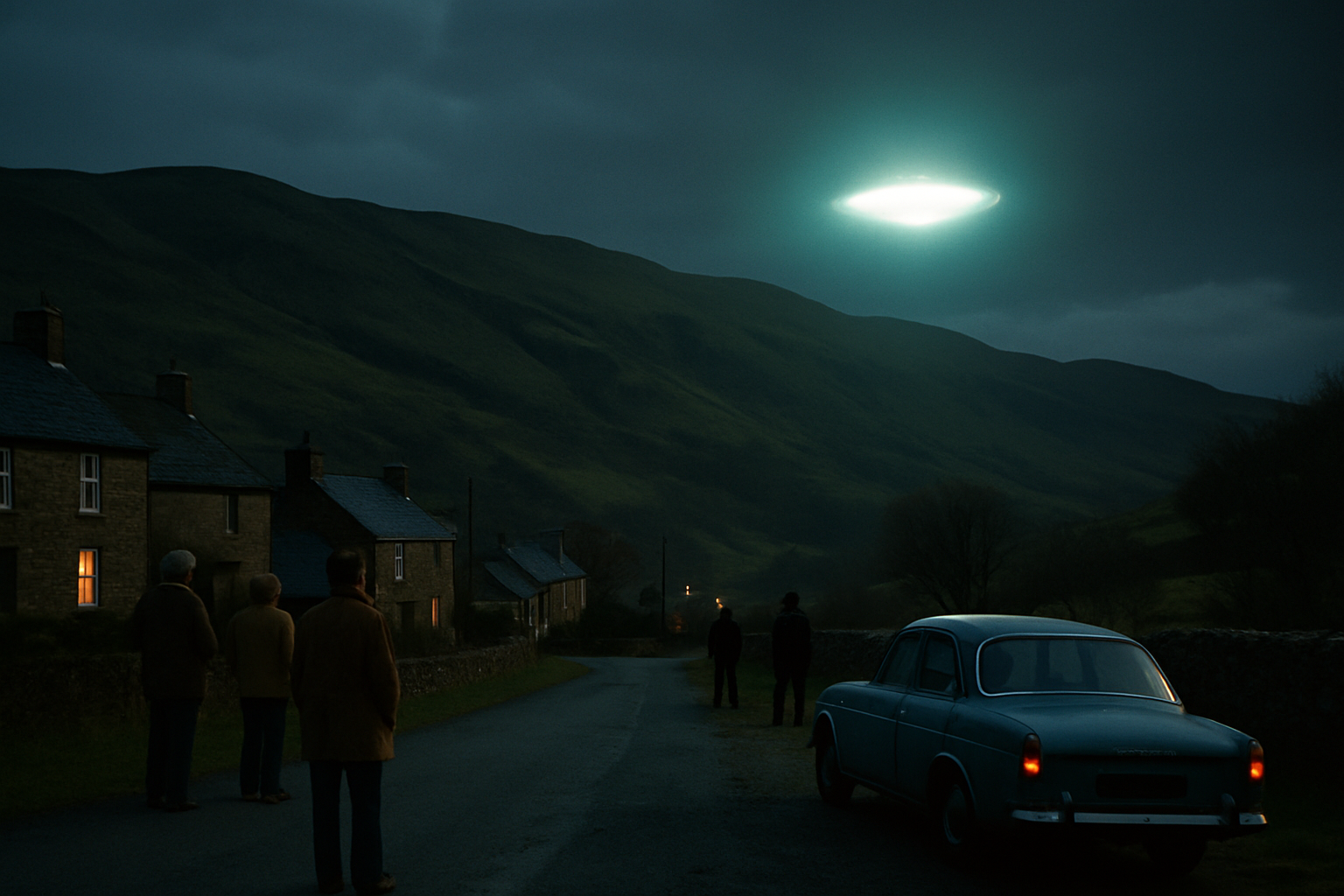
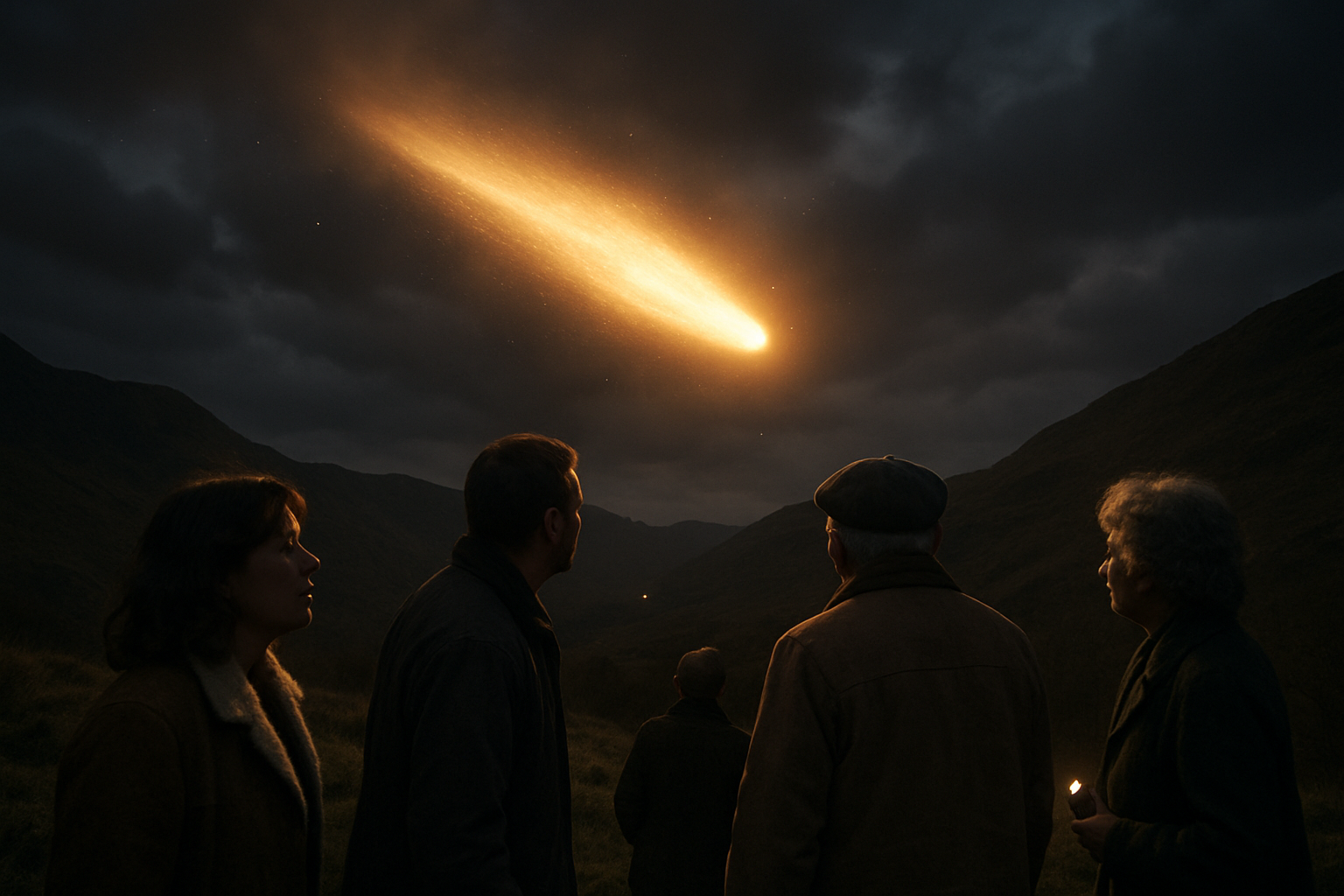
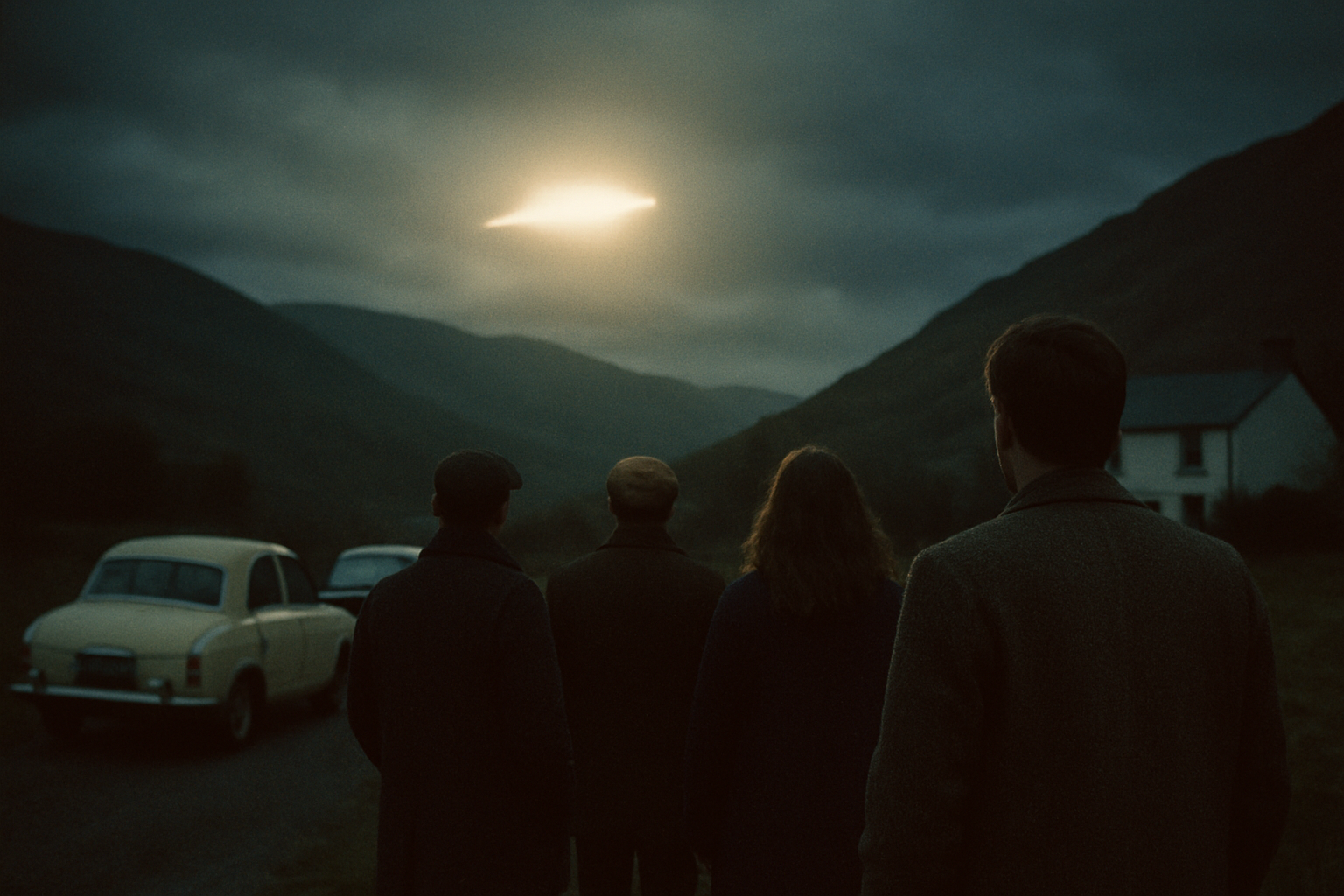
The Berwyn Mountain incident (also called the Berwyn Mountain UFO incident or the "Welsh Roswell") was a cluster of events reported on the evening of 23 January 1974 in the Berwyn Mountains near Llandrillo, in what was then Merionethshire, north Wales.[1][4] At about 8:38 p.m. local people felt a violent shaking of the ground, heard a loud bang, and some reported a bright light in the sky; police and a search-and-rescue team were alerted, but no aircraft crash or wreckage was found.[1][4] In subsequent decades the episode was reinterpreted by some ufologists as the crash and military recovery of an extraterrestrial craft, and tabloids dubbed it "The Roswelsh Incident."[1] Scientific investigation established that the night coincided with a magnitude-3.5 earthquake centred near Bala and with a bright meteor observed across Britain, and most researchers—including those who have studied the witness statements in detail—conclude that the events are best explained by these natural phenomena rather than by a crashed object.[1][2][5]
Background
The Berwyn (Welsh: *Berwyn*) is a sparsely populated upland range in north-east Wales. On the night of 23 January 1974 it became the focus of one of Britain's best-known UFO claims.[1][4]
- The events centred on the village of Llandrillo and the surrounding hills in the historic county of Merionethshire.[1]
- North Wales lies in a seismically active part of Britain, and the area around Bala has a documented history of small earthquakes.[2]
- The incident took place during the early-1970s period of heightened public interest in UFOs, which shaped how the night's events were later reported and remembered.[1][4]
Because several distinct phenomena occurred within a short span of time, the episode lent itself to multiple, competing interpretations almost from the outset.[1][5]
The events of 23 January 1974
At approximately 8:38 p.m. on 23 January 1974, residents across a wide area of north Wales and parts of north-west England felt a sudden, violent shaking accompanied by a loud noise often described as an explosion or a deep "thud."[1][4][2]
- One eyewitness, Huw Lloyd, then aged fourteen, recalled being at home watching television when "there was, like, a thud," after which "the whole place started shaking quite violently, like an earth tremor."[4]
- Believing there had been an aircraft crash or a serious accident, a local nurse, Pat Evans, drove up onto the mountain with her two daughters to offer help.[5][4]
- Evans reported seeing a glowing mass on the hillside; she later told the press, "To our left we could see a huge orange ball sitting on the mountain. It was glowing."[5]
- Other people in the area reported lights on the hills that evening, and poachers were known to have been out lamping (using bright lamps to hunt) on the Berwyn that night.[5][1]
Police converged on the area and a search-and-rescue team was alerted from RAF Valley on Anglesey, but no crashed aircraft, crater or wreckage was located.[4][5]
Investigation and natural explanations
Later scientific and documentary investigation identified two natural events that coincided on the night of 23 January 1974.[1][2][3]
Earthquake
- The Institute of Geological Sciences (now the British Geological Survey) recorded a magnitude-3.5 earthquake at about 8:38 p.m., felt across north Wales and as far as the Liverpool area.[1][2]
- Seismologist Roger Musson examined the event in a 2006 paper in *Astronomy & Geophysics*, treating it as the genuine and well-documented "Bala" earthquake that underlay many of the reports.[2]
- Investigators noted that an aircraft or spacecraft crash large enough to produce the reported effects would have left a substantial, easily visible crater, which was never found.[1]
Meteor
- A bright meteor (fireball) was widely observed over Wales and northern England the same evening, with sightings reported from locations as far apart as Somerset, Norfolk, Manchester and Edinburgh.[1][5]
- Meteor specialist Alastair McBeath, writing in *Astronomy & Geophysics* in 2006, argued that the luminous phenomena were due to a single bright meteor rather than a meteor shower.[3]
- The combination of seismic shaking, the loud report, the fireball and the poachers' lamps on the hillside is generally held to account for the principal elements of the witness reports.[1][5]
Declassified Ministry of Defence files released in later years are consistent with this earthquake-and-meteor interpretation and contain no evidence of a recovered craft.[1][5]
UFO claims and disputes
From the 1990s onward the incident was increasingly presented as a covered-up UFO crash, drawing comparisons with the 1947 Roswell incident in the United States.[1][4]
- More elaborate versions of the story alleged that the military had recovered debris—and even oblong, "coffin-like" boxes said to contain alien bodies—and transported them to the Porton Down defence research establishment, but investigators have found no credible evidence for these claims.[5]
- The Wiltshire site of Rudloe Manor, sometimes called "Britain's Area 51," has featured in such accounts, including a 2017 *Ancient Aliens* television episode.[1]
- UFO researcher Andy Roberts reviewed the witness statements and seismic data and concluded that the night's events were a coincidence of the earthquake, the meteor and ordinary lights on the hills, with no extraterrestrial element.[5][1]
- Some local researchers have disputed parts of the skeptical account; for example, questions have been raised over the timing of the poachers' lamps relative to Pat Evans's sighting, with critics arguing the lamping cannot fully explain what she described.[5]
The central points of dispute therefore concern not whether an earthquake and meteor occurred—both are well documented—but whether ordinary phenomena fully account for every detail of the witness testimony.[1][5]
Aftermath and significance
The Berwyn Mountain incident has become one of the most frequently cited UFO cases in the United Kingdom.[1][4]
- Its nickname, the "Welsh Roswell," reflects the way the story grew from a night of unusual but explicable events into a fully developed crash-and-cover-up narrative.[4][5]
- The case is regularly revisited in books, documentaries and the press; BBC One's *The One Show* featured it on 2 March 2021.[1]
- For seismologists and meteor astronomers it remains a notable example of how separate natural phenomena occurring together can be misread as a single extraordinary event.[2][3]
While a residue of disagreement persists among local researchers, the prevailing scientific assessment treats the incident as essentially explained by the documented earthquake and meteor, with no physical evidence of a crashed craft.[1][2][5]
Key quotes
“"To our left we could see a huge orange ball sitting on the mountain. It was glowing." — nurse Pat Evans, describing what she saw on the mountain
“"The whole place started shaking quite violently, like an earth tremor." — eyewitness Huw Lloyd, recalling the shaking that night
References
- 1.
- 2.
- 3.
- 4.
- 5.
Similar cases
Scored on agency / year proximity / region / tag overlap — same agency +3, near year +4, same region +2, shared tag ×2.