Cosford incident (1993)
Illustrations
AI-generated illustration — not actual footage or evidence; an interpretive depiction based on the documented account
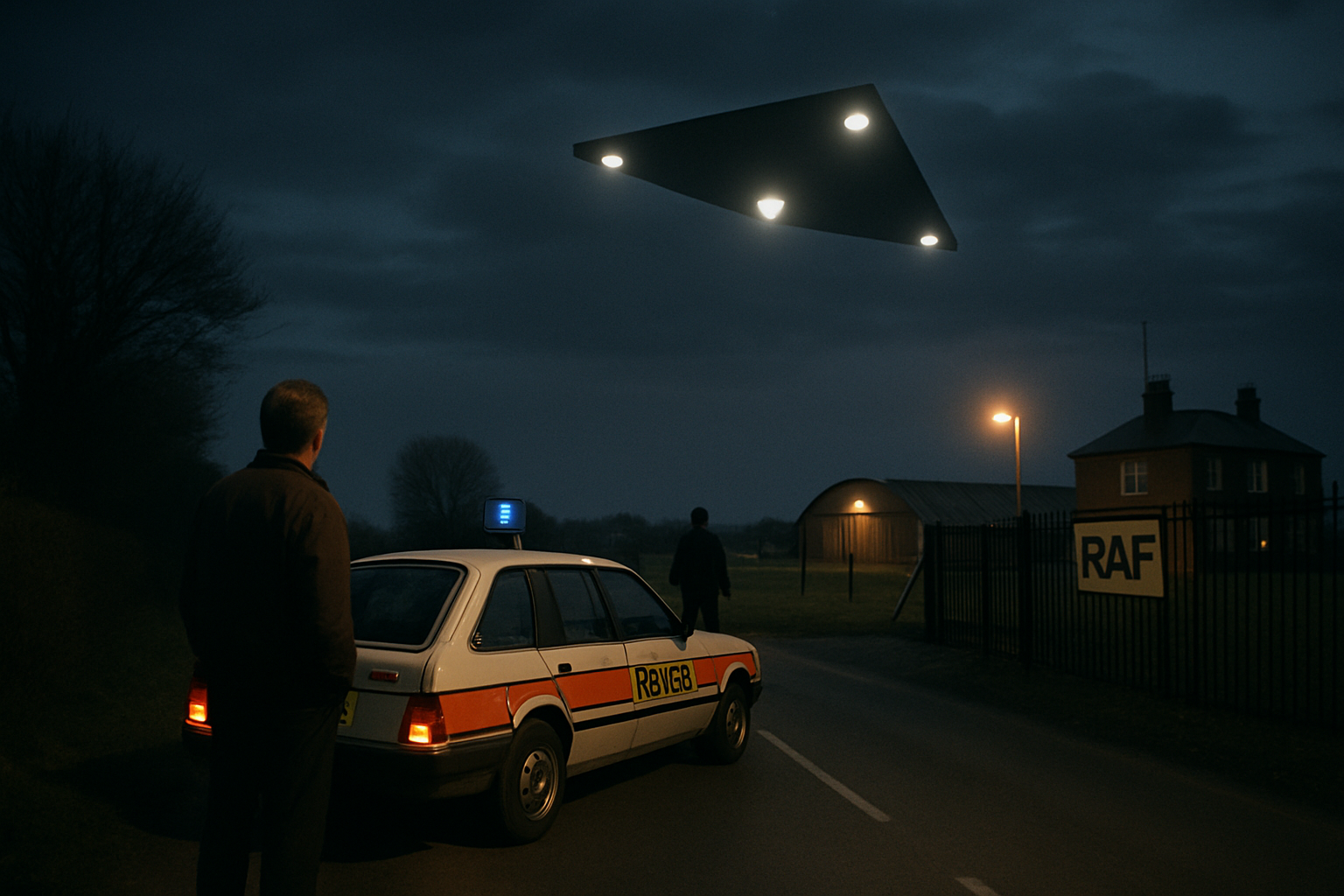
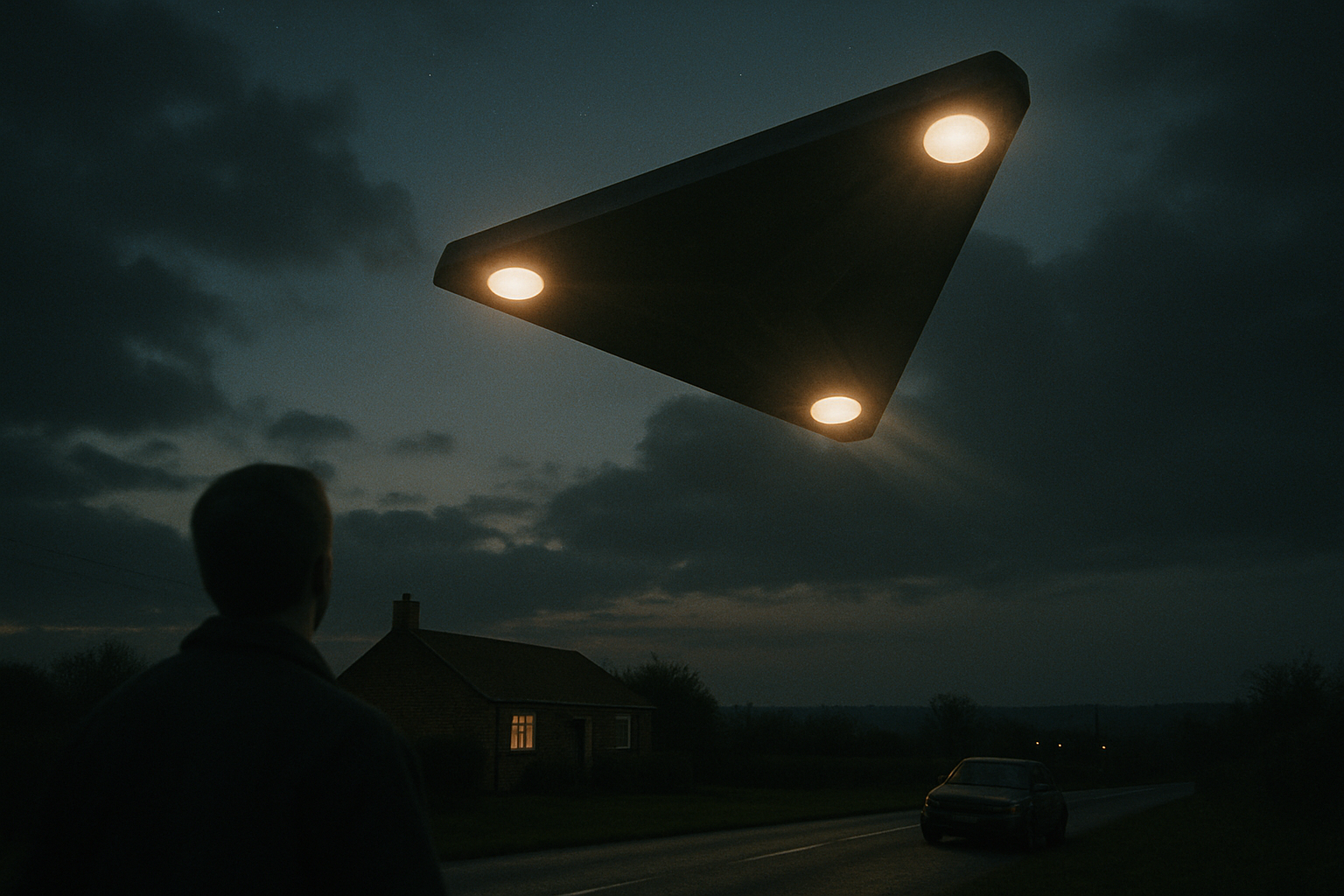
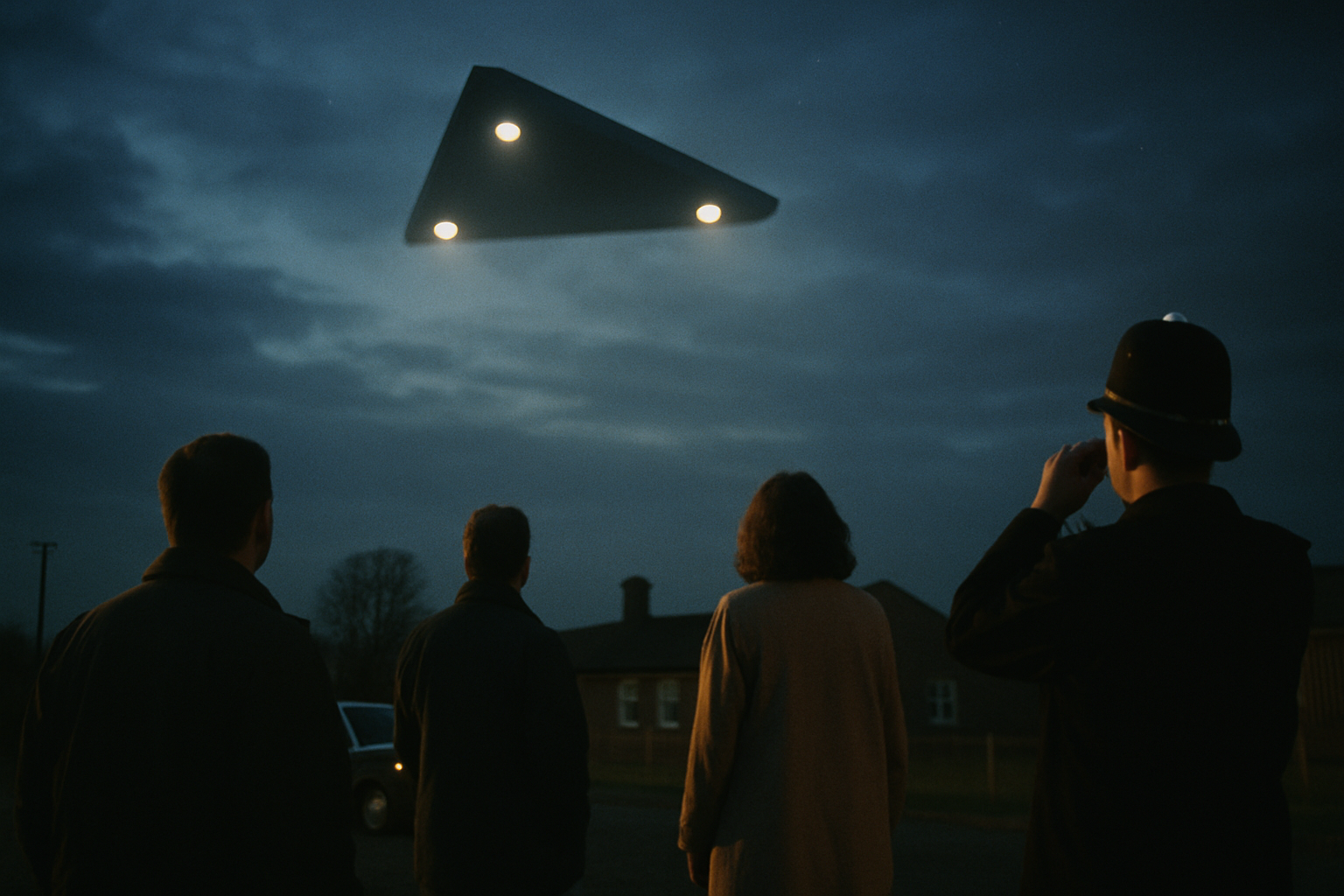
The Cosford incident was a series of unidentified flying object (UFO) sightings reported over western Britain on the night of 30–31 March 1993.[1] Within a short period dozens of witnesses — including members of the public, police officers and military personnel near RAF Cosford and RAF Shawbury in Shropshire — reported bright moving lights, with some accounts describing a large triangular craft, a beam of light directed at the ground and a low humming sound.[1][3] The case attracted attention because several of the witnesses were trained observers and because it was investigated directly by the Ministry of Defence (MOD).[2]
The sightings were examined by Nick Pope, then working at the MOD's Secretariat (Air Staff) section informally known as the "UFO desk."[2][4] In a briefing for his superiors he wrote that an object of unknown origin appeared to have operated in UK airspace undetected by radar and that this had "considerable defence significance."[2] Subsequent analysis by astronomers and orbital trackers concluded that most of the lights were caused by the fiery re-entry of the Tsyklon-2 rocket booster that had launched the Soviet/Russian Cosmos 2238 satellite on 30 March 1993, while a later close-range sighting at Shawbury was attributed to a police helicopter using a powerful searchlight.[1][5]
Background
By the early 1990s the Ministry of Defence maintained a small desk within the Secretariat (Air Staff) that received and assessed reports of unusual aerial sightings, chiefly to determine whether any had defence significance.[4] Nick Pope worked in this section, Sec(AS)2a, between 1991 and 1994, where his duties included investigating UFO reports.[4]
The sightings of late March 1993 occurred against a backdrop of heightened public interest in reports of large, silent, triangular craft, which had been described across Europe in preceding years — most prominently during the Belgian UFO wave of 1989–1990.[1] Some observers and writers at the time also speculated that such sightings might be caused by a rumoured secret American high-speed reconnaissance aircraft sometimes called "Aurora."[1]
The sightings
Most of the reports clustered in the early hours of 31 March 1993, around 01:10–01:15 BST, when witnesses across western Britain described two or more very bright white lights moving rapidly toward the southeast and trailing luminous vapour; some accounts added a third light, giving the impression of a triangular shape.[1][2]
At RAF Cosford, near Wolverhampton, a Ministry of Defence police patrol reported seeing bright lights pass over the base, and alerted nearby RAF Shawbury, some 20 miles (about 32 km) away.[1] Shortly afterwards a meteorological observer at Shawbury, later named as Wayne Elliott, reported a much closer encounter: he described a large object that blocked out the stars, carried a brilliant white light at the front "moving back and forth as if it was looking for something," emitted a low humming sound and a beam that scanned the ground, moved very slowly — "about walking speed" — for around two minutes, and then accelerated away at high speed.[3][2] According to Pope, the observer estimated the object to be between the size of a C-130 Hercules and a Boeing 747.[2]
Further reports came from elsewhere in the Midlands, from Wales and from as far afield as Somerset, where police and others described lights variously likened to "two Concordes side by side and joined together."[3] In total roughly seventy witness reports were associated with the night's events.[1]
MOD investigation and official response
The reports were referred to the MOD's UFO desk, where Nick Pope carried out the principal investigation.[2] Because some of the sightings could not immediately be matched to known aircraft, Pope treated the case as potentially serious. In a briefing prepared for his superiors he concluded that an unidentified object had apparently been present in controlled airspace without appearing on radar:
"It seems that an unidentified object of unknown origin was operating in the UK Air Defence Region without being detected on radar; this would appear to be of considerable defence significance, and I recommend that we investigate further."[2]
Pope has since described the case as the most high-profile and compelling UFO incident of his time on the project.[2] His superiors, however, were less convinced of any threat, and the MOD did not treat the episode as evidence of a hostile intrusion.[1] Documentation relating to the case later formed part of the MOD's UFO files, which were progressively released to The National Archives, and the incident has been the subject of Freedom of Information requests.[1]
Explanations and disputes
Astronomical and orbital analysis offered a largely conventional account of the night's events.
- Satellite re-entry. On 30 March 1993 a Tsyklon-2 rocket launched the ocean-surveillance satellite Cosmos 2238 from the Baikonur Cosmodrome.[5] The spent rocket booster (catalogued as object 22586) subsequently re-entered the Earth's atmosphere and broke into pieces, producing brilliant fireballs.[1] A trajectory reconstruction based on US Space Command tracking data placed the burning debris crossing Ireland and south-west England between roughly 01:07 and 01:15 BST on 31 March, matching the timing, direction and appearance of the main cluster of "bright light" reports.[1] Similar fireball sightings were logged the same morning from France and north-eastern Spain, consistent with the same re-entry path.[1]
- The Shawbury beam. The later, close-range sighting reported by the Shawbury meteorological observer occurred after the re-entry, and skeptical investigators — including the journalist and folklorist David Clarke — concluded that it was most plausibly explained by a Dyfed-Powys police helicopter equipped with a NiteSun searchlight, which had been operating in the area; an RAF Shawbury airman is reported to have confirmed this identification in 2005.[1]
Proponents of an anomalous interpretation continued to emphasise the close-range Shawbury account, the reported humming sound and the object's apparent slow, controlled movement, which they argued did not fit a re-entering booster.[3] Skeptics responded that the headline "triangular craft" reports are well explained by the disintegrating booster and that the separate Shawbury observation, primed by the earlier alert from Cosford, is consistent with a helicopter and searchlight.[1]
Aftermath and significance
The Cosford incident became one of the best-known British UFO cases of the 1990s, largely because of the involvement of military witnesses and the MOD's own internal assessment.[2] After leaving the ministry, Nick Pope cited the case publicly as among the most compelling he had handled, which kept it in circulation in books, documentaries and news coverage.[2][4]
Following the release of the MOD's UFO files and the publication of detailed astronomical analyses, the mainstream view is that the case is explained: the widespread "bright light" sightings correspond closely to the re-entry of the Cosmos 2238 booster, and the separate Shawbury encounter is best accounted for by a police helicopter.[1][5] It is frequently cited as a textbook example of how a single dramatic natural event — a satellite re-entry — combined with expectation and a second, unrelated stimulus can generate a high-profile "unexplained" episode, even though some commentators continue to regard parts of the account as unresolved.[1][3]
Key quotes
“"It seems that an unidentified object of unknown origin was operating in the UK Air Defence Region without being detected on radar; this would appear to be of considerable defence significance." — Nick Pope, in a briefing for his MOD superiors
“The Shawbury observer described the white front light as "moving back and forth as if it was looking for something," accompanied by a low humming sound.
References
- 1.
- 2.
- 3.
- 4.
- 5.
Similar cases
Scored on agency / year proximity / region / tag overlap — same agency +3, near year +4, same region +2, shared tag ×2.