Sasovo explosions (1991)
Illustrations
AI-generated illustration — not actual footage or evidence; an interpretive depiction based on the documented account
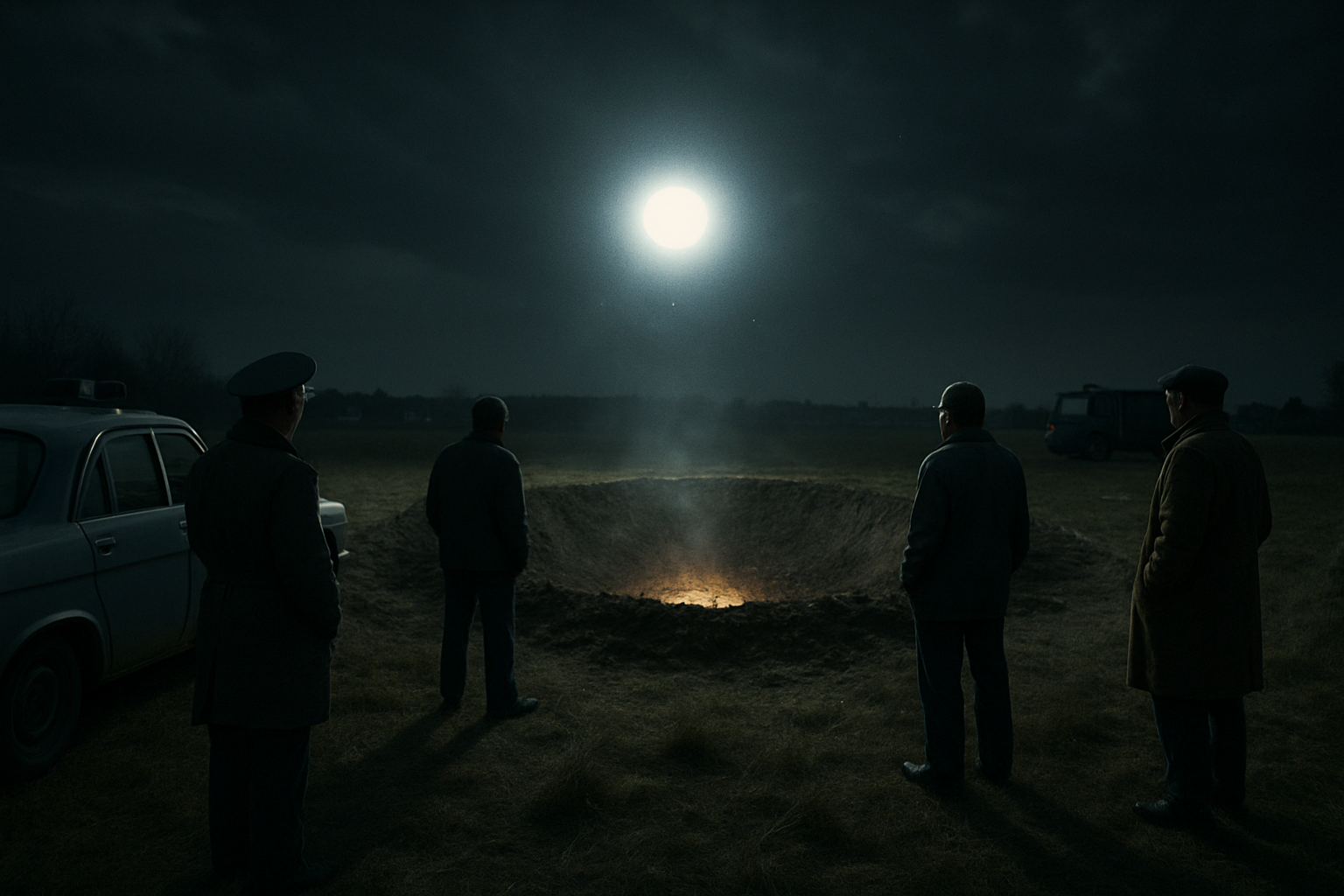
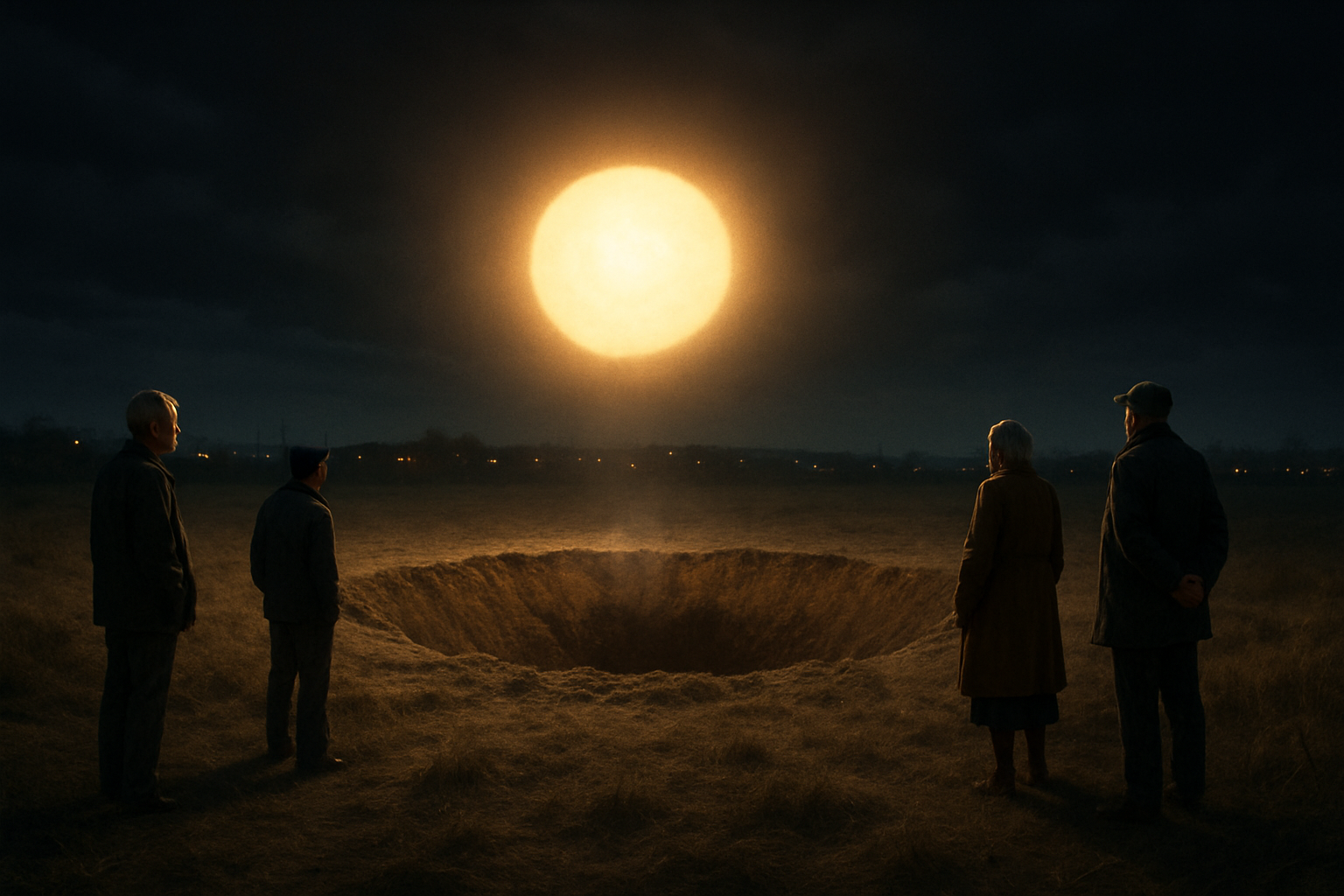
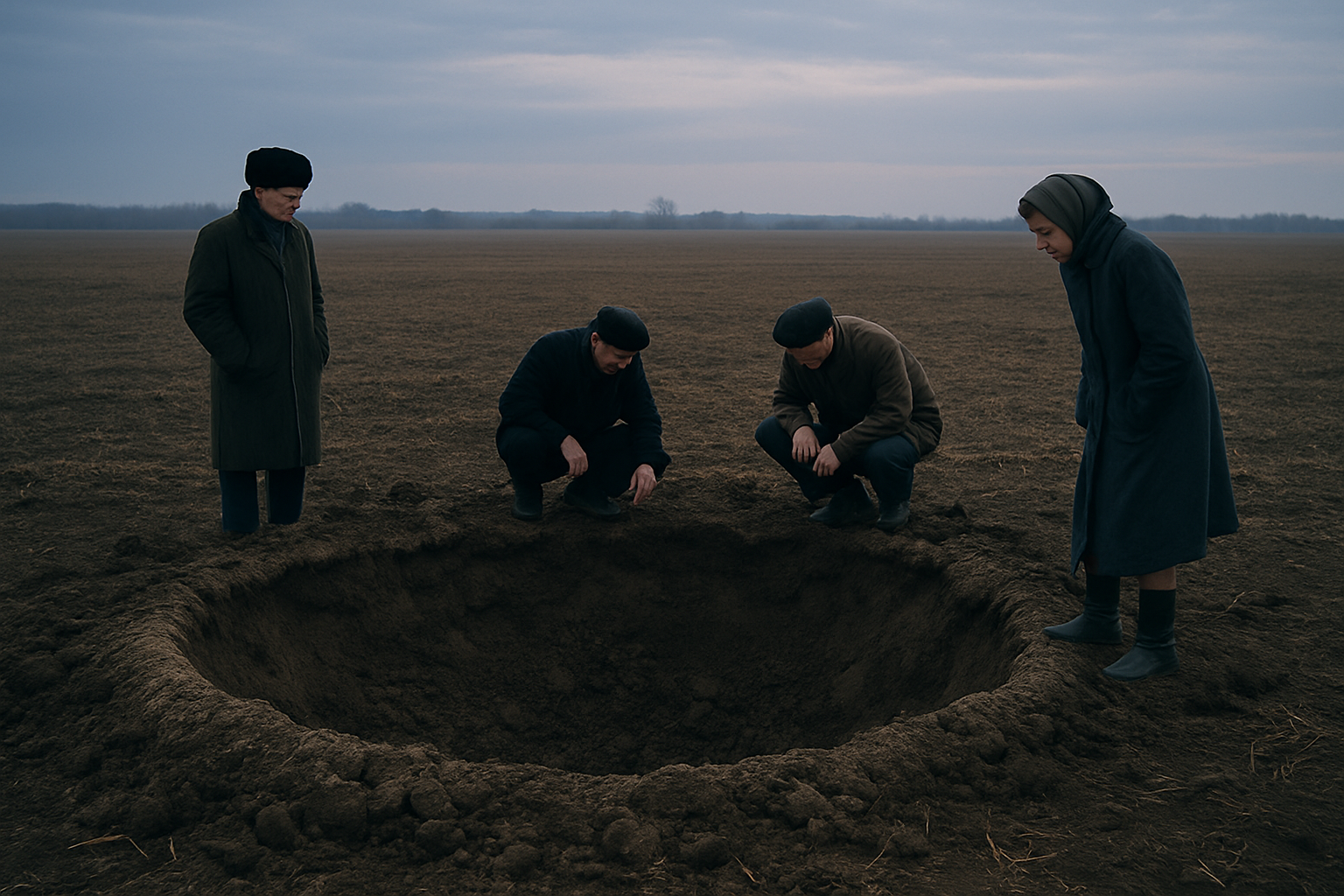
The Sasovo explosions (Russian: Сасовские взрывы, romanised *Sasovskie vzryvy*) were two powerful blasts of disputed origin that occurred in 1991 and 1992 in fields on the outskirts of the town of Sasovo, Ryazan Oblast, Russia, about 300 kilometres south-east of Moscow.[1][2] The first and far larger event took place on 12 April 1991, the eve of Cosmonautics Day, at about 01:32–01:34 local time: residents heard a rising rumble that culminated in a loud blast, and a crater roughly 28 metres across and 3–4 metres deep — with a raised mound of soil at its centre — was found near the south-western edge of the town.[1][3][4] The force was estimated at no less than 25–30 tonnes of TNT equivalent; the shock wave shattered windows and doors across much of Sasovo and tore off some roofs, yet no one was killed and only a handful of people were treated for cuts from broken glass.[3][1] A second, weaker explosion on the night of 28 June 1992 left another, smaller crater in fields not far from the first.[3][2] An official explanation attributed the blast to an accidental detonation of ammonium-nitrate fertiliser stored nearby, but this was disputed because no matching chemical residue was found in the crater and the fertiliser heaps lay well away from the epicentre.[6][2] Other explanations have ranged from an endogenic (tectonic) explosion and hydrogen degassing of the Earth to meteorite and UFO interpretations; the case was investigated by the anomalistics group Kosmopoisk and is mentioned in declassified US CIA/FBIS material on Soviet reports, and it remains disputed.[2][5][6]
The explosions
According to Russian accounts, in the early hours of 12 April 1991 — the night before Cosmonautics Day — residents of Sasovo first heard a rising rumble coming from above. At about 01:32–01:34 local time this culminated in a powerful explosion that shook the ground; in apartment blocks furniture toppled and light fittings broke, and a crater about 28 metres in diameter and 3–4 metres deep was found in fields on the south-western edge of the town. Witnesses and later investigators described an unusual feature: a raised mound of soil at the centre of the crater, rather than a simple pit, and large chunks of earth thrown well beyond the rim.[1][3][4]
The shock wave was felt across a wide area and was reported as far as villages tens of kilometres away. In the town itself it broke windows — in some descriptions in a patchy, "every other one" pattern — burst doors, tore off some roofs and disturbed water pipes, while structures very close to the crater were comparatively little damaged.[3][2][4] Despite the widespread destruction of glass, no one was killed, and only a small number of people were treated for cuts.[3][1] The blast's force was commonly estimated at at least 25–30 tonnes of TNT equivalent.[1][3]
More than a year later, on the night of 27–28 June 1992, a second explosion occurred in fields near the first site (Russian sources place it on a farm field belonging to a local sovkhoz). It produced a smaller crater — described as roughly 11–12 metres across and a few metres deep, with debris scattered over a wide radius — but its shock wave was much weaker, and locals likened the sound to a single loud clap; this time windows rattled but largely did not break.[3][2]
Reported phenomena and witness accounts
Russian-language accounts of the 1991 event collect a number of reported features, some of which are difficult to corroborate and should be treated as witness testimony rather than established fact.
Several witnesses, including railway workers and passengers, are said to have observed white glowing spheres in the area in the hours before the explosion, and some reported a bluish flash at the moment of the blast.[2][3] Some accounts describe radio interference shortly beforehand and a luminous cloud with an acrid smell afterwards.[2][4] A widely repeated detail is that an investigating prosecutor and other officials examined the site; named figures in Russian reporting include a senior investigator of the Ryazan regional prosecutor's office and local police officers.[3]
Reviewers sympathetic to an anomalous reading have emphasised that the destruction was selective — a tree close to the crater reportedly survived undamaged while glass was broken throughout the town — and that observers noticed no scorching or burning and no obvious crater of the kind a conventional surface explosive would leave.[4][2] These points have been used both to argue against a simple chemical detonation and to support more unusual explanations; the underlying observations come largely from contemporary press and later popular accounts rather than from a single agreed technical report.[4][2]
Investigations and explanations
No single cause for the Sasovo explosions has been universally accepted, and a range of explanations — both mundane and unconventional — has been put forward.[2][6]
- Ammonium-nitrate fertiliser (official version). An early official account held that heaps of ammonium-nitrate fertiliser (saltpetre) stored in the open near the town had detonated accidentally. Critics noted that the fertiliser was stored some tens of metres from the epicentre, that no corresponding chemical residue was found in samples from the crater, and that the absence of scorching was hard to reconcile with such a blast.[6][2][3]
- Military or wartime ordnance. A buried wartime bomb or stored munitions was suggested, but the command of the Moscow Military District denied any military exercise or ordnance accident, and no shrapnel consistent with a conventional bomb was reported.[2][3]
- Endogenic (tectonic) explosion. Some scientists argued for a deep-seated, endogenic origin — an explosive release of energy from within the Earth — pointing to reported pre-blast ground deformation, animal distress and the unusual central mound, and noting that a second, weaker event followed in 1992. This reading is summarised in the English-language *Science Frontiers* digest of Russian sources.[4]
- Hydrogen degassing of the Earth. A related geological hypothesis attributes the craters to hydrogen degassing rising along deep faults of the Russian Platform. In August 2005 researchers visited the Sasovo craters with the geologist Vladimir Syvorotkin (Владимир Сывороткин), who measured unusually high concentrations of free hydrogen in the subsoil — by one account about double the surrounding background near the 1992 crater — which proponents interpret as evidence that the craters and the hydrogen flux are products of the same process.[5]
- Meteorite. A meteoritic impact was proposed (associated in Russian reporting with the geologist A. Portnov), though the crater's form and the lack of meteoritic material were seen by others as problematic.[3]
- UFO interpretations. Because of the glowing spheres reported beforehand and the difficulty of fitting the event to a conventional cause, some ufologists and parts of the popular press treated the explosions as possibly connected to unidentified flying objects.[2][6]
The anomalistics association Kosmopoisk (Космопоиск), founded by Vadim Chernobrov (Вадим Чернобров), lists the Sasovo explosions among the underground blasts of unclear origin it investigated in roughly 1999–2004.[7] The case is also noted in declassified US material: a CIA document derived from Soviet-press reporting, released among files on UFO reports, records *diverging opinions on the cause of the Sasovo explosion*, reflecting the dispute between conventional and unconventional readings.[6][1]
Coverage and documentation
The Sasovo explosions are documented chiefly in Russian-language sources — contemporary Soviet press, later popular-science and anomalistics writing, and regional Ryazan media — and are far less covered in English.[1][2] There is no dedicated Wikipedia article on the event in any language: Russian Wikipedia mentions it only briefly in its article on the town of Sasovo, and English Wikipedia notes it in passing in its list of *UFO sightings in Russia* (with a slightly different date).[8][9]
International interest was renewed around 2021, when reporting highlighted that declassified CIA/FBIS material released among files on UFO reports included an item on the "mysterious explosion" at Sasovo. Russian regional outlets covered this rediscovery, while noting that the declassified material did not resolve the underlying question of what caused the blasts.[1][6]
Key quotes
“At night, residents first heard a rising rumble that culminated in the early hours in a powerful explosion of at least 25–30 tonnes of TNT equivalent, leaving a crater about 28 metres across with a raised mound of soil at its centre.
“A CIA document derived from Soviet-press reporting records "diverging opinions on the cause of the Sasovo explosion", reflecting the dispute between conventional and unconventional readings.
References
- 1.
- 2.
- 3.
- 4.
- 5.
- 6.
- 7.
- 8.
- 9.
Similar cases
Scored on agency / year proximity / region / tag overlap — same agency +3, near year +4, same region +2, shared tag ×2.