Dalnegorsk incident (Height 611)
Illustrations
AI-generated illustration — not actual footage or evidence; an interpretive depiction based on the documented account
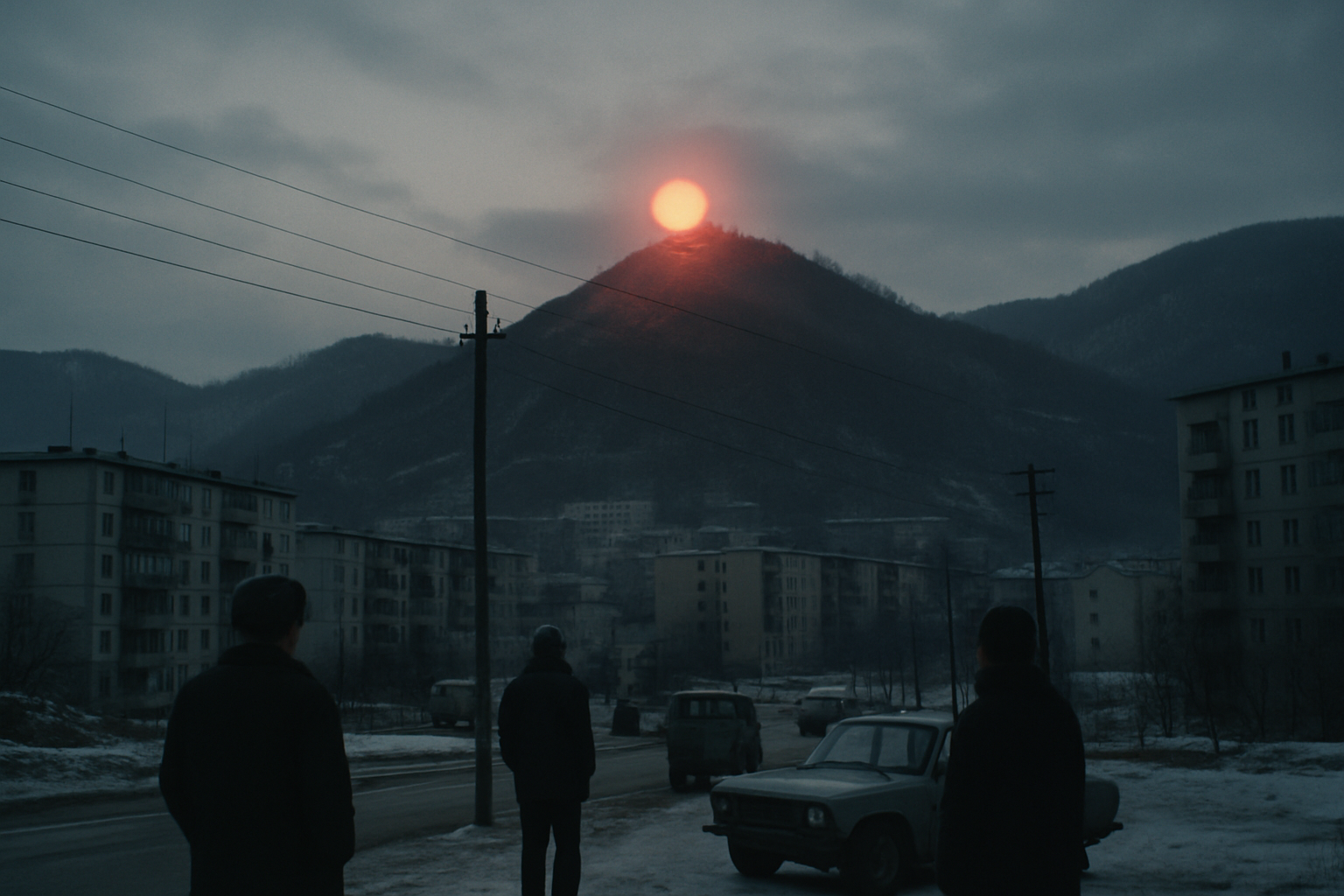
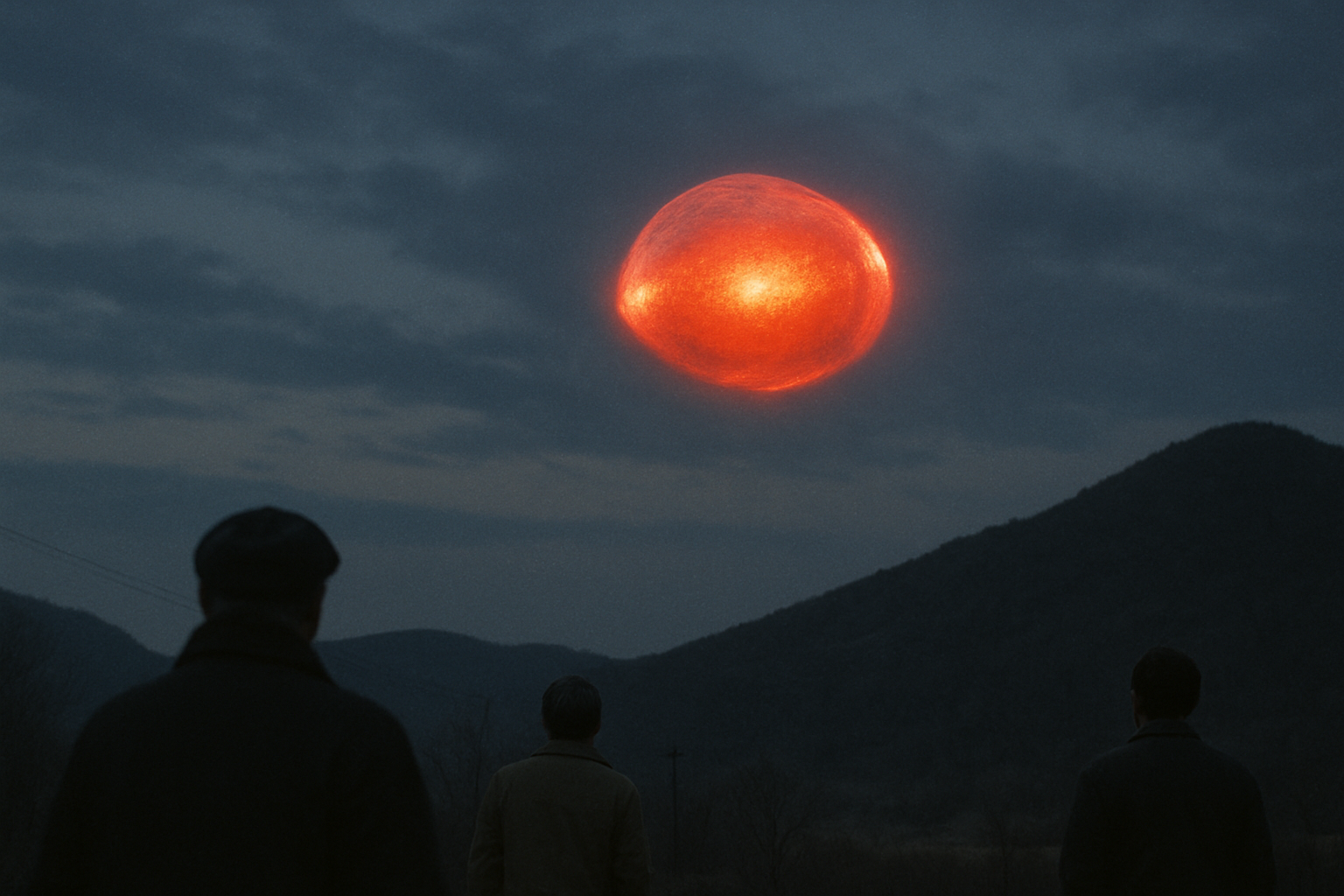
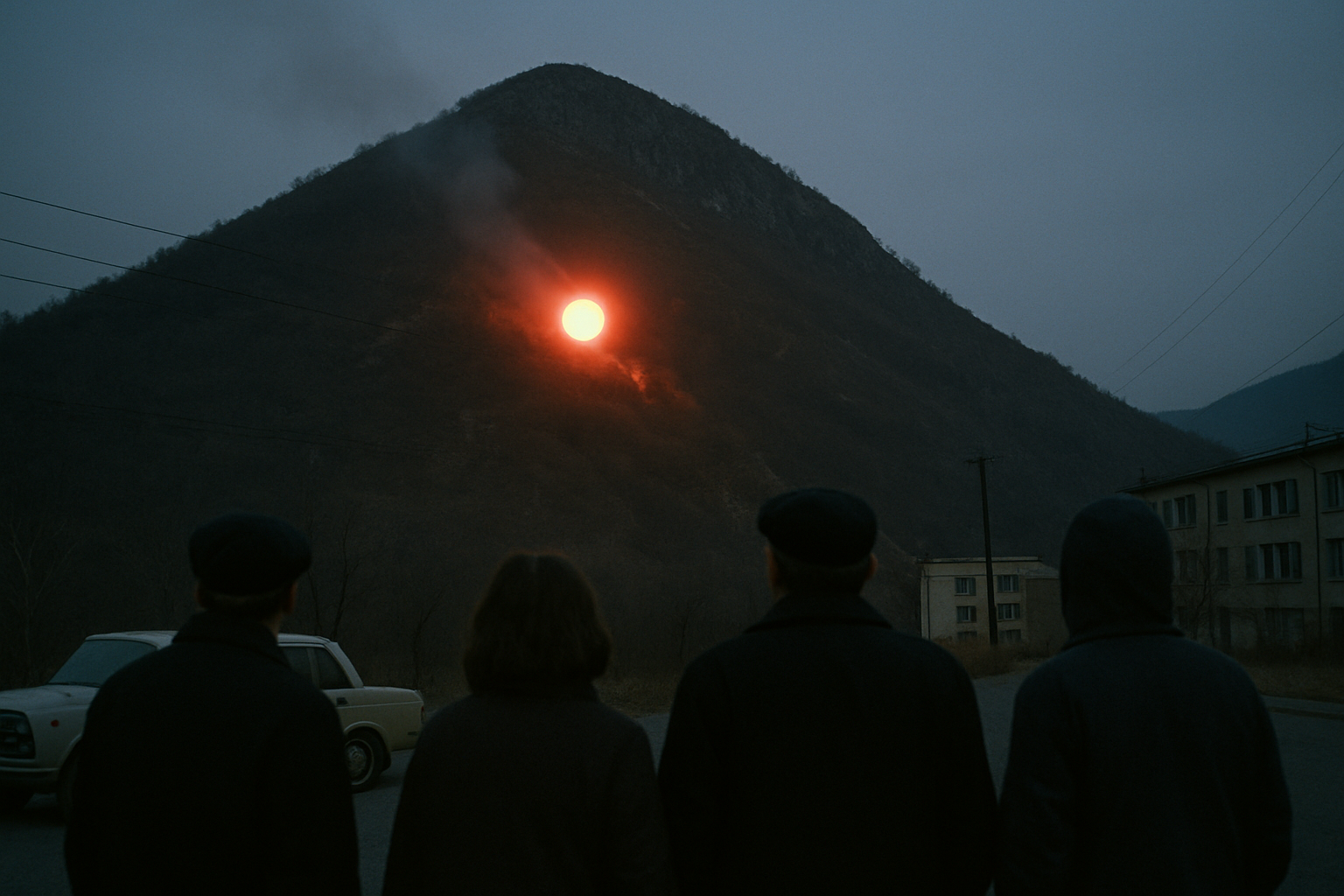
The Dalnegorsk incident, known in Russian as the "Height 611 incident" (Russian: *Инцидент на высоте 611*, *Intsident na vysote 611*), was an alleged crash of an unidentified flying object on the evening of 29 January 1986 in the mining town of Dalnegorsk (Дальнегорск) in Primorsky Krai, in the far east of the Soviet Union.[1][2] Residents reported that a silent, glowing reddish sphere — roughly half the apparent size of the Moon — flew low and parallel to the ground before descending into a hill within the town called Mount Izvestkovaya, locally known by its elevation as "Height 611" (Высота 611).[2][4] A glow consistent with a fire was seen at the summit for about an hour after the impact.[2]
Several days later the researcher Valery Dvuzhilny (Валерий Двужильный), associated with a Far Eastern committee studying anomalous phenomena, climbed the hill and, together with samples handed over by witnesses, collected fragments from the site.[3][2] These included about 70 grams of lead droplets, tens of grams of small black silicon-iron spheres, and roughly 5 grams of an unusual "little mesh" (сеточка) reported to contain gold and fine quartz filaments and to resist acids and solvents.[3][2][5] The case attracted attention from foreign ufologists between 1988 and 1994 and became known in the West as the "Russian Roswell."[4] It remains disputed: laboratory analyses pointed to a terrestrial origin for the lead, and Russian scientific commentators and skeptics regard the material as terrestrial, proposing conventional explanations.[2][3][1]
Setting
Dalnegorsk is a mining and ore-processing town in the mountainous interior of Primorsky Krai, in the Russian Far East. Mount Izvestkovaya ("Limestone Hill"), rising to 611 metres and situated on the territory of the town, gives the case its Russian name, "Height 611."[1][4]
The reported event occurred during the late Soviet period, a few years before the surge of paranormal and UFO material that filled the Soviet and post-Soviet press during *glasnost* and the early 1990s.[3] Reports of similar luminous spheres were said to have continued in the Dalnegorsk area and neighbouring districts of Primorsky Krai over the following years.[5][1]
The reported event
According to witness accounts collected by investigators and later media, on the evening of 29 January 1986, at around 19:55, numerous residents of Dalnegorsk saw a reddish, glowing sphere of small apparent size — compared to about half the disc of the Moon.[2][4]
The principal claims reported are:
- The object flew parallel to the ground, silently and without a luminous trail, at an estimated speed of about 15 metres per second (roughly 54 km/h) and an altitude of several hundred metres.[2][4]
- On reaching Height 611, it was said to have changed altitude and then descended into the summit of Mount Izvestkovaya.[2][5]
- After the impact, a glow consistent with a strong fire was observed at the site, reported to have lasted on the order of an hour.[2]
Local residents are said to have visited the site in the following days, and the area drew the attention of investigators.[2]
Investigation and samples
A few days after the event, the researcher Valery Dvuzhilny (Валерий Двужильный) reached the summit and examined a small scorched area showing signs of high-temperature effects.[3][2] From the site and from material handed over by witnesses, investigators reported recovering:
- About 70 grams of lead droplets and sprays of silvery metal.[2][3]
- Tens of grams of small black spheres said to consist mainly of silicon, iron and lead.[2][5]
- Roughly 5 grams of an unusual "little mesh" (сеточка) — a dark, glassy, perforated material reported to contain gold together with rare-earth elements (such as scandium, samarium, lanthanum and praseodymium) and sodium, with fine gold wires embedded in quartz; it was described as resistant to acids and organic solvents.[3][2][5]
Between 1988 and 1994 the case attracted ufologists and journalists from several countries, including Japan, the United States, China, Canada, Belgium and Sweden, and it became widely known abroad as the "Russian Roswell."[4][6]
Laboratory work on the lead reported an important result: although the lead's content of certain elements did not match ordinary local lead, isotopic analysis indicated a terrestrial origin, with a composition said to correspond to ore from the Kholodninskoye deposit.[2][1]
Explanations and dispute
From the start the Dalnegorsk case has been treated as disputed, with both anomalous and conventional readings.[1][2]
Anomalous interpretations. Some of the foreign ufologists who visited between 1988 and 1994 regarded the fragments as evidence of an extraterrestrial craft, citing the unusual mesh material, the high gold content and the apparent resistance of the samples to acids.[4][3] This reading underpins the "Russian Roswell" label.[4]
Skeptical and conventional explanations. Much of the Russian scientific and skeptical community regards the recovered material as terrestrial, noting that the lead's isotopic signature pointed to an earthly origin matching a known ore deposit.[2][1] Among the conventional hypotheses discussed in Russian coverage:
- A widely cited proposal is that the object was an automatic drifting aerostat (ADA) — a high-altitude reconnaissance balloon of a type flown since the mid-20th century — whose debris, including radar-reflective hull material, could account for the mesh and the assorted elements found.[3]
- Earlier Western commentary, attributed to the American magazine *Sky & Telescope*, suggested the fragments might be debris from a recovered military satellite rather than a craft of unknown origin.[3]
- Other discussions framed the spheres and lead as the products of ordinary high-temperature and geochemical processes rather than of a manufactured object.[1][2]
Because the case rests largely on witness testimony and on small samples whose interpretation is contested — and because the most testable claim, the origin of the lead, pointed to terrestrial ore — it is generally classed among unresolved and disputed reports rather than confirmed events.[2][1]
Legacy
The Dalnegorsk incident became one of the best-known UFO cases associated with the Soviet Union and the Russian Far East, sustained by repeated coverage in Russian regional and national media and by the visits of foreign researchers.[4][6] Height 611 itself has become a local landmark, and the episode is regularly revisited in Russian press features marking its anniversaries.[2][6]
Within the broader literature, the case is often presented either as a striking unexplained physical-trace event or as an example of how unusual but ultimately terrestrial debris, combined with vivid witness accounts, can sustain a long-running UFO narrative.[1][3]
Key quotes
“Dvuzhilny is said to have recovered about 70 g of lead droplets, tens of grams of black silicon-iron spheres, and roughly 5 g of an acid-resistant, gold-bearing "little mesh" (сеточка).
“Isotopic analysis indicated the lead was of terrestrial origin, with a composition matching ore from the Kholodninskoye deposit.
References
- 1.
- 2.
- 3.
- 4.
- 5.
- 6.
Similar cases
Scored on agency / year proximity / region / tag overlap — same agency +3, near year +4, same region +2, shared tag ×2.