1982 Lake Baikal underwater swimmers (military divers incident)
Illustrations
AI-generated illustration — not actual footage or evidence; an interpretive depiction based on the documented account
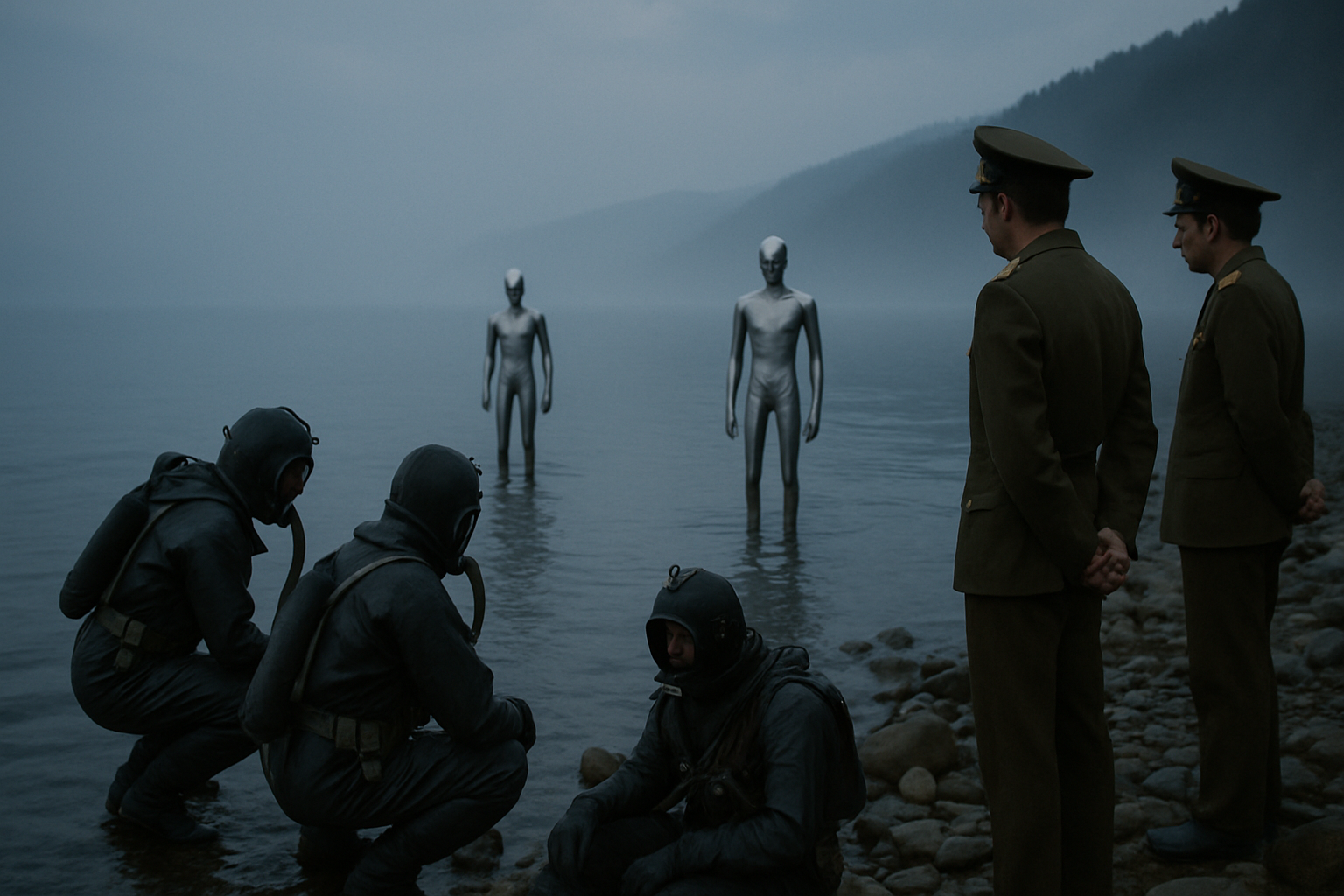

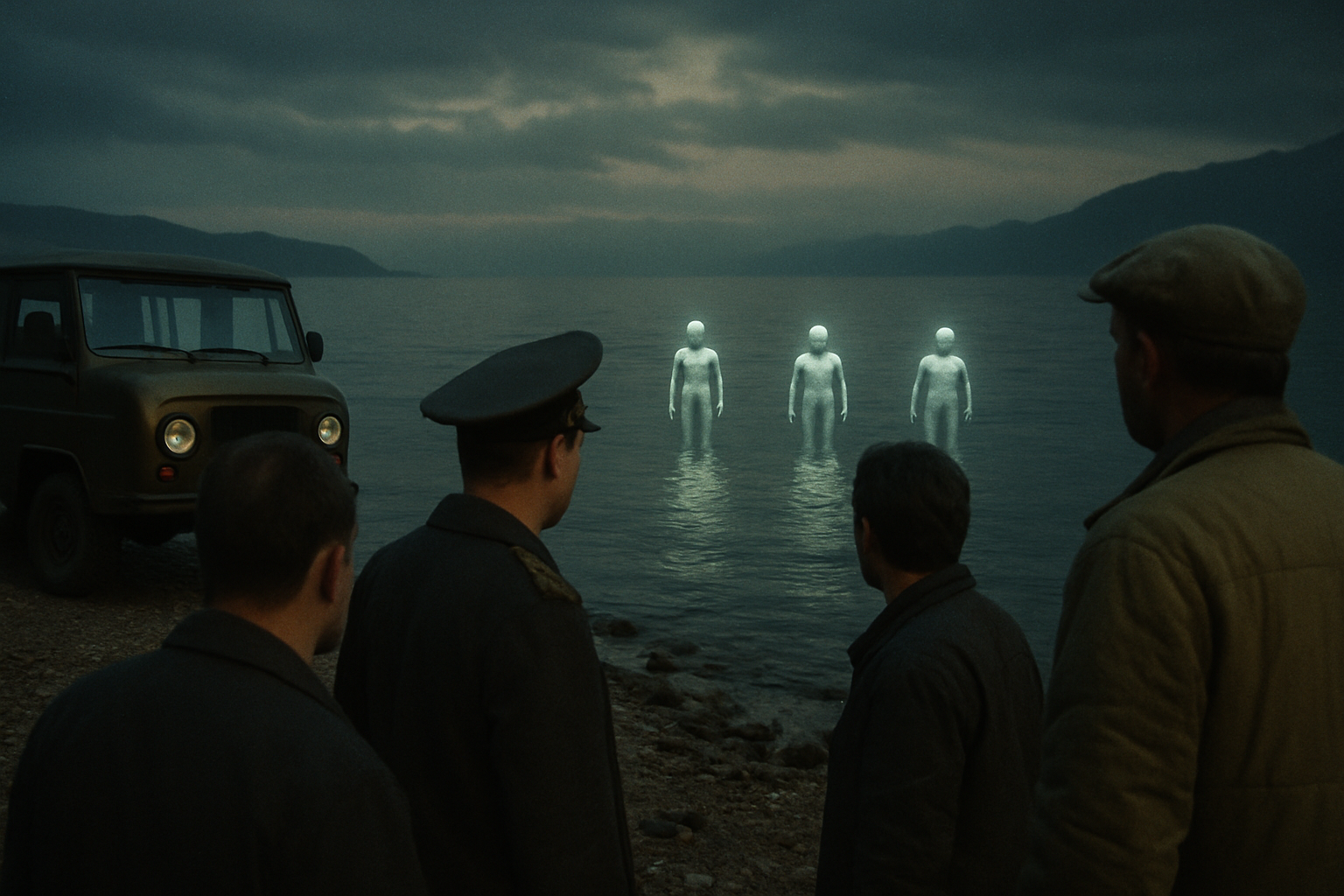
The Lake Baikal underwater swimmers (Russian: Байкальские подводные пловцы, *Baykalskiye podvodnye plovtsy*) is a Soviet and Russian unidentified-submerged-object (USO) legend set in the summer of 1982 at Lake Baikal in Siberia. According to the story, Soviet military divers training at a depth of about 50 metres encountered humanoid beings roughly three metres tall, dressed in tight silvery suits and spherical helmets and moving without any breathing apparatus; when several divers were ordered to capture one with a net, an unexplained force threw the group to the surface, causing decompression sickness that reportedly killed three and disabled the others.[1][2]
The account is not supported by any contemporaneous record. It first appeared in print in 1992, a decade after the claimed event, in an article by the diving instructor Mark Shteynberg in the ufological magazine *Anomaliya*, who presented it not as something he had witnessed but as a cautionary tale told to trainees at Lake Issyk-Kul by a visiting senior officer, Major-General Demyanenko.[6][3] Popularised by the ufologist Vladimir Azhazha, the story circulated widely in Russian-language UFO literature and later in English-language paranormal media.[3][7] Russian commentators and a detailed local investigation regard it as folklore rather than a documented incident.[4][5] The case does not have a dedicated Wikipedia article in any language.[4]
The account
As usually retold, the events occurred in the summer of 1982 during a Soviet military diving exercise at Lake Baikal. Divers working at a depth of about 50 metres (164 ft) are said to have noticed swimmers approaching them: humanoid figures about three metres tall, wearing close-fitting silvery suits and spherical helmets, with no oxygen tanks or other deep-diving equipment, who moved rapidly and appeared to observe the divers.[1][2]
After reporting the sighting, the divers were reportedly ordered to attempt a capture. In the most common version, a group of seven (sometimes given as eight) tried to throw a net over one of the beings; at that moment a powerful impulse or force ejected the entire group toward the surface. The rapid uncontrolled ascent caused decompression sickness (caisson disease), said to have killed three of the divers and left the others permanently disabled.[1][2][3]
The figures are often linked in the literature to a broader cluster of Soviet "giant underwater swimmer" claims, and the accounts vary in the number of divers, the precise location and the supposed motive for the capture order.[3][7]
Origin and transmission
The earliest known published source is an article by Mark Shteynberg (Марк Штейнберг), a Soviet military diving instructor, in the magazine ***Anomaliya* (Аномалия), issue 4, 1992** — roughly ten years after the supposed event and during the post-Soviet wave of previously suppressed and newly invented sensational stories.[6][3]
Crucially, Shteynberg did not claim to have witnessed the encounter. He wrote that, while he and Lieutenant Colonel Gennady Zverev (Геннадий Зверев) were conducting reconnaissance-diver training at Lake Issyk-Kul in the Kyrgyz SSR, they were visited by Major-General V. Demyanenko (генерал-майор Демьяненко), head of the Military Diver Service of the Engineer Forces of the USSR Ministry of Defence. Demyanenko reportedly recounted the Baikal episode as a warning about the dangers of uncontrolled ascent and decompression, telling them it had happened to another unit.[6][3]
The story was subsequently adopted and repeated by the prominent ufologist Vladimir Azhazha (Владимир Ажажа) — a former specialist who became an advocate of extraterrestrial visitation — in his UFO books and in television documentaries, and it later entered English-language paranormal media largely through the work of writers such as Paul Stonehill.[3][7] By the chain of custody, the most that can be established is a third- or fourth-hand retelling of an oral anecdote, with all named figures reaching the reader through Shteynberg's single account.[6]
Skeptical assessment
The story has no reliable provenance: there is no original document, casualty list, unit log, court of inquiry, obituary or medical report tying three dead frogmen to Baikal in 1982, and it was not part of any official disclosure.[6]
A detailed investigation by the Irkutsk-based researcher Sergey Volkov (Сергей Волков) identified several specific problems:[4]
- Chronology. The specialised diver-training centre at Severobaykalsk in northern Baikal — the facility usually implied as the site — was established only on 28 October 1996, fourteen years after the claimed event; no decompression chamber or comparable dive operation existed there in 1982.
- Source verification. Volkov reported that he personally interviewed Vladimir Azhazha, who acknowledged that he had never been to Lake Baikal and could not recall the source of his published account of the 1982 deaths.
- Local knowledge. Divers, military personnel and residents in the Severobaykalsk and Irkutsk areas, contacted over repeated visits, knew nothing of any such fatalities.
On these grounds Volkov concluded that the episode is literary fiction rather than documented history, perpetuated by enthusiasts living far from the lake who added embellishments over time.[4] Diver-training specialists have separately pointed to practical implausibilities, such as the difficulty of deploying a net at 50 metres.[1]
Context and reception
The Baikal swimmers belong to a small group of late-Soviet and post-Soviet USO and "underwater base" legends centred on the country's deep lakes, which Russian mainstream outlets such as RIA Novosti survey as part of regional folklore — alongside claims of secret alien bases and optical illusions over the lake — without endorsing them as fact.[5]
The tale has proved durable in English-language paranormal media and podcasts, where it is frequently presented as a "declassified" Soviet encounter; such framings overstate the evidence, since no declassification of any Baikal diver file has been demonstrated and the trail leads back to a single 1992 magazine article.[7][6] Within Russian-language discussion the case is generally treated as disputed or unsubstantiated, an example of how a verbally transmitted cautionary anecdote can harden, over a decade and several retellings, into a fixed "incident" with specific casualties.[3][4]
Key quotes
“The divers are said to have encountered, at about 50 metres' depth, swimmers roughly three metres tall in silvery suits and spherical helmets, with no deep-diving equipment of any kind.
“The investigator Volkov reported that, when interviewed, Azhazha admitted he had never been to Lake Baikal and could not recall the source of his account.
References
- 1.
- 2.
- 3.
- 4.
- 5.
- 6.
- 7.
Similar cases
Scored on agency / year proximity / region / tag overlap — same agency +3, near year +4, same region +2, shared tag ×2.