Voronezh UFO incident
Illustrations
AI-generated illustration — not actual footage or evidence; an interpretive depiction based on the documented account

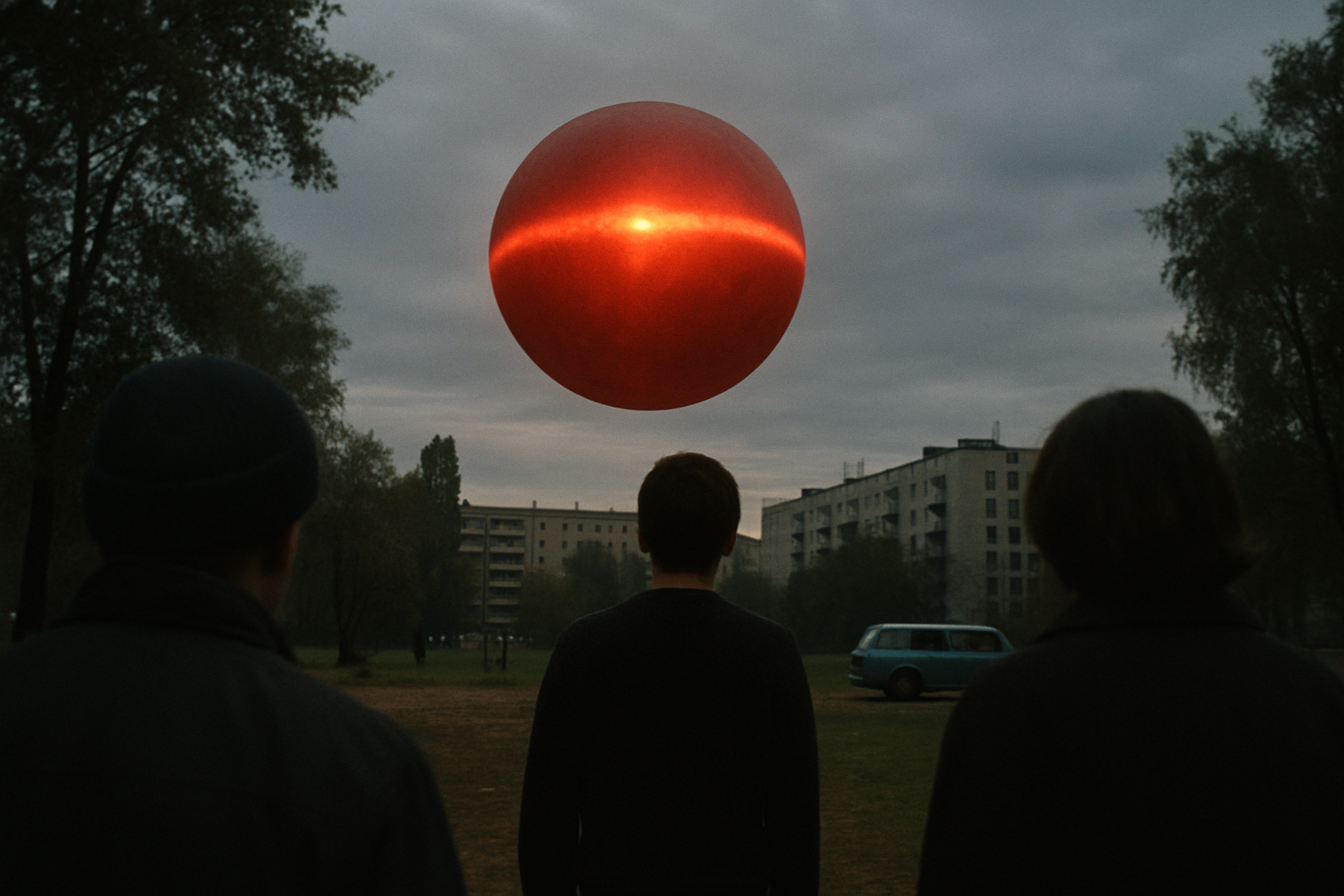

The Voronezh UFO incident was an alleged sighting of an unidentified flying object (UFO) and of extraterrestrial beings reported on 27 September 1989 by a group of children in a public park in Voronezh, an industrial city of about one million people in the southwestern part of the Russian SFSR, then part of the Soviet Union.[1][2] According to the accounts, children playing in the park saw a pink glow in the sky followed by a deep-red ball about three metres in diameter that circled, vanished, and reappeared while hovering; a tall "three-eyed" humanoid wearing bronze-coloured boots with a disk on its chest, accompanied by a robot, was said to have emerged.[1][3] The episode drew worldwide attention chiefly because the official Soviet news agency TASS reported it on 9 October 1989, a striking departure made possible by the policy of *glasnost* (openness).[2][3] The report was met with widespread skepticism in the Western and Soviet press; the children remained essentially the only witnesses to the beings, a scientist quoted as confirming a landing site later disputed those remarks, and a purported alien rock was identified as ordinary hematite.[1][2]
Background
Voronezh is a major industrial city on the Voronezh River in the southwestern part of the Russian republic of the Soviet Union, with a population of roughly one million at the time of the reports.[1][2]
The incident emerged during a period of unusual openness in the Soviet media. Under Mikhail Gorbachev's policy of glasnost, Soviet outlets increasingly carried material that earlier would have been suppressed, including stories about the paranormal.[2] The late 1980s and early 1990s saw a wave of reports about psychics, healers and UFOs in the Soviet and post-Soviet press, a phenomenon some later commentators interpreted as filling a void left by the crisis of official ideology.[2] It was against this backdrop that a local UFO report from a provincial park was picked up by the central state news agency and transmitted around the world.[2][3]
The reported encounter
The events were said to have taken place on the evening of 27 September 1989 in a park in Voronezh, where several children were playing.[1][2]
As relayed by TASS and the international press, the principal claims were:
- The witnesses first saw a pink glow in the sky, then a deep-red ball about three metres in diameter that circled, disappeared, and reappeared minutes later, hovering over the park.[1][3]
- From the object emerged a tall "three-eyed" humanoid described as wearing silvery overalls and bronze-coloured boots, with a disk on its chest, together with a robot-like figure.[1][3]
- According to the children, the being directed a tube- or ray-like device at a 16-year-old boy, who appeared to vanish and then returned after the craft departed.[1][3]
TASS described the witnesses as "10 or 12 youths."[1] Although the children were essentially the only people who claimed to have seen the beings themselves, a local police officer, Lieutenant Sergei A. Matveyev of the Voronezh district police station, was quoted as saying he had seen "a body flying in the sky," while not claiming to have observed the entities.[1][3] Reports also mentioned a depression and markings found at the supposed landing site.[3][2]
Reporting and investigation
The case became internationally prominent when TASS issued a dispatch on 9 October 1989 stating that scientists had confirmed a UFO landing in a Voronezh park.[3][2] Western outlets including *The New York Times* and the Associated Press carried the story, and it was discussed on American television programmes, an unusual level of attention for a Soviet provincial report.[1][3]
The early reporting cited Genrikh M. Silanov, head of the Voronezh Geophysical Laboratory, who was quoted as having identified the landing site. One widely circulated remark attributed to him was that the site had been located "by means of biolocation" — a dowsing- or ESP-style method.[1][2] Silanov subsequently distanced himself from the sensational coverage. He was quoted in the Soviet newspaper *Socialist Industry* warning, in substance, not to believe everything TASS had printed, and saying that much of what was published had not come from his laboratory; he also denied having performed the experiment as described.[1]
Scientific checks were reported to have followed. According to a contemporaneous wire account, a Soviet scientific commission ordered radiometric, microbiological and spectro-chemical analyses of soil and vegetation at the site, which were said to have found no clear anomaly; a rock presented as extraterrestrial was identified as hematite, an iron-ore mineral common in the region.[1][2] Elevated readings of the radioactive isotope caesium detected in the area were attributed not to alien activity but to fallout from the 1986 Chernobyl disaster.[1]
Explanations and disputes
From the outset the Voronezh report was treated with strong skepticism, even as it circulated widely.[2][1]
Skeptical and conventional explanations emphasised the nature of the testimony and the absence of corroborating physical evidence:
- The beings were described essentially only by children. A Soviet television crew led by correspondent Vladimir Posner reportedly could find no adult witnesses to the entities and suggested that the imaginations of young children may have been at work, drawing a comparison with American UFO cases.[1]
- Officials and academics expressed doubt: a vice-rector of a Voronezh university was reported to have dismissed the account as fiction.[1]
- The principal physical claims did not survive scrutiny — the supposed alien rock proved to be ordinary hematite, soil and vegetation tests showed no clear anomaly, and the raised caesium readings were explained by Chernobyl fallout.[1][2]
- Commentators noted similarities between the Voronezh narrative and earlier published UFO and science-fiction stories, raising the possibility of influence on the children's accounts; TASS reported that the witnesses said they had not read such material.[1]
Proponents and the anomalous account pointed to the consistency of the children's drawings and descriptions, the reported physical traces at the site, and the corroborating glimpse described by Lt. Matveyev.[1][3] Because the case rests almost entirely on witness testimony — much of it from children — and because the most concrete physical claims were explained conventionally, it is generally classed among unverified and disputed reports rather than confirmed events.[2][1]
Aftermath and significance
The Voronezh report became one of the best-known UFO stories to come out of the late Soviet period, less for the strength of its evidence than for the remarkable fact that it was carried by the state news agency.[2][1]
In the wake of the publicity, the episode took on a commercial dimension: a private enterprise was reported to have marketed tours promoting Voronezh as the "land of the aliens," charging a fee of around 59 rubles per person.[1] More broadly, the affair has been cited as a notable example of the surge of paranormal and UFO material in Soviet and post-Soviet media during the late 1980s and early 1990s — described by some analysts as a kind of "new opiate for the masses" amid the crisis of the official worldview.[2]
In retrospective coverage, the Voronezh incident is most often presented as a case study in how an unverified provincial report, amplified by *glasnost*-era openness and a major wire service, could circle the globe — and how quickly its more dramatic physical claims unravelled under examination.[2][1]
Key quotes
“Silanov was quoted as saying the landing site was identified "by means of biolocation," a remark he later disputed.
“Lt. Matveyev was quoted as saying he had seen "a body flying in the sky."
References
- 1.
- 2.
- 3.
Similar cases
Scored on agency / year proximity / region / tag overlap — same agency +3, near year +4, same region +2, shared tag ×2.