Ariel School / Ruwa encounter
Illustrations
AI-generated illustration — not actual footage or evidence; an interpretive depiction based on the documented account
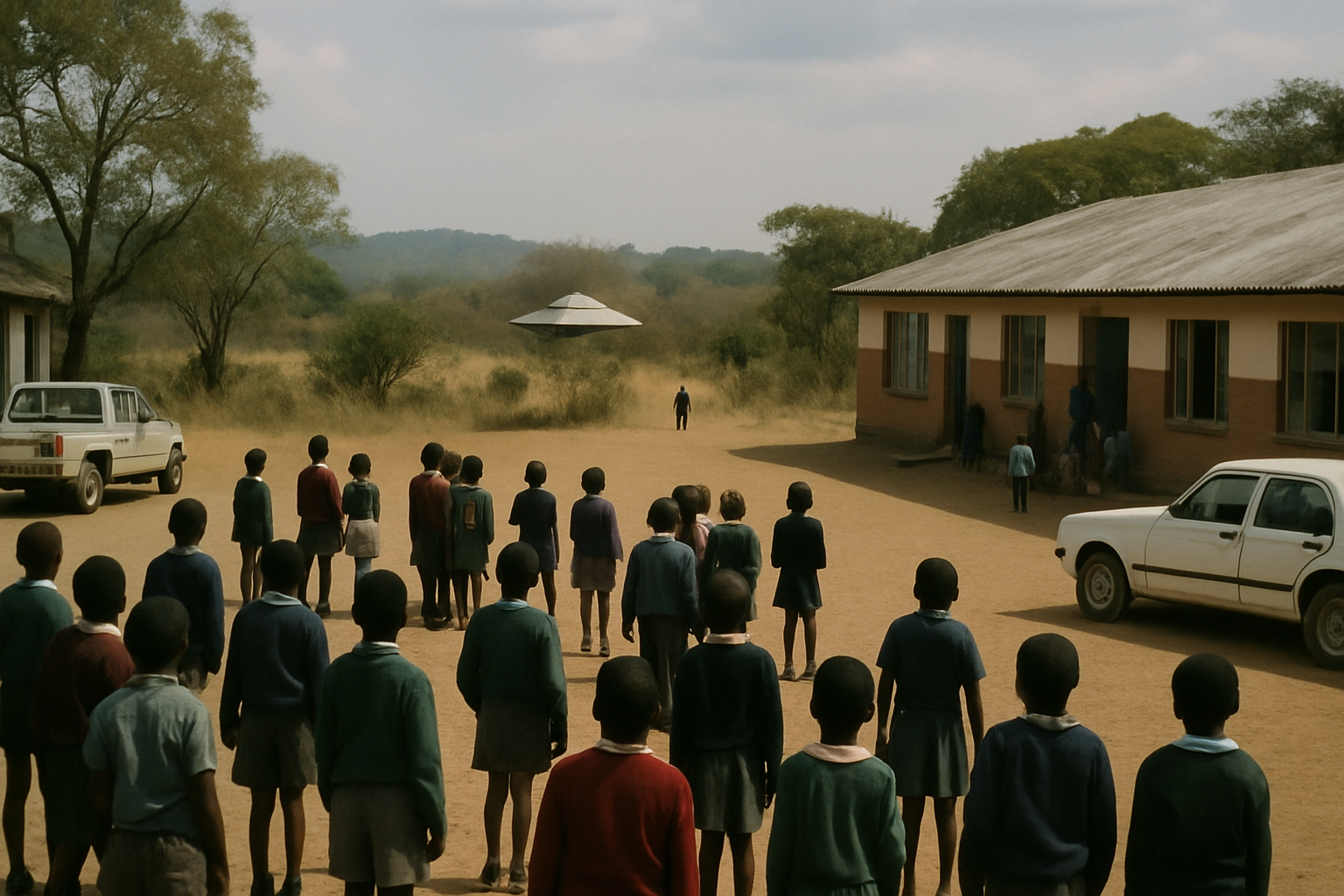
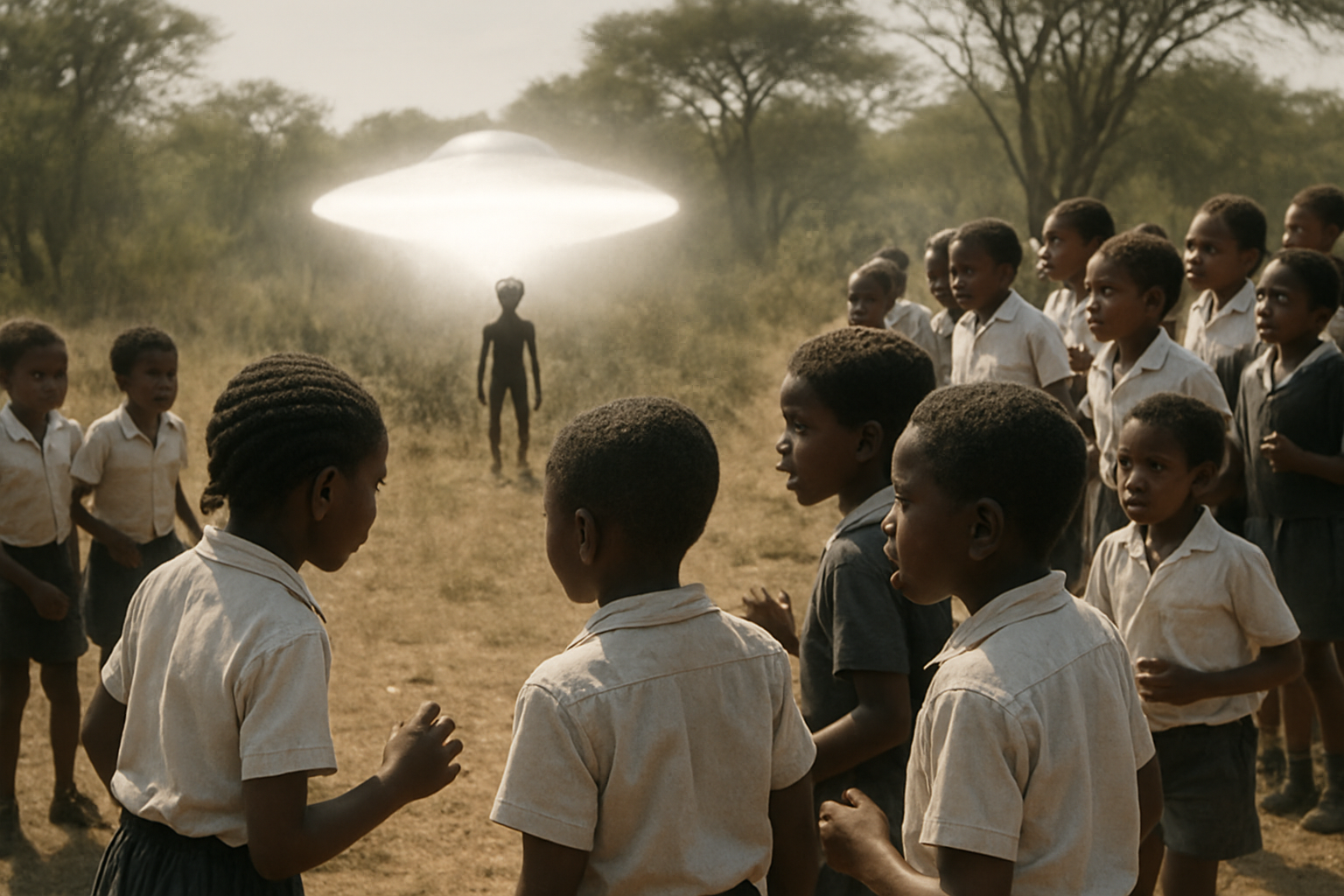
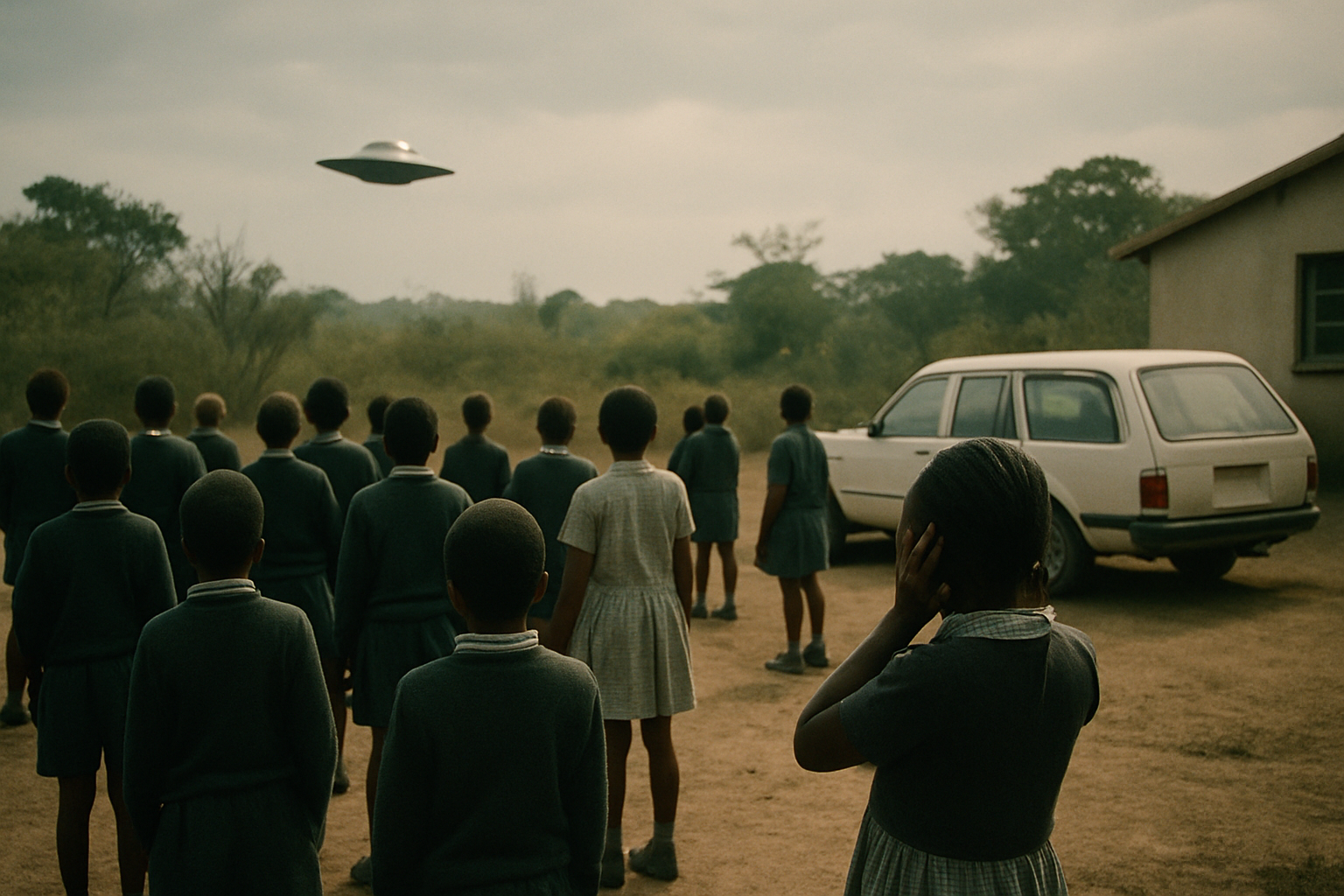
The Ariel School incident (also called the Ruwa encounter) was a reported sighting of an unidentified flying object (UFO) and of apparent extraterrestrial beings at Ariel School, a private primary school in Ruwa, Zimbabwe, about 22 km southeast of the capital, Harare, on the morning of 16 September 1994.[1][2] During the mid-morning break, with most teachers indoors, a group of children playing outside reported that one or more silver, disc-shaped craft descended and came to rest in a field of brush and small trees just beyond the school's boundary; one or more figures with large eyes, dressed in black, were said to have emerged and approached the pupils before the object left.[1][2] About 62 children, aged roughly 6 to 12, were reported to have described the event, which lasted around 15 minutes.[1][2] The story was picked up by Zimbabwean radio and then investigated by the BBC's local correspondent Tim Leach, by the veteran African UFO researcher Cynthia Hind, and, two months later, by Dr. John E. Mack, a Harvard professor of psychiatry known for his work on alleged abduction experiences.[1][3] No physical evidence confirmed the encounter, and skeptics have proposed explanations ranging from mass suggestion and misidentification to hoaxing; the case is consequently regarded as disputed, while remaining one of the most discussed close-encounter reports of the 1990s.[1][2]
Background
Ariel School is a private primary school in Ruwa, a town roughly 22 km southeast of Harare, Zimbabwe.[1][2] In September 1994 it served children of mixed local and expatriate backgrounds, and the encounter is said to have involved pupils ranging from about 6 to 12 years of age.[1]
The sighting occurred during a period of heightened UFO reports in southern Africa. In the days before the incident, observers across the region had reported lights and a fireball in the night sky, and some writers have noted that this prior "wave" may have primed expectations.[1] One conventional candidate for the preceding spectacle was the re-entry of space debris: the skeptic Brian Dunning has linked a fireball seen in the region to the re-entry of a Zenit-2 rocket associated with the launch of the Cosmos 2290 satellite.[1]
The reported encounter
According to the accounts gathered shortly afterwards, the events took place during the mid-morning break on 16 September 1994, when many pupils were outside and most staff were not.[1][2] The principal claims, as relayed by the children and their interviewers, were:
- One or more silver, disc-shaped objects were seen in the sky; at least one descended and appeared to land in a field of brush and small trees just beyond the playground.[1][2]
- Between one and four beings with large eyes, dressed entirely in black, were said to have emerged from or appeared near the craft and to have moved toward the children.[1][2] Some descriptions characterised the figures as humanlike with pale or waxy skin and long dark hair.[2]
- Several children reported that the being or beings communicated not by speech but by impressions or thoughts, conveying an environmental warning. In interviews recorded by John Mack, one pupil said the message was, in effect, that "pollution mustn't be," and another, aged about eleven, said: "I think they want people to know that we're actually making harm on this world."[1]
- The whole episode was said to have lasted about 15 minutes, after which the object departed.[1][2]
Not all the children present claimed to have seen the same thing: some reported the craft and beings in vivid detail, while others said they had seen little or nothing unusual.[2] Teachers, who were largely indoors at the time, did not witness the central events and initially treated the reports with caution.[1][2]
Investigation and reporting
The account first spread through Zimbabwean media, including radio coverage, which drew the attention of outside investigators.[1][2]
- Tim Leach, the BBC's Zimbabwe correspondent, visited the school on 19 September 1994, three days after the incident, and filmed interviews with the children.[1][2] He later described the experience as deeply unsettling, and is quoted as saying that he could handle war zones but "could not handle this."[2]
- Cynthia Hind, a long-established UFO researcher in Africa, came to the school on 20 September 1994. She interviewed the pupils and asked them to draw what they had seen, reporting that the accounts and drawings were broadly consistent with one another.[1][2]
- In November 1994, Dr. John E. Mack, a professor of psychiatry at Harvard University who had become known for studying people who reported abduction experiences, travelled to Zimbabwe and interviewed the children in person.[1][3] Mack emphasised the apparent sincerity of the testimony, later saying of the children that "these are not stories they made up."[3] It was in Mack's interviews that the environmental-message component was most prominently recorded.[1]
No physical traces were established that could independently confirm a landing, and the case rests essentially on the testimony and drawings of the children and the impressions of the adults who interviewed them.[1][2]
Explanations and disputes
From the outset the Ariel School report has been treated as controversial, and a range of conventional and skeptical explanations has been advanced.[1][2]
Skeptical and conventional explanations include:
- Mass suggestion or hysteria, in which an initially small number of vivid accounts, set against a regional UFO "wave," spread among excited children, so that some came to believe they had seen more than they did.[1][2]
- Misidentification of a natural or man-made phenomenon, such as a dust devil, or the re-entry of space debris. Brian Dunning has argued that a fireball reported in the region around that time was the re-entry of a Zenit-2 rocket linked to the Cosmos 2290 satellite launch, which could have helped seed expectations of UFOs.[1]
- A hoax or prank: in the Netflix documentary *Encounters* (2023), a former pupil identified as Dallyn claimed the episode had been a hoax — a statement that contradicted both his earlier accounts and the testimony of the other witnesses, and which has not been corroborated.[1]
- Some writers have also raised the possibility that contemporaneous touring shows in Zimbabwe — for example puppet-based programmes promoting AIDS awareness and agricultural practices — may have influenced the imagery the children reported, a hypothesis associated with the writer Gideon Reid.[1]
The anomalous account and its proponents point to the number of independent young witnesses, the broad consistency of their drawings and descriptions, and the strong reaction of experienced adults such as Leach, Hind and Mack.[1][2][3] Critics note that some commentators "give very little evidence" for their preferred explanations, while supporters acknowledge that the case rests on testimony rather than physical proof.[2] Because the central claims cannot be verified and competing accounts persist, the incident is generally classed as disputed rather than confirmed or fully debunked.[1][2]
Aftermath and significance
After the initial interviews, parents reportedly visited the school to discuss the episode with teachers, and the children's accounts continued to circulate in UFO literature and broadcasting.[1][2]
The case became one of the best-known close-encounter reports of the 1990s. The UFO writer Jerome Clark described it as "the most remarkable close encounter of the third kind of the 1990s," and a 2021 BBC programme characterised it as "one of the most significant events in UFO history."[1] Footage from the original 1994 interviews, including material associated with Tim Leach and John Mack, has been re-used in numerous documentaries.[1][3]
In the decades since, the incident has been revisited by journalists and filmmakers — including the Netflix series *Encounters* (2023) and various retrospective features — which have re-interviewed surviving witnesses now in adulthood.[1] Their differing recollections, some maintaining the original account and at least one alleging a hoax, illustrate why the Ariel School encounter continues to be cited both as a striking multiple-witness case and as a cautionary example of how childhood testimony, once gathered, can be difficult to verify or refute.[1][2]
Key quotes
“John Mack said of the children: "These are not stories they made up."
“A child of about eleven said: "I think they want people to know that we're actually making harm on this world."
“BBC correspondent Tim Leach was quoted as saying that he could handle war zones but "could not handle this."
References
- 1.
- 2.
- 3.
Similar cases
Scored on agency / year proximity / region / tag overlap — same agency +3, near year +4, same region +2, shared tag ×2.