Meng Zhaoguo incident (Phoenix Mountain incident)
Illustrations
AI-generated illustration — not actual footage or evidence; an interpretive depiction based on the documented account
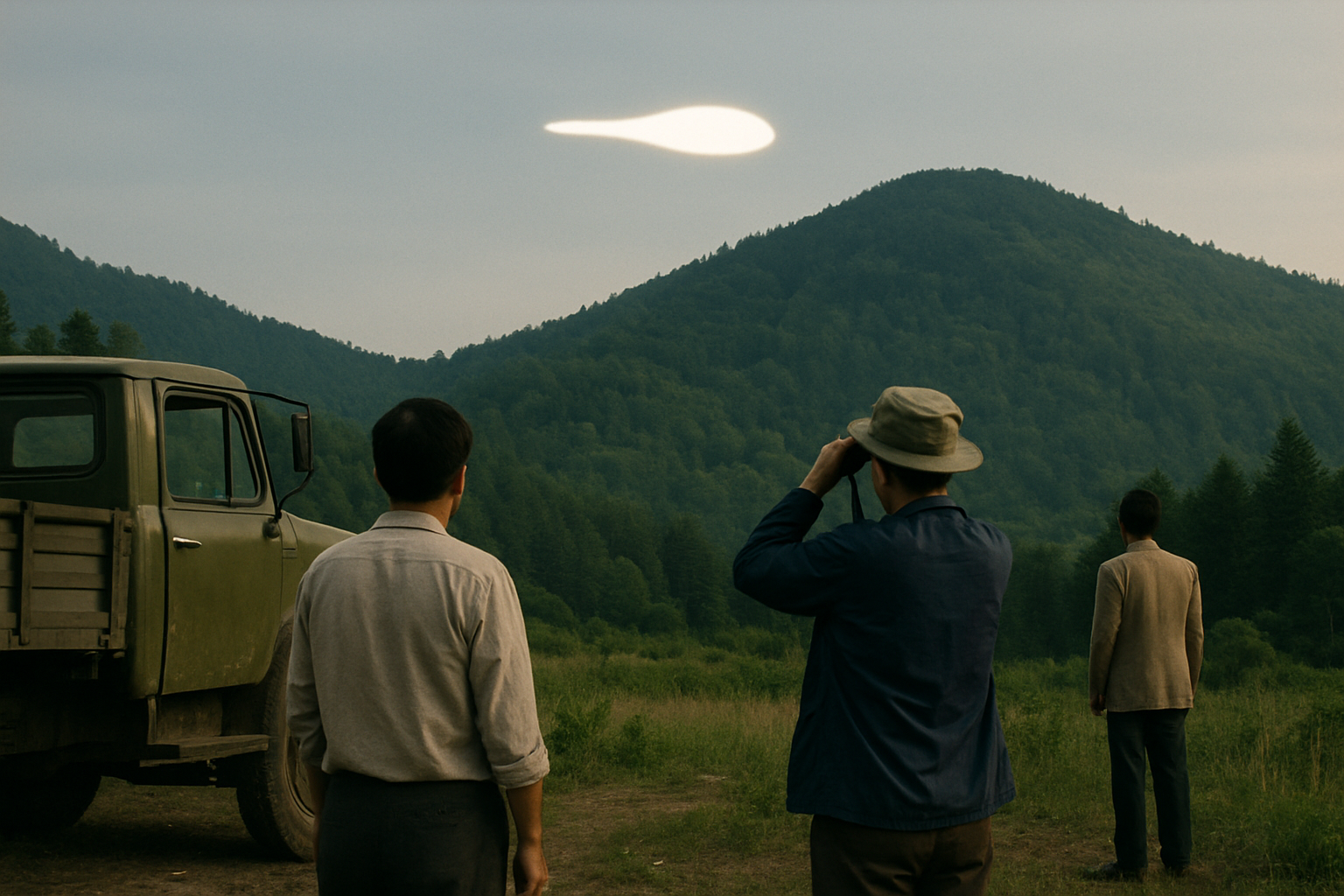
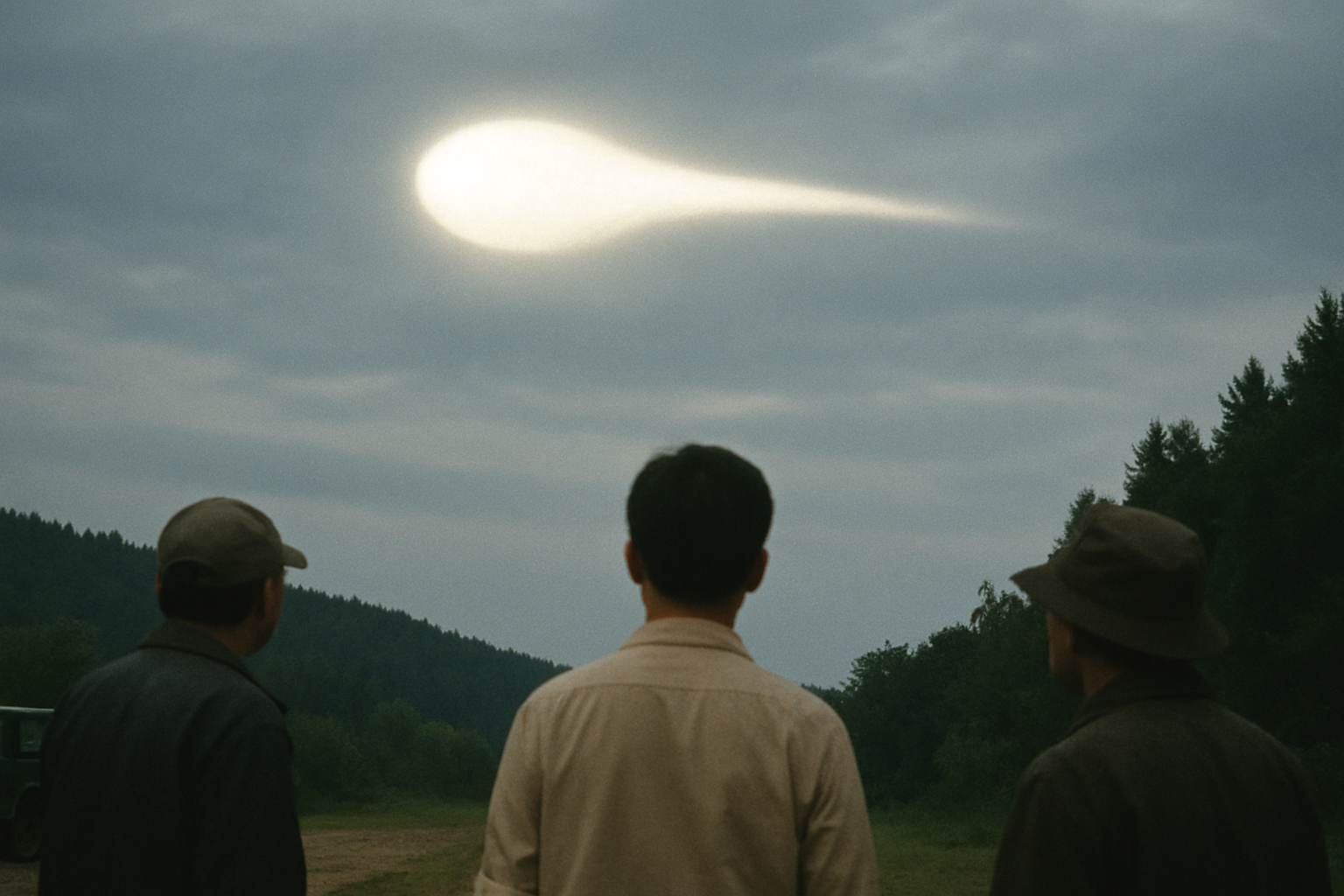
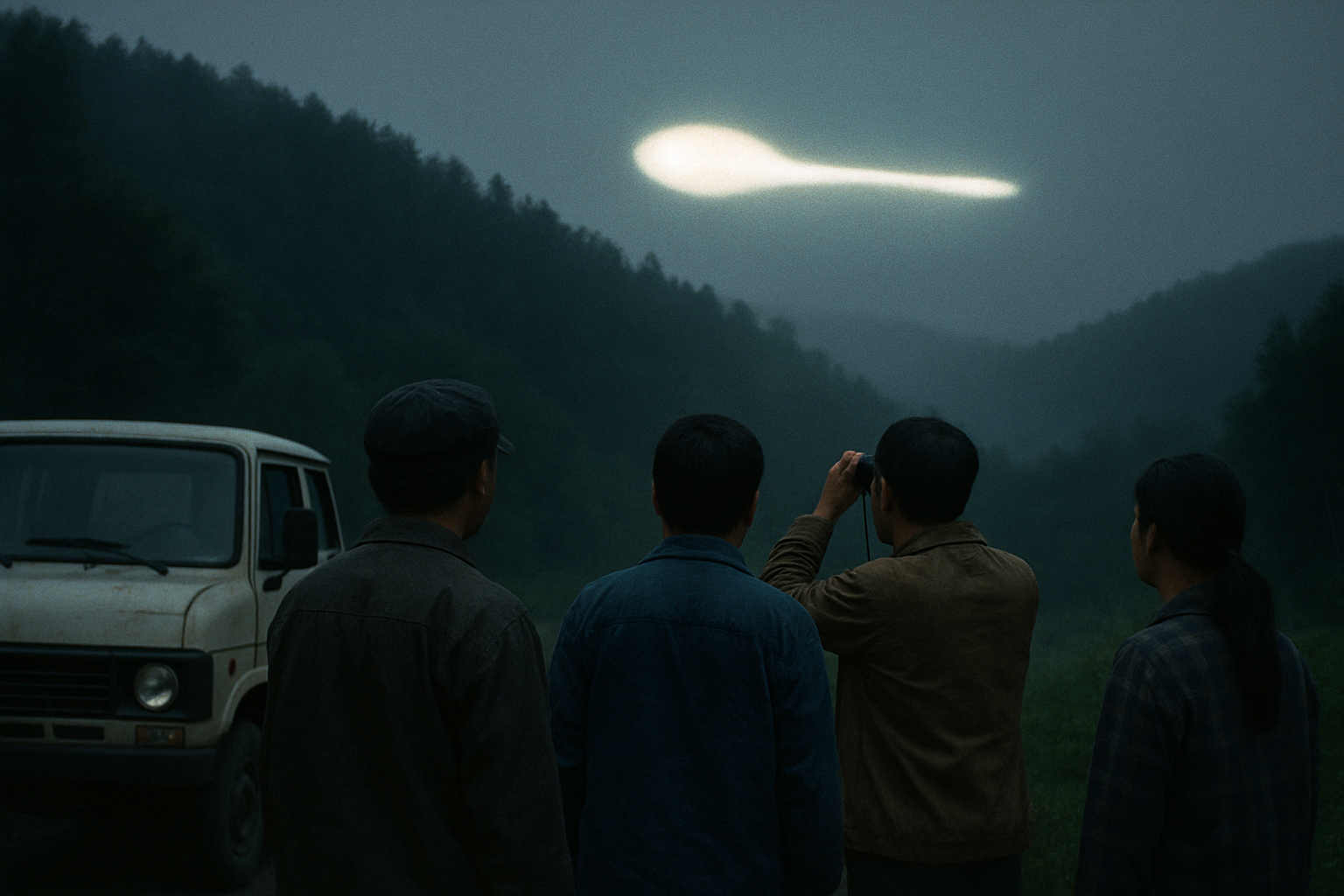
The Meng Zhaoguo incident (Chinese: 孟照國事件), also called the Phoenix Mountain incident (鳳凰山事件), was a report of an unidentified flying object and of alleged contact with extraterrestrial beings that began in June 1994 near the Red Flag (Hongqi) Forest Farm at Phoenix Mountain in Wuchang, Heilongjiang Province, in northeastern China.[1][3] The central figure was Meng Zhaoguo, a young forestry worker, who together with relatives and other villagers said they had seen a white, tadpole-shaped luminous object on the mountain, and who later described a series of close encounters, including being struck by an electric-shock-like force and an alleged abduction.[1][4] In retellings he claimed to have had contact with a female being roughly three metres tall with six fingers on each hand, and to have been taken aboard a craft.[3][6]
The case attracted attention from local police, the New China News Agency, university researchers and Chinese UFO organizations, and Chinese media revisited it in documentaries for years afterward.[1][4] The China UFO Research Organization, with the Beijing UFO Research Organization and other groups, carried out a field investigation and in 1997 issued a preliminary conclusion that the episode was "real," and in 2003 Meng was reported to have passed a polygraph test administered under hypnosis.[1][5] No physical evidence of extraterrestrial origin was produced, however, and most scientists dismissed the account as delusion or mental illness, with critics noting that polygraph examinations are unreliable for people who genuinely believe a false experience.[3][1] It remains one of the best-known UFO cases in China and is far better documented in Chinese than in English, where no dedicated Wikipedia article exists.[2][3]
Background and setting
The events were said to have taken place around Phoenix Mountain (Fenghuang Shan), near the Red Flag (Hongqi) Forest Farm administered under Wuchang in Heilongjiang Province, a forested, sparsely populated part of northeastern China.[1][4] Meng Zhaoguo was a local forestry worker in his mid-to-late twenties at the time.[3][6]
The reports coincided with a period of strong public interest in UFOs in China, sustained by organizations such as the China UFO Research Organization and the long-running magazine *UFO Exploration* (飛碟探索).[5][1] The episode also became linked in popular accounts with the Comet Shoemaker–Levy 9 impacts on Jupiter, which were observed in July 1994 — close in time to the Phoenix Mountain reports — though commentators have stressed that the coincidence does not establish any connection.[3][7]
The reported encounters
According to accounts summarized on Chinese Wikipedia and in Chinese media, the events unfolded in stages in June 1994:[1][4]
- First sighting (c. 6 June). Villagers near the forest farm reported a large circular or tadpole-shaped luminous object on a slope of Phoenix Mountain. The object was described as cream-white with a yellowish tint and very large.[1][4]
- Approach (c. 7 June). Meng Zhaoguo and his nephew-in-law Li Honghai went to look more closely. As they neared the object Meng reported being struck by an electric-shock-like force, along with eye pain and nausea, and the two retreated.[1][4]
- Collapse (9 June). Led by the forest farm's union chairman, a group of about thirty people climbed the mountain. While viewing the site through binoculars, Meng reportedly collapsed with convulsions and was left with a small scorch mark between his eyebrows, after which he was unconscious for a period.[1][4]
In later retellings, Meng described an alleged abduction and contact: he said a female being about three metres tall with six fingers on each hand visited him, that they had a sexual encounter, and that he was shown an extraterrestrial base and told the visitors' purposes.[3][6] He also reported physical marks on his body, including scars on his leg and torso that investigators later examined.[3][1]
Investigation
The case drew an unusually wide range of investigators for a rural Chinese UFO report, including local public security officers, a New China News Agency journalist and university academics, among them a professor associated with the Harbin Institute of Technology.[1][4] Investigators reported finding scorched tree branches and fractured rocks on the slope, although there was disagreement over whether such marks reflected anything unusual or could be explained by sun exposure, weathering and ordinary erosion.[1][4]
The China UFO Research Organization, together with the Beijing UFO Research Organization and other groups, conducted field examinations after 1994; its expert and academic committees were reported to have issued a preliminary conclusion in 1997 that the UFO event was "real," while not asserting proof of extraterrestrial contact.[1][5] In 2003, the UFO researcher Zhang Jingping arranged for Meng to undergo a polygraph examination under hypnosis, and reported that the results indicated Meng had not lied about the experience; a medical examination was said to have noted that a scar on his thigh did not appear to result from ordinary injury or surgery.[1][3] Chinese television and print media revisited the case repeatedly over the following decade.[1][4]
Explanations and reception
The case has been read in sharply different ways.[1][3]
Skeptical and conventional explanations emphasise the absence of any physical evidence of extraterrestrial origin and the nature of Meng's testimony. Many scientists characterised the abduction narrative as hallucination, confabulation or a sign of mental illness, and some local officials were quoted describing Meng as not credible.[3][1] Critics also note that a polygraph chiefly registers whether a person believes what they are saying; someone with a genuine but false belief, such as a vivid hallucination, can pass such a test, so Meng's result does not confirm the events.[1][3] Reported numerical and descriptive details are said to have shifted between retellings.[1]
Proponents point to the large number of ordinary witnesses to the initial luminous object, the consistency of accounts given to police and outside experts, the unusual tadpole-shaped description (distinct from stereotypical "flying saucer" imagery), and the level of official and academic attention the case received.[1][5] Because the affair rests almost entirely on witness testimony — and because no verified physical artifact has been produced — it is generally classed among disputed and unverified UFO reports rather than confirmed events.[3][2]
Legacy
The Meng Zhaoguo incident is often described as one of the most famous and most discussed UFO cases in China, in part because of its dramatic claims and the breadth of people who looked into it.[3][7] It has been featured in Chinese documentaries, magazine coverage and online discussion for decades, and is sometimes grouped with other well-known Chinese cases of the era.[1][7]
Meng himself is reported to have later moved to Harbin and worked in other jobs while continuing, in interviews, to stand by his account.[1][3] The episode is also an example of a case that is far better documented in Chinese than in English: it is covered at length on Chinese Wikipedia and in Chinese media, whereas English-language reference works treat it only briefly, with no dedicated Wikipedia article.[2][3]
Key quotes
“Zhang Jingping, the UFO researcher who arranged the test, said the polygraph indicated Meng had not lied about the incident.
“Critics note that a person with a genuine but false belief, such as a hallucination, can pass a polygraph, so the result does not confirm the events occurred.
References
- 1.
- 2.
- 3.
- 4.
- 5.
- 6.
- 7.
Similar cases
Scored on agency / year proximity / region / tag overlap — same agency +3, near year +4, same region +2, shared tag ×2.