Kofu Incident (1975)
Illustrations
AI-generated illustration — not actual footage or evidence; an interpretive depiction based on the documented account
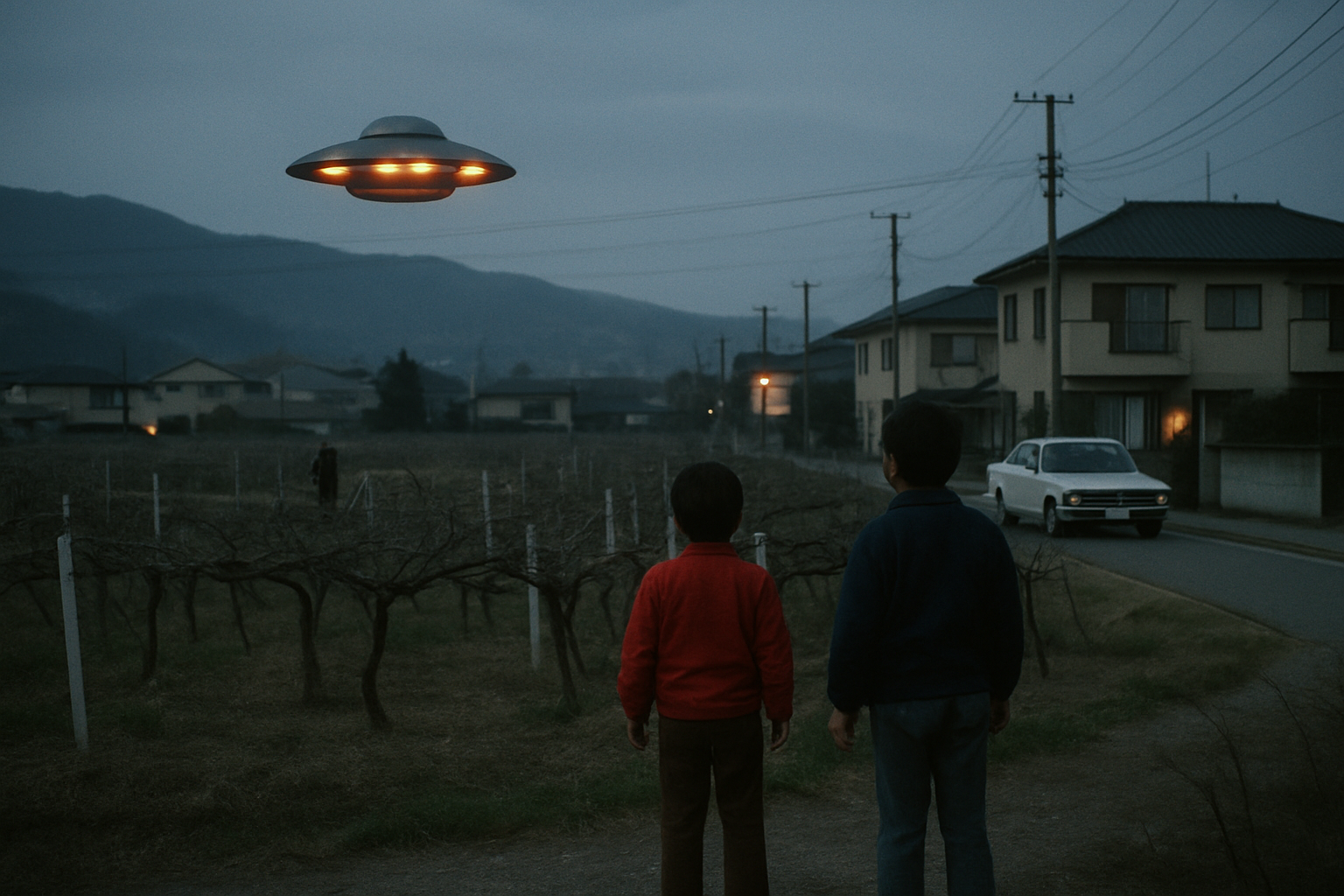
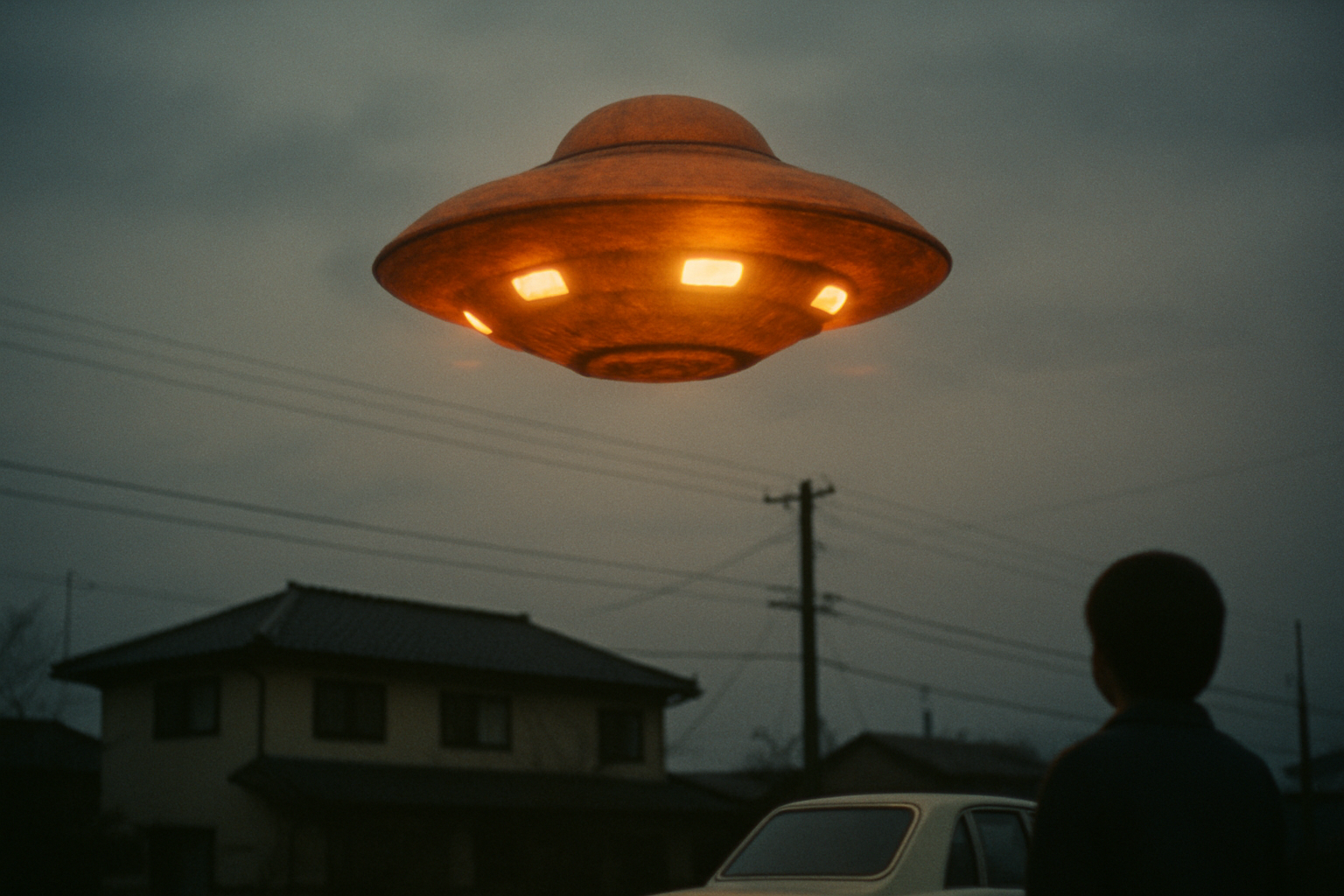
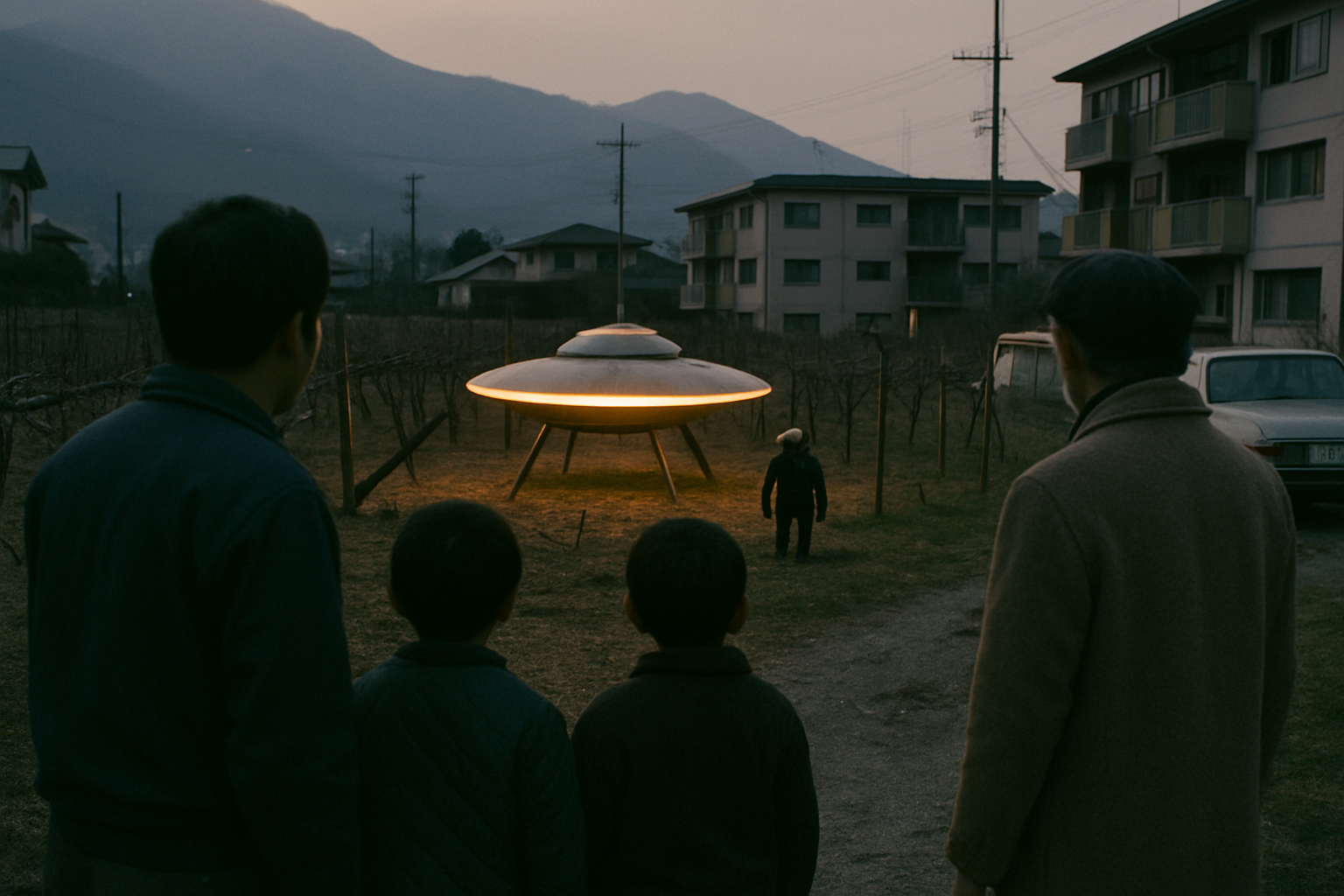
The Kofu Incident (Japanese: 甲府事件, *Kōfu jiken*) is a close-encounter UFO report from the evening of 23 February 1975 in Kofu, the capital of Yamanashi Prefecture in central Japan.[1] Two second-grade boys, cousins Kawano Masato (河野雅人) and Yamahata Katsuhiro (山畠克博), said they saw two orange glowing objects in the sky, that one of them descended into a vineyard, and that a short, wrinkle-faced occupant emerged and tapped Yamahata on the shoulder.[1][2][6] A field survey conducted with the cooperation of the local *Yamanashi Nichinichi Shimbun* newspaper recorded toppled concrete vineyard posts and other ground disturbances, and a science teacher licensed to handle radiation reported detecting artificial residual radioactivity in soil from the site.[1][6] The episode is one of the best-known Japanese UFO cases and is often listed among "Japan's three great UFO incidents," yet several physical inconsistencies and the limits of child testimony have led skeptics to treat it cautiously; it is best characterised as disputed.[2][7] The case continues to attract attention in Japan, including renewed public testimony from one of the witnesses around its fiftieth anniversary, but it remains thinly covered outside Japanese-language sources.[4][5]
The sighting and encounter
According to the accounts later collected from the two boys, on the evening of 23 February 1975, while playing outdoors near a block of company housing in Kofu, Kawano and Yamahata noticed two orange luminous objects in the eastern sky.[1][6] One object moved off into the distance, while the other descended toward the ground. The boys reported that the object appeared to pursue them, and that they fled and briefly hid near a cemetery before returning to look.[1]
They then said the craft had come down in a vineyard behind the housing. The boys described a disc-shaped object several metres across, of metallic or silvery appearance, with spherical landing supports beneath it and unfamiliar markings on its surface.[6] An occupant roughly 130 cm tall was said to have emerged: dark, wrinkled, brown-skinned, with no clearly visible eyes or nose, pointed fang-like teeth, elongated ears and a silvery, glowing garment.[2][6] According to the boys, the figure tapped Yamahata on the shoulder, after which Kawano helped him away and they ran to fetch family members.[1][6]
Investigation and physical traces
The boys' parents, teachers and local UFO researchers questioned them in the following days, and a **field survey was carried out with the cooperation of the *Yamanashi Nichinichi Shimbun* (the Yamanashi daily newspaper).{{cite:1:wiki_ja}}{{cite:6:jikenbo}} Investigators reported that concrete support posts in the vineyard had been broken or toppled, that the wire netting** strung over the vines was depressed as though a heavy object had rested on it, and that there were holes and cart-track-like marks in the ground.[1]
A local high-school teacher licensed to handle radiation collected numerous soil samples at the site and reported detecting artificial residual radioactivity with an unusual decay pattern.[6] Decades later, Japanese researchers associated with the Japan Space Phenomena Society and the magazine *Mu* (ムー) revisited the surviving data and argued that the radioisotope involved was phosphorus-32, a short-lived isotope they noted is produced by neutron irradiation, which they put forward as supporting evidence; this re-analysis has not been independently confirmed.[3] The teacher who made the original measurements himself acknowledged he could not be certain whether any anomalous reading came from the reported object or from atmospheric fallout from contemporary nuclear weapons testing.[6]
Skeptical and conventional assessments
Commentators who doubt the literal account have pointed to several physical inconsistencies. Critics note that the concrete posts were broken while nearby trees were left undamaged, and that an object of the size the boys described could not plausibly have fitted between the posts or down into the netted vineyard rows, making the reported landing geometry difficult to reconcile.[7][1] Some have suggested more mundane sources for the lights, including aircraft, and have observed that the described occupant resembled contemporary Japanese television and toy monsters, raising the possibility of imagination or embellishment by young children whose initial account became difficult to retract.[7]
At the same time, supporters emphasise the consistency of the two boys' independent retellings, the existence of contemporaneous newspaper-assisted documentation, and the reported physical disturbances at the site.[1][6] No single conventional explanation has been established to general agreement, and the case is consequently treated as disputed rather than firmly explained or confirmed.[7]
Legacy and later testimony
The Kofu Incident became one of the most widely discussed UFO cases in Japan and is frequently grouped with other domestic episodes as one of "Japan's three great UFO incidents" (日本三大UFO事件).[2] It has featured in Japanese television programmes, magazines such as *Mu*, and local commemorations around its anniversaries.[3][4]
Around the case's later anniversaries, Yamahata Katsuhiro—the boy said to have been tapped on the shoulder—gave renewed public testimony, including at a Kofu event tied to a crowdfunding project marking the approach of the fiftieth anniversary. He restated his account of the encounter and, in one widely reported new detail, said that the object had vanished on the spot rather than flying away.[4][5] Despite this continuing Japanese interest, the case remains under-documented in English, with coverage largely confined to enthusiast websites; there is no English-language Wikipedia article, and the primary encyclopedic record is in Japanese.[1]
Key quotes
“In later testimony, witness Yamahata Katsuhiro was reported as saying that the object "did not fly away, but vanished on the spot."
References
- 1.
- 2.
- 3.
- 4.
- 5.
- 6.
- 7.
Similar cases
Scored on agency / year proximity / region / tag overlap — same agency +3, near year +4, same region +2, shared tag ×2.