1981 southwestern China spiral object (24 July 1981 spiral event)
Illustrations
AI-generated illustration — not actual footage or evidence; an interpretive depiction based on the documented account
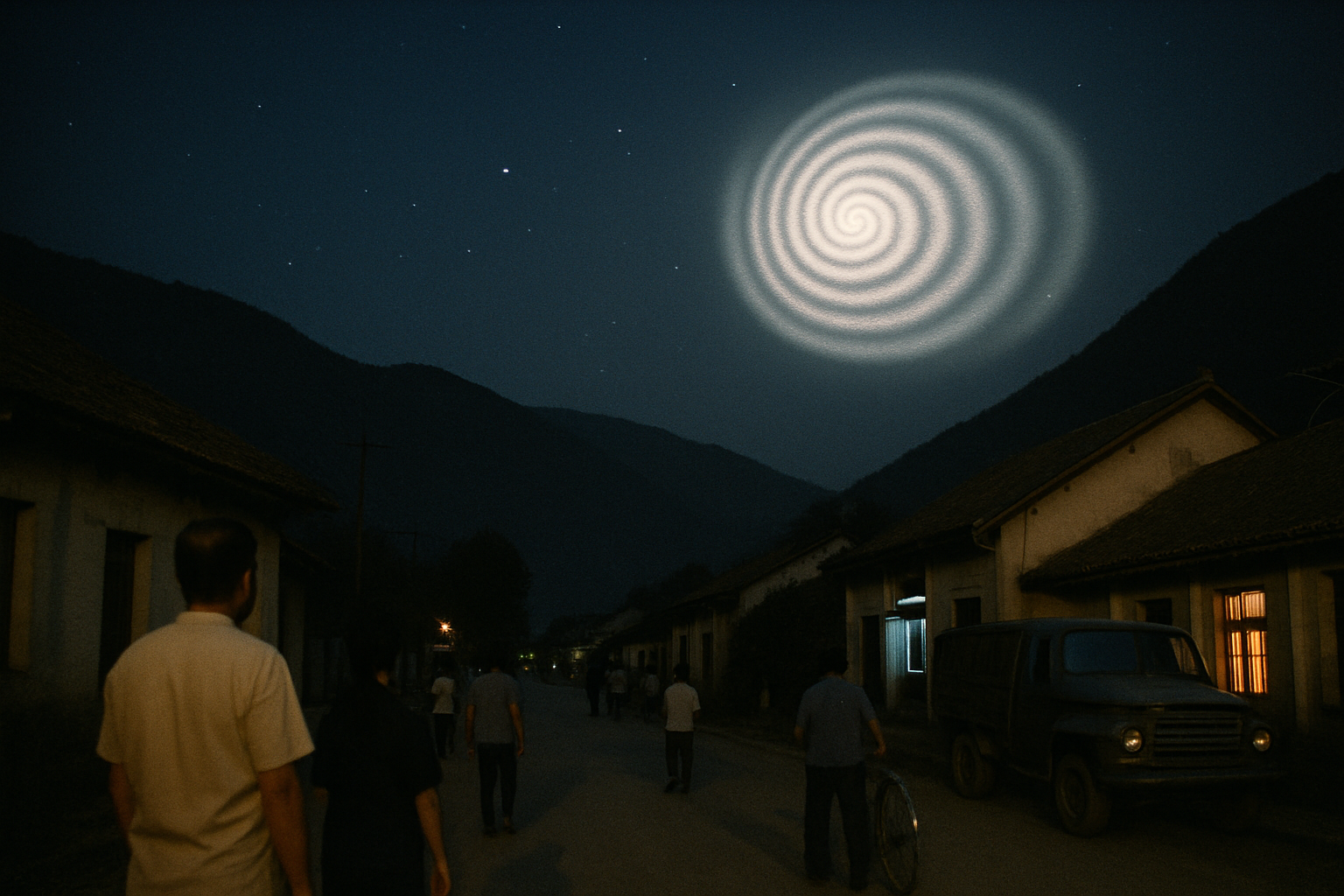
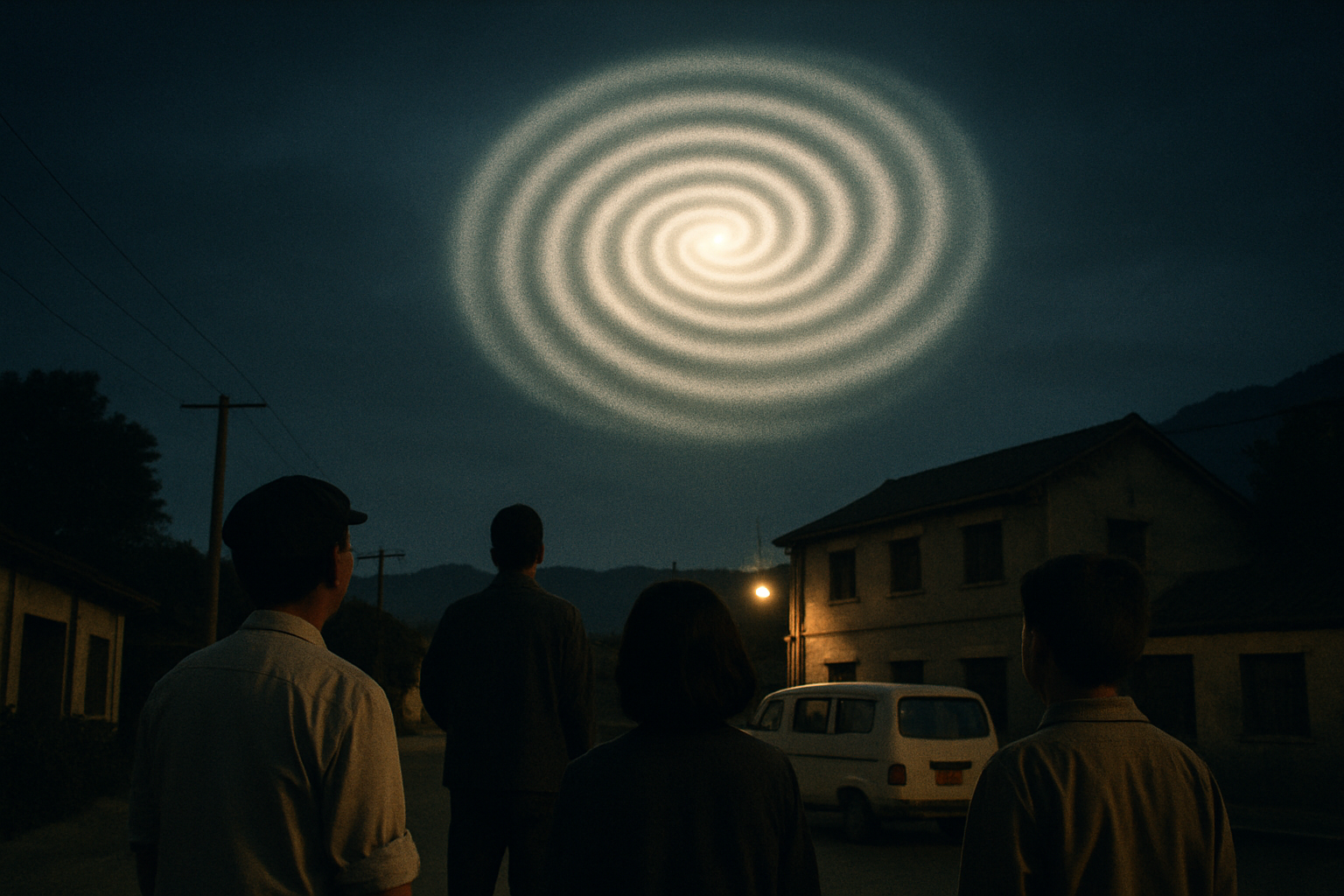
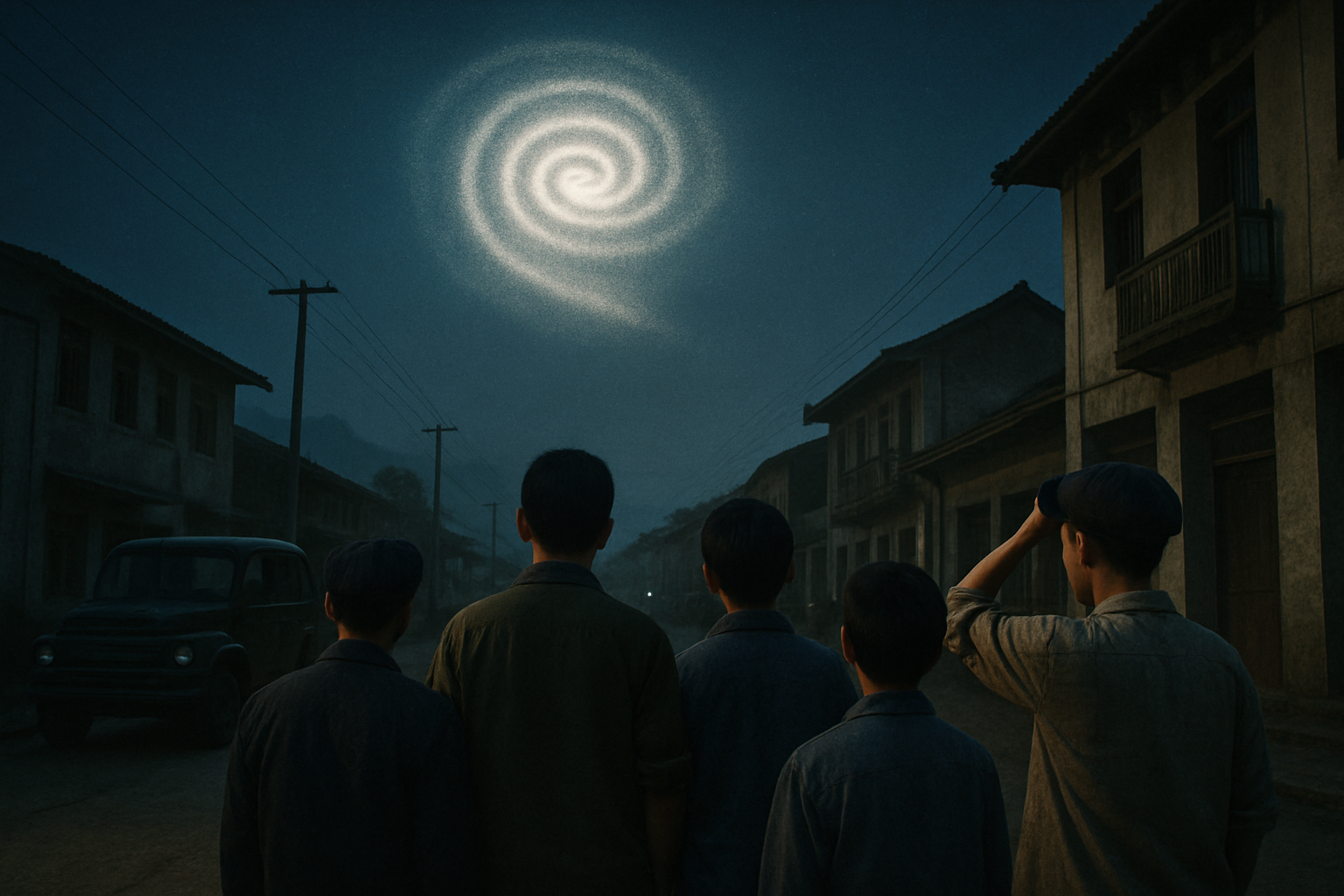
The 1981 southwestern China spiral object was a widely reported sighting on the night of 24 July 1981, at about 22:33–22:52 local time, of a large, slowly rotating luminous spiral in the sky over western and southwestern China.[1][3] Witnesses across more than a dozen provinces and municipalities — among them Gansu, Sichuan, Yunnan, Guizhou, Qinghai and Shaanxi — described a bright point of light that began to turn and unwind into a coil-like spiral, frequently likened to a coil of mosquito-repellent incense, drifting from east to west before fading after several minutes.[1][2] The observers reportedly included several staff of the Purple Mountain Observatory of the Chinese Academy of Sciences, and Chinese-language media and ufological accounts present the case as one of the most widely witnessed unidentified-object events in the country's history, with claims of over a million observers.[3][2] The amateur astronomer Liu Yan, comparing eyewitness reports from different locations, estimated an altitude of about 650 kilometres for the 24 July object and concluded it was most likely a man-made aircraft, publishing the analysis in the magazine *Amateur Astronomer*.[4] Comparable luminous spirals elsewhere have been explained as light rings produced when a tumbling rocket upper stage vents leftover propellant at high altitude, and the cause of the 1981 event remains disputed.[7][4]
The sighting
According to Chinese accounts, on the night of 24 July 1981, between roughly 22:33 and 22:52 local time, observers first noticed a bright, star-like point of light in the clear night sky.[3][1] Over the following minutes the point appeared to rotate and gradually unwind, developing a glowing band that coiled outward into a large spiral shape; many witnesses compared it to a coil of mosquito-repellent incense, and some described it as far larger than the full Moon.[2][1] The luminous spiral drifted slowly from east to west and faded after several minutes before it disappeared toward the west.[1][3]
The phenomenon was reported over a very wide area. Chinese sources list sightings across more than ten provinces and municipalities of western and southwestern China — including Gansu, Sichuan, Yunnan, Guizhou, Qinghai and Shaanxi — note that the witnesses included several staff of the Purple Mountain Observatory, and characterise it as one of the largest UFO observation events, by area and number of witnesses (with claims of over a million), in the country's recorded history.[3][2]
Investigation and analysis
The analysis of the 24 July event most often cited in English coverage was carried out by the amateur astronomer Liu Yan. According to *Sixth Tone*, Liu compared eyewitness reports of the apparent position and size of the object from more than one location and concluded that the 24 July object was likely a man-made aircraft flying at an altitude of about 650 kilometres; he published the result in the magazine *Amateur Astronomer*, his first article on UFOs.[4] Liu's colleague Wang Sichao (1937–2016), a researcher and planetary astronomer at the Purple Mountain Observatory (Zijinshan Observatory) of the Chinese Academy of Sciences who collected and analysed Chinese UFO reports from the 1970s onward, was associated with the case in the public mind and called for a rapid observation network so that widely separated witnesses could be coordinated.[4][5]
The ~650 km altitude figure should be treated with caution: the same value (alongside a figure of about 1,460 km) is attached in the Chinese-language literature to a *different* incident — Wang Sichao's analysis of an October 1998 sighting — so it is not a settled, uniquely 1981 measurement.[5][4] These quantitative estimates were contemporaneous interpretations and have not been independently confirmed.
Explanations
A range of explanations has been offered for the 1981 spiral, and the case is best described as disputed rather than settled.[4][7]
- Rocket or upper-stage fuel venting. The leading conventional explanation for luminous spirals of this kind is that a rocket upper stage, after releasing its payload, tumbles or spins while venting leftover propellant at very high altitude; the fuel freezes into reflective particles that are flung outward and, lit by sunlight while the ground below is dark, trace a slowly expanding spiral. This mechanism has been documented for spirals over Norway in 2009 and for numerous SpaceX launches in the 2020s.[7][4] *Sixth Tone* notes that, in the assessment associated with this research, UFOs above about 100 kilometres in the shape of a spiral, arc, horn or spring tend simply to be high-altitude man-made objects, such as the residual traces left by fuel released from jettisoned rockets.[4]
- Man-made aircraft at high altitude. The amateur astronomer Liu Yan, who analysed eyewitness reports of the 24 July 1981 event, concluded that the source was most plausibly a man-made aircraft at an altitude of about 650 kilometres rather than a natural body — a conclusion broadly consistent with the rocket-activity reading.[4][1]
- Anomalous interpretation. Some Chinese ufological accounts have stressed features they considered hard to explain — notably the apparent east-to-west motion, since many satellites are launched eastward to exploit Earth's rotation — and have treated the case as not fully accounted for by conventional explanations.[2][1]
No single explanation has achieved universal acceptance for the specific 1981 report, but the broad scientific understanding of large sky spirals as a by-product of rocket activity, together with Liu Yan's man-made-aircraft conclusion, provides the most widely cited account.[7][4]
Context and legacy
The 24 July 1981 spiral became a touchstone in the development of organised UFO interest in China during the 1980s, a period when the magazine *UFO Exploration* (飛碟探索) and bodies such as the China UFO Research Organization brought together enthusiasts and some scientists.[2][3] It is frequently ranked in Chinese-language listicles of the country's most notable sightings and is often paired with later, similar spiral reports.[3][2]
The event also illustrates a recurring pattern: spectacular, widely seen sky spirals that generate intense public interest and are later associated, in the broader literature, with high-altitude rocket activity.[7][4] The 24 July analysis was published by the amateur astronomer Liu Yan, while his colleague Wang Sichao (1937–2016) became China's best-known public commentator on unidentified aerial phenomena until his death.[4][6] The 1981 spiral does not have a dedicated Wikipedia article in any language; documentation of the case is found chiefly in Chinese-language media and ufological sources, and in English-language coverage of Wang Sichao and Liu Yan.[4]
Key quotes
“Witnesses described a huge, slowly rotating luminous spiral resembling a coil of mosquito-repellent incense, moving from east to west across the night sky.
References
- 1.
- 2.
- 3.
- 4.
- 5.
- 6.
- 7.
Similar cases
Scored on agency / year proximity / region / tag overlap — same agency +3, near year +4, same region +2, shared tag ×2.