Petrozavodsk Phenomenon (1977)
Illustrations
AI-generated illustration — not actual footage or evidence; an interpretive depiction based on the documented account
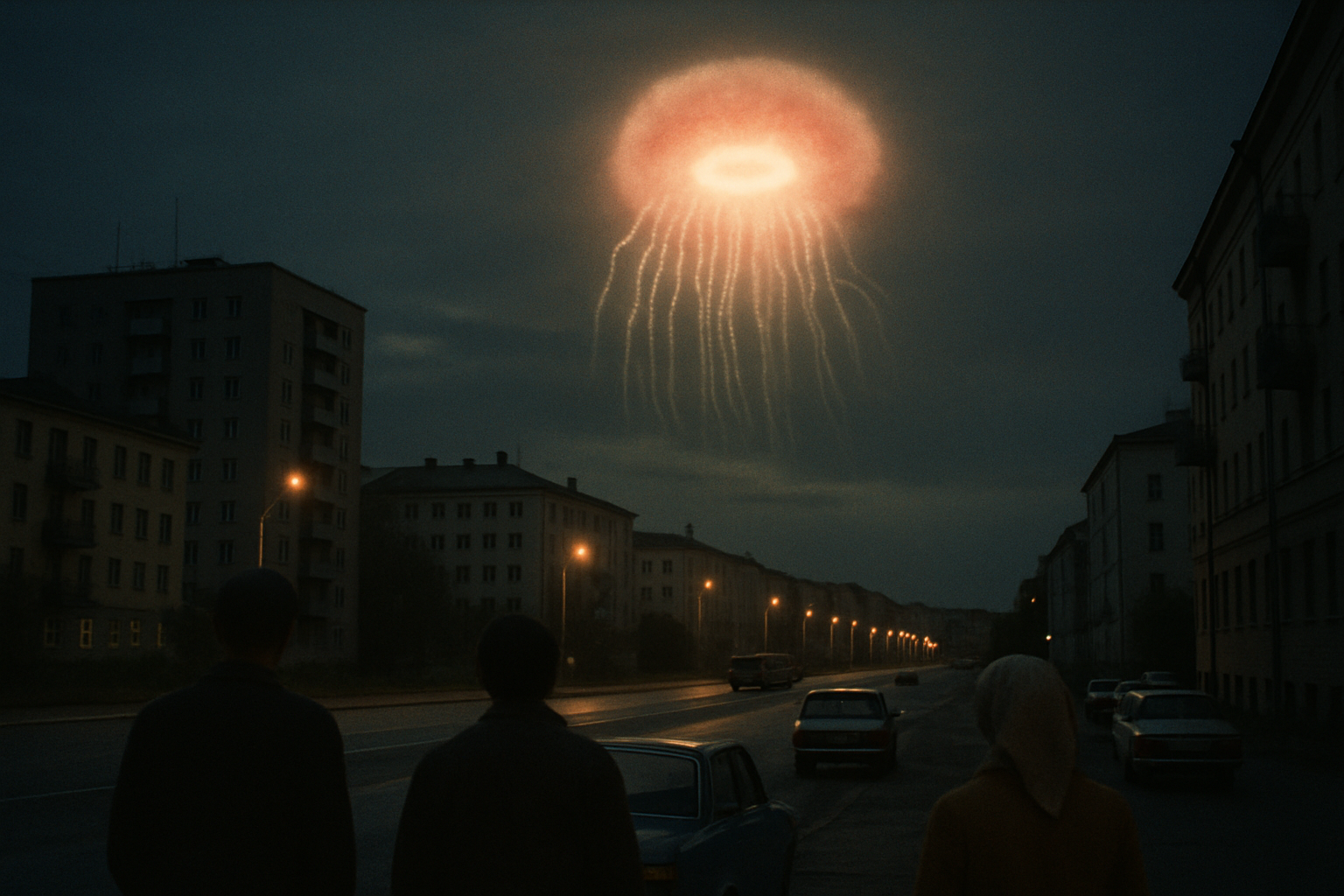
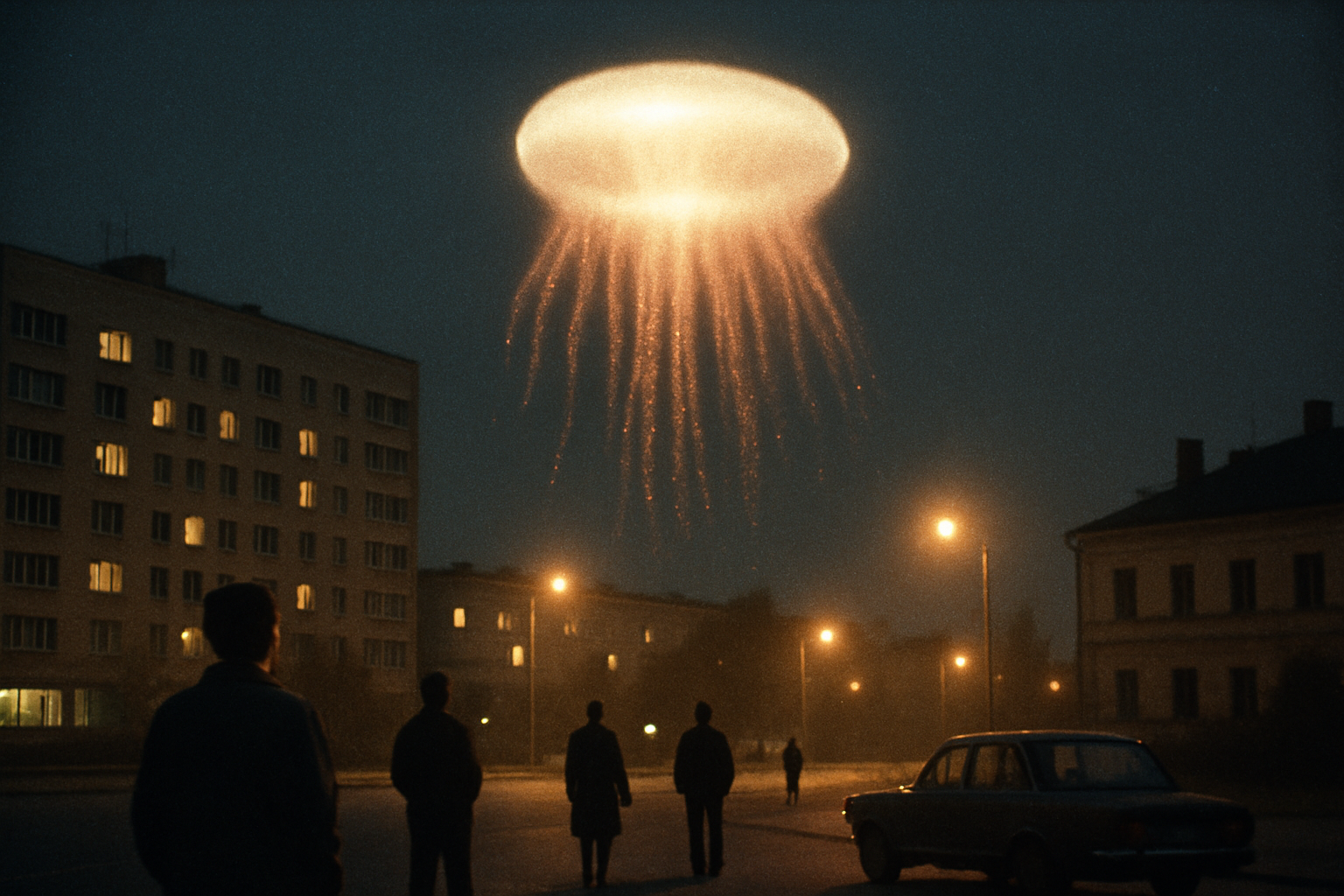

The Petrozavodsk phenomenon (Russian: *Петрозаводский феномен*) was a luminous aerial display observed over north-western Soviet territory in the early hours of 20 September 1977.[1] It is named after the city of Petrozavodsk, capital of the Karelian Autonomous Soviet Socialist Republic, where witnesses reported a glowing object that flared up and spread "in the form of a jellyfish, showering the city with a multitude of very fine rays."[1] Similar sightings were reported over an enormous region, with accounts ranging from Helsinki and Copenhagen in the west to the Soviet Far East.[1] The event was reported openly by the Soviet news agency TASS, an unusual step at the time, and prompted an investigation by the USSR Academy of Sciences.[1][3] The display has most commonly—though not universally—been attributed to the launch of the Soviet ELINT satellite Kosmos-955 from the Plesetsk Cosmodrome earlier that morning, whose high-altitude rocket exhaust, illuminated by sunlight, would have produced the glowing, jellyfish-like shape.[1][2][3]
Background
In September 1977 the Soviet Union maintained tight control over reporting of unidentified aerial phenomena, and the relatively open coverage that followed the event was itself notable.[1] The phenomenon occurred against the backdrop of intensive Soviet space and missile activity, much of it conducted from the northern Plesetsk Cosmodrome, the world's busiest launch site during that era.[2]
- The principal display was seen over Petrozavodsk, capital of the Karelian ASSR, in the early morning of 20 September 1977.[1]
- Observers across a vast territory—reportedly from Helsinki, Turku and Copenhagen in the west to locations in the Soviet Far East—described related luminous effects the same morning.[1]
- The event drew unusually prominent press attention after TASS correspondent Nikolai Milov filed a report that appeared in major Soviet newspapers including *Pravda* and *Izvestiya*.[1]
The sighting
Witnesses in Petrozavodsk described a brilliant object resembling "a huge star" that flared and then expanded into a jellyfish-like form, projecting numerous fine rays down over the city.[1] Reported characteristics included:
- A bluish-white glow with a reddish core, hovering over the city for roughly five minutes before changing.[1]
- An estimated total duration of about 10–15 minutes for the overall phenomenon.[1]
- Movement described as silent, with the object reportedly drifting slowly at first before accelerating away.[1]
The witnesses were varied and included paramedics, military personnel, airport staff, seamen and amateur astronomers.[1] Notably, the objects were not detected by air-traffic radars at Helsinki, Pulkovo or Peski airports, nor reportedly by the Soviet air-defence system, although weather radar at the Karelian Hydrometeorological Observatory was later said to have recorded comparable returns on subsequent dates.[1]
Investigation and official response
Because of the scale of the reports, the USSR Academy of Sciences treated the event seriously and organised a formal inquiry.[1][3]
Academy of Sciences
- A preliminary Academy analysis found the eyewitness accounts "mutually consistent and complementary," and concluded that a single low-altitude object could not easily explain simultaneous observations across distant sites.[1][3]
- In January 1978 the Academy dispatched an expert group to Karelia; researchers associated with the inquiry included Lev Gindilis of the Sternberg Astronomical Institute.[1]
- Theodolite measurements were carried out by Y. Mezentsev of Petrozavodsk University, and a psychologist, Y. Andreyeva, who evaluated nine eyewitnesses concluded they were "mentally sane" and their testimony truthful.[1]
The Setka programmes
The Petrozavodsk event is widely credited with prompting the creation in 1978 of the paired Soviet investigation programmes Setka-AN (Academy of Sciences) and Setka-MO (Ministry of Defence).[3] Setka-AN was centred at IZMIRAN under Academician V. V. Migulin, with physicist Yuli Platov heading the working group, while Setka-MO studied possible effects on military hardware and personnel.[3] Over roughly thirteen years the network processed about 3,000 reports, of which a few hundred were classed as extraordinary.[3]
Explanations and disputes
The most widely accepted explanation links the display to a contemporaneous space launch.[1][2]
- Kosmos-955 launch. Kosmos-955 was a Soviet ELINT (signals-intelligence) satellite launched on a Vostok-2M carrier rocket from the Plesetsk Cosmodrome on 20 September 1977 at about 01:01 UTC.[2] Because the vehicle ascended to the north-east and Petrozavodsk lay to the south-west, observers there are thought to have seen the illuminated exhaust trail from the rocket's nozzles; at high altitude such plumes, lit by the sun while the ground remained dark, can form glowing, jellyfish-like shapes.[1] IZMIRAN's Yuli Platov linked the radiant structure to the rocket's passage through the upper atmosphere, and the Setka analysts identified "the main display with the launch of Kosmos-955 from Plesetsk."[1][3]
- Unresolved details. The explanation does not satisfy every observer. The ufologist Felix Ziegel argued that a reported westward motion of the object was inconsistent with a north-eastward launch, and witnesses with launch experience said the display differed from rocket phenomena they had seen.[1] An Academy report acknowledged that, "based on the available data, it is unfeasible to satisfactorily understand the observed phenomenon."[1]
- Compound event. Some analysts have suggested the morning involved more than one cause—chiefly the Kosmos-955 launch, possibly combined with a concurrent unsuccessful ballistic-missile test—which may account for divergent witness descriptions.[3]
Aftermath and significance
The Petrozavodsk phenomenon became one of the best-known Soviet-era UAP cases and had a lasting influence on official policy.[1][3]
- It directly motivated the long-running Setka-AN / Setka-MO programmes, an institutionalised state effort to collect and analyse anomalous aerial reports across the USSR.[3]
- Material from the inquiry reportedly reached Western researchers, including the French study group GEPAN and the NASA-affiliated scientist Richard Haines.[1]
- The episode is frequently cited as a case study in how aerospace activity—rocket plumes illuminated at twilight—can generate large-scale, genuinely puzzling sightings, while also illustrating how some reported details can resist tidy explanation.[1][2]
Most researchers today regard the core display as explained by the Kosmos-955 launch, while acknowledging that the event remains a notable and partly contested chapter in the history of Soviet UAP investigation.[1][3]
Key quotes
“"…in the form of a jellyfish, showering the city with a multitude of very fine rays." — eyewitness description of the object over Petrozavodsk
“"Based on the available data, it is unfeasible to satisfactorily understand the observed phenomenon." — USSR Academy of Sciences report
References
- 1.
- 2.
- 3.
Similar cases
Scored on agency / year proximity / region / tag overlap — same agency +3, near year +4, same region +2, shared tag ×2.