Aeroflot Flight 8352 UFO encounter (1984 Minsk UFO case)
Illustrations
AI-generated illustration — not actual footage or evidence; an interpretive depiction based on the documented account
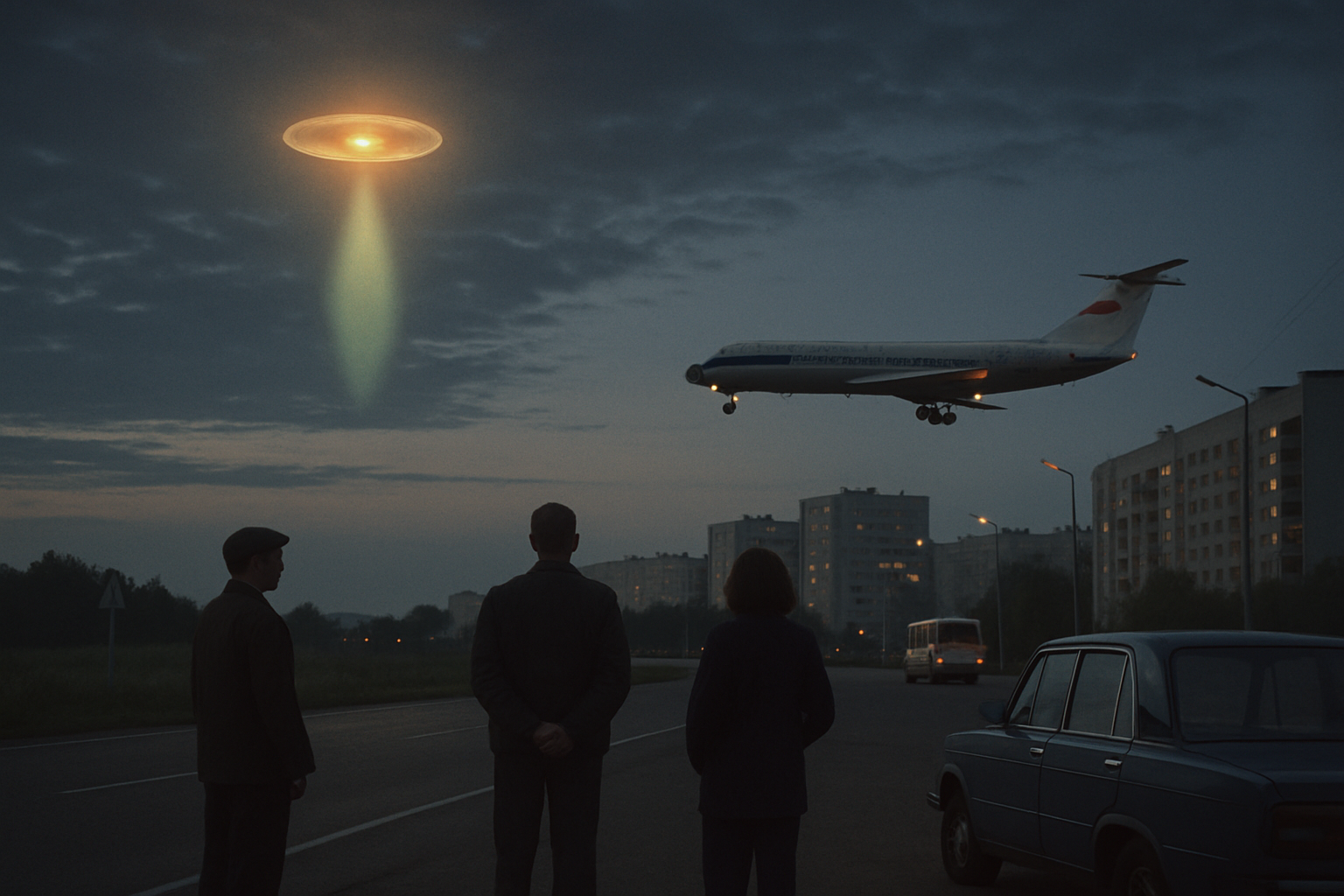
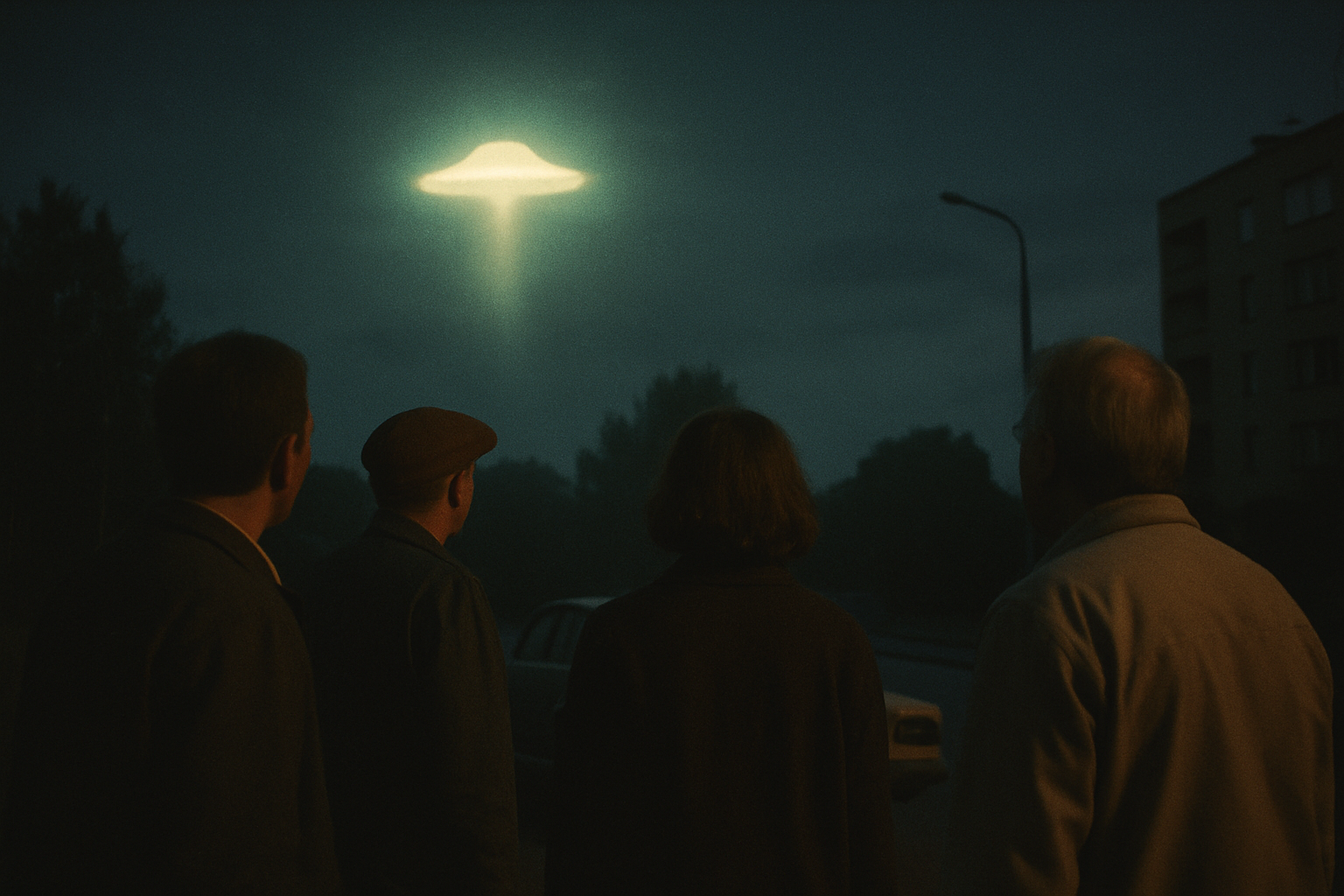
The Aeroflot Flight 8352 UFO encounter, also known in Russian-language ufology as the "Minsk variant" (минский вариант) UFO case, was a widely reported sighting on the morning of 7 September 1984 of a luminous, shape-shifting object by the crew of a Soviet airliner near Minsk, in the Byelorussian SSR.[1][2] At about 04:10 Moscow time, the crew of an Aeroflot Tupolev Tu-134A flying Flight 8352 (Tbilisi – Rostov-on-Don – Tallinn) reported a small yellow point of light that grew bright, projected a descending beam, developed concentric rings, expanded into a yellow-green glowing cloud and finally resembled a "wingless aircraft" that appeared to pace their flight.[1][4] Co-pilot Gennadiy Lazurin (Геннадий Лазурин) sketched the changing shapes minute by minute.[3][2] A second Tu-134 on the opposite route (Flight 7084) was vectored toward the object by a ground controller and also reported a luminous, cigar-like glow.[1]
The case became one of the most famous in Soviet UFO history after the newspaper Trud (Труд) published an account titled "Exactly at 4:10…" ("Ровно в 4.10…") on 30 January 1985.[2][3] The American aerospace engineer and skeptic James Oberg later investigated the report and concluded that it was almost certainly a nighttime missile or rocket launch over the far north of the Soviet Union — most likely a submarine-launched ballistic missile from the Barents Sea / Murmansk area — observed simultaneously by witnesses in Sweden and Finland, with the pilots grossly misjudging the object's range because they could not gauge its true size.[3][4] On that basis the encounter is generally treated as explained.[3]
The encounter
On the morning of 7 September 1984, an Aeroflot Tupolev Tu-134A was operating Flight 8352 on the route Tbilisi – Rostov-on-Don – Tallinn and was in the vicinity of Minsk at about 04:10 Moscow time.[1][2] According to the crew, co-pilot Gennadiy Lazurin first noticed a small yellow spot in the sky; a bright beam of light suddenly shot downward from it, broadening into a cone, and additional cones and concentric rings appeared around it.[1][2] The crew said the spot then expanded into a yellow-green glowing cloud with lights flashing inside it, and that the cloud assumed the form of a "wingless aircraft" with a pointed tail that appeared to keep pace with the airliner.[1][4]
Crucially, Lazurin drew the phenomenon minute by minute as it changed shape outside the cockpit window; a sequence of these sketches was later published.[3][2] The crew reported the sighting to ground control. A second Tu-134 flying the opposite direction (Flight 7084, Leningrad – Borispol – Tbilisi) was, according to Russian accounts, asked by the dispatcher to look to the left and up — "Turn left 20°. Proceed on this course toward the object" (Отверните влево 20°… в сторону объекта) — and its co-pilot Yuri Kabachnikov likewise reported a bright green, cigar-shaped object with beams of light.[1]
Publication and public reaction
The encounter became widely known only months later. On 30 January 1985 the mass-circulation Soviet newspaper Trud (Труд) published an article by journalist Vladimir Vostrukhin (Владимир Вострухин) titled "Exactly at 4:10…" ("Ровно в 4.10…").[2][3] Russian sources note that the issue sold out almost immediately — "the newspaper then had a print run of 20 million, yet by lunchtime it had vanished from the kiosks" — and that the story was reprinted abroad, making it, in the words of one later headline, "arguably the most sensational UFO incident in Russian history."[2][3]
It was unusual for the official Soviet press, generally averse to UFO topics, to publish such a story at all.[3] Russian accounts report that authorities later regarded the publication as "erroneous and harmful," with consequences for the editorial staff.[1][4] Over the following years the case was repeated and embellished in ufological literature: the French-American computer scientist Jacques Vallée cited it in *UFO Chronicles of the Soviet Union* (1992) as one of only a few Russian "encounters" said to involve serious injury or death, and the British writer Jenny Randles recounted it in *The UFO Conspiracy*. Several such retellings added claims — for example that a pilot later died of cancer or radiation and that another crew member suffered lasting harm — that, as Oberg noted, could not be traced to original firsthand sources.[3]
Investigation and conventional explanation
The most detailed published investigation was carried out by the American aerospace engineer and skeptic James Oberg, a former NASA Mission Control specialist, in an article in the *Skeptical Inquirer* (2009; a shorter version appeared on MSNBC.com in 2008).[3] Because the Soviet press had omitted the exact date, Oberg reconstructed it from Aeroflot schedules and found that on the same morning of 7 September 1984 observers in Sweden and Finland had reported a strikingly similar luminous apparition — a rising bright object, expanding rings and a coloured cloud — collated by researchers such as Claus Svahn of UFO-Sweden.[3]
Plotting the directions in which the various witnesses looked, Oberg found that the Scandinavian observers were not looking toward Minsk but to the north-east, and that the sight-lines tended to converge over the Barents Sea, far from land. He argued that this rules out the idea that the object was close to the airliner or reacting to it.[3][4] When the May/June 1991 issue of the magazine *Science in the USSR* reprinted fourteen of Lazurin's real-time sketches, Oberg said the sequence of bright light, rays, expanding halos, misty cloud and a "tadpole" tail matched the known visual evolution of nighttime rocket and missile launches seen from the side and rear, including launches from the Plesetsk Cosmodrome and submarine launches in the northern seas.[3]
Oberg's prosaic hypothesis was that the crew was unexpectedly treated to a spectacular naval missile test launch from the Murmansk area; interpreting it as a structured craft and a possible threat, they badly misjudged its range and "intentions", while other people alerted by radio then looked for and "found" anomalies of their own.[3] He stressed that, absent released Russian launch records, the identification remains technically unproven, but considered it compelling.[3] A similar conclusion — a ballistic-missile launch from the far north — is reported in Russian and Russian-derived coverage, sometimes coupled with the idea of an accompanying high-altitude ionospheric or alkali-vapour experiment that created an artificial luminous cloud.[4][2]
Assessment and legacy
The Aeroflot Flight 8352 case is frequently cited as a textbook example of how a mundane stimulus — a high-altitude rocket or missile launch — can give rise to a dramatic UFO narrative through misperception, the difficulty of judging distance and size at night, and the accretion of unverified detail over time.[3] Oberg used it to illustrate that precise times, locations and viewing directions are decisive in such investigations and that retellings tend to add, rather than clarify, information.[3]
The event remains well documented in Russian-language media and ufological sources under the name *минский вариант* ("the Minsk variant"), and in English chiefly through Oberg's analysis and secondary summaries; there is no dedicated Wikipedia article about it in either Russian or English.[1][2][3] Some of the more sensational physiological claims attached to the story in later accounts (illness or death of crew members) have not been independently substantiated and were not part of the contemporaneous reporting.[3]
Key quotes
“"Exactly at 4:10…" — the title of the Trud newspaper article that publicised the encounter on 30 January 1985.
“Oberg's conclusion: the crew "was unexpectedly treated to a spectacular naval missile test launch from the Murmansk area" and badly misjudged its range.
References
- 1.
- 2.
- 3.
- 4.
Similar cases
Scored on agency / year proximity / region / tag overlap — same agency +3, near year +4, same region +2, shared tag ×2.