Greifswald lights
Illustrations
AI-generated illustration — not actual footage or evidence; an interpretive depiction based on the documented account
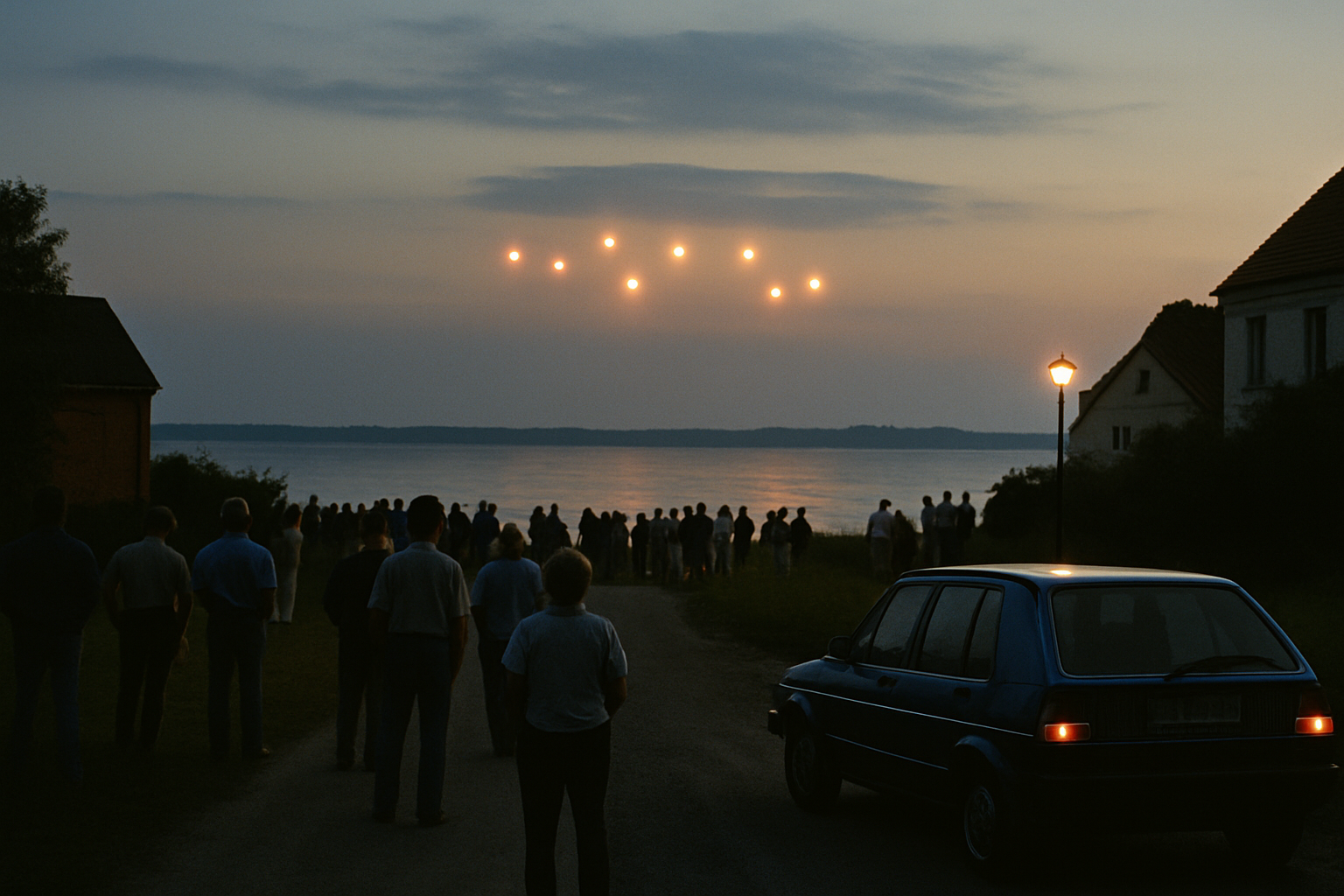
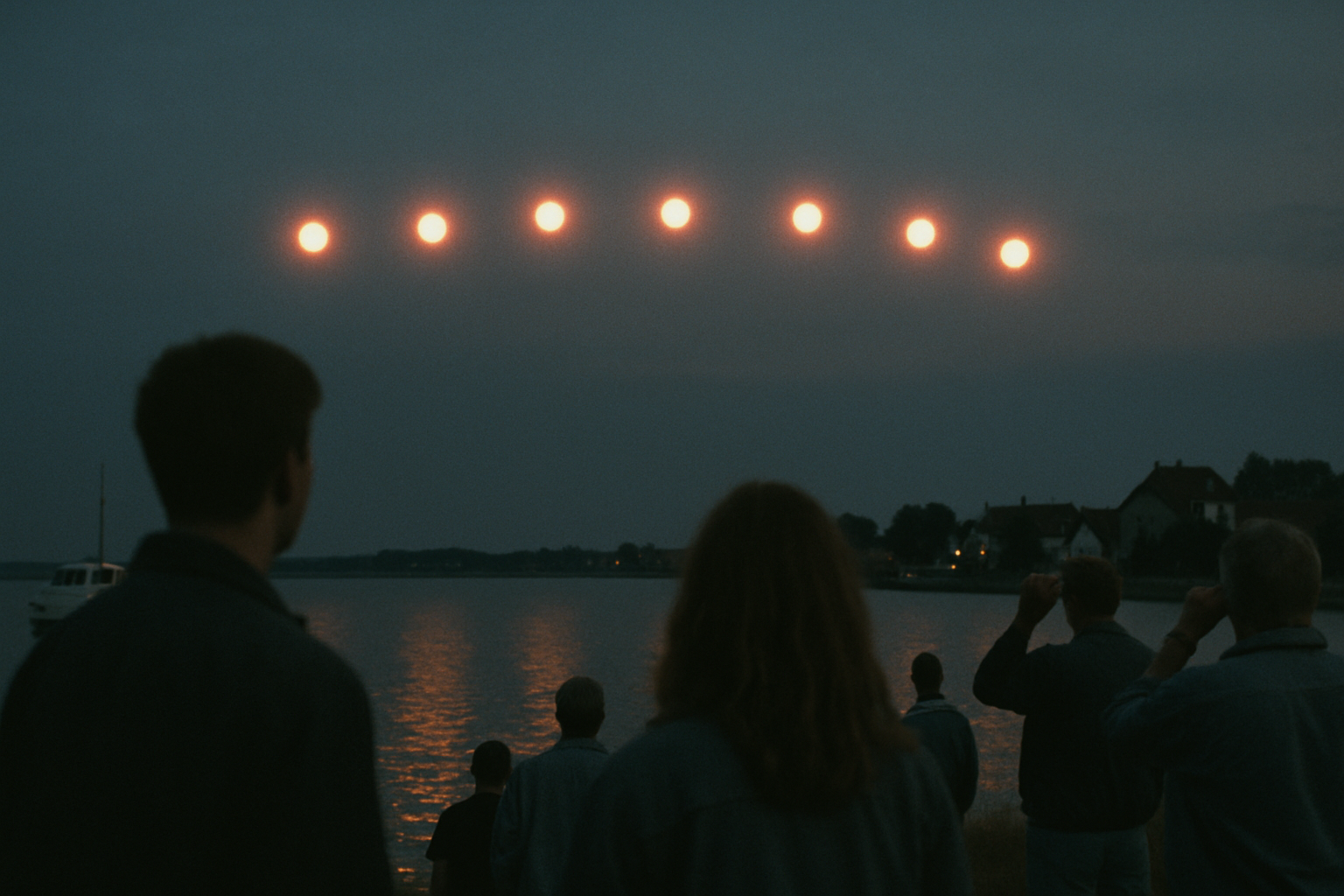
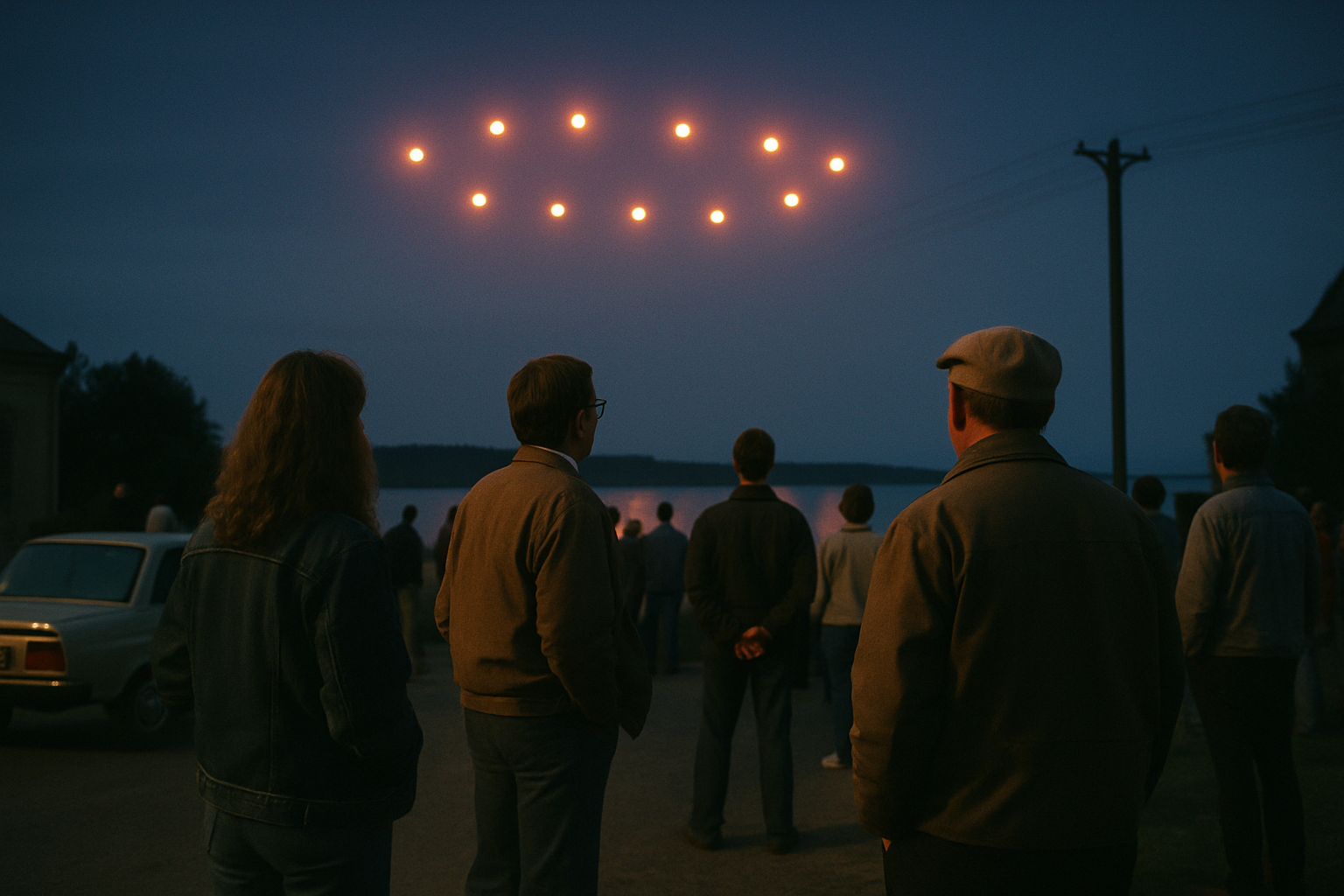
The Greifswald lights (German: *Greifswalder Lichter*) were a UFO sighting that took place on the evening of 24 August 1990 over the Greifswalder Bodden, a shallow Baltic lagoon near the city of Greifswald in the north-east of Germany.[2][1] The episode occurred only weeks before German reunification, in a region that until that year had been part of the German Democratic Republic (East Germany).[5] After dusk, numerous witnesses around the Bodden reported two groups of roughly seven reddish-white luminous spheres that appeared over the sea, hovered in formation and moved slowly; the sighting lasted on the order of half an hour and was documented in at least several amateur videos and a number of photographs.[1][5] It became one of the most widely discussed UFO cases in the German-speaking world.[2][6]
The dominant explanation, advanced by the German skeptics' group CENAP and by later research, is that the lights were military illumination flares (*Leuchtbomben*) descending on parachutes during a Warsaw Pact exercise over the Baltic Air Firing Zone II (*Luftschießzone II*).[1][3][2] Some UFO researchers, including Illobrand von Ludwiger of MUFON-CES, have disputed this, citing the duration of the sighting and the reported movements of the objects.[1][4]
Background
Greifswald is a town on the Baltic coast of Mecklenburg-Vorpommern in north-eastern Germany; the Greifswalder Bodden is a broad, shallow lagoon between the mainland and the islands of Rügen and Usedom.[2] In the summer of 1990 the area was still recovering from four decades within the German Democratic Republic, and German reunification was only weeks away.[5]
The waters of the southern Baltic off Usedom lay within a designated military zone, the Luftschießzone II (Air Firing Zone II), which Warsaw Pact forces used for exercises.[1] The nearby Greifswald (Lubmin) nuclear power station and the historic rocket-testing grounds at Peenemünde lent the area a strategic character that later featured in popular retellings of the case.[5]
The sighting
On the evening of 24 August 1990, beginning at roughly 20:00–20:30, witnesses around the Greifswalder Bodden saw two formations of about seven brightly glowing spheres each appear over the sea.[1][5] Observers described reddish-white points of light that hovered, drifted and appeared to move within the formations while the groups as a whole held together; some accounts mention a sudden bright flash during the display.[5]
The lights were seen not only at Greifswald but across a wide area, with reports from Rügen, Usedom and other localities along the coast and inland.[5] Witnesses included holidaymakers on the beaches and motorists; one frequently cited account places a family near the Lubmin nuclear power station as the display unfolded overhead.[5] The sighting lasted on the order of half an hour, long enough for several observers to fetch cameras, and at least several video recordings and a number of photographs were made — documentation that is often cited as making this one of the better-recorded European sightings of its era.[1][5]
Investigation and explanations
From an early stage the case was examined by German UFO researchers and skeptics, and it became a touchstone in the German-language debate over UFO reports.[2][6]
Military-flare explanation. The German skeptics' organisation CENAP (Centrales Erforschungsnetz außergewöhnlicher Himmelsphänomene) and its researcher Werner Walter concluded that the lights were illumination flares deployed in a military exercise.[1] In an analysis published in the magazine *Skeptiker* (issue 4/1999), Walter set out the case that the spheres were *Leuchtbomben* — luminous charges fired aloft and then descending slowly on oversized parachutes — released over the Baltic Air Firing Zone II.[1] A former NVA officer was quoted describing how such luminous spheres were shot up from a warship by small rockets, ignited in rough formation, and sank slowly on parachutes, producing exactly the kind of display reported.[1]
Czechoslovak Air Force attribution. In November 2012 the researcher Dennis Kirstein, writing for *ufo-information.de*, published a detailed report attributing the event specifically to an exercise by the Czechoslovak Air Force, which as a Warsaw Pact member was entitled to use the firing zone.[3] Kirstein identified the objects as SAB-type illumination bombs, each carrying about seven pyrotechnic flares and released at roughly 10 km altitude, and tied the display to a Czechoslovak exercise in the zone.[3] He acknowledged, however, that he had not obtained documentary confirmation from the air or naval forces of the former Warsaw Pact states he had contacted.[3][4] On this basis CENAP and the GWUP skeptics regarded the case as solved.[2][1]
Dissenting view. Not all investigators accepted the flare explanation. Illobrand von Ludwiger of MUFON-CES had earlier promoted a UFO interpretation, and a cross-organisation working group of German UFO researchers (DEGUFO, GEP, MUFON-CES) responded to Kirstein's report by arguing that ordinary illumination ammunition could not account for how long a single formation remained in the sky or the way the objects appeared to move, treating the case as not fully resolved.[1][4] This disagreement, periodically revisited in German media and online, is part of what has kept the Greifswald lights prominent in regional UFO discussion.[4][6]
Legacy
The Greifswald lights are often described as a classic of German UFO lore, both for the number of witnesses and for the amount of photographic and video material generated.[2][5] In English-language UFO writing the case is sometimes framed as a "last sighting of the Cold War," given its timing on the eve of reunification and its setting near the Lubmin nuclear plant and the Peenemünde rocket site.[5]
Within Germany the episode is more commonly cited as an example of how a dramatic mass sighting can be reconciled with a mundane military cause: skeptics point to it as a well-documented case in which the flare explanation accounts for the observations, while a minority of researchers continue to regard it as not fully explained.[1][4] Footage and stills attributed to the event continue to circulate, and the case is periodically revisited in regional reporting and on UFO websites.[6][2]
Key quotes
“Werner Walter of CENAP summed up the case: "It was only NVA illumination flares."
“Kirstein identified the lights as pyrotechnic flares carried by SAB-type illumination bombs released at high altitude during a Warsaw Pact exercise.
References
- 1.
- 2.
- 3.
- 4.
- 5.
- 6.
Similar cases
Scored on agency / year proximity / region / tag overlap — same agency +3, near year +4, same region +2, shared tag ×2.