Belgian UFO wave (1989–1990)
Illustrations
AI-generated illustration — not actual footage or evidence; an interpretive depiction based on the documented account
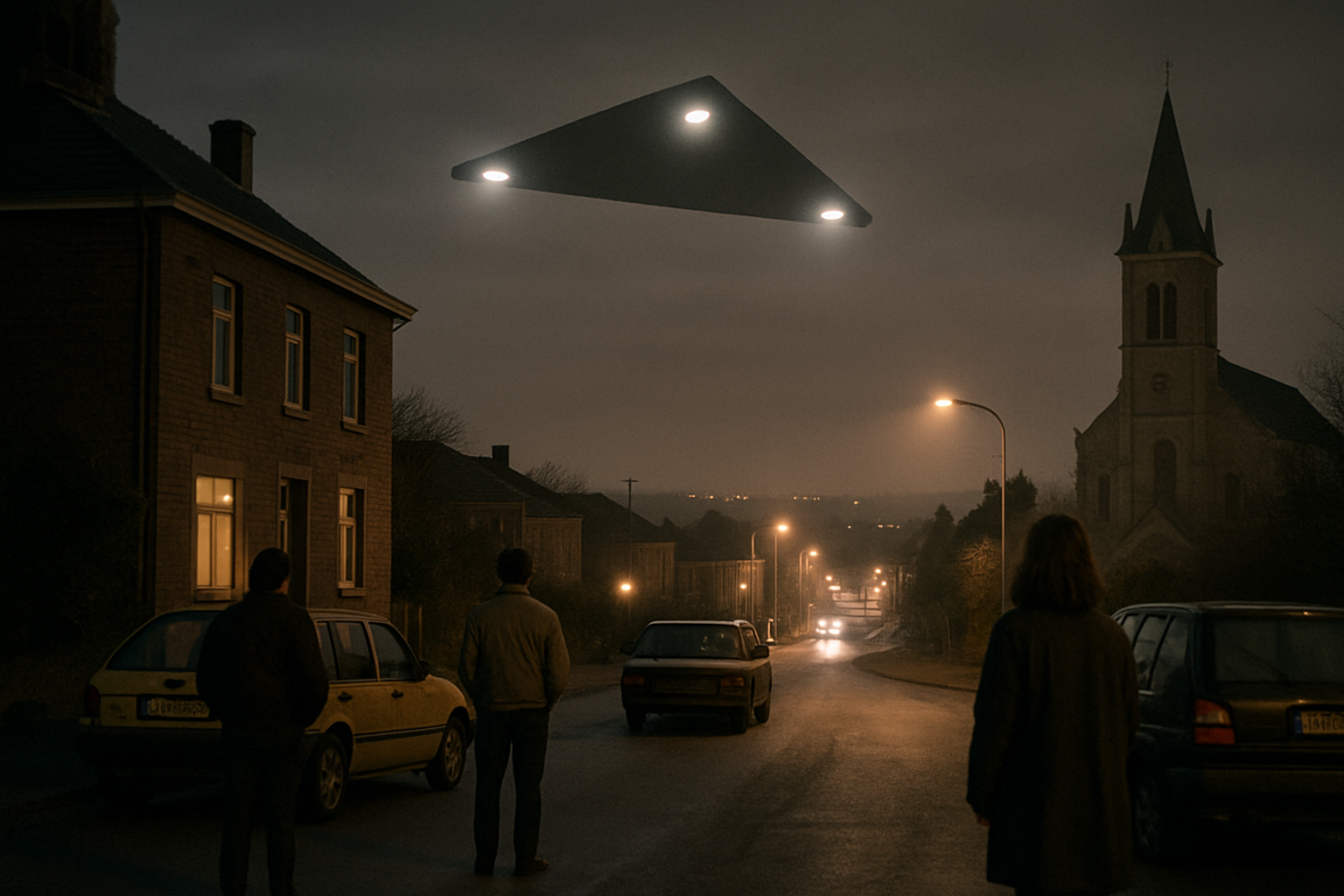
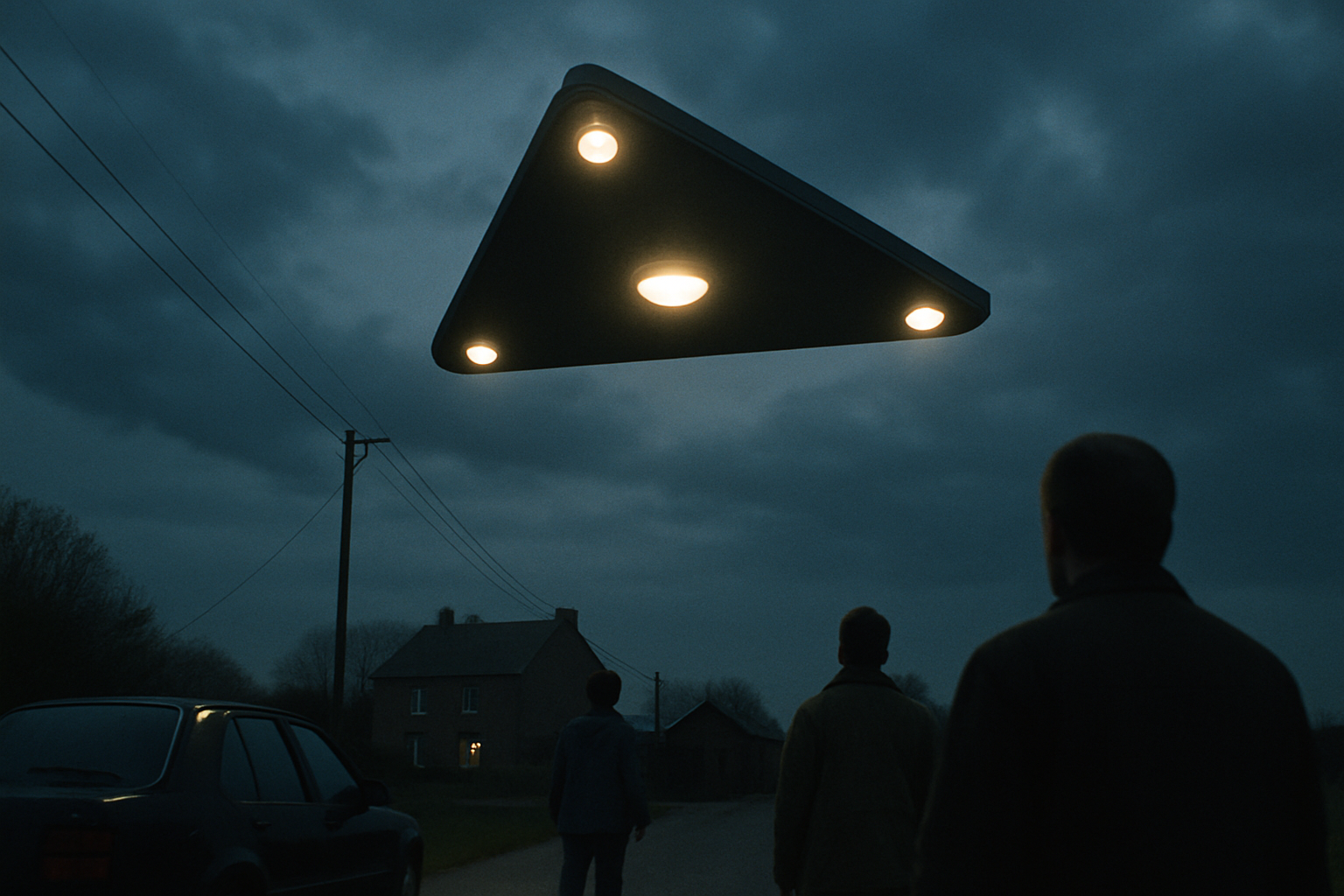
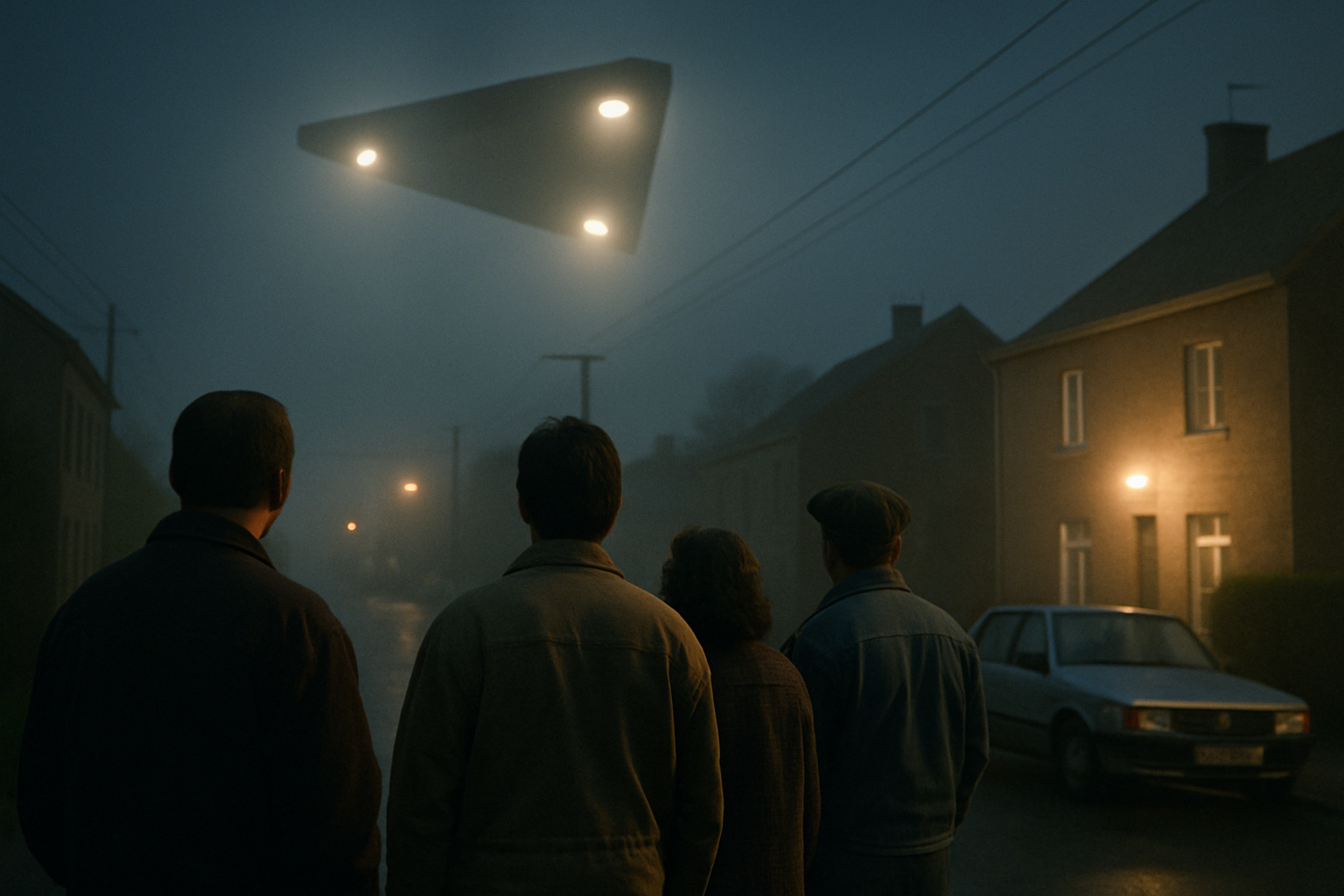
The Belgian UFO wave was a series of unidentified flying object sightings reported in Belgium between 29 November 1989 and April 1990, during which large numbers of observers described seeing enormous, silent, low-flying objects of a flat triangular shape with bright lights at the corners.[1] The wave began over the eastern town of Eupen and spread across the country, with the civilian Société belge d'étude des phénomènes spatiaux (SOBEPS) eventually collecting roughly 2,600 written reports.[1] Its most-discussed episode occurred on the night of 30–31 March 1990, when the Belgian Air Force scrambled two F-16 fighters in response to radar echoes, although the pilots obtained no visual confirmation.[1]
The case is notable for the unusually open response of the Belgian military, which cooperated with civilian investigators and released radar and report data.[2] No single official explanation was ever issued: the Air Force attributed most radar contacts to atmospheric interference, while skeptics have pointed to media-driven excitement, misidentified helicopters and the absence of physical evidence.[1] The iconic *Petit-Rechain* photograph of a black triangle, long cited as evidence, was admitted to be a hoax in 2011.[2]
Background and onset
Reports of triangular nocturnal objects in Belgium are usually dated to the evening of 29 November 1989, when two gendarmes near the eastern town of Eupen reported a large, silent craft hovering at low altitude and projecting powerful beams of light from circular surfaces near its corners, together with a red rotating beacon.[1][3] According to later accounts, around thirty separate groups of witnesses described the phenomenon in the Eupen area that same evening.[2]
The objects were generally described as:
- Triangular or flat in plan, often said to be very large;
- Silent or nearly silent, sometimes with a faint low hum;
- Carrying bright white lights at the corners and a red light toward the centre;
- Moving slowly at low altitude, occasionally appearing to follow roads.[1]
From late 1989 through the spring of 1990 hundreds of further reports were filed across Belgium. Estimates of the total number of witnesses are commonly given as more than 13,000 people, with the civilian research group SOBEPS recording on the order of 2,600 written statements.[1] Because many descriptions noted a low engine noise and what some witnesses called "a stick coming out one end with a turbine on it," a number of observers themselves suspected a helicopter.[1]
The night of 30–31 March 1990
The wave's best-documented episode took place on the night of 30–31 March 1990. Shortly before 23:00, the Control Reporting Centre at Glons received reports of three unusual lights moving toward Thorembais-Gembloux, southeast of Brussels, and a tracking radar at Semmerzake registered an object, prompting orders to scramble two F-16 fighters from Beauvechain Air Base.[1]
Over roughly an hour the F-16s attempted about nine interceptions. According to the Belgian Air Force account, the pilots never reported seeing any of the claimed objects and obtained radar locks only on one another or on contacts that could not be visually confirmed; the aircraft returned to base shortly after 01:00.[1] Some published summaries of the radar data describe contacts that appeared to change velocity and altitude very rapidly — for example shifting between roughly 150 and several hundred knots and between thousands of feet and near ground level — although other traces produced impossible readings (such as apparent negative altitude) consistent with radar artefacts.[3]
Members of the Wavre gendarmerie, sent to corroborate the reports, said they watched four lights arranged in a square formation making short, jerky movements.[1] In its review the Air Force concluded that most of the radar contacts were the result of a known atmospheric effect called Bragg scattering rather than a solid craft, while acknowledging that the night's events were not fully resolved.[1]
Investigation and official response
The episode is unusual for the openness of the Belgian authorities. The Belgian Air Force cooperated with the civilian SOBEPS and made radar and report material available, and Major General Wilfried De Brouwer, then Chief of Operations of the Air Staff, addressed the public and the press about the F-16 incident.[1][2]
- De Brouwer initially considered whether the sightings might involve foreign experimental aircraft, but U.S. authorities stated that no USAF stealth aircraft were operating in the area during the relevant periods.[1]
- He nonetheless declined to declare the matter closed; in one account he said that the possibility of electromagnetic interference could not be excluded and that "the question is still open, so there is no final answer."[3]
- He maintained that the witnesses were sincere and that the wave was not, in his view, a product of mass hysteria.[2]
SOBEPS conducted a multi-year inquiry and published a lengthy two-volume report. The physicist Auguste Meessen, of the Catholic University of Louvain, took part in the analysis and suggested that some visual sightings might be explained by exceptional atmospheric refraction, while leaving room for unexplained elements.[3][1]
Explanations and disputes
No single explanation has been accepted by all parties, and the case remains disputed.
Conventional and skeptical accounts have proposed several mechanisms:
- Atmospheric and radar effects. The Air Force attributed most of the 30–31 March radar contacts to Bragg scattering, a recognised form of atmospheric interference.[1]
- Misidentified aircraft. Researchers including Renaud Leclet argued that some ground sightings are consistent with helicopters, with the reported silence explained by engine noise inside witnesses' cars or by wind direction.[1]
- Media-driven excitement. In a 1992 essay Marc Hallet argued that the wave was largely a "mass delusion" amplified by SOBEPS, echoing Philip J. Klass's observation that publicity can lead people to reinterpret ordinary objects as UFOs.[1] The skeptic Brian Dunning likewise characterised the wave as a psycho-social phenomenon and noted the near-total absence of corroborating photographs despite the very large claimed number of witnesses.[1]
- Solicited testimony. Critics note that many statements, including the often-cited reports from 30 March, were collected only after sustained media appeals for witnesses.[1]
Anomalist accounts emphasise the consistency of the triangular descriptions across many independent observers and the official willingness to call the radar data unresolved.[2]
The most famous single piece of evidence, the Petit-Rechain photograph of a black triangle with corner lights, was released anonymously in 1990 and examined by several institutions without obvious signs of fakery; SOBEPS treated it as authentic for some twenty years.[1] In 2011 the man who made it confessed on Belgian television that it was a hoax, describing how he had built a model from polystyrene, painted it and added lights.[2][1]
Aftermath and significance
The Belgian wave became one of the most widely cited UFO episodes in Europe, partly because of the scale of public participation and partly because the military engaged openly rather than dismissing the reports outright.[2] The combination of numerous independent witnesses, the F-16 scramble and a striking (later discredited) photograph gave the case lasting prominence in popular and ufological literature.[1]
Three decades on, no authority has identified a single confirmed cause that accounts for all the reports, and assessments range from a media-amplified psycho-social phenomenon to a genuinely unexplained series of observations.[2] The 2011 hoax admission for the Petit-Rechain photograph removed the wave's best-known piece of physical evidence and is frequently cited by skeptics, while supporters of an anomalous interpretation continue to stress the volume of eyewitness testimony and the contemporaneous official statements.[1][2]
Key quotes
“"The question is still open, so there is no final answer." — Major General Wilfried De Brouwer, on the F-16 incident
“The Air Force concluded that most of the night's contacts "were all found to be the result of a well-known atmospheric interference called Bragg scattering."
References
- 1.
- 2.
- 3.
Similar cases
Scored on agency / year proximity / region / tag overlap — same agency +3, near year +4, same region +2, shared tag ×2.