Foo fighters (1944)
Illustrations
AI-generated illustration — not actual footage or evidence; an interpretive depiction based on the documented account
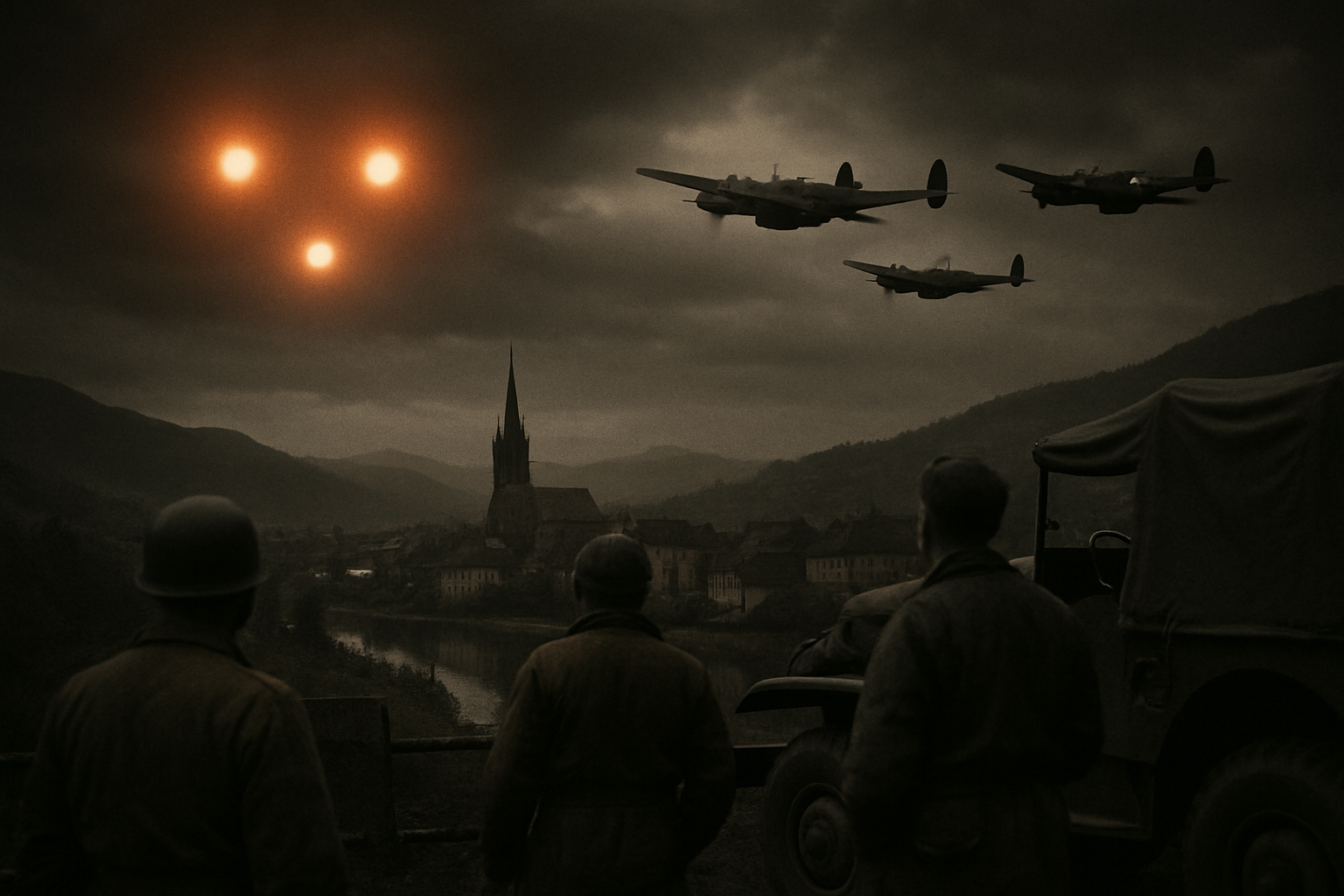
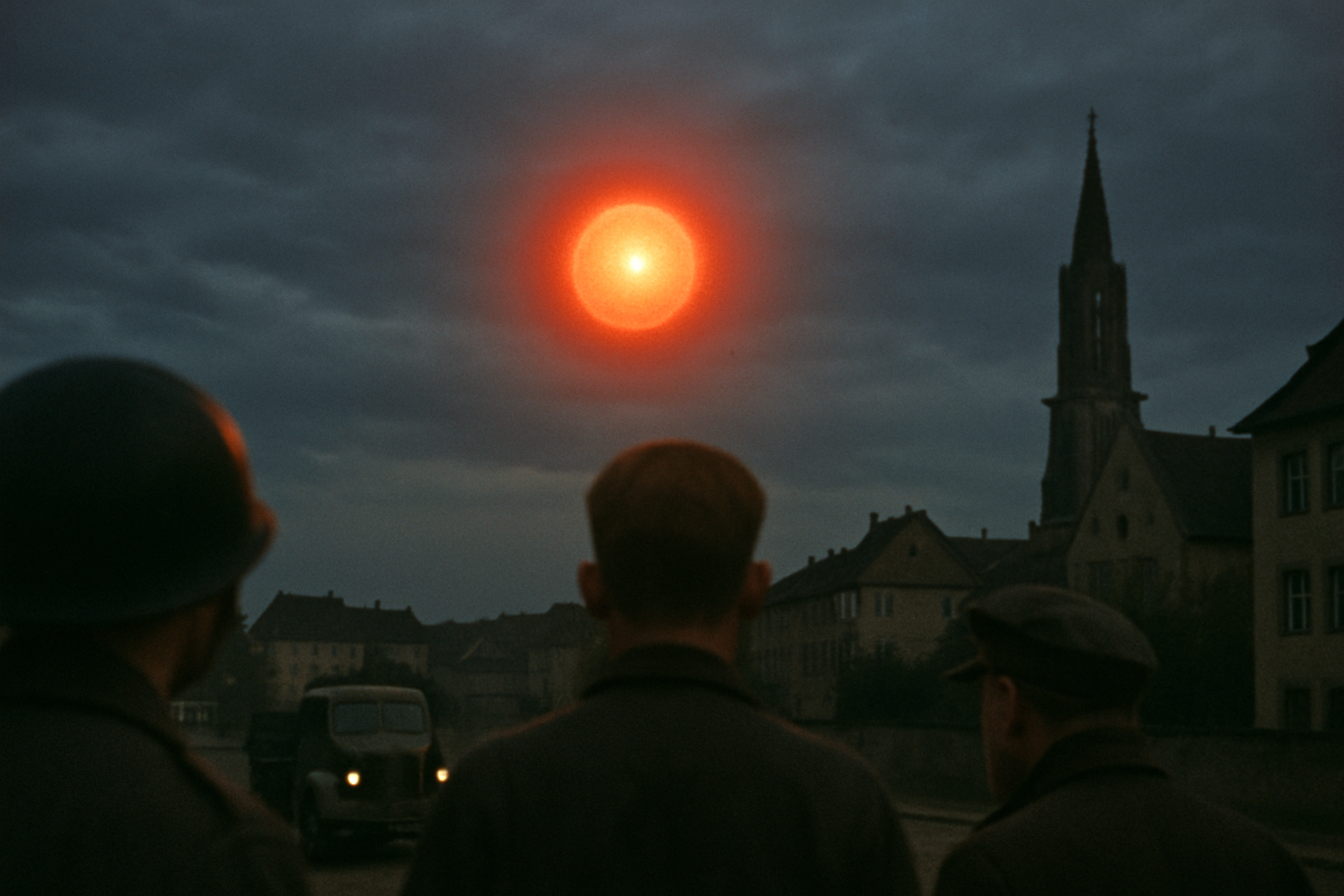
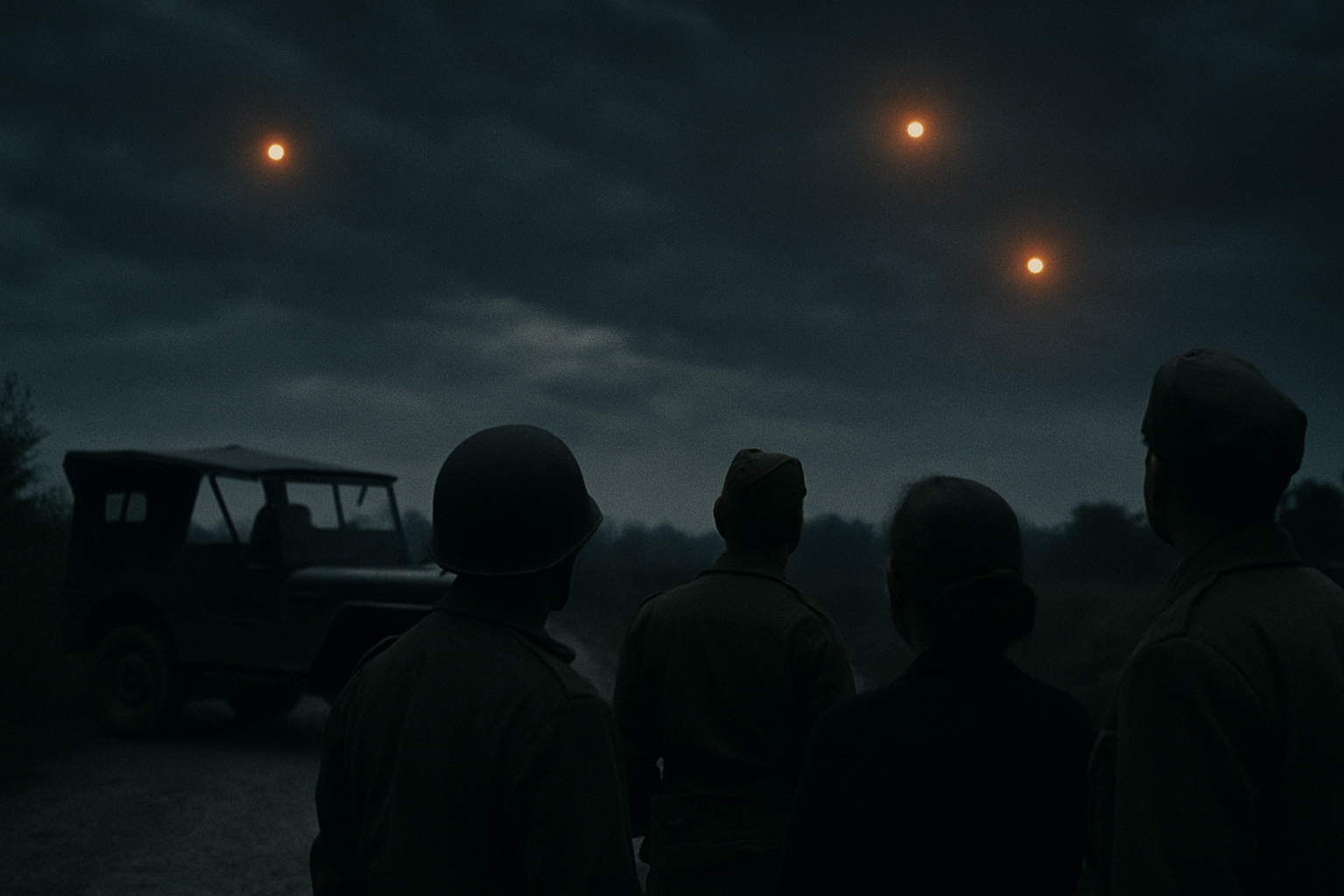
Foo fighters is the name Allied aircrews gave to various unidentified flying objects and atmospheric phenomena reported during World War II, in both the European and Pacific theatres of operations.[1] The objects were typically described as glowing red, orange or white balls or points of light that appeared to follow or pace aircraft, manoeuvred rapidly, and yet behaved in a non-hostile manner; in most accounts they were not detected by airborne or ground radar.[2][3] The term was popularised in late 1944 by the U.S. Army Air Forces' 415th Night Fighter Squadron, whose crews flew night missions over occupied Western Europe, and entered public awareness through an Associated Press dispatch published at the start of 1945.[1][2] At the time the sightings were variously attributed to German secret weapons, electrostatic effects such as St. Elmo's fire, ball lightning, or pilot disorientation, but no single explanation was ever officially confirmed.[1][3]
Background and the name
Origin of the term
The word “foo” was a nonsense term popularised in the early 1930s by cartoonist Bill Holman in his *Smokey Stover* fireman comic strip, which ran in the *Chicago Tribune* and used catchphrases such as “where there's foo, there's fire.”[1] According to the most widely repeated account, radar operator Donald J. Meiers of the 415th Night Fighter Squadron borrowed the word during a debriefing, and — because no better designation existed — the label “foo fighters” stuck for the mysterious lights the crews were seeing.[1][2]
Earlier wartime reports
Lights and luminous objects following aircraft had been noted before the 415th's sightings:
- Royal Air Force personnel are said to have reported lights trailing their aircraft as early as 1942.[1]
- American crews of the 422nd Night-Fighter Squadron recorded sightings over occupied Belgium in the autumn of 1944, at first wondering whether they were seeing German interceptors.[1]
The phenomenon was therefore not unique to a single unit, but it was the 415th's reports near the Rhine that gave it its lasting name.[1][2]
The 1944 sightings
The 415th Night Fighter Squadron
The best-documented encounters occurred in late 1944 over the German-occupied Rhine valley near Strasbourg, on the French–German border.[2][3] On a November night a Bristol Beaufighter crewed by pilot Lt. Edward Schlueter, radar observer Lt. Donald J. Meiers and intelligence officer Capt. Fred Ringwald reported, in Ringwald's account, “eight to 10 bright orange lights off the left wing…flying through the air at high speed,” which were detected neither by the aircraft's radar nor by ground control.[2][3] When Schlueter turned toward the lights they reportedly disappeared, then reappeared farther off, before fading after several minutes.[2]
Further encounters
Additional reports were logged in the following weeks, including:
- 17 December 1944, near Breisach: a crew reported five or six flashing red and green lights arranged in a “T” shape that trailed the aircraft before vanishing.[3]
- 22 December 1944, near Hagenau: two crews described lights that seemed to be “under perfect control at all times.”[3]
- Lt. Samuel A. Krasney reported a “wingless cigar-shape object, glowing red” that stayed beside his aircraft for several minutes.[3]
Witnesses generally agreed that the objects could change direction sharply, paced the aircraft at speeds reported around 200 mph, appeared in red, orange, white or green hues, and yet never opened fire.[3][2]
Publicity and official response
Press coverage
The phenomenon became public when Associated Press correspondent Robert C. Wilson spent New Year's around the 415th's base; his dispatch, carried on front pages at the start of January 1945, brought “foo fighters” to a national audience.[2][3] Around the same period the Supreme Headquarters Allied Expeditionary Force (SHAEF) described the lights as a possible “new German weapon,” and *Time* magazine ran a feature on the subject in early 1945.[1]
Wartime and post-war inquiries
The British Air Ministry considered explanations such as enemy aircraft or “flak rockets,” while acknowledging that the evidence was “very sketchy and varied.”[1] After the war, Allied investigators questioned German scientists, engineers and former Luftwaffe officers about wartime “balls of fire,” but none claimed knowledge of a secret weapons programme that matched the descriptions.[1] In 1953 the CIA-convened Robertson Panel, chaired by physicist Howard P. Robertson, reviewed foo-fighter reports among other cases, noting their non-threatening behaviour but reaching no firm conclusion; the panel observed that had the term “flying saucers” been current in 1943–1945, the objects would likely have been so labelled.[1][3]
Proposed explanations
Several conventional and unconventional explanations have been advanced, none of which fully satisfied the experienced aircrews who made the reports.[3][1]
- Electrostatic and atmospheric phenomena. St. Elmo's fire — a luminous electrical discharge sometimes seen at aircraft extremities — and ball lightning were proposed as possible causes, since both can produce glowing forms near aircraft.[1][2]
- German secret weapons. Some wartime observers, and later writers such as Renato Vesco with his account of a *Feuerball* (“fireball”) device, suggested the lights were advanced German weapons. This idea is unsupported by hard evidence and has been criticised as implausible and single-sourced.[1]
- Pilot disorientation and fatigue. Visual illusions and spatial disorientation experienced by night aviators were studied after the war, and “combat fatigue” was suggested as a factor; the airmen themselves rejected this, pointing to their squadron's record.[1][3]
- Misidentified aircraft or ordnance. Enemy interceptors, flares, weather balloons and “flak rockets” were all proposed, but witnesses argued that such things could not track and pace their aircraft as the lights did.[3][1]
Aftermath and significance
Although foo fighters were never conclusively explained, the episode is frequently cited as one of the earliest large bodies of credible military UFO reports, predating the post-war “flying saucer” era.[1][3] The name itself — drawn from a comic strip — has endured in popular culture, later adopted, for example, by a well-known rock band.[1] In the history of UAP study, the wartime reports are often discussed as a baseline case: numerous trained observers describing similar phenomena, set against a range of mundane and exotic explanations, with the official record ultimately leaving the matter open.[1][2]
Key quotes
““Eight to 10 bright orange lights off the left wing…flying through the air at high speed.” — as described by the 415th Night Fighter Squadron crew
“The Robertson Panel observed that, had the term “flying saucers” been current in 1943–1945, these objects would likely have been so labelled.
References
- 1.
- 2.
- 3.
Similar cases
Scored on agency / year proximity / region / tag overlap — same agency +3, near year +4, same region +2, shared tag ×2.