Shag Harbour incident (1967)
Illustrations
AI-generated illustration — not actual footage or evidence; an interpretive depiction based on the documented account
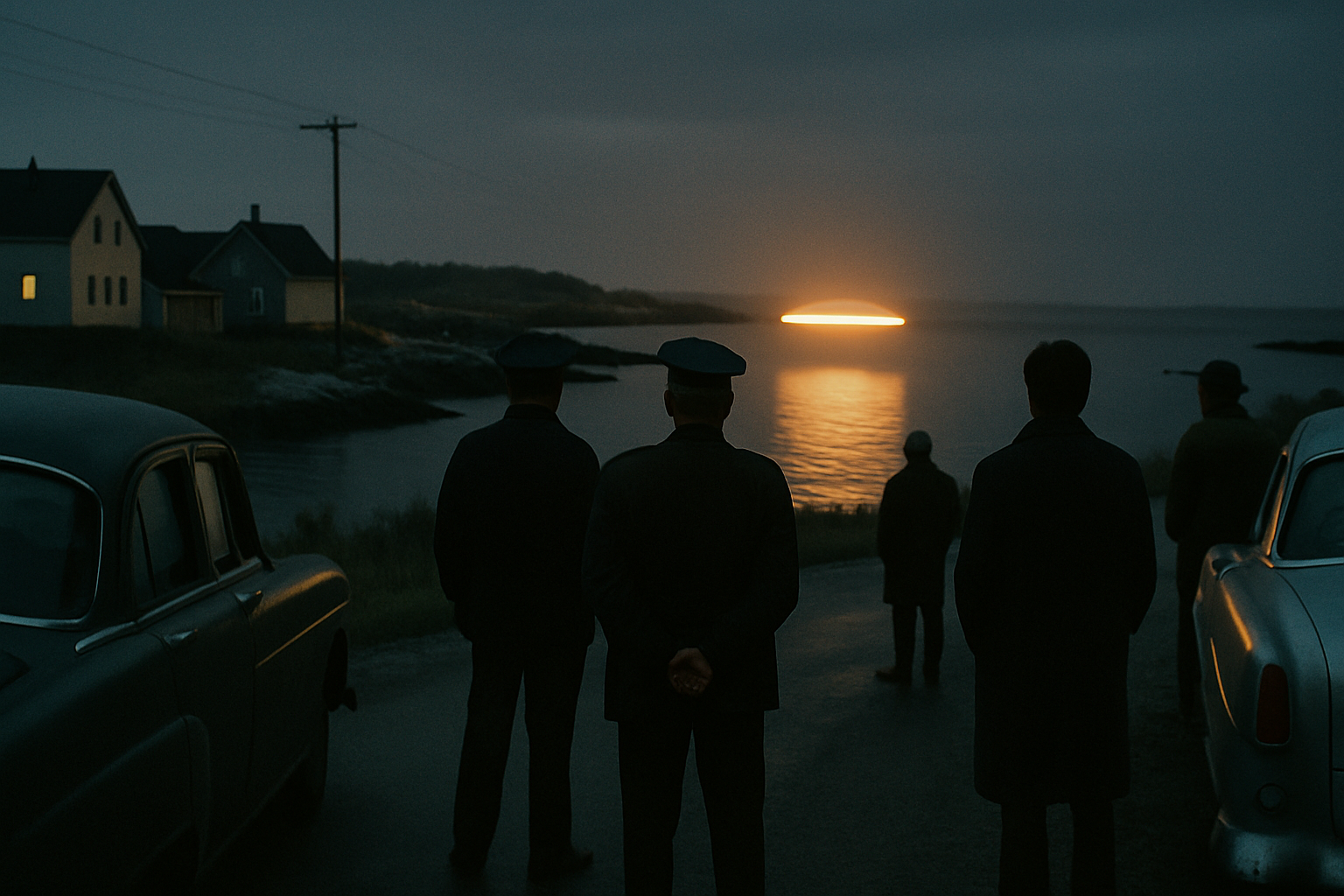
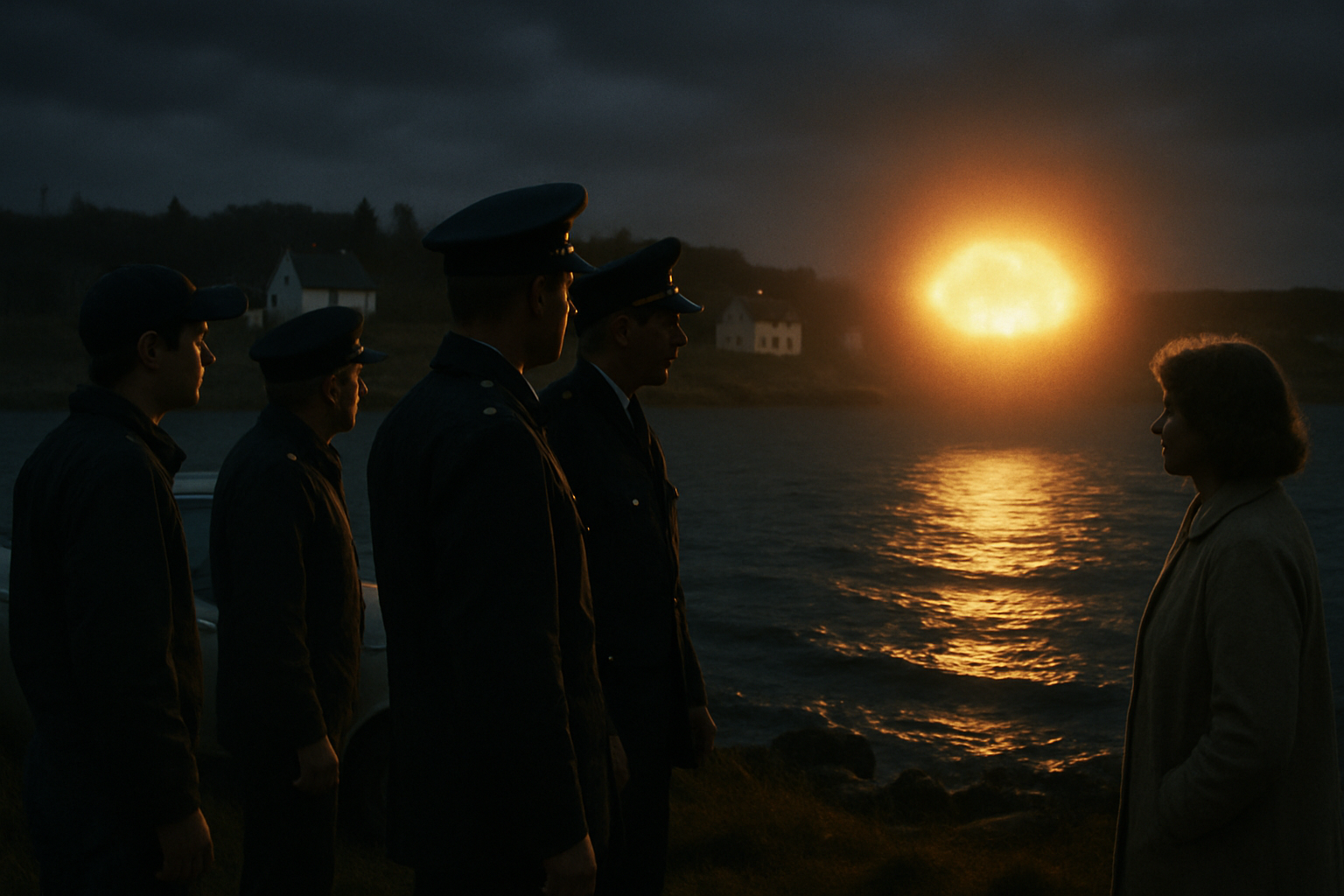
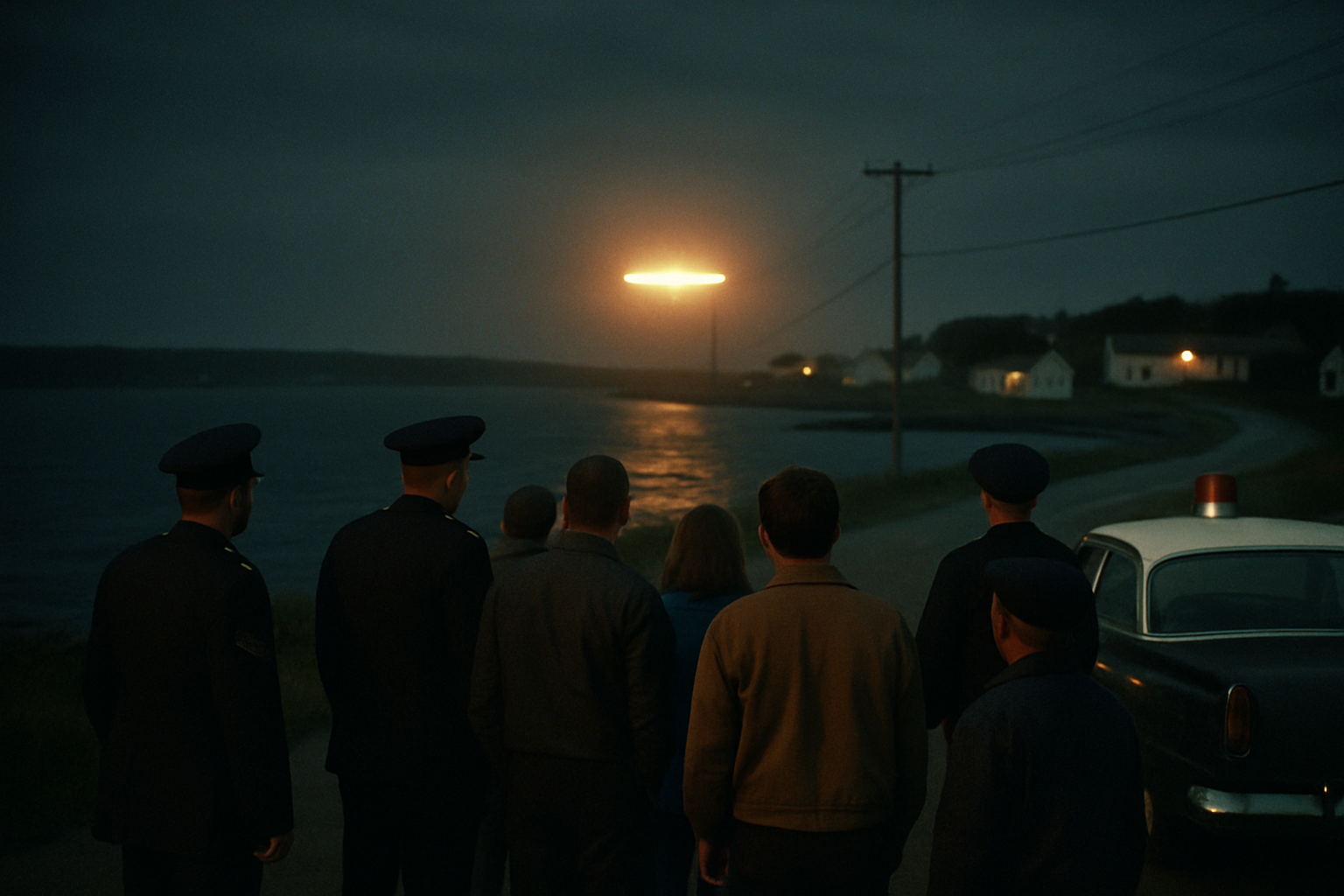
The Shag Harbour incident was the reported impact of an unknown object into the waters near Shag Harbour, a small fishing village in Shelburne County on the southern Atlantic coast of Nova Scotia, Canada, on the night of 4 October 1967.[1] At approximately 11:20 p.m. Atlantic Daylight Time, at least eleven people — including local residents and several officers of the Royal Canadian Mounted Police (RCMP) — saw a low-flying, illuminated object descend at an angle and strike the sea roughly half a mile offshore, after which it appeared to float briefly and then sink.[1][4] Civilian and military agencies, including the RCMP, the Canadian Coast Guard, and the Royal Canadian Navy, mounted a search, and Navy divers examined the seabed for several days without recovering any wreckage.[3] Because no aircraft was reported missing anywhere along the eastern seaboard, Government of Canada records formally described the event as a "UFO" report; it is frequently cited as one of the best-documented such cases in Canadian history and remains officially unexplained.[2]
Background
Shag Harbour is a small fishing community in Shelburne County, on the southern Atlantic coast of Nova Scotia, near coordinates 43°30′N 65°42′W.[1] The events of 4 October 1967 were preceded by a number of other reported sightings across eastern Canada and the adjacent United States seaboard the same evening, which witnesses and later researchers connected to the harbour report.[1]
- Crew aboard the fishing vessel MV Nickerson, under Captain Leo Howard Mersey, reported detecting blips arranged in a rectangular formation on the ship's radar earlier that evening.[1]
- Residents in other parts of southwestern Nova Scotia, and observers as far away as the Halifax area, reported glowing or maneuvering objects during the same period.[1]
The period coincided with the U.S. Air Force's Project Blue Book era and the contemporaneous Condon Committee study at the University of Colorado, which later reviewed reports connected to the Shag Harbour events.[1]
The event
Shortly before 11:20 p.m. on 4 October 1967, local resident Laurie Wickens and four companions, driving on Highway 3 through Shag Harbour, saw a lit object descend toward the water.[1] Wickens contacted the RCMP detachment at Barrington Passage, initially believing he had witnessed an aircraft crash.[1]
Witness descriptions of the object and its descent included:
- A set of orange lights reported to flash in sequence, followed by a sudden dive toward the sea at roughly a 45-degree angle.[4]
- RCMP Constable Ron Pound, who also observed the object, estimated its length at approximately 60 feet (about 18 metres).[4]
- A whistling or "whoosh" sound and a sound likened to a bomb, followed by a bright flash or bang as the object met the water.[1]
After striking the sea roughly half a mile offshore, the object reportedly floated on the surface for several minutes, showing a yellow light that moved across the water and left a trail of yellowish foam in its wake before it sank from view.[4] Local fishing boats put out within about half an hour, and a Canadian Coast Guard cutter arrived from the Clark's Harbour area, but no survivors, bodies, or solid debris were recovered.[1][4]
Investigation and official response
By the following morning, the Rescue Coordination Centre (RCC) Halifax had determined that no commercial, private, or military aircraft were missing along the Atlantic provinces or the New England seaboard, and that the available reports could not be explained by a conventional crash.[1] Having ruled out a known aircraft, RCC Halifax forwarded a priority message to the Royal Canadian Air Force in Ottawa describing the matter as a "UFO Report."[1]
The military then escalated the underwater effort:
- The Royal Canadian Navy tasked its Fleet Diving Unit Atlantic, and the minesweeper HMCS Granby was directed to the site.[1][4]
- A detachment of Navy divers was assembled two days after the incident and searched the seabed for three days, but found no trace of any object.[1]
The case is preserved in Department of National Defence files held by Library and Archives Canada, including a series of RCMP reports and telex correspondence between officials in Halifax and Ottawa.[2] These records note that RCMP Corporal Victor Werbicki of Barrington Passage and other witnesses described a large object that descended to the water over roughly five minutes, floated, and then sank.[2] Reports were also reviewed by the U.S.-based Condon Committee.[1]
Explanations and disputes
No conventional cause was confirmed at the time, and the official Canadian file left the object's origin undetermined.[2] Various possibilities have been considered in subsequent discussion:
- Aircraft or aircraft debris — ruled out by RCC Halifax because no aircraft was reported missing along the relevant coastline.[1]
- A meteor or other natural phenomenon — proposed by some commentators, though this is difficult to reconcile with witness accounts of an object floating on the surface and the reported lights and foam.[1]
- A military or experimental craft — raised in later popular accounts, but not established by the contemporaneous documentation.[1]
Because the surviving evidence consists almost entirely of eyewitness testimony and official correspondence — with no recovered physical material — the case remains disputed in its details. Proponents emphasise the unusually high number of credible witnesses, including police officers, and the formal "UFO" wording in government records; skeptics note that the absence of any recovered object leaves natural or prosaic explanations open.[1][2]
Aftermath and significance
No wreckage was ever recovered, and after the multi-day Navy search the operation was called off, leaving the case without a confirmed resolution.[3] The Shag Harbour incident has since become one of the most frequently cited Canadian UFO cases, in part because it is documented in government and military records rather than resting on private testimony alone.[2]
The community has commemorated the event:
- The Shag Harbour UFO Incident Centre, located on Highway 3, operates as a small museum and information centre about the case.[4]
- An interpretive site near the museum allows visitors to view the area of water where the object was reported to have entered the sea.[1]
The event continues to be examined in books, documentaries, and archival research, and the underlying Department of National Defence records remain publicly accessible through Library and Archives Canada.[2]
Key quotes
“"We get hundreds of reports every week, but the Shag Harbour incident is one of the few where we may get something concrete on it." — attributed to an Air Force officer in contemporaneous Halifax press coverage
References
- 1.
- 2.
- 3.
- 4.
Similar cases
Scored on agency / year proximity / region / tag overlap — same agency +3, near year +4, same region +2, shared tag ×2.