Aguadilla UFO incident
Illustrations
AI-generated illustration — not actual footage or evidence; an interpretive depiction based on the documented account
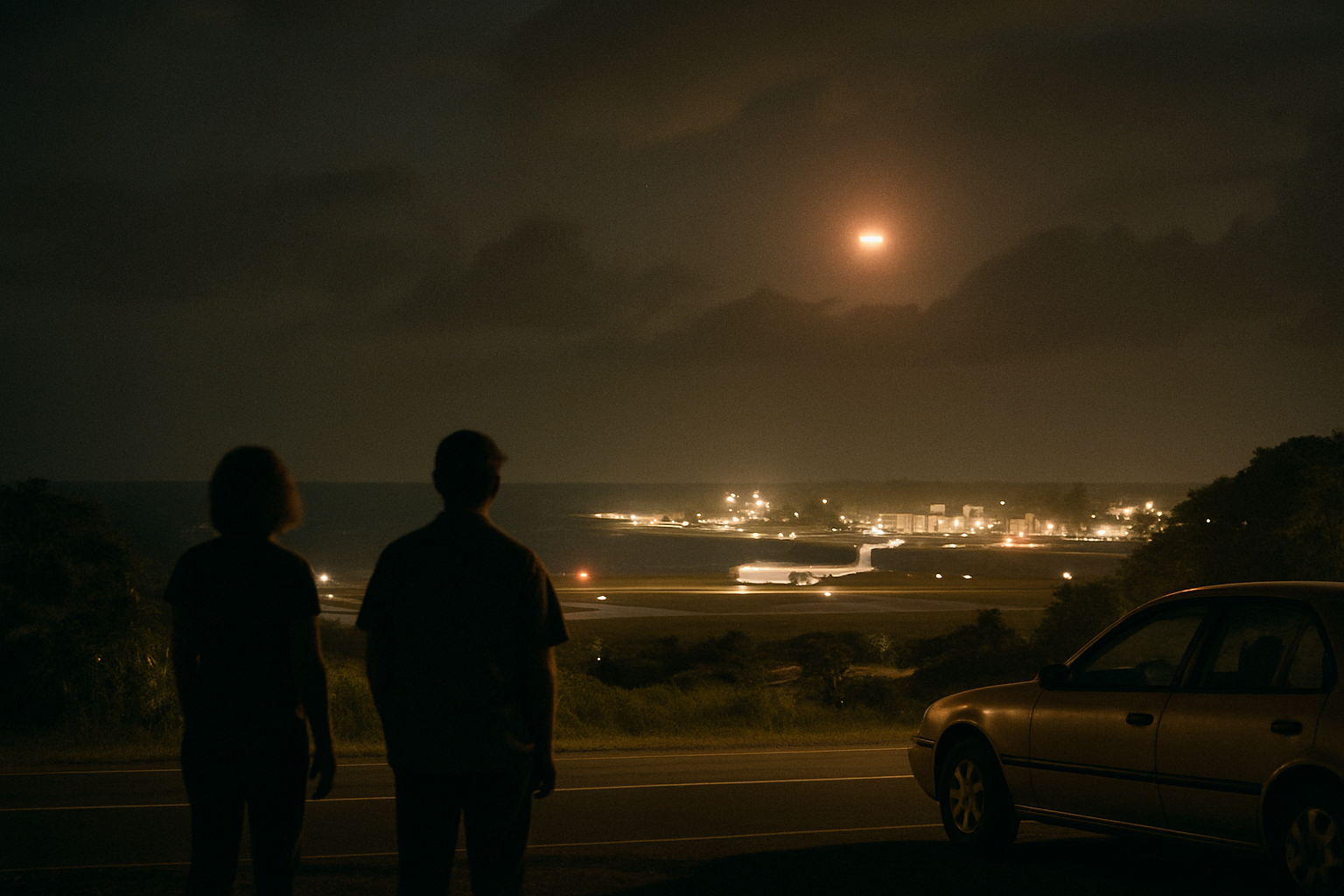
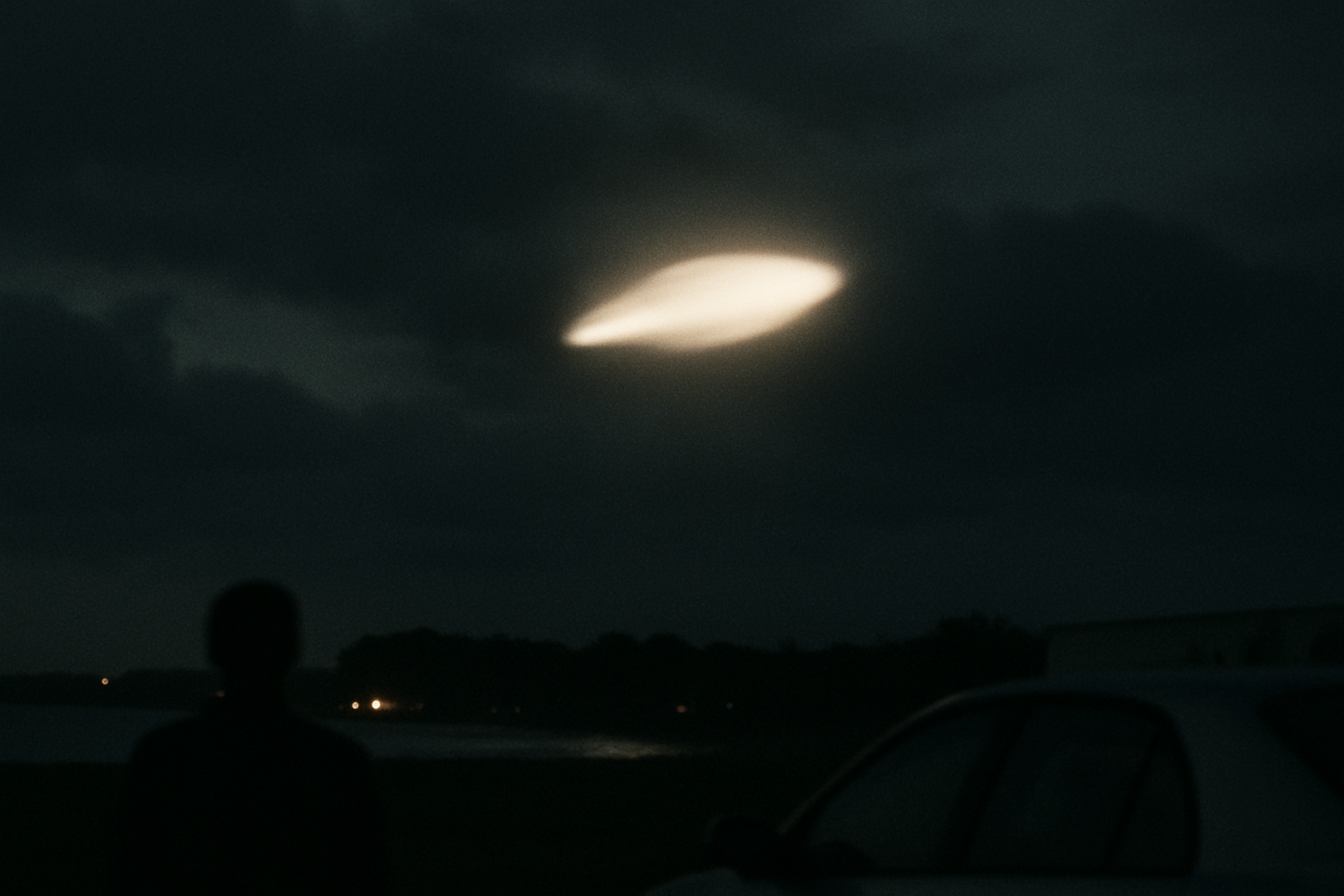

The Aguadilla UFO incident (also called the Aguadilla or Puerto Rico UAP case) refers to an infrared video recorded by a U.S. Customs and Border Protection (CBP) DHC-8 maritime patrol aircraft operating near Rafael Hernández Airport at Aguadilla, on the north-western tip of Puerto Rico.[1][2] The full thermal sequence runs about five minutes, while the leaked clip most widely circulated online is roughly three minutes long.[1][2] The recording is dated to the night of 25 April 2013 in local Atlantic time; because the on-screen sensor timestamp is in UTC (Zulu), the same event is often dated 26 April 2013 (01:22Z).[1][3] The footage, captured with a Wescam MX-15D electro-optical/infrared turret, shows a small, light-emitting target moving across the airport environment and adjacent coastline at low altitude, apparently passing over both land and water and seeming to split into two objects near the end of the clip.[2][4] After the video leaked publicly around 2015, the civilian Scientific Coalition for UAP Studies (SCU) released a lengthy frame-by-frame analysis arguing that the object's speed and behaviour were hard to reconcile with ordinary aircraft, balloons or lanterns.[2][5] Skeptical investigators at the analysis site Metabunk countered that the imagery is consistent with wind-blown sky lanterns, and in March 2025 the Pentagon's All-domain Anomaly Resolution Office (AARO) issued a case-resolution report concluding that the video most likely shows two lanterns drifting with the wind, leaving the incident disputed.[4][3][6]
Background
Aguadilla is a municipality on the north-western coast of Puerto Rico, a Caribbean territory of the United States. It is served by Rafael Hernández Airport (IATA: BQN), a civilian airport built on the site of the former Ramey Air Force Base, situated close to the coastline.[1][2]
The footage at the centre of the case was recorded by a DHC-8 (Bombardier Dash 8) turboprop operated by the U.S. Customs and Border Protection (CBP) Office of Air and Marine, an aircraft used for maritime surveillance and counter-smuggling patrols.[2][4] Such aircraft carry a stabilised Wescam MX-15D electro-optical/infrared (EO/IR) sensor turret, and the recording was made in a mid-wave infrared (thermal) mode in darkness, so the object appears as a bright or dark thermal blob rather than as a clearly resolved shape.[2][4]
The clip became public after being shared online and through a Freedom of Information process, and was promoted as one of the best-documented modern unidentified aerial phenomena (UAP) videos because it came from a government sensor rather than a casual ground observer.[2][7]
The footage
The full thermal sequence runs about five minutes, although the leaked clip most often shared online is roughly three minutes long.[1][2] The on-screen sensor timestamp reads 26 April 2013, 01:22 UTC (Zulu), which corresponds to the night of 25 April 2013, about 21:22 in local Atlantic time; for this reason the case is variously dated 25 or 26 April.[3][2]
What the video shows
In the thermal imagery a small, roughly oval light-emitting object is seen moving across the landscape around Rafael Hernández Airport. According to the SCU reconstruction, the target:
- moved at night without navigation lights, sometimes appearing to pass at very low altitude over terrain, vegetation and the airport;[2][4]
- travelled at a ground speed the SCU estimated at the order of 100 mph (about 160 km/h) at times;[2][4]
- appeared to continue out over the coastline and the sea, with the SCU describing an apparent brief water entry with minimal disturbance;[2][5]
- near the end of the clip appeared to divide into two separate objects that continued on close, parallel paths.[2][4]
Tracking by the camera operator
Because the camera was mounted on a moving aircraft and was being slewed by an operator to keep the target in frame, the apparent motion of the object in the video is a combination of the object's own movement, the aircraft's motion and the camera's panning — a point that becomes central to the later dispute.[4][3]
SCU analysis
The most detailed pro-anomaly study was produced by the Scientific Coalition for UAP Studies (SCU), formerly styled the Scientific Coalition for Ufology, and released on 10 August 2015.[2][5]
Methods
The SCU team carried out a frame-by-frame reconstruction of the video, combined with airport and terrain geometry and with weather and wind data.[2][5] The group also obtained radar data from the U.S. Air Force 84th Radar Evaluation Squadron through a Freedom of Information Act (FOIA) request, which it said helped establish the recording's authenticity and context.[2]
Conclusions
From this analysis the SCU argued that the object's combination of speed, low altitude, smooth flight over land and water, and apparent water entry and splitting was difficult to reconcile with conventional explanations.[2][5] In particular it rejected the sky-lantern hypothesis, calculating that matching the observed track would require winds of at least about 16 mph (roughly 26 km/h), which it argued was typically too fast for a lantern to remain aloft intact.[2] The SCU presented the case as a well-documented UAP event warranting further scientific study and invited critics to submit alternative hypotheses that could be reproduced from the data.[2]
Skeptical explanations and AARO resolution
The Aguadilla footage became the subject of a sustained skeptical re-examination that reached a markedly different conclusion from the SCU.[4][3]
The Metabunk / sky-lantern analysis
Investigators associated with the analysis website Metabunk, including Mick West, argued that the imagery is consistent with one or more sky (Chinese / wedding) lanterns drifting on the wind. The Argentine analyst Rubén Lianza identified the candidate as heart-shaped wedding lanterns of a type released from a nearby beach resort, noting that the truncated thermal shape matched the circular air-intake opening beneath such a lantern's flame.[4] Using the aircraft's recorded GPS track to triangulate, West contended that the object never actually went out over the water and instead drifted slowly to the west, while Lance Moody's 3-D simulation showed that a small object moving at the night's wind speed reproduced the observed track.[4] In this account the dramatic speed is an illusion produced by motion parallax and the changing camera angle and focal length, and the apparent splitting is explained as two lanterns (tied or flying close together) whose merged thermal signatures separate as the viewing geometry changes.[4]
AARO case resolution (2025)
On 20 March 2025 the U.S. Department of Defense's All-domain Anomaly Resolution Office (AARO) published a case-resolution report on the Puerto Rico / Aguadilla video.[3][6] AARO concluded that the footage most likely depicts two separate objects travelling close together — rather than a single object splitting in half — and assessed with moderate confidence that these were a pair of sky lanterns of the kind commonly released by resorts and hotels in the area during celebrations.[3][6] AARO's reconstruction found that the objects actually drifted at roughly 8 mph (about 13 km/h), consistent with the measured wind speed and direction, showing no signs of propulsion or anomalous performance.[3][6] This is distinct from — and well below — the roughly 16 mph minimum wind that the SCU had argued would be needed under its own track reconstruction, a difference that reflects the two groups' competing geometric models of where the object actually flew. AARO attributed the object's apparent high speed to motion parallax, the optical effect by which a slow-moving or near-stationary object can appear to move much faster when viewed from a moving platform such as the patrol aircraft.[3]
Continuing dispute
The SCU and some independent researchers have disputed the lantern and parallax explanations, maintaining that they do not fully account for all the measured flight dynamics, so the case remains contested rather than settled.[2][6]
Significance
The Aguadilla video is frequently cited as one of the most-discussed modern UAP cases captured on a government sensor, alongside the U.S. Navy videos that became prominent later in the decade.[7][1]
Its appeal to UAP researchers rests on the apparent rigour of its provenance — a stabilised military-grade infrared turret aboard a federal patrol aircraft, supported by FOIA-obtained radar data — which the SCU used to argue that the event could be studied with measurable parameters rather than eyewitness recollection alone.[2][5] For skeptics, by contrast, the case has become a textbook example of how motion parallax and infrared imaging can make a mundane object such as a drifting lantern appear to perform impossible manoeuvres.[4][3]
The 2025 AARO resolution placed the incident among the cases the office formally addressed as part of the U.S. government's broader review of UAP reports, though it did not end debate among independent investigators, and the footage continues to circulate as a focal point in discussions of how to evaluate sensor-based UAP evidence.[3][6]
Key quotes
“The SCU argued that matching the observed track would require winds of at least about 16 mph, which is "typically too fast for a lantern to remain airborne."
“AARO assessed with moderate confidence that the footage shows a pair of sky lanterns, and attributed their apparent high speed to motion parallax.
References
- 1.
- 2.
- 3.
- 4.
- 5.
- 6.
- 7.
Similar cases
Scored on agency / year proximity / region / tag overlap — same agency +3, near year +4, same region +2, shared tag ×2.