Japan Air Lines flight 1628 incident
Illustrations
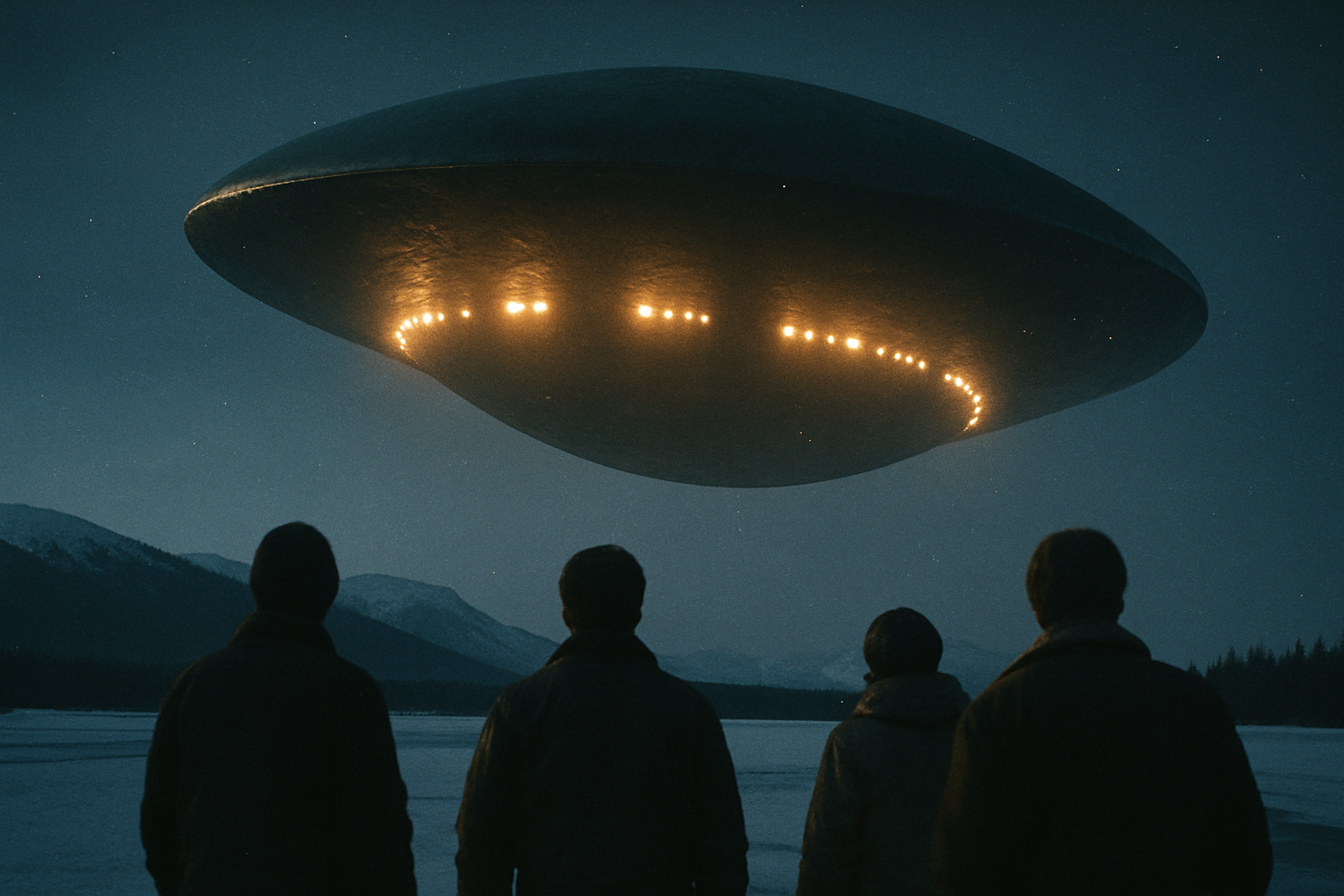
AI-generated illustration — not actual footage or evidence; an interpretive depiction based on the documented account
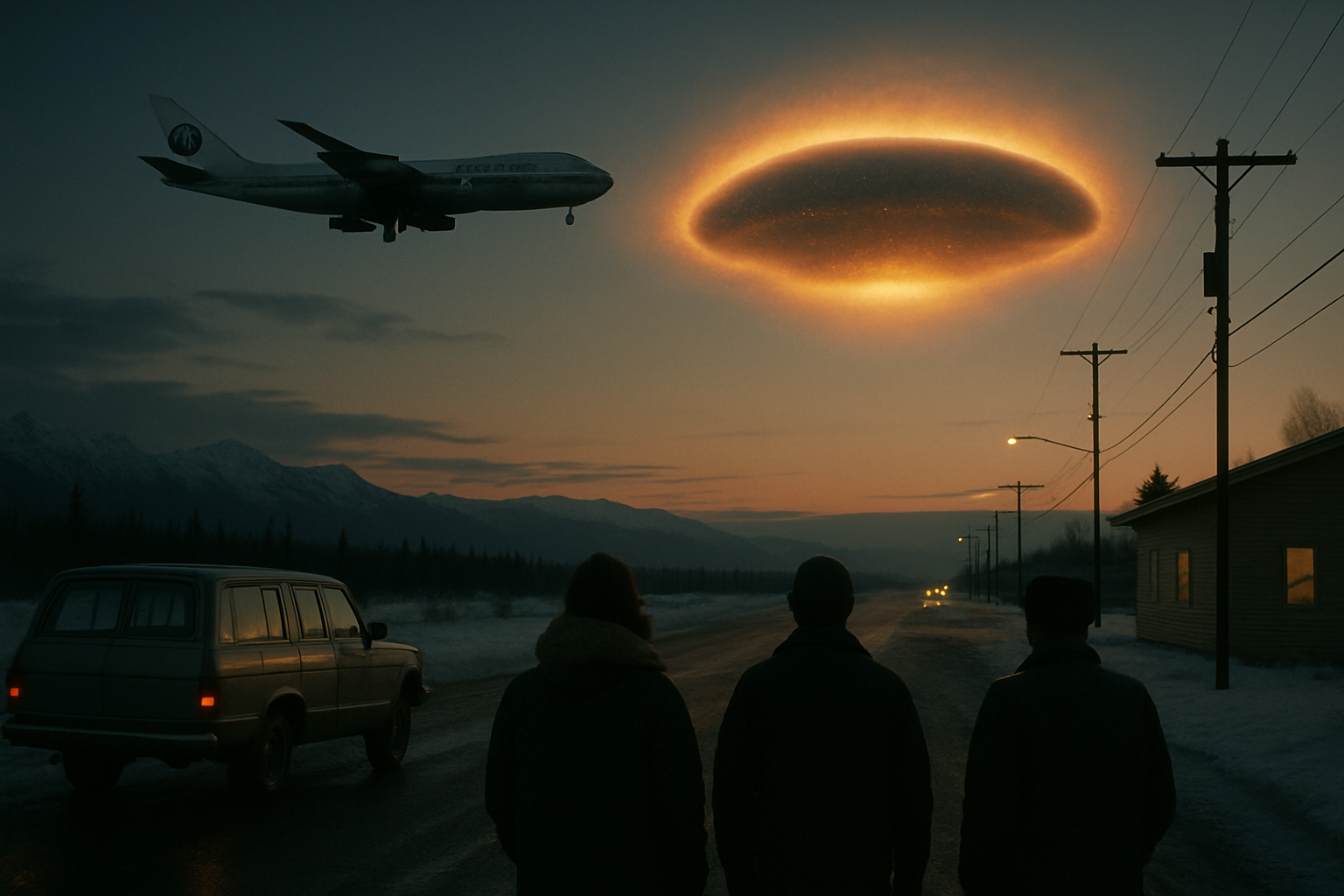
The Japan Air Lines flight 1628 incident was a 17 November 1986 aviation UFO encounter in which the crew of a Boeing 747-200F cargo aircraft reported unidentified objects accompanying their jet over eastern Alaska.[1] The aircraft, operating as JAL flight 1628 from Paris to Tokyo with a cargo that included Beaujolais wine, was on the leg from Iceland to Anchorage when, at about 17:11 Alaska time over the Fort Yukon area, Captain Kenju Terauchi and his two crew members reported first seeing two smaller sets of lights and later a much larger object.[1][2] Terauchi, a pilot with roughly three decades of experience, described the large object in vivid terms, saying it was "twice the size of an aircraft carrier," and the encounter lasted on the order of 30 to 50 minutes across several hundred miles of flight.[1][2] FAA controllers and U.S. military radar in Anchorage at times showed an unidentified return near the aircraft, and the FAA opened a formal inquiry, preserving more than 1,500 pages of voice tapes, radar data and crew statements.[1][3] A subsequent review by the FAA and the Air Force concluded the radar evidence was inconclusive — describing it as clutter or a coincidental "split image" of the 747 itself — while skeptics such as Philip J. Klass argued the lights were the planets Jupiter and Mars, leaving the case disputed rather than resolved.[1][4]
Background
Japan Air Lines flight 1628 was a scheduled cargo service flying a Boeing 747-200F freighter from Paris–Charles de Gaulle to Narita International Airport near Tokyo, with stopovers en route.[1] On 17 November 1986 the aircraft carried freight reported to include Beaujolais wine, and was routed across the North Atlantic and the Arctic, with a leg between Iceland and Anchorage, Alaska.[1]
The flight deck was crewed by three Japanese airmen:
- Captain Kenju Terauchi, the commander, a veteran pilot with roughly 29 years of flying experience.[2]
- First Officer Takanori Tamefuji.[1]
- Flight Engineer Yoshio Tsukuda.[1]
The aircraft was cruising at about 35,000 feet in darkness over the sparsely populated interior of eastern Alaska when the crew reported the first unusual lights, near the locality of Fort Yukon.[1][6]
The encounter
According to the crew's accounts and the FAA voice tapes, the sighting unfolded over roughly half an hour to fifty minutes as the aircraft flew southward toward Anchorage.[1][6]
First lights
At about 17:11 Alaska time, the crew said they noticed two clusters of lights off to the aircraft's left that appeared to rise from below and then move into formation alongside the 747, keeping pace with it.[1][2] Terauchi described the two smaller objects as maneuvering and at times displaying arrays of flashing lights; at one point he said the glow was bright enough that he could feel its warmth on his face and see it illuminate the cockpit, an impression that critics later treated cautiously.[6][4]
The large object
Later in the encounter, Terauchi reported a third, far larger object that he said trailed the aircraft. In interviews he likened it to a gigantic craft, famously saying it was "twice the size of an aircraft carrier", and in sketches he drew a rounded, walnut- or Saturn-like silhouette.[2][1] The crew said the objects accompanied the flight over a distance variously reported as about 350 to 400 miles.[1][2]
Crew response and ground contact
The crew radioed Anchorage air traffic control, which tracked the flight and at times reported an unidentified radar return in the vicinity of the 747.[1][6] Controllers cleared the aircraft to change heading and altitude and to make turns to try to determine whether the objects were truly following; Terauchi said the lights remained nearby through several of these maneuvers.[1][2] A United Airlines flight and a U.S. Air Force aircraft in the area were asked to look for the objects but reported seeing nothing unusual.[1][4] The aircraft landed safely at Anchorage with all three crew unharmed.[1]
Investigation and official response
The episode drew unusual official attention because it involved professional aircrew, air traffic control recordings and radar data rather than a single ground observer.[1][3]
FAA inquiry
The Federal Aviation Administration opened a formal inquiry and compiled an extensive case file. Records associated with the case — later released and archived publicly — run to more than 1,500 pages, including voice tapes, radar printouts and crew statements.[3][1] FAA investigators interviewed the crew and concluded they were credible: the airmen were assessed as professional and rational, with no indication of drugs or alcohol and no sign that they were hallucinating.[1][4]
Radar review
Initial reports suggested that FAA and military radar had confirmed an object near the aircraft, but a closer review was less conclusive.[1][4] On subsequent analysis, the unidentified returns were attributed to radar clutter or to a coincidental "split image" — a second, spurious return generated from the 747 itself — rather than a separate solid target, and the U.S. Air Force characterized the radar evidence as inconclusive.[1][4]
John Callahan's later account
Years afterward, John Callahan, who had been the FAA's Division Chief for Accidents, Evaluations and Investigations, said he had personally gathered the radar records, voice tapes and pilot reports and briefed senior officials.[5][1] By his account he showed the material to FAA Administrator Donald Engen, and a briefing was later held for representatives of other agencies; Callahan's recollections, given publicly from around 2001, are a major reason the case remained widely discussed, although elements of his account rest on his own testimony.[5][1]
Explanations and disputes
The cause of the JAL 1628 sighting is contested, and several conventional explanations have been offered alongside the anomalous interpretation.[1][4]
Astronomical misidentification
The veteran UFO skeptic Philip J. Klass argued that the bright lights the crew first saw were the planets Jupiter and Mars, which were positioned in that part of the sky.[4][1] Because Jupiter sat only about 10 degrees above the horizon, Klass suggested it could "appear to the pilot to be roughly at his own 35,000-foot altitude," so that a planet low in the sky would seem to pace an aircraft as it flew.[4][1]
Inconsistencies and observer reliability
Klass and the astronomer Robert Sheaffer pointed to differences between what Terauchi reported over the radio at the time and his later, more elaborate descriptions, and argued that he was not an "unbiased or objective observer."[1][4] A separate sighting that Terauchi reported in January 1987 was attributed to lights from small villages being diffused through thin clouds of ice crystals, which skeptics cited as evidence that he was prone to interpreting ordinary lights as craft.[1][4] The science writer Brian Dunning dismissed the episode as "just another unevidenced aerial anecdote."[1]
The case for an anomaly
Supporters of an unexplained interpretation emphasize that three trained crew described coordinated, maneuvering objects over a sustained period; that controllers at one point reported a radar return; and that the FAA judged the crew credible and preserved a large documentary record.[1][3] Because the radar evidence was ultimately deemed inconclusive and the visual account is open to the planetary explanation, the incident is generally classed as disputed rather than firmly resolved.[1][4]
Aftermath and significance
The JAL 1628 incident became one of the most frequently cited aviation UFO cases, partly because of the volume of FAA documentation behind it and partly because of John Callahan's later public statements.[1][5]
For Captain Terauchi, the publicity had professional consequences: after the case drew media attention he was reportedly reassigned to ground duties for a period, a move he linked to his willingness to discuss the sighting.[1][2]
The case is regularly revisited in surveys of pilot UFO reports and in discussions of how aviation authorities handle such encounters. Its core elements — a credible professional crew, contemporaneous voice and radar records, a dramatic description of a very large object, and an ultimately inconclusive radar review — recur across reference works, and the documentary file has been republished online, keeping the incident a touchstone in debates over unidentified aerial phenomena (UAP).[1][3][4]
Key quotes
“Captain Terauchi described the large object as being "twice the size of an aircraft carrier."
“Skeptic Philip J. Klass argued that Jupiter, only about 10 degrees above the horizon, might "appear to the pilot to be roughly at his own 35,000-foot altitude."
References
- 1.
- 2.
- 3.
- 4.
- 5.
- 6.
Similar cases
Scored on agency / year proximity / region / tag overlap — same agency +3, near year +4, same region +2, shared tag ×2.