RB-47 UFO incident
Illustrations
AI-generated illustration — not actual footage or evidence; an interpretive depiction based on the documented account
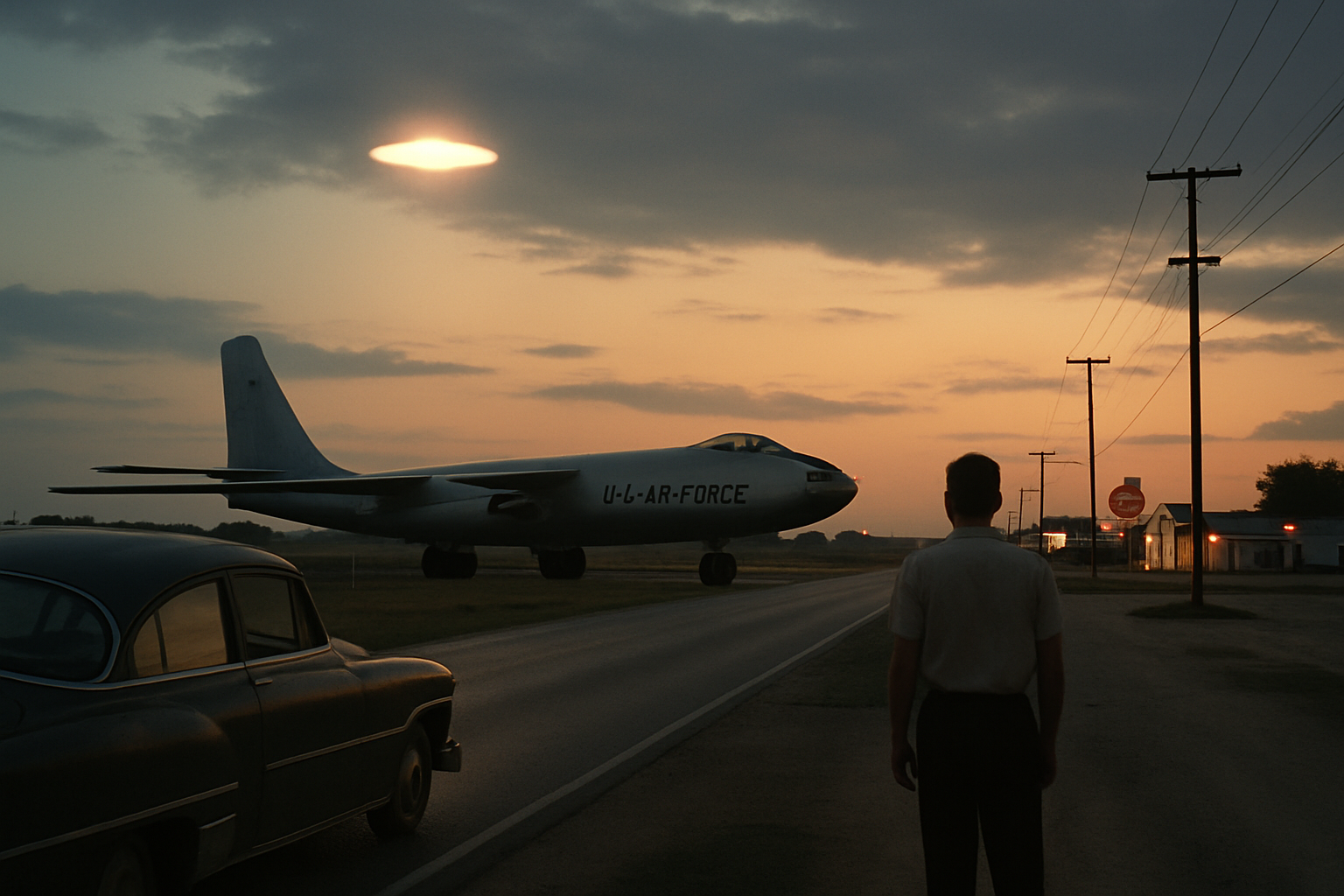
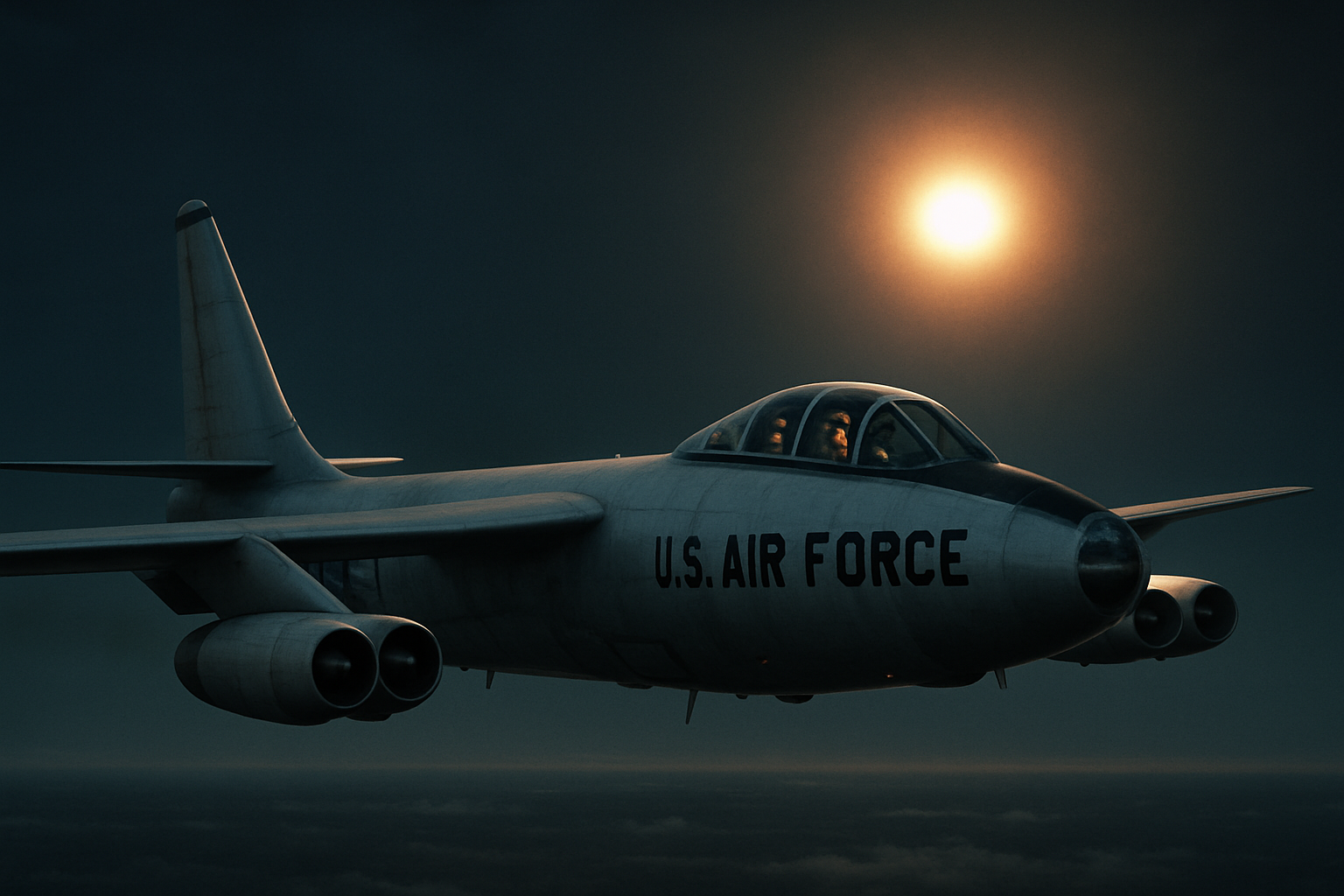
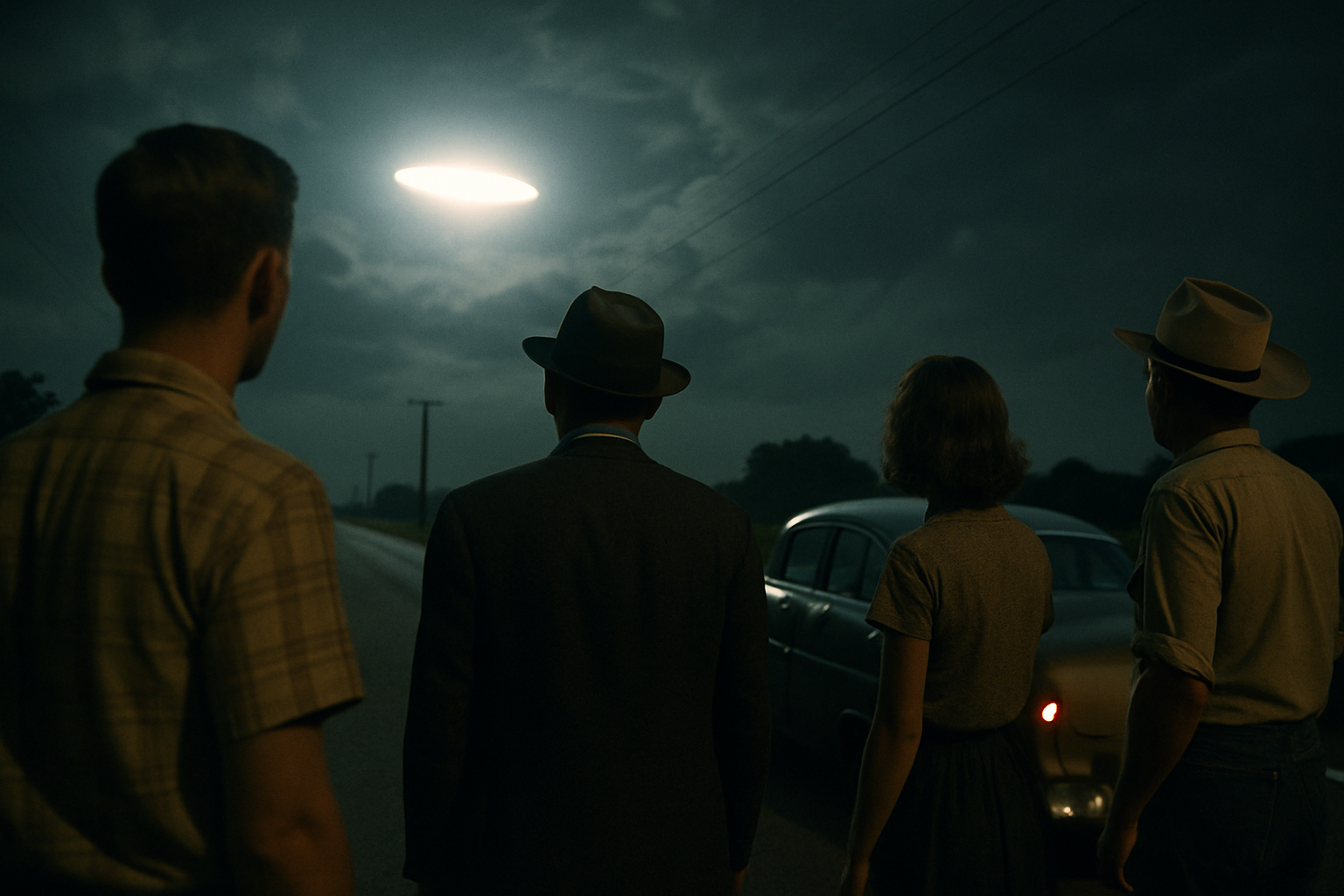
The RB-47 UFO incident was a radar-visual-electronic encounter that took place on 17 July 1957, when a U.S. Air Force RB-47H electronic-reconnaissance aircraft reported being accompanied by an unidentified object across the southern United States.[1][2] The aircraft, tail number 53-4299 of the 55th Strategic Reconnaissance Wing based at Forbes Air Force Base in Topeka, Kansas, carried a crew of six and a suite of electronic countermeasures (ECM) equipment designed to detect, identify and locate radar emitters.[2][3] During the flight the crew detected an airborne signal at about 2,800 MHz that did not behave like a ground radar, observed an intense light that they could see visually, and received reports that a ground-radar site was tracking a target in the same area, with the three data streams at one point correlating and then dropping out together.[1][5]
The case was investigated by the Air Force's Project Blue Book and later analysed in detail by atmospheric physicist James E. McDonald and, independently, by the University of Colorado UFO Project (the Condon Committee), where investigator Roy Craig wrote it up as Case 5.[1][4] The Condon Report concluded that the object remained unidentified, and the incident is frequently cited as one of the most evidentially significant Cold-War radar-visual UFO reports because of the convergence of independent measurements and the credibility of the military witnesses.[1][5]
Background
The RB-47H was a reconnaissance variant of the Boeing B-47 Stratojet, configured to carry electronic-intelligence (ELINT) and electronic-countermeasures equipment for detecting and locating hostile radar.[2] On 17 July 1957 the aircraft, tail number 53-4299 of the 55th Strategic Reconnaissance Wing, flew a composite training mission out of Forbes AFB in Kansas that included gunnery practice over the Texas–Gulf area, a navigation leg over the open Gulf of Mexico, and an ECM exercise on the return flight across the south-central United States.[2][5]
The crew comprised six trained airmen: the aircraft commander Major Lewis D. Chase, co-pilot Lt. James H. McCoid, the navigator, and three electronic-warfare officers who operated the ECM monitoring positions — Frank B. McClure at the number-two monitor, John J. Provenzano at the number-one monitor (APD-4) and Walter A. Tuchscherer at the number-three monitor.[1][5] The monitoring equipment included direction-finding and intercept receivers (identified in McDonald's analysis as ALA-6, APR-9 and APD-4 type sets) capable of detecting the frequency and bearing of radar emitters; this technical sophistication is central to why the case is considered unusually well documented.[5][4]
The encounter
Accounts of the encounter are drawn chiefly from the crew's later interviews and from the Condon Report's reconstruction.[1]
- First detection. While the aircraft was leaving the Gulf area, the number-two ECM monitor (operated by McClure) picked up a strong signal at about 2,800 MHz — a frequency band associated with ground search radars — coming from an unexpected direction.[1][5] Crucially, as the aircraft flew on, the signal's bearing moved in a way inconsistent with a stationary ground emitter, suggesting the source was airborne and keeping pace.[5][4]
- Visual sighting. Over the following part of the flight, across Louisiana, Mississippi and into Texas, the aircraft commander reported an intense bluish-white light ahead of the aircraft, which on at least one occasion appeared to cross rapidly in front of the bomber.[1][5]
- Triple correlation. The crew reported that the airborne ECM signal, the visual light and a ground-radar contact — from an Air Force radar site in the Duncanville, Texas area (operating under the call-sign / code-name "Utah") — were at times all indicating an object in essentially the same position, providing rare simultaneous visual, electronic and radar data.[1][5]
- Disappearance. At one point the object was reported to have vanished simultaneously from the pilot's view, from the number-two monitor and from the ground radar, then to have reappeared; the chase continued across Texas toward Oklahoma until, with fuel running low, the RB-47 broke off and returned to base.[1][5]
The whole episode is generally described as lasting on the order of an hour and a half.[5]
Investigation and official response
The encounter was reported through Air Force channels and handled by Project Blue Book, the service's UFO-investigation program.[2] The case received relatively little public attention for years and some of the original technical records were difficult to locate, which later complicated reconstruction of events.[5]
In the late 1960s the case was examined in depth by two separate investigators. Atmospheric physicist James E. McDonald interviewed the surviving crew members and located documentary material, presenting the incident in technical papers as a strong radar-visual-electronic case.[4] At about the same time, the U.S. Air Force-funded University of Colorado UFO Project (Condon Committee) assigned the case to investigator Roy Craig, who wrote it up as Case 5 in the 1968 final report; a separate radar-propagation analysis of the incident was contributed by physicist Gordon David Thayer.[1]
Craig worked from crew recollections gathered roughly a decade after the event, because, as the report notes, identification "must ... rest entirely on the recollection of crew members ten years after the event."[1] He examined and rejected the suggestion that the crew had simply tracked a commercial airliner, and after analysing the available data the report classified the object as unidentified.[1][4]
Explanations and disputes
Several conventional explanations have been proposed, none of which is generally regarded as fully accounting for the combined data.[1][5]
Aircraft or airliner
One suggestion was that the crew had observed and tracked another aircraft, such as a commercial flight. Craig and McDonald argued that an ordinary aircraft could not explain a single object that was simultaneously seen visually, detected on a 2,800 MHz airborne receiver and tracked by ground radar while displaying the reported abrupt changes in position.[1][4]
Electronic or instrument effects
Because much of the evidence is electronic, critics have asked whether equipment artefacts, signal reflections or misinterpreted returns could be responsible. The case's defenders point to the agreement between independent systems — eye, airborne ECM and separate ground radar — as difficult to reconcile with a single instrument fault.[1][5]
Documentary gaps
Skeptical commentators note that the reconstruction depends heavily on witness memory years after the fact and that some original records are incomplete or contradictory, so they treat the more dramatic details with caution.[1][5]
Overall, the Condon Report's own conclusion that the object was unidentified, combined with the technical nature of the data, has led most reviewers to classify the case as genuinely unexplained rather than firmly resolved.[1]
Aftermath and significance
The RB-47 case is frequently cited as one of the most evidentially substantial UFO reports of the Cold War era, precisely because it is not a single-witness light-in-the-sky account but a convergence of visual, airborne-electronic and ground-radar data gathered by trained military personnel.[1][5] Its inclusion in the Condon Report as an unexplained case is often highlighted by researchers who argue that the report's own case studies do not always support its generally skeptical summary.[1]
The incident has been revisited in technical analyses, popular histories and documentary treatments, and continues to feature in discussions of how electronic-intelligence data might be used to study unidentified aerial phenomena.[3][2] As of the present, no conventional explanation has been broadly accepted, and the case is generally listed among the better-documented unresolved military UFO encounters.[1][5]
Key quotes
“Identification of the phenomenon encountered ... must ... rest entirely on the recollection of crew members ten years after the event.
References
- 1.
- 2.
- 3.
- 4.
- 5.
Similar cases
Scored on agency / year proximity / region / tag overlap — same agency +3, near year +4, same region +2, shared tag ×2.