1952 Washington, D.C. UFO incident
Illustrations
AI-generated illustration — not actual footage or evidence; an interpretive depiction based on the documented account
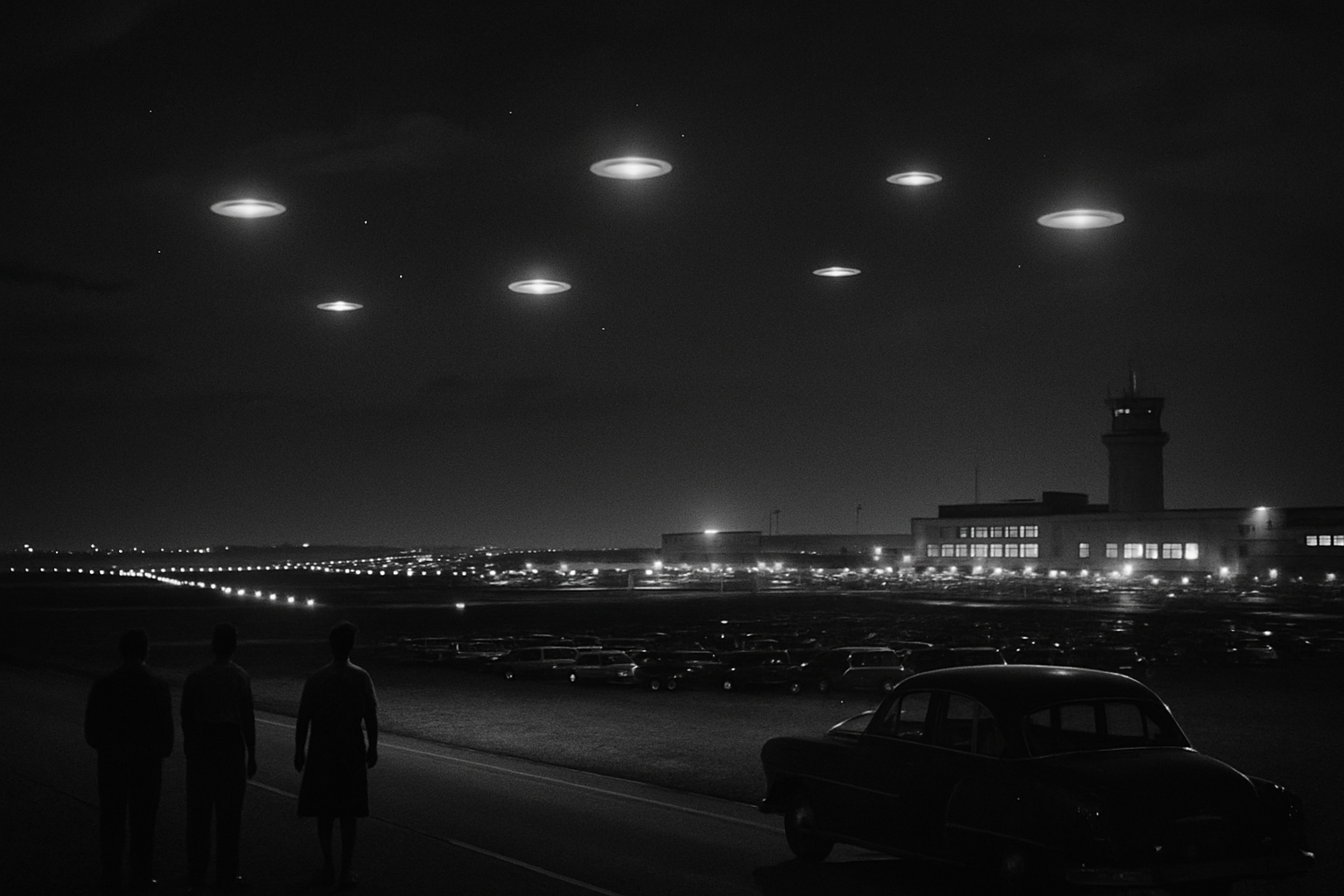
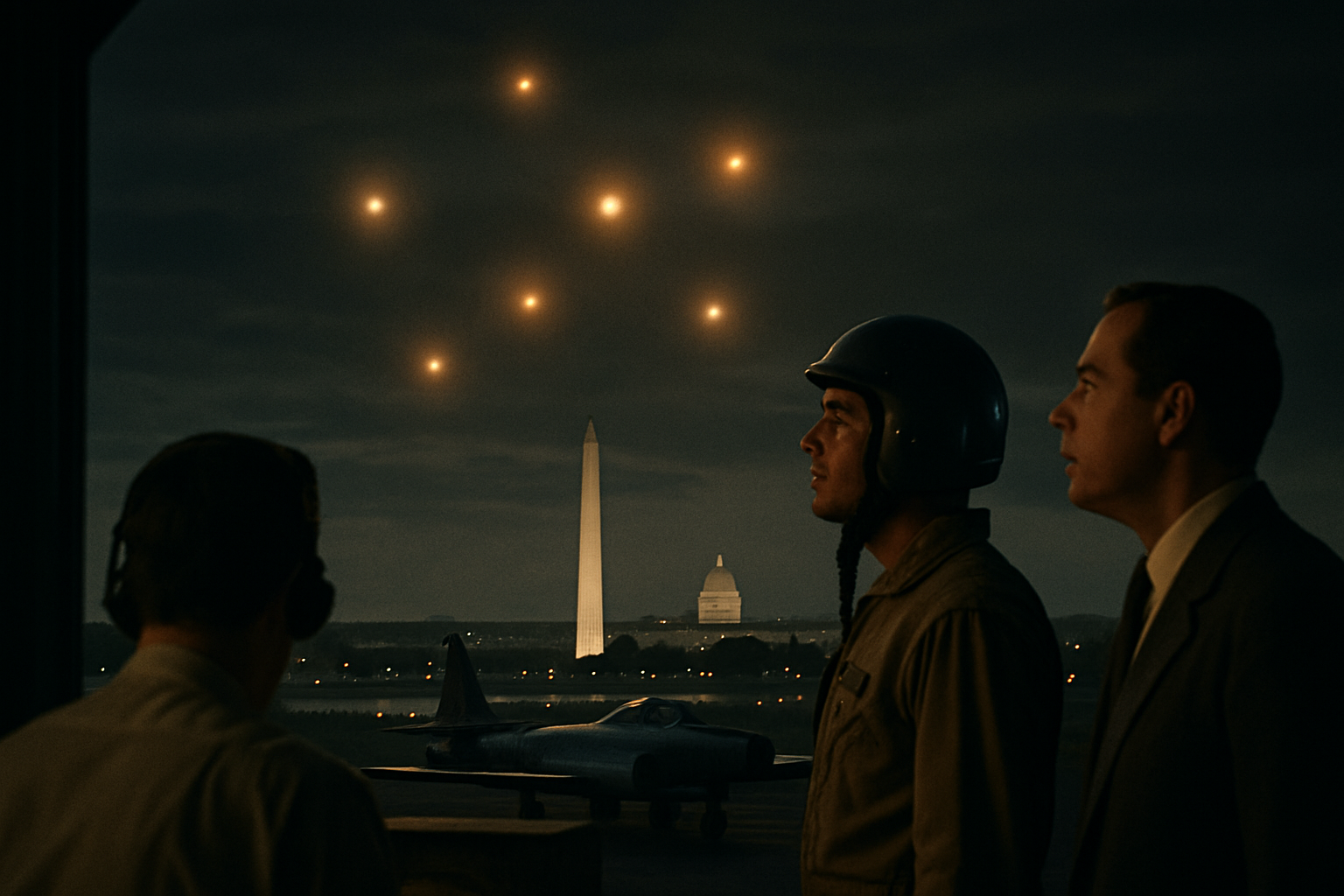
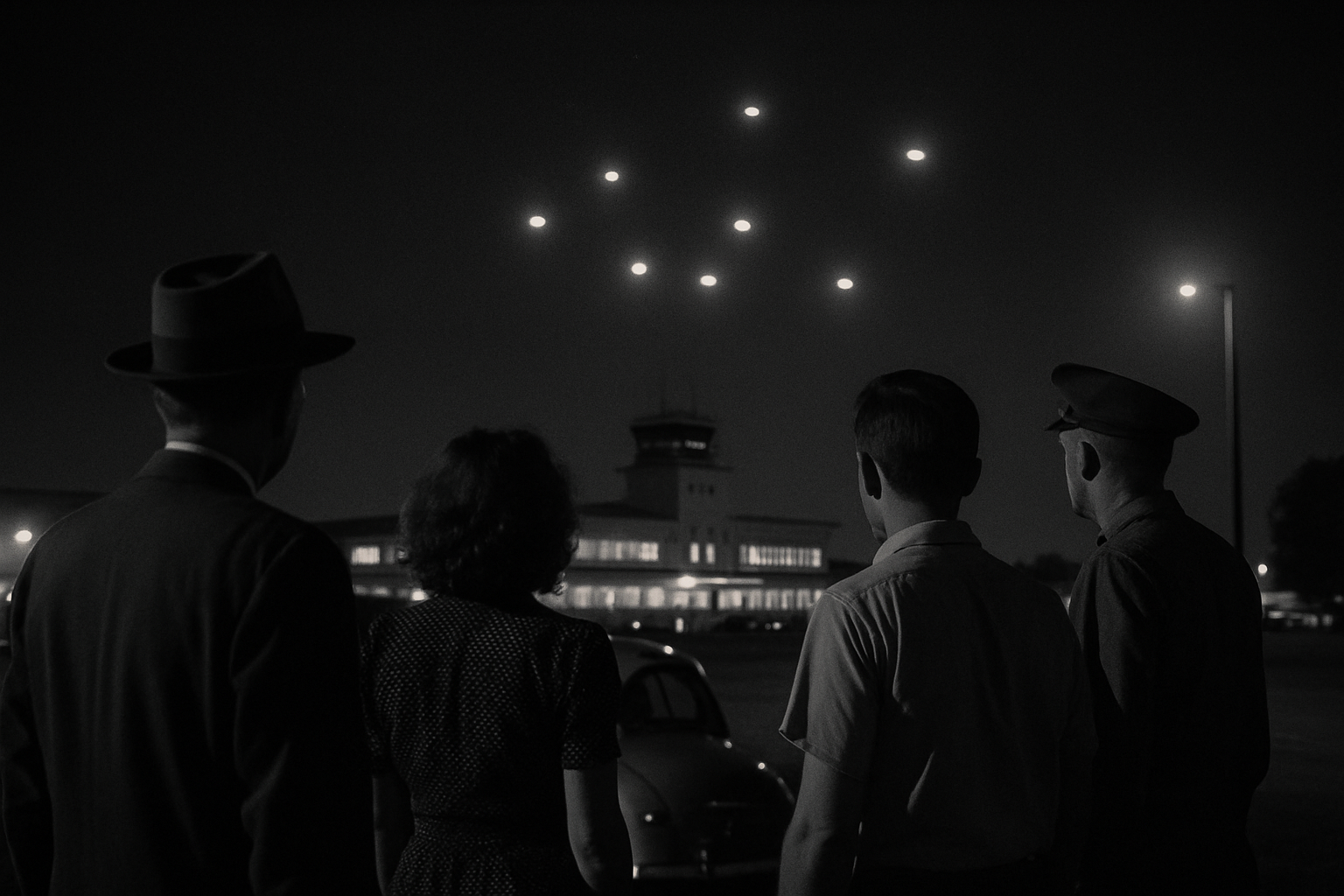
The 1952 Washington, D.C. UFO incident, sometimes called the Washington flap or the Invasion of Washington, was a series of unidentified flying object reports over Washington, D.C. on two consecutive weekends, 19–20 and 26–27 July 1952.[1] Radar operators at Washington National Airport and at Andrews Air Force Base tracked unknown targets, while airline and Air Force pilots and ground witnesses reported lights, prompting the U.S. Air Force to scramble F-94 Starfire interceptors.[1] The events generated front-page coverage across the United States and led the Pentagon to hold its largest press conference since the Second World War on 29 July 1952, at which the Air Force attributed the radar contacts to temperature inversion.[1][3] Some controllers, pilots and investigators disputed that explanation, and the case remains among the most widely discussed of the 1952 American UFO wave.[1]
Background
By the summer of 1952 the United States was in the midst of a marked surge in UFO reports, later remembered as the "1952 flap." The Air Force's investigative unit, Project Blue Book, received hundreds of reports that year — far more than in the preceding period — and the Washington events became its most intense episode.[1]
- The reports were collected and assessed by Project Blue Book, directed at the time by Captain Edward J. Ruppelt.[1]
- Washington National Airport in 1952 operated an Air Route Traffic Control Center and a separate tower radar, while nearby Andrews Air Force Base maintained its own radar — a configuration that later allowed claims of objects being tracked simultaneously by more than one set.[1]
- The incident unfolded against a Cold War backdrop in which unexplained objects over the national capital raised concerns about both air defense and possible enemy activity.[1][2]
First weekend (19–20 July)
Shortly before midnight on 19 July 1952, air-traffic controller Edward Nugent at Washington National Airport detected seven objects on radar to the south-southwest of the city, in airspace where no aircraft were expected.[1] Senior controller Harry Barnes reviewed the returns, judged them genuine, and alerted other facilities including Andrews Air Force Base.[1]
- Controllers in the tower reported seeing a bright light that, according to the account, departed at high speed.[1]
- Capital Airlines pilot Captain S. C. Pierman, airborne near Washington, reported observing several white, fast-moving lights over a period of minutes while in radio contact with Barnes.[1]
- Personnel at Andrews also reported an orange-red light that appeared to hover and then change direction abruptly.[1]
- F-94 Starfire interceptors were eventually sent toward the area; according to the reports, the radar targets faded as the jets arrived and returned after they left, the final returns disappearing around dawn.[1]
Barnes later remarked that the movements were "completely radical compared to those of ordinary aircraft."[1]
Second weekend (26–27 July)
The pattern recurred a week later, on the night of 26–27 July 1952. Radar at Washington National Airport and at Andrews again displayed unknown targets, and crews of commercial flights reported lights.[1][2]
- As the activity intensified, the Air Force again scrambled F-94 jets. One pilot reported being surrounded by lights; the wingman, identified in accounts as Lieutenant William Patterson, radioed asking what he should do, but the lights did not allow a sustained intercept.[1]
- Major Dewey Fournet, Blue Book's Pentagon liaison, and a Navy radar specialist were present at the radar center; Fournet stated that those present believed the targets were "most likely caused by solid metallic objects," while the temperature-inversion conditions reported that night were judged by some present to be too weak to account for the strong returns.[1]
- Some targets were later matched to mundane sources — one was identified as a riverboat — and a bomber crew vectored over the contacts reported seeing nothing.[1]
The sightings and radar returns again ceased around sunrise.[1]
Investigation and official response
The repeated sightings over the capital drew intense press attention and reached the White House, where President Harry Truman's air aide telephoned Ruppelt for an explanation.[1] Ruppelt, who had not yet interviewed the witnesses, suggested temperature inversion as a possible cause.[1]
On 29 July 1952 the Air Force convened what was described as its largest press conference since the Second World War, co-led by Major General John A. Samford, USAF Director of Intelligence, and Major General Roger M. Ramey, USAF Director of Operations.[1][4]
- The Air Force attributed the unknown radar contacts to temperature inversion, a weather condition in which a warm layer over cooler air can bend radar beams and return signals from ground objects, producing false "targets."[1][2]
- Visual sightings were explained as misidentified meteors, stars and other ordinary phenomena combined with witness excitement.[1][2]
- Samford stated that the contacts came from no "solid material objects" that posed a threat to national security.[1]
The 1952 wave also alarmed intelligence agencies; the CIA convened the Robertson Panel in January 1953, which examined leading cases and recommended that the Air Force reduce the public "aura of mystery" around UFOs.[1][2]
Explanations and disputes
The temperature-inversion explanation became the standard official account, but it was contested both at the time and afterward.[1]
Supporting the conventional explanation:
- Astronomer Donald Menzel and aviation writer Philip Klass argued that inversion layers and immature 1952 radar technology could plausibly produce the anomalous returns.[1]
- Several targets were resolved as mundane objects, and at least one pilot concluded he had seen an atmospheric distortion of a star rather than a craft.[1]
Disputing it:
- Ruppelt himself noted that during June, July and August in Washington "hardly a night passed" without a temperature inversion, yet routine UFO returns did not appear on radar — a point he raised in his own account of the case.[2]
- Major Fournet and the Navy radar specialist present on 26–27 July maintained the returns behaved like solid objects, and former controller Howard Cocklin told the Washington Post in 2002 that he had seen an object "on the [radar] screen and out the window."[1]
- In his book *The Report on Unidentified Flying Objects*, Ruppelt recorded that several radar and control-tower personnel, along with some Air Force officers, disagreed with the temperature-inversion explanation.[1]
The net effect is that the incident is best described as disputed rather than conclusively resolved.[1][2]
Aftermath and significance
The Washington flap is widely regarded as a turning point in the public history of UFOs in the United States.[1][3]
- It is often cited as the climax of the 1952 UFO wave, the year in which Project Blue Book received its heaviest volume of reports.[1]
- The CIA's concern that adversaries might exploit UFO hysteria, together with the strain on the air-defense reporting system, contributed directly to the convening of the Robertson Panel in 1953 and to a subsequent policy emphasis on debunking rather than publicizing unexplained cases.[1][2]
- The episode entered popular culture as the story of "flying saucers" over the capital and is still referenced in modern coverage of unidentified aerial phenomena.[2][3]
More than seven decades later, the case remains a touchstone in debates over how seriously governments treat radar-and-visual UFO reports, precisely because key participants — including Blue Book's own Pentagon liaison — never accepted the temperature-inversion explanation the Air Force gave in public.[1][3]
Key quotes
“Those present believed the targets were "most likely caused by solid metallic objects." — Major Dewey Fournet, Project Blue Book liaison
“"I saw it on the [radar] screen and out the window." — former controller Howard Cocklin, to the Washington Post in 2002
References
- 1.
- 2.
- 3.
- 4.
Similar cases
Scored on agency / year proximity / region / tag overlap — same agency +3, near year +4, same region +2, shared tag ×2.