Lakenheath-Bentwaters incident
Illustrations
AI-generated illustration — not actual footage or evidence; an interpretive depiction based on the documented account
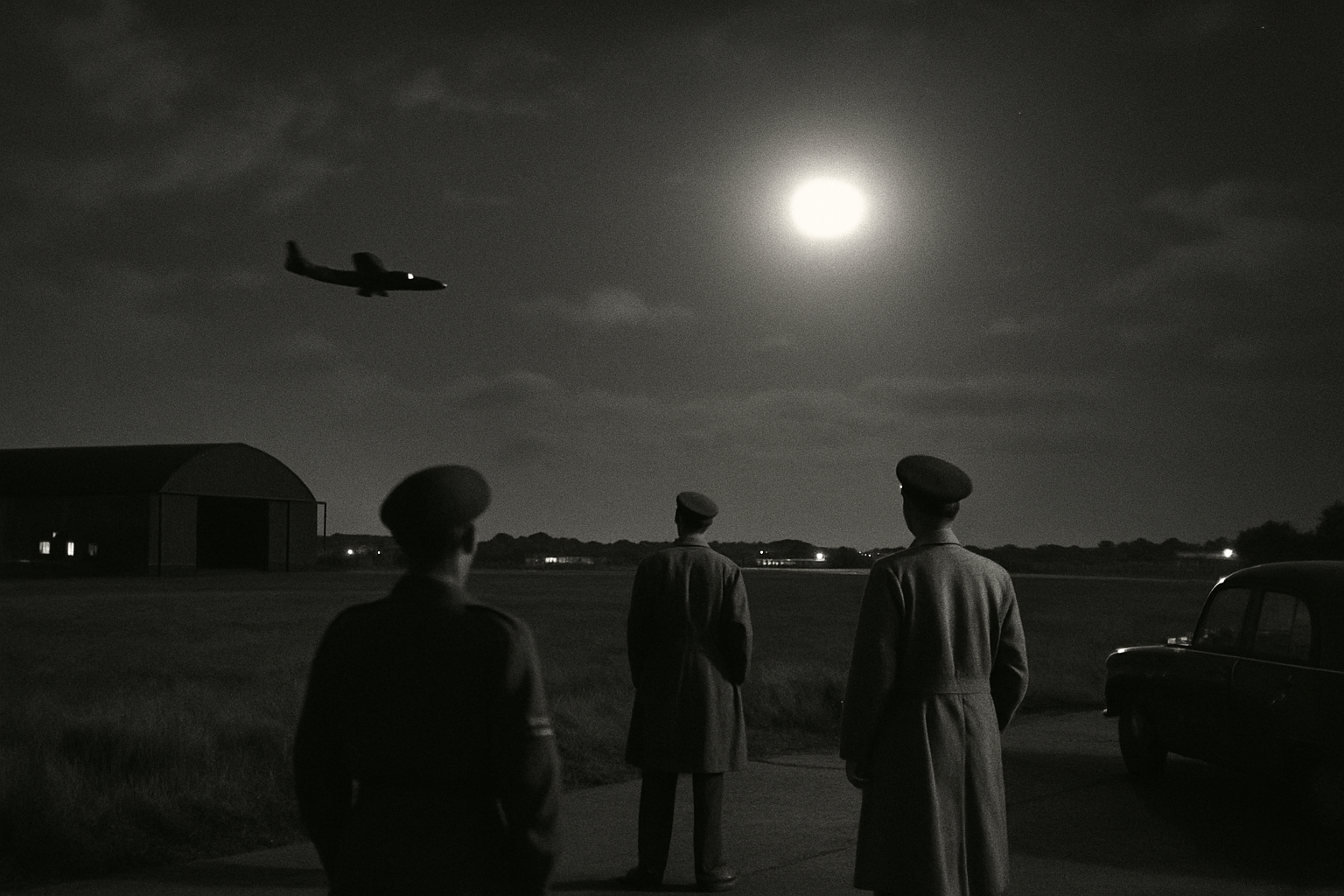
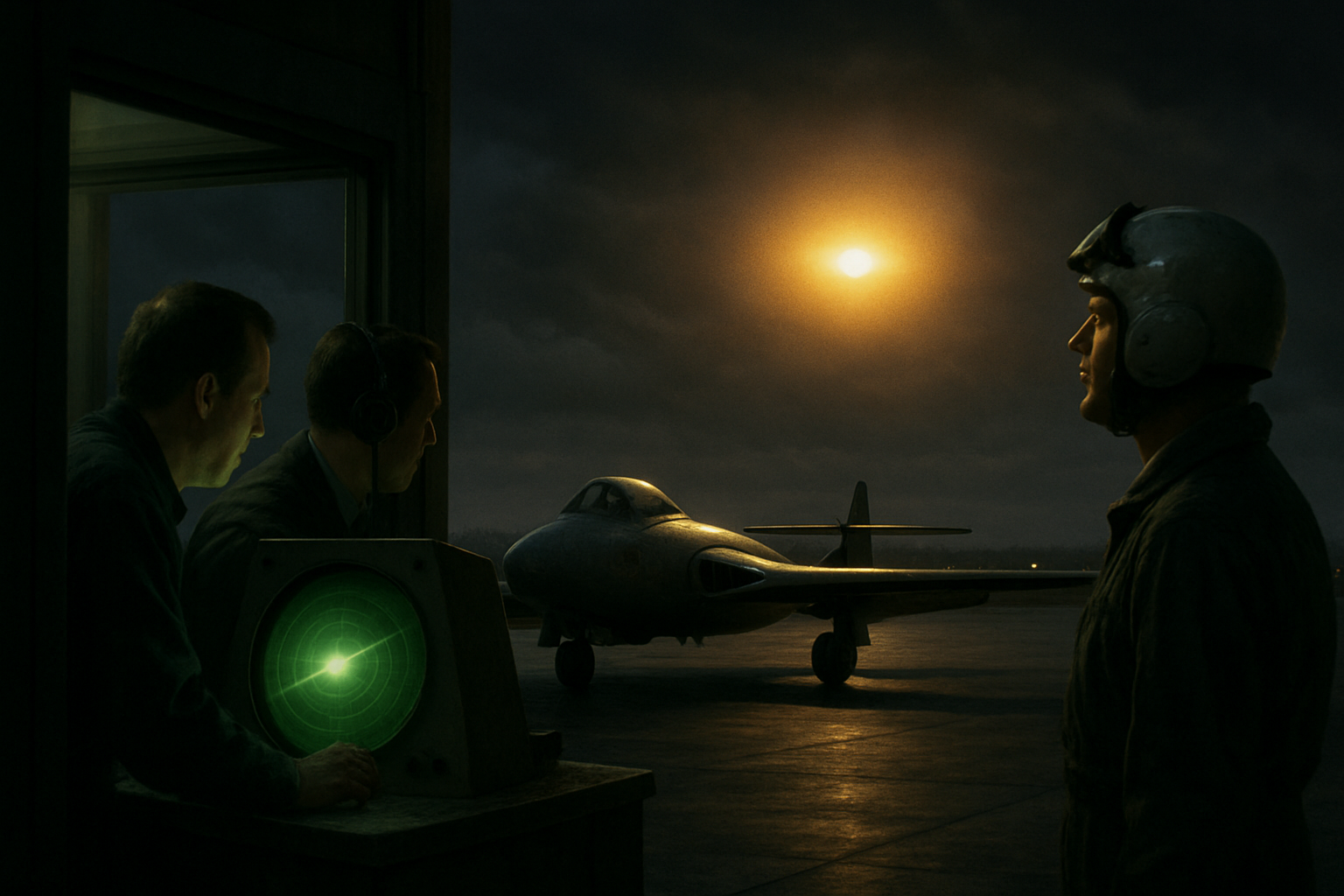
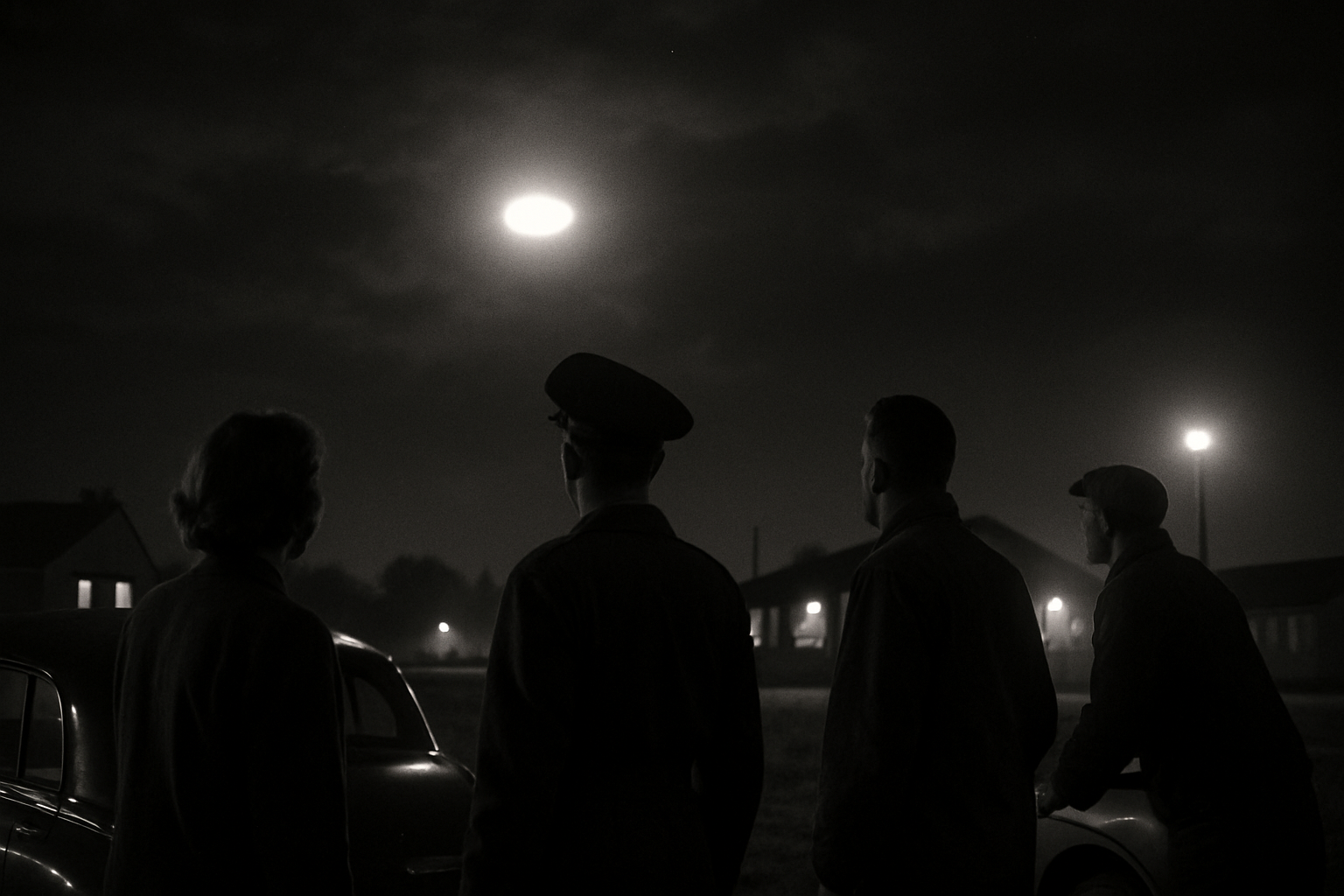
The Lakenheath-Bentwaters incident was a series of radar and visual contacts with unidentified flying objects (UFOs) over eastern England on the night of 13–14 August 1956, involving Royal Air Force (RAF) and United States Air Force (USAF) personnel at the U.S.-operated bases RAF Bentwaters (Suffolk) and RAF Lakenheath.[1] Over a period of several hours, ground radar at Bentwaters and the radar air-traffic control centre at Lakenheath tracked targets moving at extreme speeds and making abrupt manoeuvres, while ground and airborne observers reported luminous objects in the sky.[2][3]
The RAF scrambled a de Havilland Venom night fighter from RAF Waterbeach; according to the principal witnesses, the interceptor briefly gained a radar lock, after which an object reportedly positioned itself behind the aircraft and followed it for several minutes before departing.[2][3] The episode was reported through USAF channels to Project Blue Book and was later examined in detail as Case 2 of the Condon Report (1968–69), which concluded that conventional explanations seemed insufficient and that "the probability that at least one genuine UFO was involved appears to be fairly high."[2][1] Skeptics, most prominently Philip J. Klass, have argued that the events can be accounted for by anomalous radar propagation, temperature inversions and misidentified Perseid meteors.[4][1] The case is widely regarded as one of the strongest radar-visual UFO reports on record and is sometimes called a British counterpart to the Roswell or Rendlesham Forest cases.[3]
Background
In 1956 several RAF airfields in eastern England were operated by, or hosted, units of the United States Air Force as part of Cold War air-defence arrangements.[1] RAF Bentwaters, near Woodbridge in Suffolk, and RAF Lakenheath, in the Suffolk/Cambridgeshire border area, were among these bases and were equipped with ground-controlled approach (GCA) and radar air-traffic control facilities staffed by American personnel.[2]
The events unfolded on a clear August night that coincided with the Perseid meteor shower, producing an unusually large number of bright "shooting stars" — a detail later cited both as context and as the basis of one skeptical explanation.[1][4] Radar coverage that night involved several independent systems, including the Bentwaters GCA radar, the Lakenheath radar air-traffic control centre (RATCC), and an RAF radar station; this redundancy of independent sensors would become central to later assessments of the case.[2]
The events of 13–14 August 1956
The episode extended from about 2130Z on 13 August to roughly 0330Z on 14 August 1956 and unfolded in several distinct phases.[2]
Initial Bentwaters radar contacts. At about 2130Z, the GCA radar at Bentwaters tracked a target approaching at very high speed — described in accounts as several thousand miles per hour. Around the same period operators noted a group of slow-moving returns (roughly 80–125 mph) and, separately, a single very strong echo described as "several times" the size of the return expected from a B-36 bomber.[2][3]
The 2255Z contact and the white light. At about 2255Z, Bentwaters radar tracked a target moving westward at an estimated 2,000–4,000 mph. At about the same time a bright white light was seen from the ground, and the pilot of a C-47 transport flying at roughly 4,000 feet reported a similar light passing beneath his aircraft.[2][3]
The Lakenheath phase and the Venom interception. Reports were relayed to RAF Lakenheath, whose RATCC then tracked targets that hovered and then made sharp, high-speed manoeuvres, with ground observers also seeing luminous objects.[2] The RAF scrambled a de Havilland Venom night fighter from RAF Waterbeach, southwest of Lakenheath. According to the Lakenheath watch supervisor Forrest Perkins, the Venom crew acquired a radar lock on a target — the pilot reportedly saying words to the effect that he had his "guns locked on" it — but the object then moved behind the aircraft and the pilot, despite repeated manoeuvres, was unable to shake it off or get behind it again.[2][3] The object reportedly followed the interceptor for several minutes before breaking away and departing northward.[2]
Investigation and official response
The incident was documented at the time through USAF channels: teletype messages were sent from the Lakenheath unit to Project Blue Book, the U.S. Air Force's UFO investigation programme, in the days after the event.[2]
More than a decade later the case was re-examined in depth by the University of Colorado UFO Project, commonly known after its director Edward U. Condon as the Condon Committee. Its 1968–69 report (the Condon Report) treated the episode as Case 2. The case study was prepared by Gordon D. Thayer, who relied heavily on a detailed 1968 account from Forrest Perkins and on supporting documentation.[2]
Key aspects of the witness testimony were later corroborated publicly by Freddie Wimbledon, an RAF radar controller who said he had been on duty at RAF Neatishead and had directed the Venom interception, supporting Perkins's account of the aircraft being pursued.[3] The combination of multiple independent radars and both ground and airborne visual observers gave the case an unusual degree of internal redundancy compared with most UFO reports.[2]
Explanations and disputes
The Condon Report's assessment
In his Condon Report analysis, Gordon Thayer systematically considered conventional explanations — including radar malfunction, anomalous propagation (false radar returns caused by atmospheric layering), and astronomical or meteoric phenomena — and judged that none adequately accounted for the full set of correlated radar and visual observations.[2] The report's much-quoted conclusion is that, after considering the available evidence, "the probability that at least one genuine UFO was involved appears to be fairly high."[2][1] Thayer emphasised that "genuine UFO" here meant an unidentified material object in flight, not a claim of extraterrestrial origin.[2]
Skeptical explanations
The most prominent skeptical treatment came from Philip J. Klass, who argued that the radar contacts could be explained by anomalous propagation and ground-clutter effects associated with a strong temperature inversion, and that the visual elements were largely Perseid meteors, which were unusually numerous that night.[4][1] On this view the apparent high speeds and abrupt manoeuvres of the radar targets were artefacts rather than the motion of solid objects.[4]
Later commentators have offered additional possibilities. Some British researchers have suggested that the activity might be linked to the testing of radar countermeasures or spoofing, noting that pilots they interviewed recalled unimpressive contacts and, in some cases, no visual sightings at all.[1] Proponents of the anomalous-aircraft interpretation counter that anomalous propagation does not easily reproduce a target that both shows on independent radars and is reported visually, nor one that manoeuvres relative to a moving interceptor as described.[2]
Aftermath and significance
Because it was conceded as unexplained in the otherwise skeptical Condon Report, the Lakenheath-Bentwaters incident has remained one of the most frequently cited radar-visual UFO cases in the literature.[2][3] Investigators favourable to the unexplained interpretation point to the multiple, mutually corroborating channels of observation — ground radar, airborne radar, ground-visual and airborne-visual — as setting the case apart from single-witness reports.[2]
The episode is often discussed alongside the United Kingdom's other best-known military UFO event, the Rendlesham Forest incident of December 1980, which occurred near the same Bentwaters/Woodbridge complex; the two are sometimes jointly described in popular media as Britain's equivalent of Roswell.[3] More than half a century after the event, the case continues to be re-analysed by both proponents and skeptics, and no single explanation has achieved general acceptance.[1][3]
Key quotes
“The Condon Report's conclusion on the case: "the probability that at least one genuine UFO was involved appears to be fairly high."
“According to Forrest Perkins, the Venom pilot reported that after the object got behind him, "I did everything I could to get behind him and I couldn't."
References
- 1.
- 2.
- 3.
- 4.
Similar cases
Scored on agency / year proximity / region / tag overlap — same agency +3, near year +4, same region +2, shared tag ×2.