Robert Taylor Incident (Dechmont Woods Encounter)
Illustrations
AI-generated illustration — not actual footage or evidence; an interpretive depiction based on the documented account
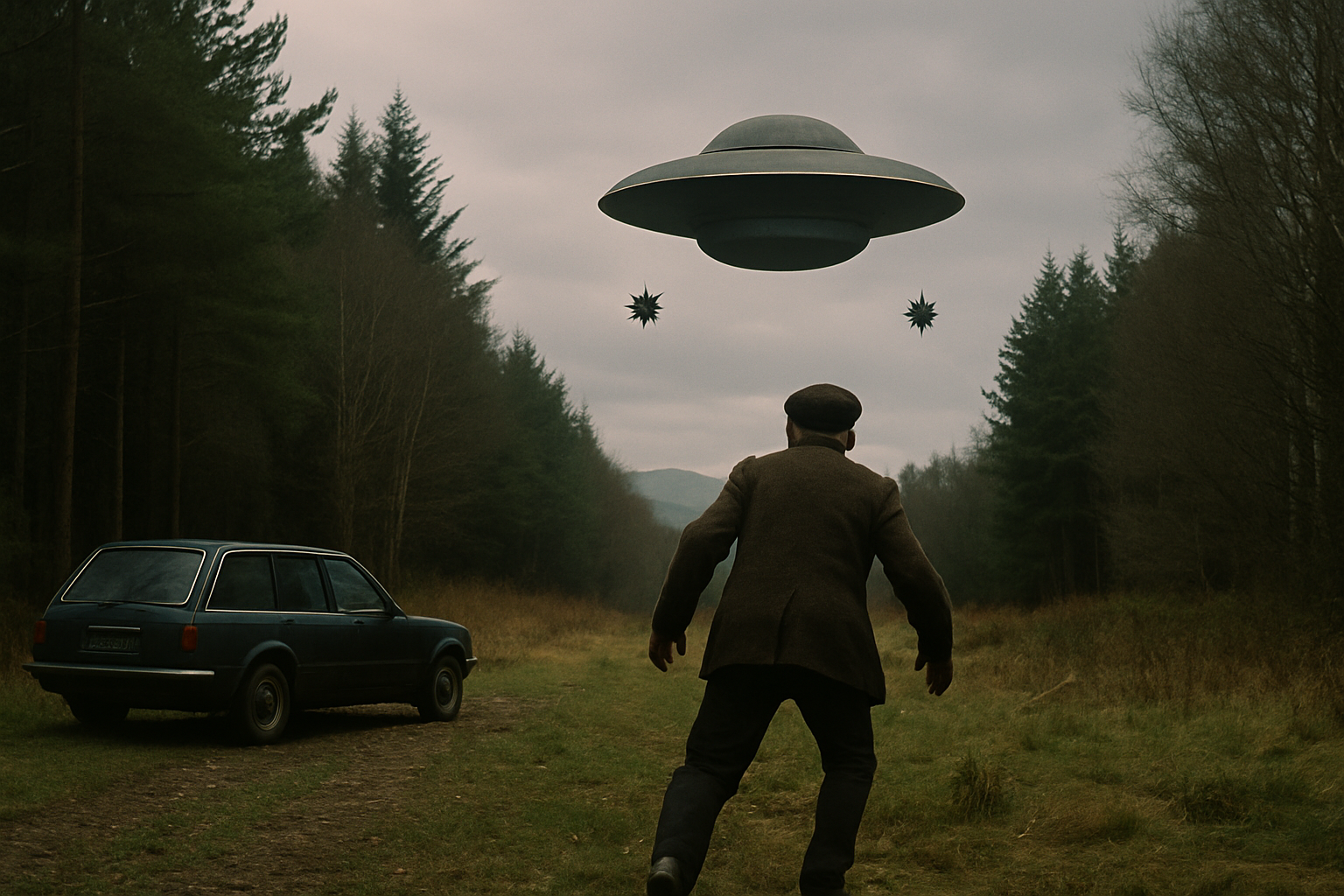
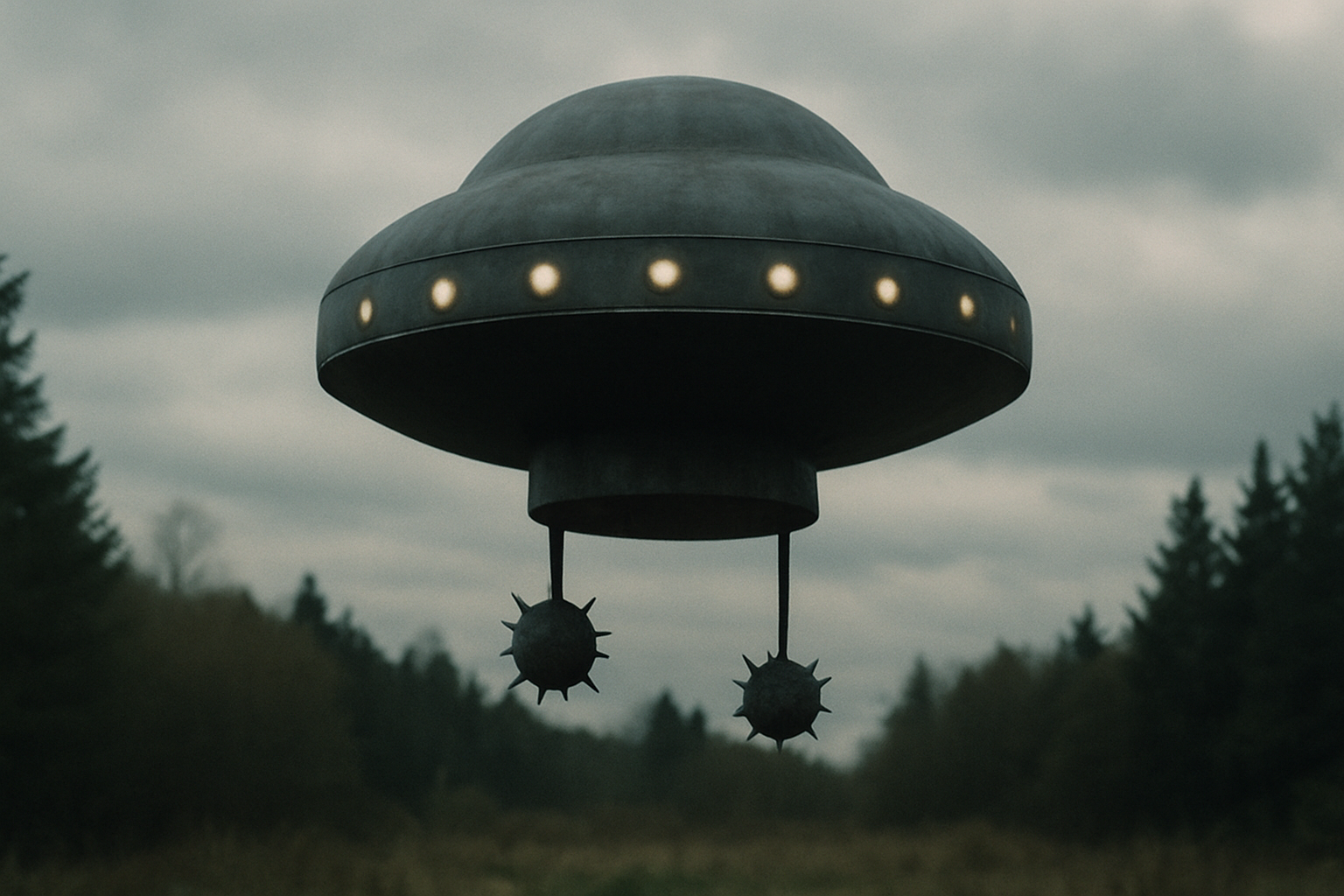
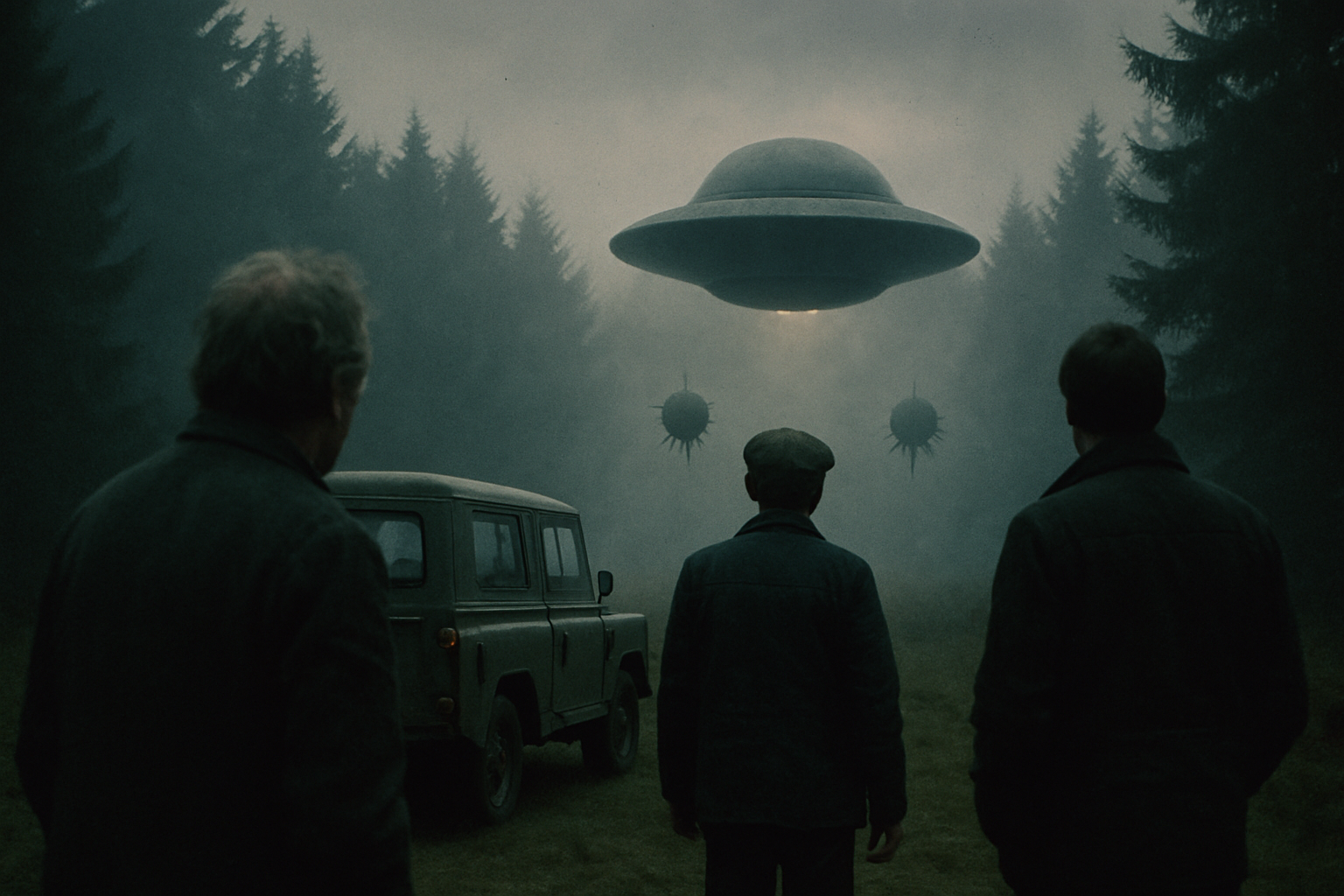
The Robert Taylor incident, also known as the Livingston incident or the Dechmont Woods encounter, refers to a reported close encounter on 9 November 1979 at Dechmont Law, near Livingston in West Lothian, Scotland.[1] Robert "Bob" Taylor (1919–2007), a forestry worker for the Livingston Development Corporation, said that while walking with his dog he came upon a hovering dome-shaped object and two smaller spiked spheres that seized him and dragged him before he lost consciousness.[1] He returned home dishevelled, with torn clothing and grazes, and his wife summoned a doctor and the police.[3] Because Taylor was injured, the police recorded the matter as a common assault — the reason the case is often called the only UFO report in Britain to become the subject of a criminal investigation.[2] Investigators documented marks on the ground at the site, while skeptics have proposed medical and astronomical explanations; the case has never been conclusively resolved.[1]
Background
Dechmont Law is a low hill on the edge of Livingston, a new town in West Lothian, Scotland, beside the M8 motorway.[3] At the time the surrounding land was being planted with new forestry by the Livingston Development Corporation, which employed Robert Taylor, then aged 61, as a forester.[1]
Taylor was a long-serving and locally respected outdoor worker with about fifteen years' experience, and accounts consistently describe him as a sober, reliable witness with no history of inventing stories.[3] He had a history of meningitis, a detail later cited in medical discussions of the case.[1]
The encounter
On the morning of 9 November 1979 Taylor parked his pickup truck beside a road near the M8 and walked up a forest path on Dechmont Law with his red setter, Lara, to inspect the plantation.[2] At about 10:00 he rounded a bend in the trees and, in a clearing, reported seeing a large hovering object.[1]
He described it as a "flying dome" — a roughly spherical or dome-shaped craft about 7 yards (6.4 m) in diameter, a very dark grey, with a surface like rough sandpaper and an outer flange carrying arm-like propellers.[1][3] According to his account, two smaller spheres, each studded with spikes and resembling naval sea mines, rolled toward him, attached themselves to his legs, and began dragging him toward the larger object.[3]
- Taylor reported a strong, acrid smell "like burning brakes" during the encounter.[3]
- He said he then lost consciousness.[1]
- When he came to, the objects were gone and his dog Lara was barking; he was lying on the ground, unable at first to speak clearly, with a headache and a dry throat.[1]
Unable to start his truck, Taylor walked home, arriving muddy and dishevelled with torn trousers and grazes to his chin and thighs.[3]
Investigation and official response
Taylor's wife called both the family doctor, who treated his grazes, and the police.[3] Because he had visible injuries, Lothian and Borders Police treated the report as a possible assault and opened an inquiry, accompanying Taylor back to the site.[2]
At the clearing officers documented physical marks in the ground:
- A set of ladder-shaped marks where Taylor said the large dome had hovered, described as two parallel tracks resembling rungs.[1][2]
- A number of smaller holes or marks that Taylor attributed to the two spiked spheres.[1]
The handling of the case as a criminal matter is the basis for its frequent description as the only alien-encounter report in Britain to become the subject of a formal criminal investigation.[2] Because no assailant was ever identified, the file was never resolved in the ordinary way.
Explanations and disputes
The case has attracted both believers, who treat it as one of Britain's most credible close-encounter reports, and skeptics, who argue for conventional causes.[1]
Medical hypotheses
The physician Patricia Hannaford suggested that Taylor's collapse was an isolated attack of temporal lobe epilepsy, during which hallucinations could account for the objects he reported; she pointed to his prior meningitis and the perceived odour as consistent with such a seizure.[1] Critics of this view note that Taylor had no recorded history of epileptic attacks before or after the event.[2]
Astronomical and physical hypotheses
The UFO skeptic Steuart Campbell visited the site and proposed that Taylor may have experienced a hallucination triggered by an astronomical mirage of the planet Venus.[1] Campbell also suggested that the ground marks could have a mundane origin, noting PVC pipes stored in an adjoining field and proposing that stacks of such pipes might explain the impressions in the clearing.[1]
The anomalous account
Against these explanations, supporters emphasise that Taylor was an experienced, level-headed countryman, that he never sought publicity or profit, and that his torn clothing, grazes and the marks on the ground were physical and independently observed.[3] No single explanation has gained universal acceptance, and the incident remains genuinely disputed.
Aftermath and significance
Robert Taylor maintained the same account for the rest of his life and never sought to profit from it; he died in 2007.[3] The episode became one of the best-known UFO cases in Britain and is sometimes likened to the 1964 Lonnie Zamora landing at Socorro, New Mexico, because of its trace evidence and credible single witness.[3]
In January 1992 the Livingston Development Corporation marked the spot in Dechmont woods with a commemorative cairn and plaque recording Taylor's encounter, and the wooded site has since become a minor point of local interest for visitors.[1] The case continues to feature in surveys of British UFO reports and in discussions of how ground traces and a sincere witness can leave an event unresolved despite both anomalous and conventional interpretations being available.[2]
Key quotes
“Taylor described the object as a "flying dome" and said the air carried a smell "like burning brakes."
References
- 1.
- 2.
- 3.
Similar cases
Scored on agency / year proximity / region / tag overlap — same agency +3, near year +4, same region +2, shared tag ×2.