Trans-en-Provence case
Illustrations
AI-generated illustration — not actual footage or evidence; an interpretive depiction based on the documented account


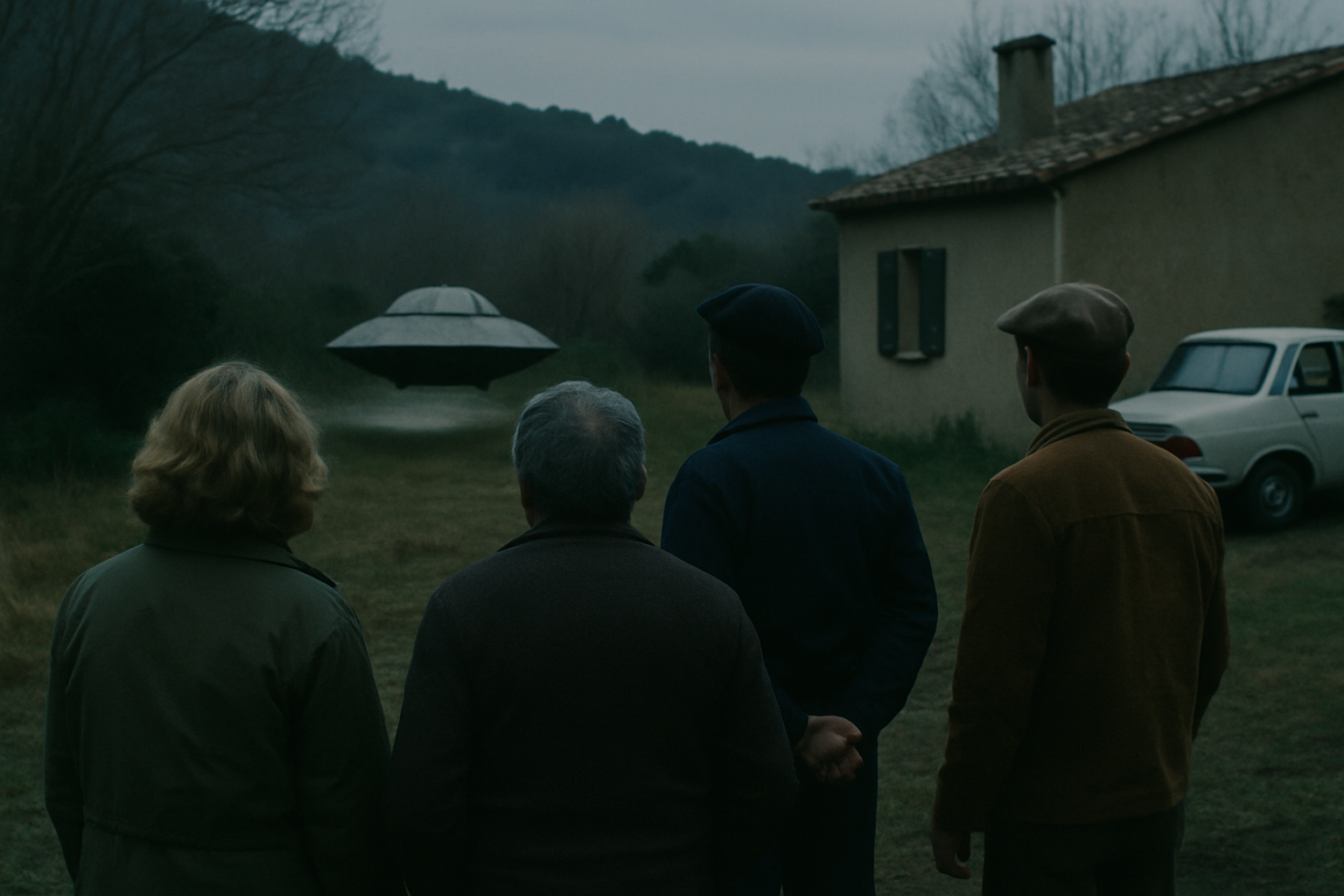
The Trans-en-Provence case is a reported close-encounter and physical-trace incident that occurred on 8 January 1981 at Trans-en-Provence, a commune in the Var department of southeastern France.[1][2] The sole witness, a retired mason named Renato Nicolaï (then about 55), said that in the late afternoon he saw a lead-coloured object shaped like two saucers placed rim to rim descend onto a terrace in his garden, rest there briefly, and then rise and fly off toward the northeast; the whole observation lasted only some tens of seconds.[1][2] The following day the local gendarmerie examined the spot, photographed and measured ring-shaped marks on the ground, and collected soil and vegetation samples, after which the case was referred to GEPAN (Groupe d'Étude des Phénomènes Aérospatiaux Non identifiés), the unit set up within the French national space agency CNES to study unidentified aerial phenomena.[1][3] Subsequent laboratory work — including analyses associated with the biochemist Michel Bounias — reported that the soil had been compressed and heated and that alfalfa growing near the trace showed substantially reduced chlorophyll, findings summarised in GEPAN's Note Technique no. 16 (1983), which classified the event as unexplained.[1][2][4] The case has been promoted by some researchers as one of the most thoroughly documented physical-trace sightings on record, while skeptics have argued that the marks and other features are consistent with ordinary causes, leaving its true nature disputed.[4][2]
Background
Trans-en-Provence is a small commune in the Var department in the Provence region of southeastern France, in hilly country not far from the Canjuers military camp.[1] At the time of the incident France had a comparatively structured official channel for handling reports of unidentified aerial phenomena: in 1977 the national space agency CNES (Centre National d'Études Spatiales) had established GEPAN (Groupe d'Étude des Phénomènes Aérospatiaux Non identifiés) in Toulouse to collect and study such reports, working in cooperation with the gendarmerie nationale, whose local brigades routinely took the first statements and gathered evidence.[1][3]
This arrangement meant that, unlike many anecdotal sightings, the Trans-en-Provence report was followed within a day by an on-site gendarmerie examination and the collection of physical samples, and was then handed to a body equipped to commission laboratory analysis.[1][3] These institutional features are central to why the case became widely cited in the UFO literature.[4]
The reported sighting
According to the account Nicolaï gave to investigators, on the afternoon of 8 January 1981 he was working at the lower end of his sloping garden — by several accounts building a small concrete shelter for a water pump — when he heard a faint whistling sound and turned to see an object descending toward a terrace some tens of metres away.[1][2]
He described the object in these broad terms:
- It was the colour of lead and had the form of two saucers (or plates) joined rim to rim, one inverted over the other, with a raised ridge or rim around the circumference.[1][2]
- It measured roughly 2.5 metres in diameter and on the order of 1.5 to 1.8 metres high.[1][2]
- Beneath the body he reported two protruding circular features — variously interpreted as landing feet or as reactors — extending some 20 cm below, and two circular trapdoor-like openings.[2]
Nicolaï said the object rested on the ground only momentarily before lifting off, rising above the tree line and departing; he estimated the whole observation at roughly 30 to 40 seconds.[1][2] He reported no occupants and no obvious lighting beyond the metallic appearance of the craft itself.[2] After it left, he said, he went to the spot and noticed marks on the ground, and he subsequently spoke to family members and to the authorities.[1]
Investigation and official response
The day after the sighting, the local gendarmerie went to Nicolaï's property, interviewed him, and documented the site.[1][3] They recorded ring-shaped traces on the ground — described in secondary sources as roughly circular or concentric marks about 2.2 to 2.4 metres across, with darker striations — and they collected samples of soil and of vegetation from the affected area, doing so within about a day of the event.[1][2] The case was formally notified to GEPAN a few days later under the cooperation arrangement between the gendarmerie and CNES.[1]
GEPAN, with its investigation led by Jean-Jacques Velasco, arranged for laboratory analysis of the samples by several specialists.[4][2] The reported physical findings included:
- The ground appeared to have been compressed by a mechanical load on the order of 4 to 5 tonnes.[1][3]
- The soil showed signs of heating, with estimates placing the temperature reached somewhere in the range of a few hundred degrees Celsius (sources cite figures up to roughly 300–600 °C / below about 600 °C).[1][2]
- Trace amounts of phosphate and zinc were reported in the sampled material.[1]
The biochemist Michel Bounias, of the French national agronomic research institute (INRA), is associated with the analysis of the plant material.[4][2] The work reported that alfalfa (lucerne) growing near the trace showed chlorophyll levels roughly 30–50% lower than expected, with biochemical changes that were said to correlate with distance from the centre of the trace and to diminish over the following weeks and months as the plants recovered.[1][4] Bounias was careful about interpretation; he is quoted as concluding that it was not his aim to identify the exact nature of the phenomenon, but that "it can reasonably be concluded that something unusual did occur that might be consistent, for instance, with an electromagnetic source of stress."[4]
GEPAN summarised the inquiry in its Note Technique no. 16, issued in 1983, which presented the witness account, the gendarmerie findings and the laboratory results and concluded that a notable event had taken place at the site that the investigation could not explain in conventional terms.[2][4]
Explanations and disputes
The Trans-en-Provence case is genuinely contested, and it is best treated as unresolved rather than as proven evidence of anything in particular.[1][2]
The anomalous interpretation. Proponents emphasise the rapid official response, the combination of an eyewitness account with measured physical traces, and the laboratory reports of soil compaction, heating and the chlorophyll deficit in nearby alfalfa.[4][3] Some writers have argued that the convergence of these elements makes it one of the most fully documented physical-trace cases on record, and the ufologist Jacques Vallée discussed GEPAN's report in his 1990s writing as an example of physical effects associated with close encounters.[4][1]
Conventional and skeptical explanations. Critics caution that the case rests on a single witness and that some of the physical features are open to ordinary readings:
- The gendarmerie reportedly noted that the dark striations across the marks resembled tyre tracks, and skeptics have pointed out that vehicles were present at or near the property — Nicolaï is said to have acknowledged this — suggesting the traces could relate to ordinary ground use rather than to a landed craft.[1][2]
- The geometry of the marks has been described as overlapping semicircles rather than the single clean circle one might expect from a saucer-shaped object, which critics regard as inconsistent with the witness's description.[1]
- Skeptics such as Éric Maillot have questioned the proposed physical mechanism, asking how an object resting on the ground and supposedly emitting pulsed microwaves could heat the soil to several hundred degrees while leaving the surrounding plants without the obvious thermal damage one would expect from such temperatures.[2]
There is also disagreement in the literature about the reliability of the testimony over time, with some skeptical sources citing later remarks attributed to Nicolaï and questioning how firmly the original account was established.[2] Because the conclusions on both sides draw heavily on the same limited evidence — one witness, a set of traces, and a body of laboratory measurements whose interpretation is disputed — neither the anomalous nor the fully conventional reading can be regarded as settled.[1][2]
Aftermath and significance
The Trans-en-Provence case became one of the most frequently cited examples in discussions of so-called physical-trace UFO reports, in part because of the speed and apparent thoroughness of the official handling and the involvement of a national space agency.[4][1] GEPAN and its successor bodies within CNES (later operating under names such as SEPRA and, from 2005, GEIPAN) continued to be cited in connection with the case as French institutional study of unidentified phenomena developed.[1]
The episode has been repeatedly revisited in books, articles and broadcasts, both by researchers who treat it as strong evidence for an unexplained physical event and by skeptics who argue that the ordinary explanations have not been adequately ruled out.[4][2] One often-repeated characterisation, attributed to popular coverage, calls it "perhaps the most completely and carefully documented sighting of all time" — a description that itself reflects the case's status as a touchstone in the debate rather than a neutral verdict on what occurred.[1]
More than four decades on, the official classification of the event as unexplained, set against the unresolved skeptical objections, leaves Trans-en-Provence as a case in which an unusually full evidentiary record has not produced an agreed conclusion.[1][2]
Key quotes
“"It can reasonably be concluded that something unusual did occur that might be consistent, for instance, with an electromagnetic source of stress." — Michel Bounias, on the alfalfa analysis.
References
- 1.
- 2.
- 3.
- 4.
Similar cases
Scored on agency / year proximity / region / tag overlap — same agency +3, near year +4, same region +2, shared tag ×2.