Colares UFO Flap (Operação Prato)
Illustrations
AI-generated illustration — not actual footage or evidence; an interpretive depiction based on the documented account
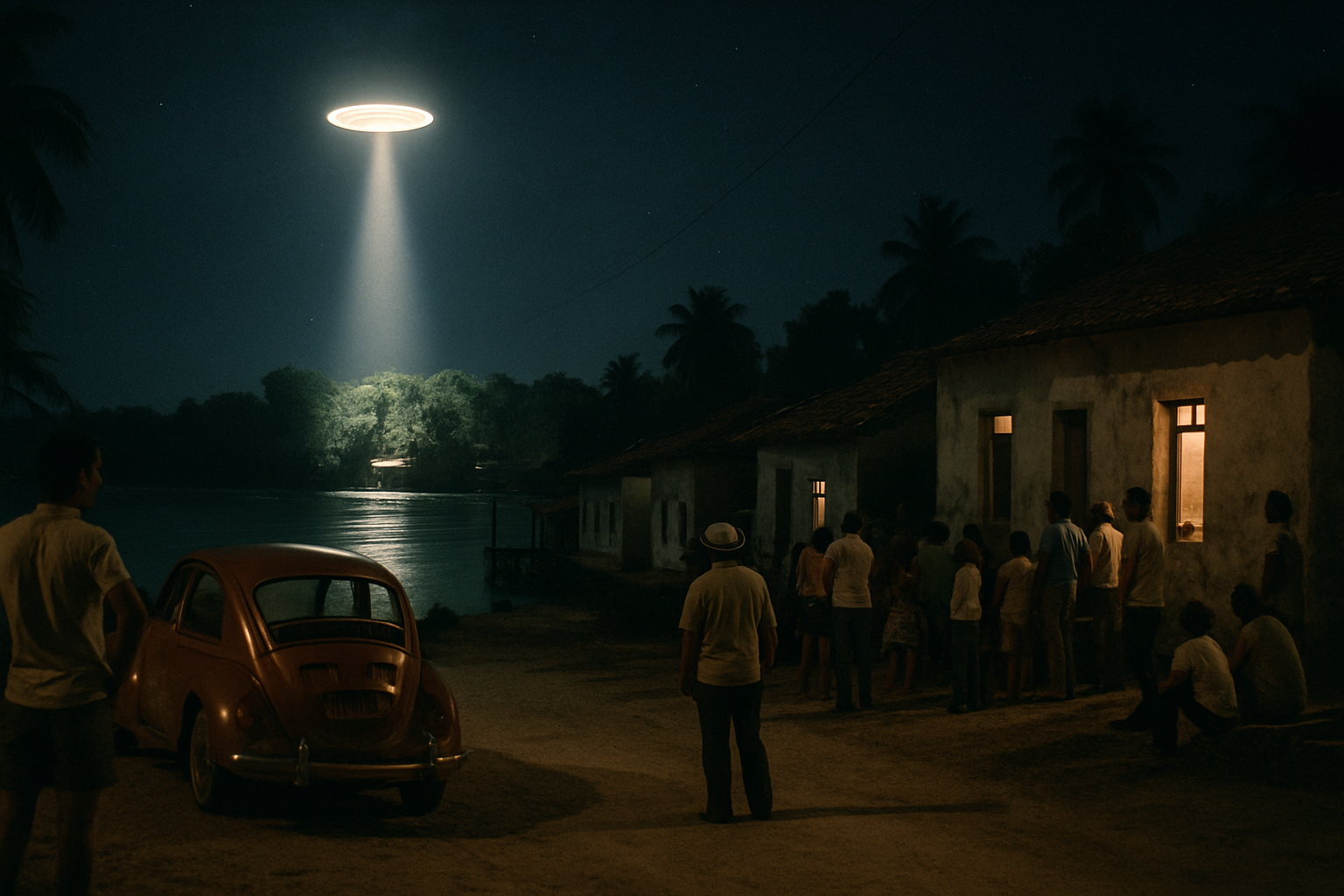
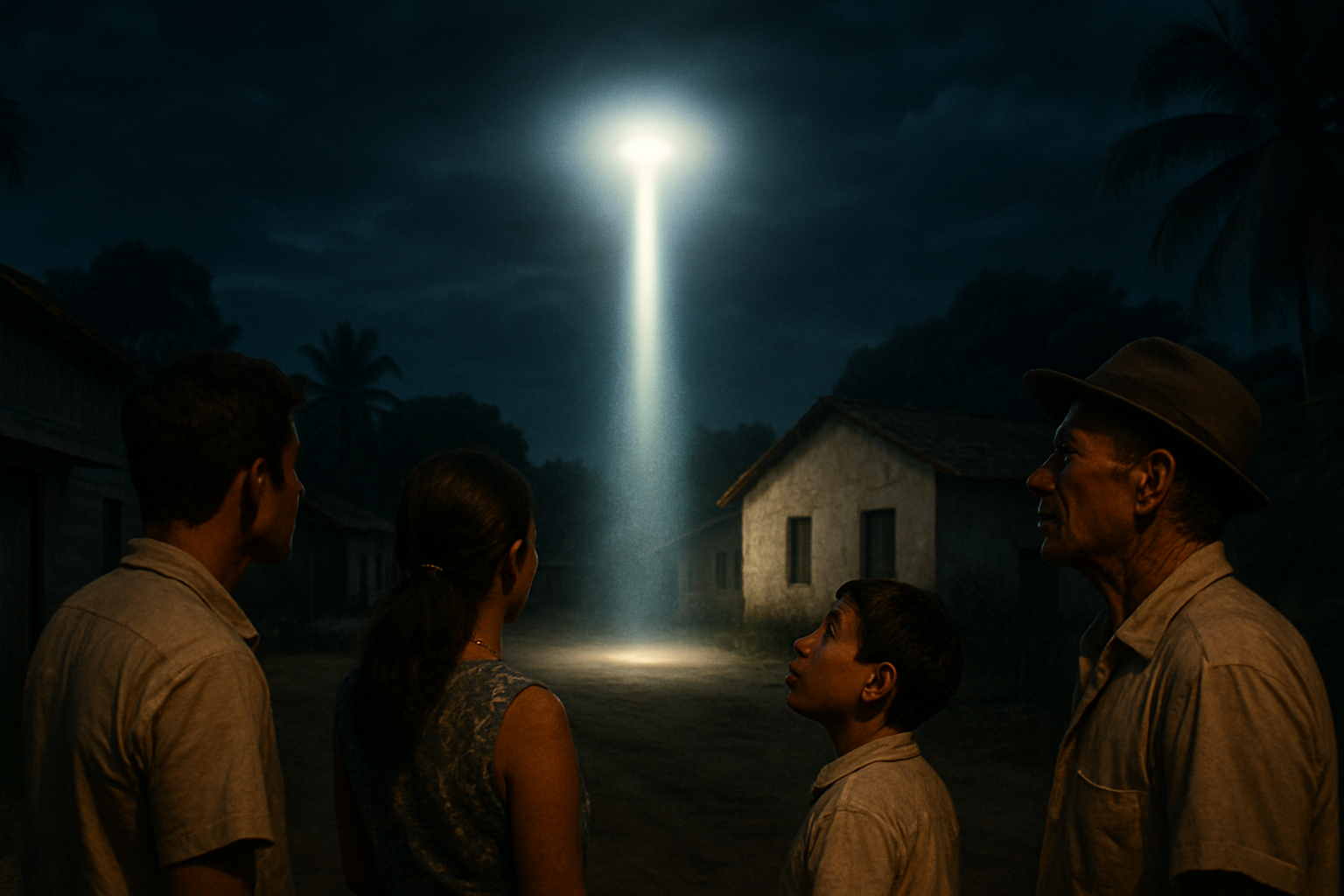
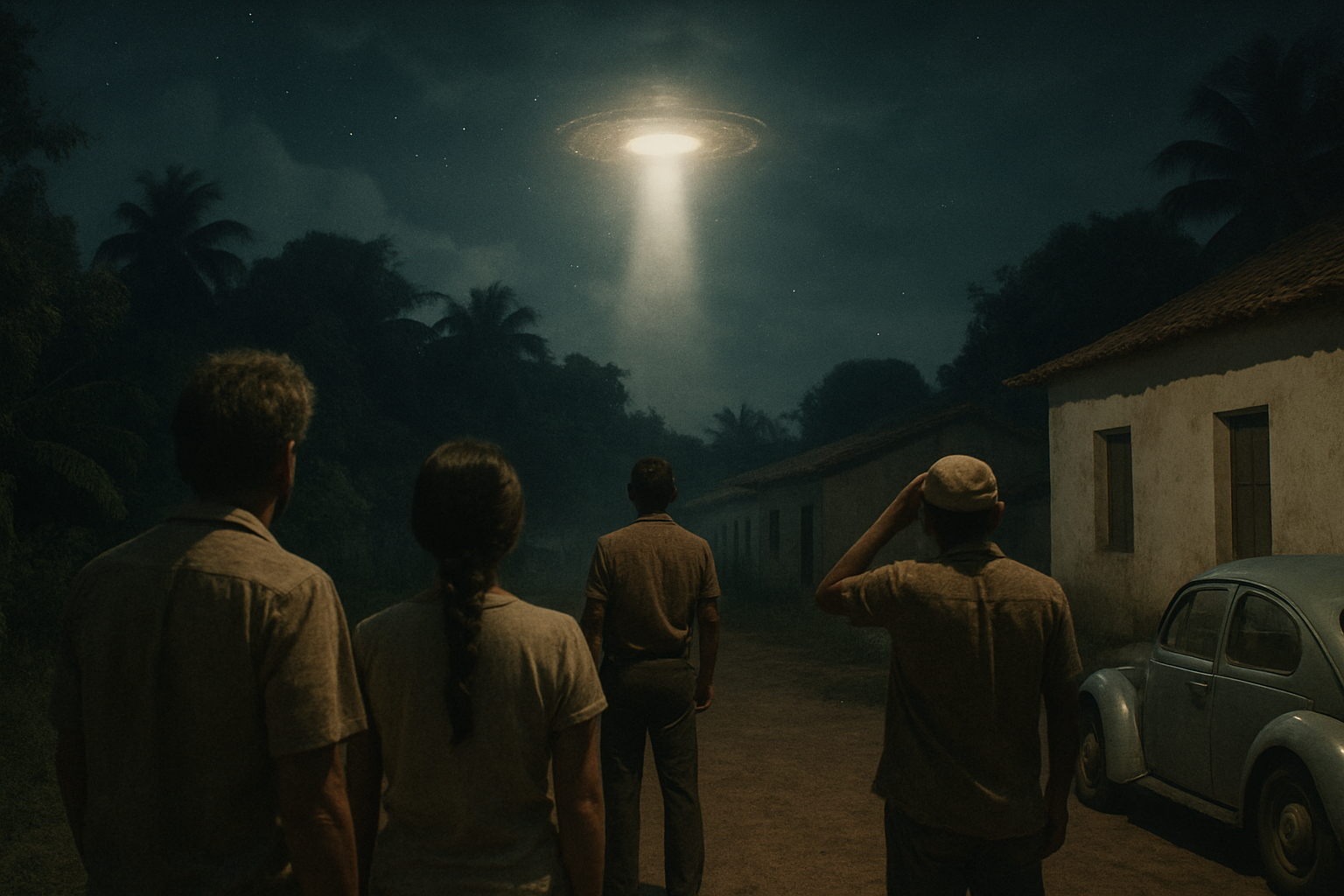
The Colares UFO flap, and the military inquiry it prompted, Operação Prato (Portuguese for "Operation Saucer" or "Operation Plate"), refers to a wave of unidentified-object reports in and around the island of Colares in the Brazilian state of Pará, in the Amazon estuary near Belém, during the second half of 1977.[1][2] Local residents described nocturnal objects that hovered over the water and houses and projected intense beams of light; because some witnesses reported burns and puncture-like marks that they likened to being "sucked," the phenomenon became known locally as the "chupa-chupa" (sucker-sucker).[1] The Brazilian Air Force (Força Aérea Brasileira) opened a field investigation, led by Captain Uyrangê Hollanda, that ran in two observation phases in late 1977 and collected witness statements, photographs and film.[2] The case is frequently cited as one of the rare instances of a government conducting a dedicated UFO investigation, and its files were kept classified until the late 1990s, with a partial release through Brazil's National Archives in 2009.[1][3] The reality and cause of the reported injuries, and the significance of the surviving documentation, remain disputed between proponents who see strong evidence of an anomalous phenomenon and skeptics who emphasize misidentification, psychological amplification and the absence of verifiable physical proof.[3]
Background and setting
Colares is a small island and municipality in the state of Pará, in northern Brazil, situated in the Amazon River estuary a short distance from the regional capital, Belém.[2] The surrounding area is a low-lying riverine landscape of fishing communities scattered across the estuary, an environment in which nocturnal lights over the water are common.[1]
During the second half of 1977, reports of unusual luminous objects spread through Colares and dozens of neighbouring villages north of Belém. Witnesses described glowing objects that approached silently and projected narrow, intense beams of light toward people, boats and houses.[1][4] Because the lights were said to leave marks on the body and were associated with a sensation of being drained, residents nicknamed the phenomenon the "chupa-chupa" — Portuguese for "sucker-sucker."[1] The episode unfolded against a wider Brazilian backdrop of UFO interest in the 1970s and the country's relatively organized civilian and military attention to such reports.[3]
The reports
The core of the Colares accounts is the claim that beams emitted by the objects physically affected people. Witnesses and later ufologists reported burns, reddened skin and small puncture-like wounds, and some accounts described victims feeling weak or faint after an encounter.[4][3] Proponents have asserted that hundreds of people were affected and that the injuries were "consistent with radiation effects from microwaves," though this characterization is contested.[2][3]
Key features reported during the flap include:
- Nocturnal luminous objects that hovered over the estuary and descended toward villages, sometimes silently.[1][4]
- Directed beams of light said to strike individuals, leaving burn marks or puncture-like wounds.[1]
- A widespread climate of fear among residents, some of whom kept fires and noise going at night in an attempt to ward off the lights.[4]
Skeptical reviewers note that the most dramatic injury narratives — including a frequently cited young female patient and detailed medical descriptions — were elaborated in later interviews rather than recorded in the earliest military paperwork, and caution that the round figure of roughly 400 affected people derives largely from ufological retellings rather than a verified census.[3]
Operação Prato and the Air Force investigation
In response to the reports, the Brazilian Air Force dispatched an intelligence team from the air base at Belém to investigate, in an operation codenamed Operação Prato.[2][3] The field commander was Captain Uyrangê Bolivar Soares Nogueira de Hollanda Lima, usually referred to as Captain Uyrangê Hollanda.[2] The active observation took place in two phases in late 1977, roughly from 20 October to 11 November and again from 25 November to early December 1977, during which agents interviewed witnesses in Colares and a number of other villages and attempted to observe and record the lights themselves.[2]
The team produced witness statements, written reports, sketches, photographs and film. A documented military report of roughly 160 pages catalogued well over a hundred individual sightings; far larger figures later circulated, with the commander claiming in the 1990s that the full archive amounted to thousands of pages, hundreds of photographs and many hours of Super 8 film that were never publicly released in full.[3] The operation was eventually wound down, and according to the official line it closed without confirming any unusual phenomenon.[2]
The surviving files were kept classified until the late 1990s and were partially declassified in 2009, with material deposited in Brazil's National Archives (Arquivo Nacional).[2][3] The release was incomplete: the large body of photographs and film described by the commander did not appear in the declassified holdings, a gap that proponents cite as evidence of withheld material and that skeptics regard as consistent with the claims having been exaggerated.[3]
Explanations and disputes
The Colares case is genuinely contested, and several lines of conventional explanation have been advanced for different elements of the flap.[3]
- Misidentification. The estuary setting makes ordinary stimuli — bright planets and stars, aircraft and fishing-boat lights over water, and atmospheric and electrical phenomena — plausible sources for at least some of the nocturnal lights.[3]
- Psychological amplification. Skeptics argue that fear spread socially once the lights were dubbed "chupa-chupa," so that anxiety and expectation shaped how subsequent experiences and minor injuries were interpreted. A Brazilian psychiatrist who reviewed cases nonetheless rejected a simple diagnosis of mass hysteria, stating that there had not been "any kind of mass hysteria or visual hallucinations," and proponents stress that the reports came from many scattered communities rather than a single cohesive group.[3]
- Medical causes for the injuries. Examinations of an injured young woman produced conflicting readings: one physician attributed the marks to self-inflicted scratching during a state of agitation, while a UFO-sympathetic doctor described them in terms that can also result from fingernail trauma.[3]
- Documentation problems. The earliest military report did not record the injuries that later became central to the story, several dramatic medical accounts surfaced only in interviews many years afterward, and Brazil's National Archives certified some sketches and stamped documents as fabrications (catalogued under reference numbers such as BR_DFANBSB_ARX_0_0_0271 and BR_DFANBSB_ARX_0_0_0322); a serviceman's relative also admitted that some published photographs had been altered to make light dots resemble flying saucers.[3]
Proponents counter that the sheer volume of independent witnesses, the military's decision to mount a dedicated operation, and the existence of contemporaneous official files distinguish Colares from ordinary sighting waves, and that the unreleased photographs and film — if genuine — would constitute unusually rich evidence.[1][3] No consensus physical explanation has been established, and the official investigation's stated finding of no confirmed anomaly has not resolved the debate.[2][3]
Aftermath and legacy
Operação Prato is often described as one of the few formal, dedicated UFO investigations carried out by a national armed force, which has given the Colares episode lasting prominence in the history of the subject in Brazil and beyond.[1][2]
The story gained renewed attention in 1997, when Captain Hollanda — long after the operation — granted an interview to ufologists Ademar José Gevaerd and Marco Antônio Petit, describing the events he said he had witnessed during the investigation.[2] A few months after the interview, Hollanda was found dead at his home, in what was reported as a suicide by hanging; the timing fueled conspiracy speculation, though no evidence has linked his death to the case.[2]
The 2009 partial declassification through the National Archives renewed public and ufological interest and made some of the original paperwork available for study, even as the most striking claimed materials remained absent.[2][3] Colares has since featured widely in books, documentaries and broadcasts about UFOs, and continues to be invoked both as a benchmark case by proponents and as a cautionary example of how reports can grow in the retelling by skeptics.[1][3]
Key quotes
“A Brazilian psychiatrist who reviewed cases stated that there had not been "any kind of mass hysteria or visual hallucinations."
References
- 1.
- 2.
- 3.
- 4.
Similar cases
Scored on agency / year proximity / region / tag overlap — same agency +3, near year +4, same region +2, shared tag ×2.