Varginha UFO incident
Illustrations
AI-generated illustration — not actual footage or evidence; an interpretive depiction based on the documented account
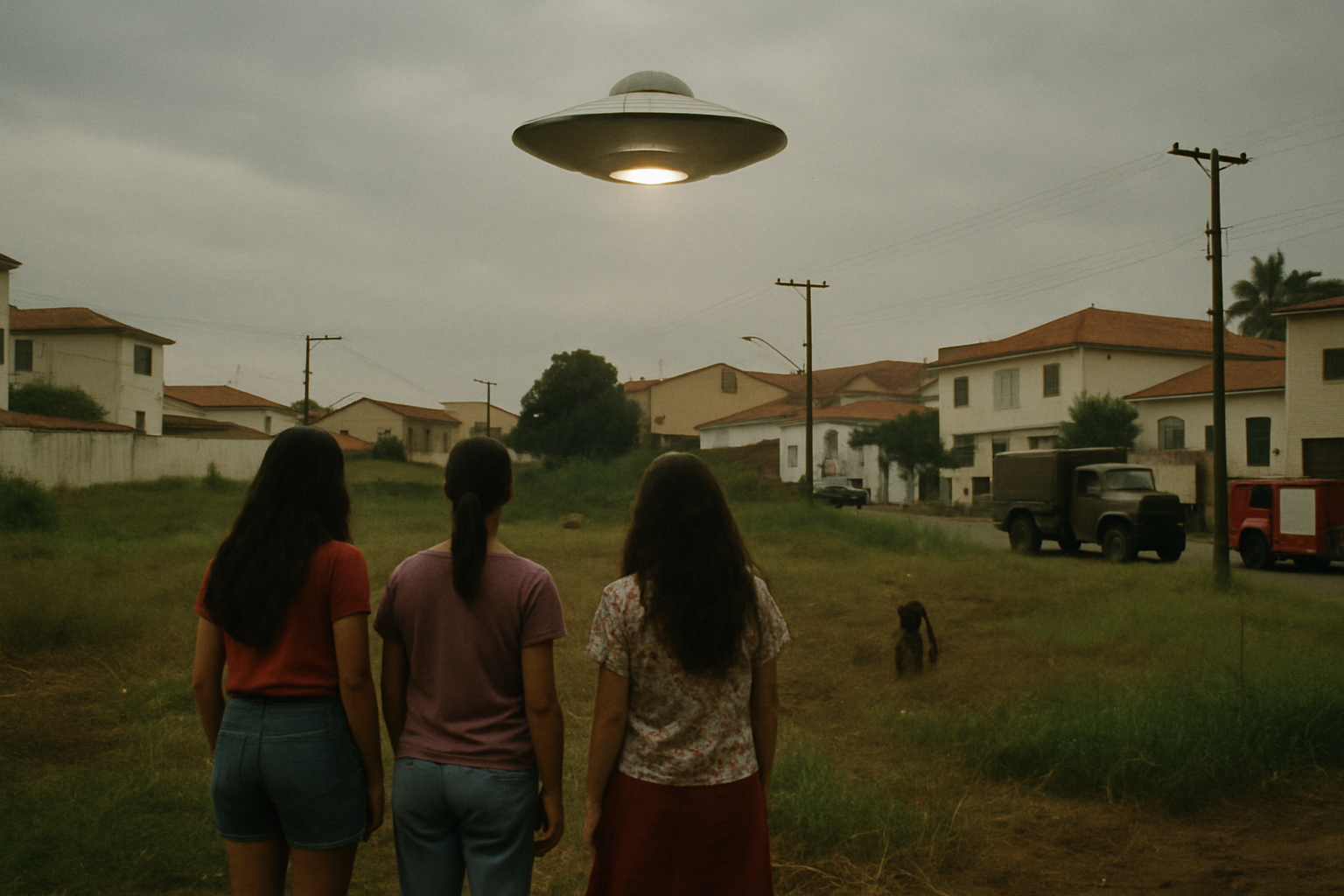
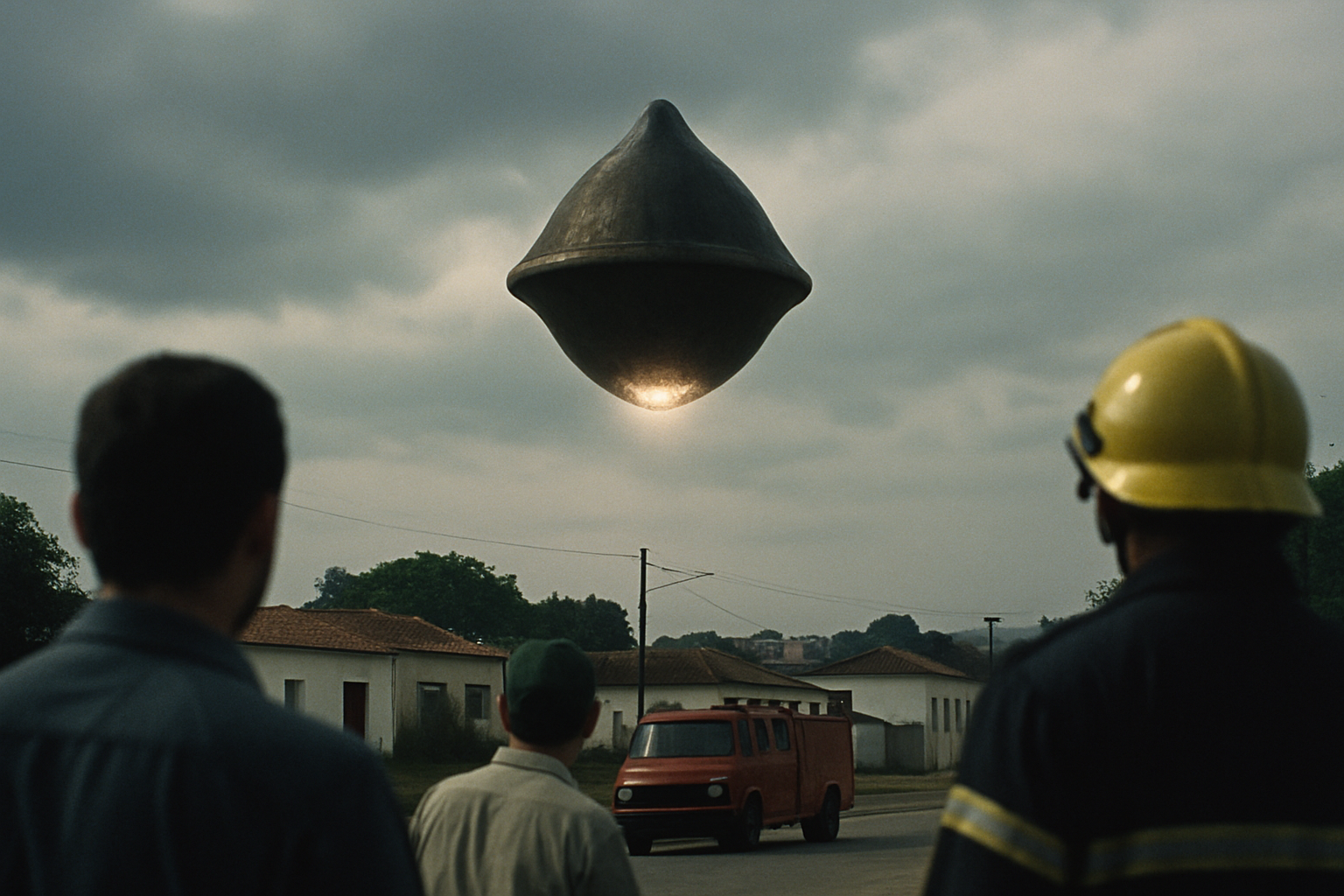
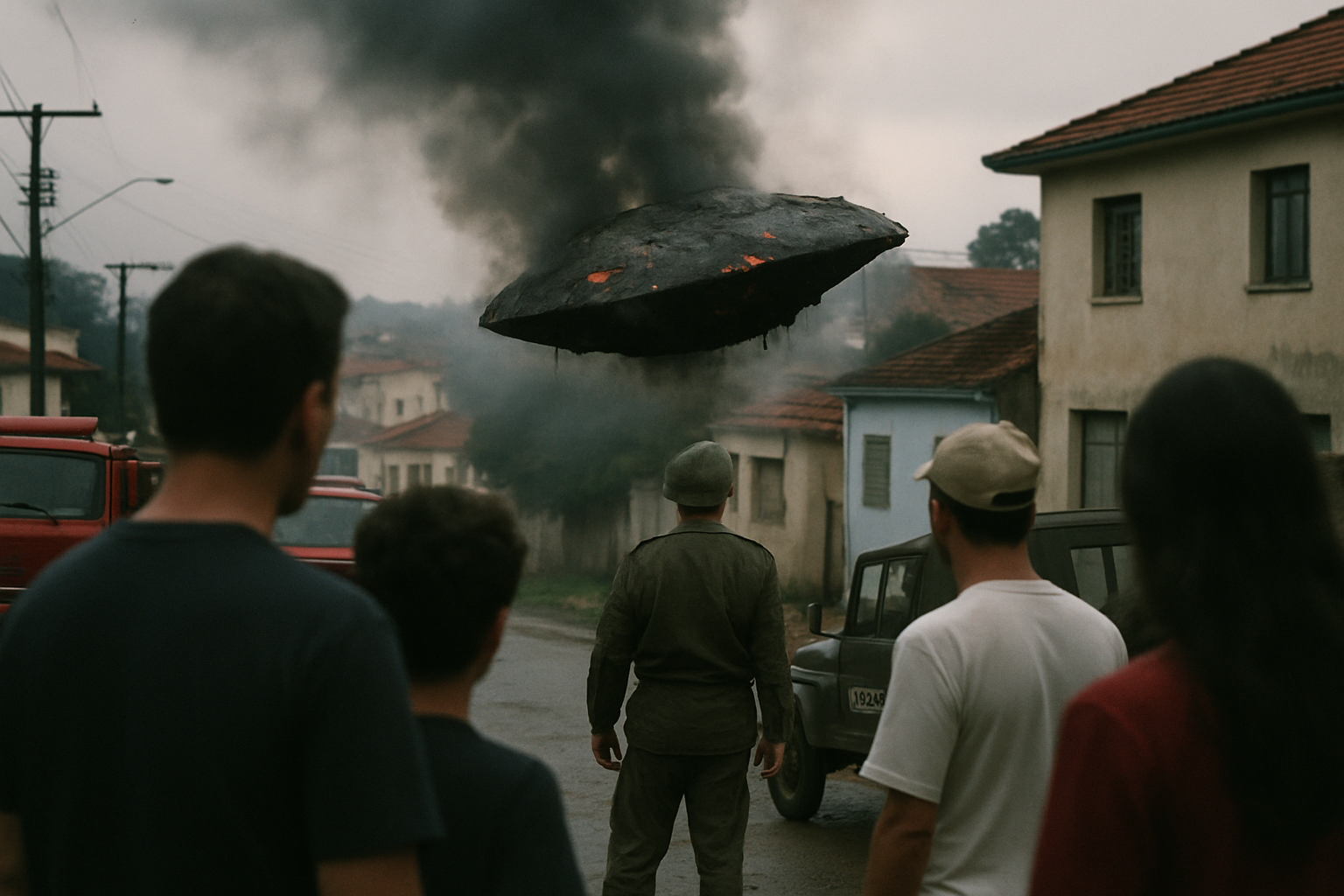
The Varginha UFO incident (Portuguese: *Caso Varginha*) was a series of reported unidentified-flying-object and "creature" sightings in and around the city of Varginha, in the state of Minas Gerais in southeastern Brazil, in January 1996.[1][2] The episode became widely known after three young women — sisters Liliane and Valquíria Silva and their friend Kátia Andrade Xavier — said that on the afternoon of 20 January 1996 they encountered a short, dark-skinned biped with a large head and red eyes in a vacant lot in the Jardim Andere neighbourhood.[1][2] In the following days, accounts circulated of a fallen or smoking object, of fire-brigade and military vehicles operating in the area, and of one or more creatures allegedly captured by personnel and taken to local hospitals; these claims, which were never officially confirmed, led ufologists to call the case "Brazil's Roswell."[2][3] A subsequent Brazilian military inquiry concluded that the women had most likely mistaken a disabled local vagrant for an extraterrestrial and that the military movements were routine, an explanation that the witnesses and several researchers rejected.[1][4] No independently verified physical evidence — wreckage, biological samples or photographs of a being — has been produced, and the case remains disputed.[2][4]
Background
Varginha is a city of the southern part of Minas Gerais state, in southeastern Brazil, with a population on the order of a hundred thousand at the time.[1] By the mid-1990s Brazil had a substantial public interest in UFO topics, supported by an active ufology community and frequent media coverage.[2]
Some accounts of the case begin a week before the most famous sighting. Researchers have cited a claim by a man named Carlos de Sousa that on or around 13 January 1996 he witnessed a cylindrical or cigar-shaped object trailing smoke near the region; no debris from any such object was recovered or independently analysed.[2][6] These earlier reports are treated cautiously in the literature, as they rest largely on later testimony rather than contemporaneous documentation.[2]
The reported sightings (20 January 1996)
The core of the case is the encounter reported by three young women on the afternoon of 20 January 1996.[1][2]
- According to their account, Liliane Fátima Silva (about 16), her sister Valquíria Aparecida Silva (about 14) and their friend Kátia Andrade Xavier (about 22) were crossing a vacant lot on Rua Dr. Benevenuto Braz Vieira, in the Jardim Andere district, at around 3:30 p.m. when they saw a strange figure crouching near a wall.[1][2]
- They described a short biped with a large head, brown skin that looked oily or greasy, prominent veins, three protrusions or ridges on the head, and large red eyes.[1][2] The women said the being appeared unwell or frightened, and they fled.[2]
Over the same period, residents reported a variety of additional phenomena that later became attached to the case, including sightings of military police and fire-brigade vehicles, claims that personnel were searching for or had captured a creature, and reports of military trucks near local hospitals.[2][3] Accounts also linked the episode to unexplained deaths of animals at a local zoo.[1] Many of these elements rest on second-hand testimony gathered after the fact, and their reliability is contested.[1][2]
Alleged capture, hospitals and the death of a soldier
A central and heavily disputed strand of the case concerns claims that one or more beings were captured and taken into medical or military custody.[2][3]
According to accounts compiled by ufologists, a being was allegedly captured on the evening of 20 January and taken first to a local hospital, with at least one creature said to have been moved later to another facility under guard; some narratives name a neurosurgeon, Dr. Ítalo Venturelli, as having described seeing an unusual being.[2] None of these hospital or custody claims was officially confirmed, and no medical records, photographs or specimens substantiating them have been publicly produced.[2][4]
The most emotionally charged element is the death of Corporal Marco Eli Chereze, a military police officer who, according to the anomalous accounts, handled a captured creature with his bare hands and then fell ill, dying in February 1996 of an infection.[2][5] Skeptical and conventional treatments note that a death from infection has ordinary medical explanations and does not by itself demonstrate any extraterrestrial cause; the link to the alleged creature rests on testimony rather than documented findings.[1][4]
Investigation and official response
The case was investigated and promoted chiefly by civilian ufologists rather than by an official scientific body.[2]
- Ubirajara Franco Rodrigues, a lawyer and ufologist, conducted much of the on-the-ground investigation and gathered numerous recorded witness statements; he has been described as later expressing reservations, saying there was no proof that an extraterrestrial being had actually been captured.[2]
- Vitório Pacaccini, an engineer and researcher, publicised the case widely and named military personnel he said were involved, an approach that some fellow researchers regarded as overly assertive.[2]
The Brazilian armed forces denied the central claims. Officials stated that any troop or vehicle movements in the area were routine and unrelated to any extraterrestrial event.[1][4] A Military Police inquiry — associated with Lieutenant Colonel Lúcio Carlos Pereira — concluded that the three women had not seen an extraterrestrial at all, but most likely a homeless man known as "Mudinho" who had a disability; the official account suggested that, dirtied by heavy rain and seen crouching by a wall, he was mistaken "as a space creature" by the frightened witnesses.[1] The witnesses rejected this, saying they knew Mudinho personally and that the being they saw was not him.[2][5]
Explanations and disputes
Interpretations of the Varginha events diverge sharply, and the case is best regarded as unresolved.[1][2]
Anomalous interpretation. Proponents point to the consistency of the women's description, the volume of secondary testimony about military activity and an alleged capture, and the death of Corporal Chereze, which they connect to handling a creature.[2][3] In this reading the official explanation is a cover-up, and Varginha is presented as one of the most significant claimed close-encounter and "crash-retrieval" cases since Roswell.[2]
Conventional and skeptical explanations. Critics emphasise that the case is built almost entirely on after-the-fact testimony, with no recovered debris, no biological samples and no verifiable photographs of any being.[4][2] Specific conventional explanations and criticisms include:
- Misidentification. The military inquiry's view that the women encountered a disabled vagrant rather than an alien.[1]
- Media amplification. Skeptics such as Brian Dunning have argued that ordinary events were exaggerated; in one assessment the case is described as one in which "literally nothing at all happened that was remotely unusual" before being magnified into supposed proof of alien visitation.[1]
- Ordinary medical causes. The corporal's fatal infection is consistent with common illness and does not require an exotic explanation.[1][4]
A recurring difficulty for both sides is evidentiary: the absence of preserved primary documentation and physical material means that competing conclusions are drawn from largely testimonial sources.[2][4]
Aftermath and significance
The Varginha case has had a lasting cultural and civic afterlife in Brazil.[1][3]
The witnesses reported sustained personal consequences. Accounts describe the three women facing harassment, surveillance, public ridicule and social difficulties in their home town for years afterward.[5] Such reports are part of the witness testimony and reflect the intense local attention the case attracted.[5]
The city itself embraced the episode as part of its identity, building a spaceship-shaped water tower (the *Nave Espacial de Varginha*), themed bus stops, and producing extraterrestrial-themed merchandise and tourism, while books, documentaries and other media kept the story in circulation.[1][3]
The case has also figured in later debates over government transparency about UFOs/UAP. In 2026, around the thirtieth anniversary, the incident featured in U.S. discussions and testimony calling for the release of records, with lawmakers and figures such as David Grusch invoking Varginha in arguments for greater disclosure; at the same time, official bodies including the U.S. All-domain Anomaly Resolution Office (AARO) have reported finding no verifiable evidence that UAP sightings represent extraterrestrial activity.[4] Whether viewed as a serious unexplained encounter or as a case of misidentification amplified by media and enthusiasm, Varginha remains among the best-known UFO incidents associated with Brazil.[1][2]
Key quotes
“The official account suggested the vagrant was "mistaken by the three terrified girls as a space creature."
References
- 1.
- 2.
- 3.
- 4.
- 5.
- 6.
Similar cases
Scored on agency / year proximity / region / tag overlap — same agency +3, near year +4, same region +2, shared tag ×2.