Antônio Vilas-Boas abduction
Illustrations
AI-generated illustration — not actual footage or evidence; an interpretive depiction based on the documented account
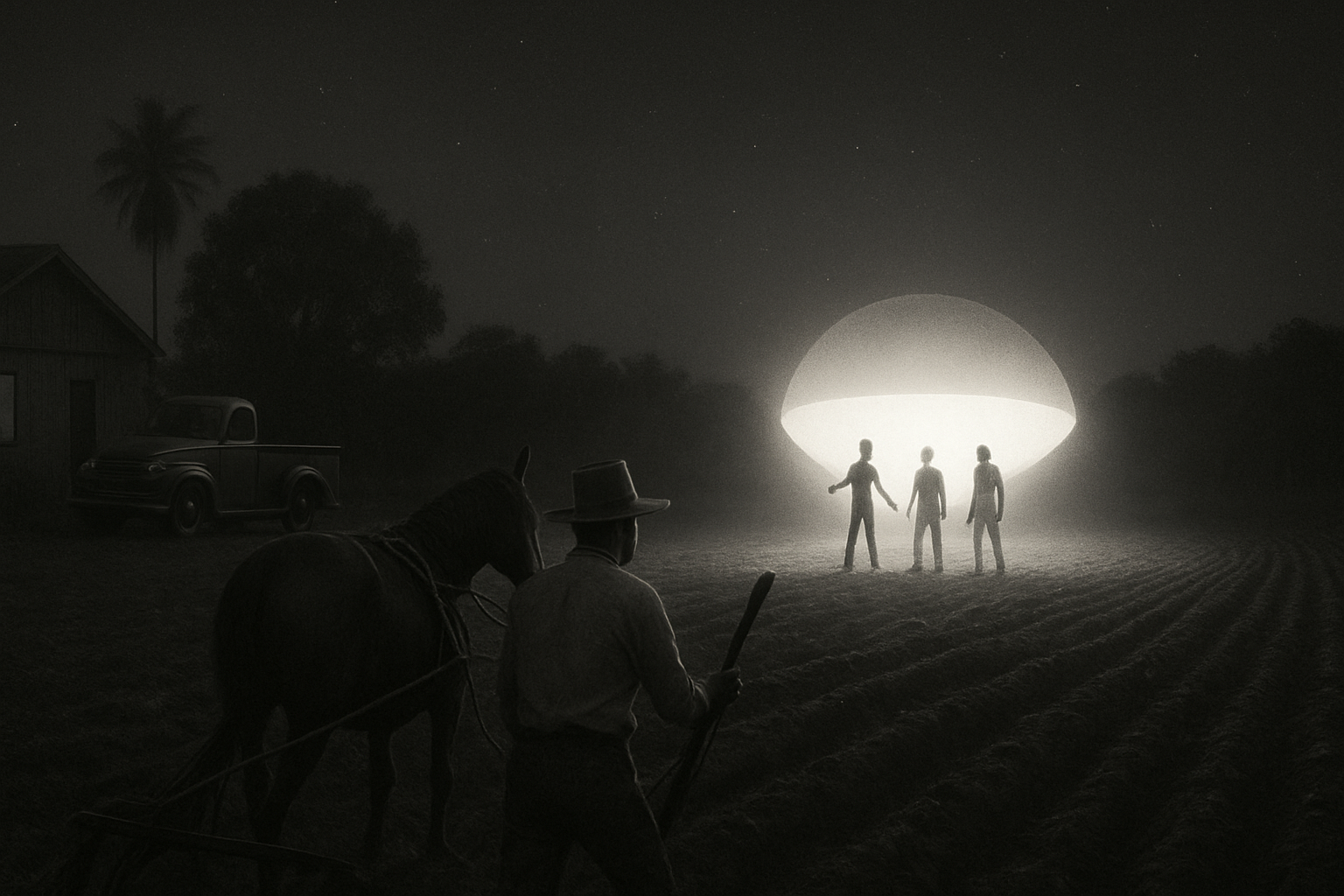


The Antônio Vilas-Boas abduction refers to claims made by a 23-year-old Brazilian farmer, Antônio Vilas-Boas (1934–1991), that he was taken aboard a landed craft by non-human beings on the night of 15–16 October 1957 near São Francisco de Sales in the state of Minas Gerais, Brazil.[1] According to his account, he was ploughing a field at night to avoid the daytime heat when an egg-shaped craft descended; he was seized by grey-clad humanoids, examined, and engaged in sexual intercourse with a human-looking female being before being released after roughly four hours.[1] The case is widely cited as one of the earliest alien-abduction narratives to be reported in detail and to receive broad attention, preceding the better-known Betty and Barney Hill case of 1961.[1] It became publicly known through the Brazilian press and ufologists in the late 1950s and early 1960s, and reached an English-speaking audience chiefly through Gordon Creighton's translations in the British periodical *Flying Saucer Review* from 1965.[3] Its authenticity is disputed: there is no official investigation or government ruling, and skeptics have offered conventional explanations.[1]
Background
Antônio Vilas-Boas was born in 1934 and worked on his family's farm near São Francisco de Sales, in the Triângulo Mineiro region of Minas Gerais, Brazil.[1] He later trained and worked as a lawyer.[1] In 1957, to avoid the heat of the day, he and his brother had been carrying out nocturnal work in the fields with a tractor.[1]
The episode occurred during a broad wave of UFO reports in Brazil in the late 1950s, a period when sightings were widely discussed in the popular press.[2] Vilas-Boas later said that he had observed unusual lights in the fields on nights before the main incident, including a bright light over the field that he and his brother watched together, which influenced how he interpreted the later, central event.[1]
The reported encounter
By Vilas-Boas's account, on the night of 15–16 October 1957 he was ploughing alone when he saw a "red star" in the sky that grew larger as it approached, resolving into an egg-shaped craft with a red light at its front and a rotating cupola on top; it descended onto the field on three or four supporting legs.[1]
He said he attempted to drive away, but the tractor's engine and lights failed after a short distance, after which he tried to flee on foot.[1] He reported being seized by a humanoid roughly 1.5 metres tall, wearing grey coveralls and a helmet, with small blue eyes, and that several similar beings overpowered him and took him aboard.[1] He described the beings as communicating among themselves in sounds he likened to barks or yelps.[1]
Inside the craft, Vilas-Boas said he was stripped, covered with a clear gel-like substance, and led into a chamber where the beings drew blood samples from his chin.[1] He said he was then left in a room into which a gas was introduced that made him violently ill.[1] He further described the appearance of a naked female being of similar height, with a pointed chin, large blue cat-like eyes, and long whitish hair on her head but reddish hair elsewhere, with whom he said he had sexual intercourse.[1] He recounted that before leaving she rubbed her abdomen and gestured upward, which he interpreted as a sign that any offspring would be raised elsewhere, and he later remarked that he had felt used "like a good stallion."[1]
According to the account, he was given a tour of part of the craft, attempted unsuccessfully to take a clock-like device as proof, and was then escorted outside, where he watched the craft rise and depart. He estimated that the whole experience had lasted about four hours.[1]
Medical examination and disclosure
In the weeks after the alleged event, Vilas-Boas reported a range of physical complaints, including nausea, headaches, weakness, persistent eye irritation, and skin lesions.[1] The case came to wider notice after the journalist João Martins (named José Martins in some accounts), who in 1957 ran a series on flying saucers in the magazine *O Cruzeiro* and solicited accounts from readers, corresponded with the young farmer from Minas Gerais, prompting Vilas-Boas to come forward.[2]
In early 1958, Vilas-Boas was examined by Dr. Olavo Fontes of the National School of Medicine of Brazil, a physician associated with the U.S.-based Aerial Phenomena Research Organization (APRO).[1][2] Fontes documented symptoms that he characterized as consistent with exposure to radiation, including described skin lesions that left small nodules with central openings discharging a yellowish fluid.[1] Fontes regarded the witness and his symptoms as compelling, although such a conclusion cannot independently confirm the abduction narrative.[1]
The earliest dated print appearance of the account was in the bulletin of the Brazilian society SBEDV in 1962, after the story had circulated among investigators for several years.[1] English-language readers learned the details chiefly through Gordon Creighton's translations of Walter Bühler's SBEDV report, published in the British periodical *Flying Saucer Review* beginning in 1965.[3] Fontes was also in contact with the U.S.-based research group APRO, which helped bring the case to the attention of American ufologists.[1][2]
Explanations and disputes
The case has never been the subject of an official government investigation, and it rests almost entirely on the testimony of a single witness.[1] As such, it is generally classified as unverified rather than confirmed.
Skeptics and several researchers have questioned the account on a number of grounds:
- Possible borrowing of details. The researcher Peter Rogerson noted that a comparable narrative had appeared in the Brazilian magazine *O Cruzeiro* in November 1957, raising the possibility that motifs were drawn from material already in circulation.[1]
- Resemblance to contactee lore. Critics have observed similarities to the popular "contactee" stories of the era, such as those associated with George Adamski.[1]
- Questions about credibility framing. Rogerson criticized contradictory reasoning by some ufologists, who at times dismissed Vilas-Boas as an uneducated farmer and at other times as "too respectable" once his standing as a lawyer became known, and he pointed out that owning a tractor placed the family above the poorest rural class.[1]
Proponents counter that Vilas-Boas maintained a consistent account for the rest of his life and that the documented physical symptoms are not easily explained.[1] Because no independent physical evidence survives and the experience was witnessed by no one else, the case remains genuinely disputed rather than resolved in either direction.[1]
Aftermath and significance
Vilas-Boas married, had four children, and reportedly held to his account throughout his life; he died on 17 January 1991.[1]
The case is frequently described as a landmark in the history of the alien-abduction phenomenon. Reported in 1957 and detailed before the widely publicized Betty and Barney Hill case of 1961, it is cited as one of the first abduction narratives to combine the now-familiar elements of capture, a medical-style examination, and communication with non-human beings.[1][2] Some commentators have argued that early Brazilian and American abduction stories of this period helped establish a template that later accounts would echo, a point used both by those who see a shared underlying experience and by those who see cultural transmission of a common story.[2]
Key quotes
“Vilas-Boas later remarked that he had felt used "like a good stallion."
References
- 1.
- 2.
- 3.
Similar cases
Scored on agency / year proximity / region / tag overlap — same agency +3, near year +4, same region +2, shared tag ×2.