Doullens case (1954)
Illustrations
AI-generated illustration — not actual footage or evidence; an interpretive depiction based on the documented account
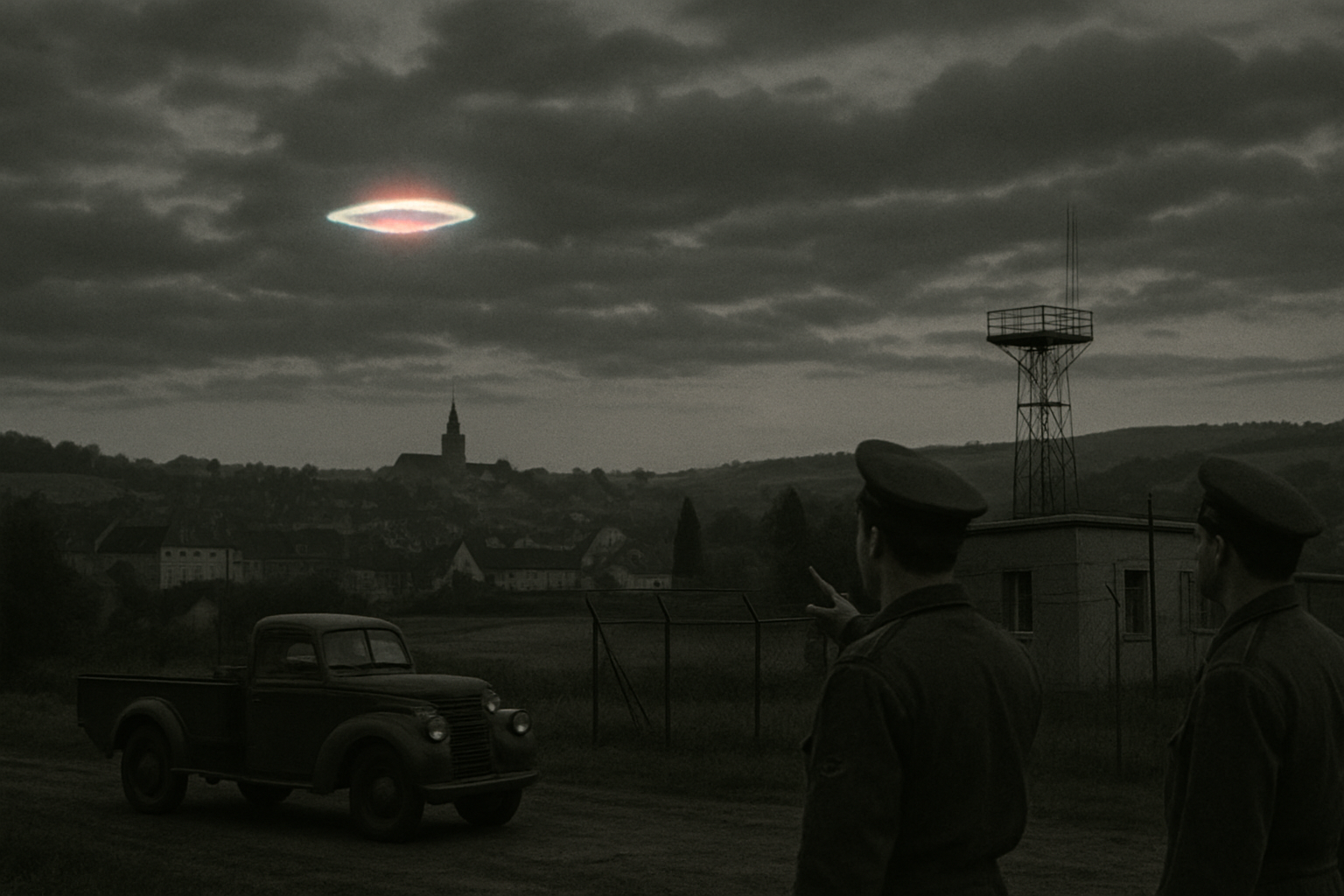
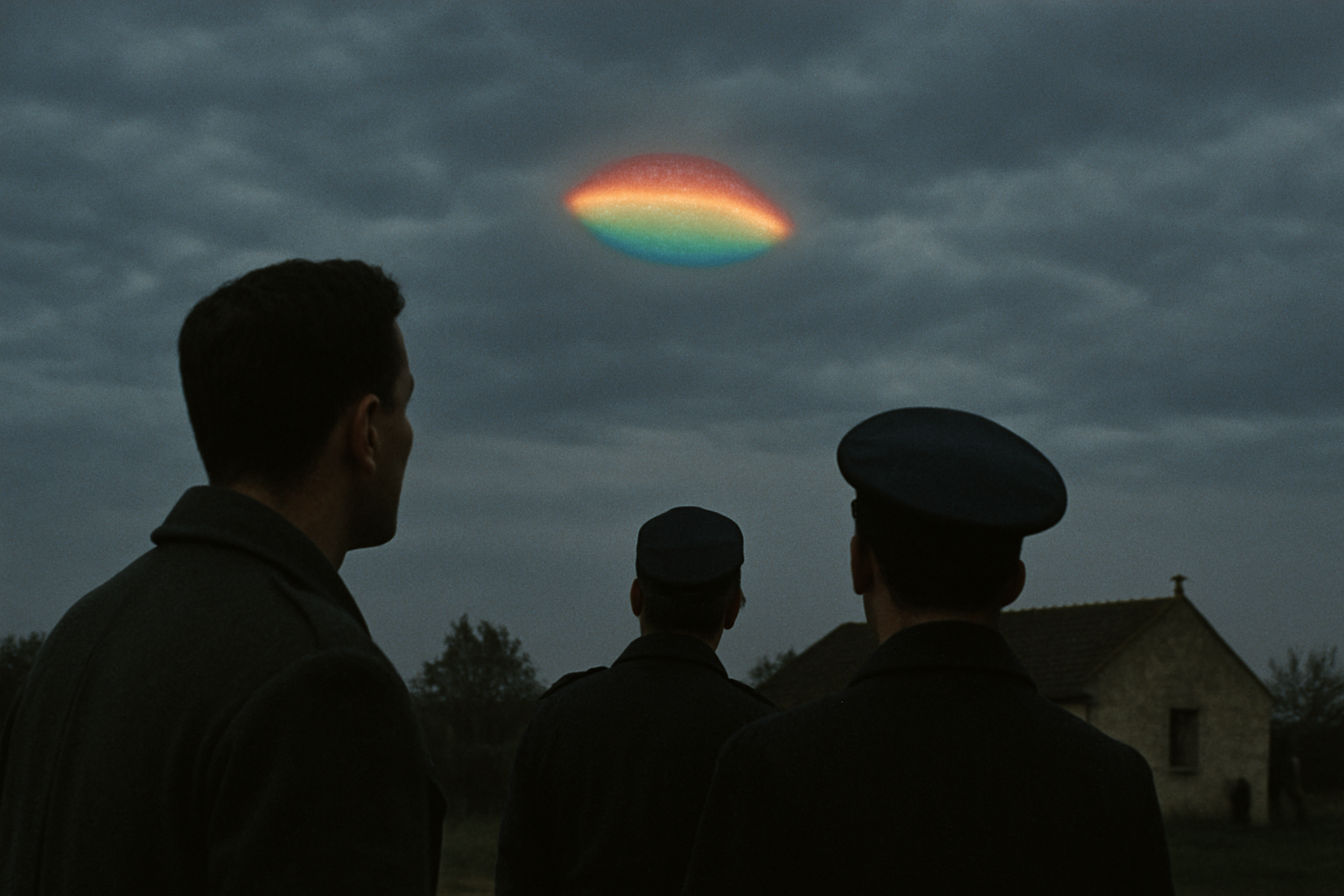
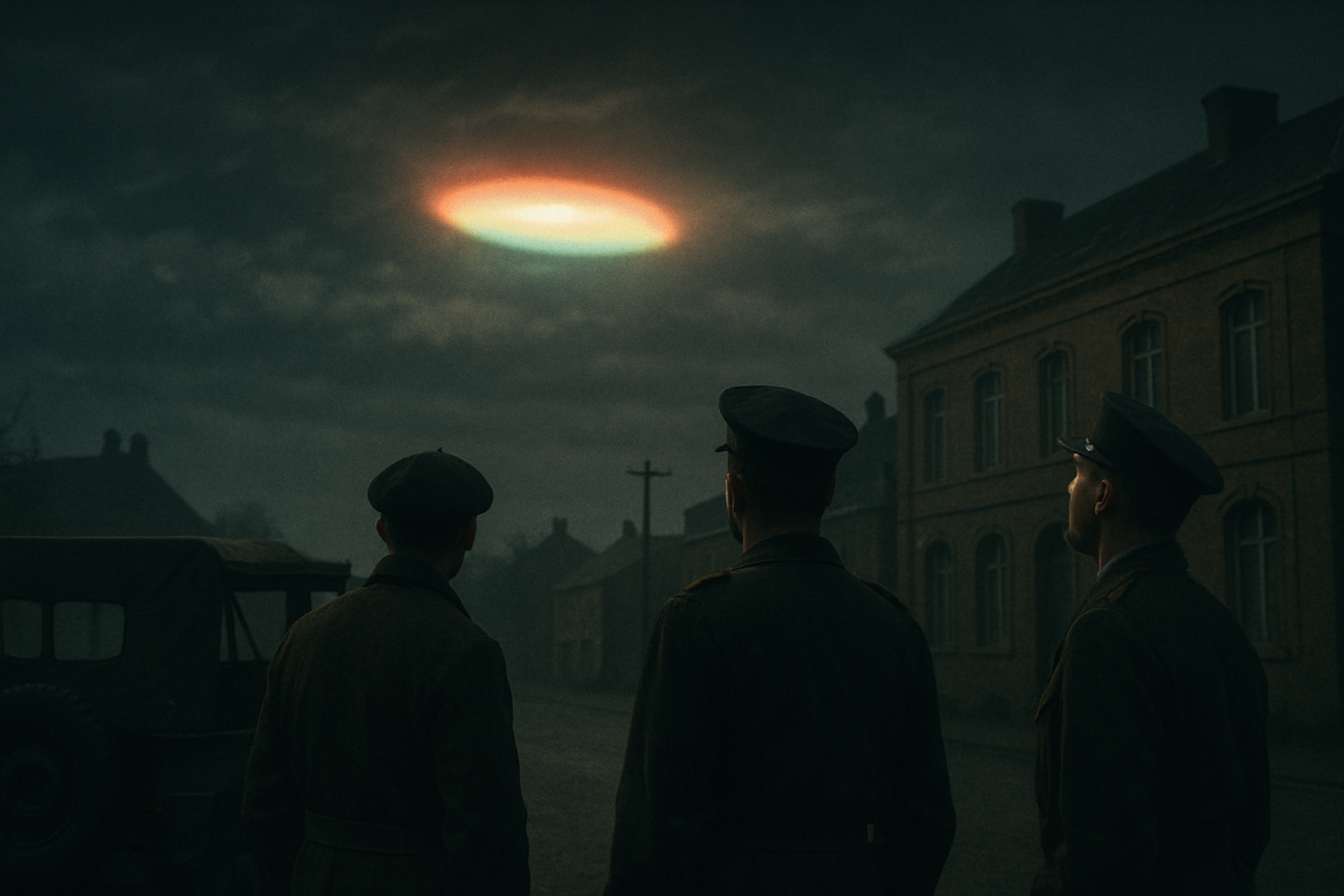
The Doullens case is a French unidentified aerial phenomenon (UAP) sighting that occurred in the early hours of 19 October 1954 at Doullens, in the Somme department of Picardy.[1] Several servicemen on duty at a military radar station reported a luminous object that moved beneath the cloud base and repeatedly changed colour.[1] The sighting took place during the well-documented autumn 1954 UFO wave, a period of intense reporting across France.[3] The case is held in the public archive of GEIPAN, the unidentified-aerial-phenomena study unit of the French national space agency CNES, where it is classified "D" — a strange phenomenon that has not been explained.[1]
Background
The autumn of 1954 saw an exceptional wave of UFO reports across France, concentrated in September, October and November and peaking in October; the episode remains one of the most studied in French ufology.[3] The Somme and neighbouring departments of northern France produced numerous reports during this period.[3] The Doullens sighting was made by personnel at a military radar station, although, according to the case file, the station's radar was not operating on the night in question.[1]
Observation
According to the GEIPAN file, the phenomenon was observed at around 01:34 on 19 October 1954, on a dark night beneath a continuous layer of stratocumulus cloud whose base was estimated at about 1,000 metres.[1] The witnesses — described as a second-class soldier, a corporal-chief and a sergeant — reported the event in three phases.[1] In the first phase a green light emerged from the clouds and travelled horizontally, changing colour from green to orange to a dull red.[1] In the second phase the object remained roughly stationary in the sky for two to three minutes, appearing as a disc or inclined ellipse that emitted changing colours every few seconds.[1] In the final phase it moved rapidly back and disappeared into the cloud, briefly reappearing before vanishing.[1] A separate contemporary account collected in French ufology sources describes additional low-altitude observations in the surrounding countryside.[2]
Investigation and classification
The case is preserved in the GEIPAN database under reference 1954-10-09217, based on an official report (procès-verbal) numbered PV n°4126.[1] During its review, GEIPAN considered several conventional explanations. The Moon — which was near Jupiter in the sky that evening — was assessed, but the file notes that the reported colour changes and movements are difficult to reconcile with a lunar misidentification.[1] An ordinary aircraft was judged incompatible with the several-minute stationary phase, and the alternating coloured lights suggested a helicopter, but the high speeds reported during other phases were considered poorly compatible with a helicopter as well.[1] GEIPAN concluded that the case was of medium consistency and "quite strange although distant," and assigned it to Class D: a strange-to-very-strange phenomenon of medium-to-strong consistency.[1] In the GEIPAN scheme, a Class D rating means the available data did not allow a conventional explanation to be established, so the case is recorded as unexplained.[1]
Sources and coverage
The primary documentary source for the case is the GEIPAN case page, which includes the official report and supporting material such as a sky map.[1] French ufology references, notably the catalogue compiled by Patrick Gross, reproduce contemporary press material including a report in the local newspaper *L'Abeille de la Ternoise* of 30 October 1954.[2] As of this writing the event is not the subject of a dedicated Wikipedia article in English or French, and is documented mainly through the GEIPAN archive and French-language ufology collections.[1][2]
Key quotes
“"This case of medium consistency, quite strange although distant, is classified D: a strange-to-very-strange phenomenon of medium-to-strong consistency." (GEIPAN conclusion)
References
- 1.
- 2.
- 3.
Similar cases
Scored on agency / year proximity / region / tag overlap — same agency +3, near year +4, same region +2, shared tag ×2.