Hangzhou Xiaoshan Airport UFO Incident (2010)
Illustrations
AI-generated illustration — not actual footage or evidence; an interpretive depiction based on the documented account
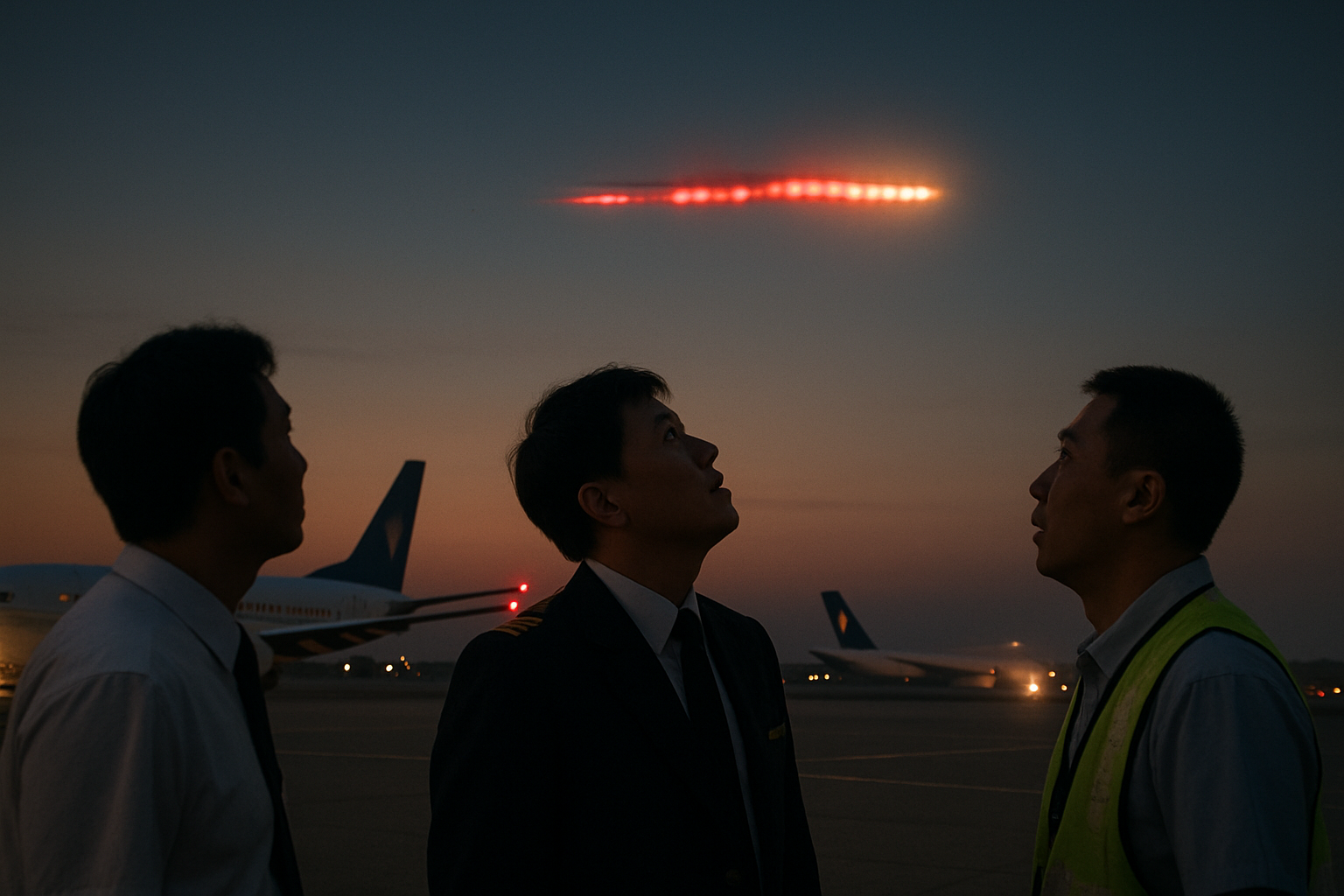
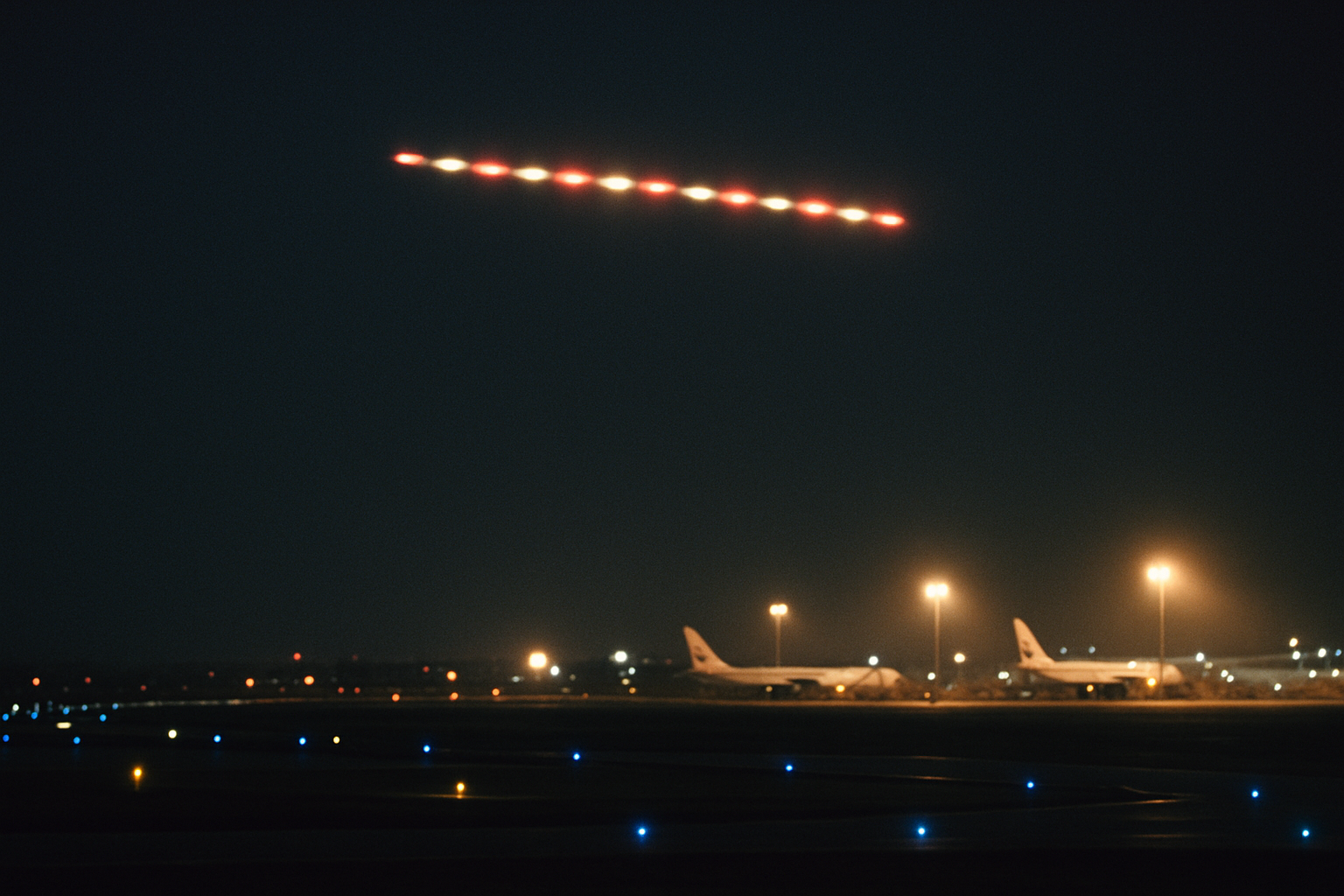
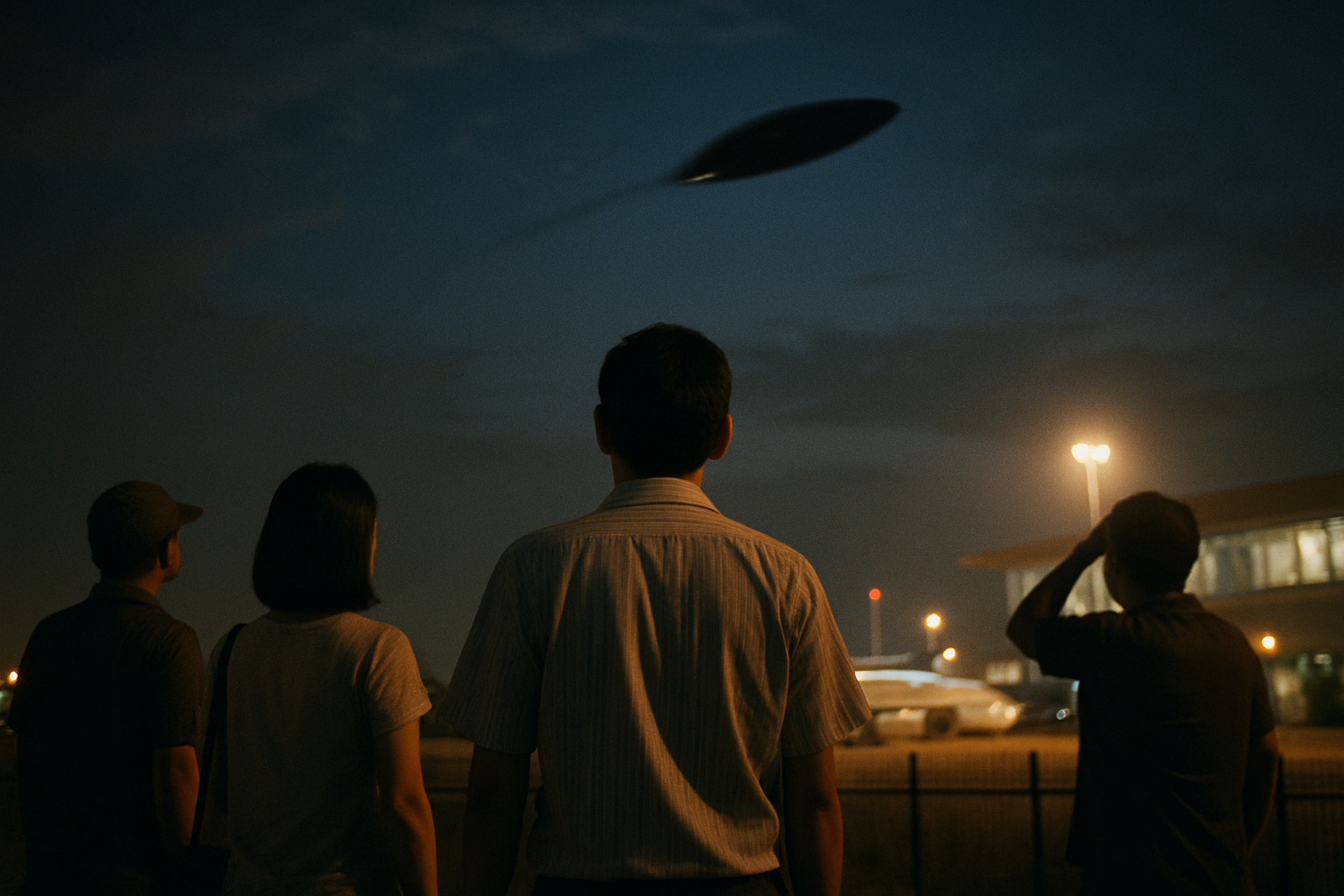
The Hangzhou Xiaoshan Airport UFO incident was an unidentified-flying-object sighting that disrupted operations at Hangzhou Xiaoshan International Airport in Zhejiang, China, on the evening of 7 July 2010.[1][5] After the crews of two airliners reported a moving luminous object southeast of the airport at about 20:40, controllers halted all departures and arrivals for roughly an hour, affecting eighteen flights and diverting some inbound traffic to nearby airports.[1][4] The event drew nationwide and international attention, amplified by a striking photograph taken earlier that evening by a local resident, Ma Shijun.[1][6] Chinese civil-aviation authorities and astronomers subsequently put forward conventional explanations—most prominently that the airspace disruption was caused by an unauthorised, undeclared private aircraft—although no single, fully conclusive official statement closing the case was widely publicised at the time.[1][4] The episode is frequently cited in Chinese popular media as one of the country's best-known modern UFO cases, yet it has no dedicated Wikipedia article in either Chinese or English.[5]
The incident and airport shutdown
On the evening of 7 July 2010, the crews of two airliners preparing to land at Hangzhou Xiaoshan International Airport reported, at roughly the same time and at about 20:40, a moving luminous object to the southeast of the airport, which they relayed to the control tower.[4][6] Air-traffic control suspended all takeoffs and landings; according to summaries of the event, the shutdown ran from about 20:45 to 21:41, with eighteen flights affected—six departing and twelve arriving—and some inbound flights diverted to Ningbo and Wuxi while outbound flights were held on the ground.[1][5] Normal operations resumed within about an hour.[1]
News of the closure, carried by the official Xinhua News Agency and quickly picked up abroad, framed the event as a UFO that had forced a major airport to stop flying, and noted that many Hangzhou residents had reported seeing a bright object in the sky before the disruption.[5][1]
The Ma Shijun photograph
The most widely circulated piece of evidence was a photograph taken at about 20:26 that evening by Ma Shijun (麻世俊), a resident of Xinjie in Xiaoshan district, who is referred to in much of the coverage simply as "Mr. Ma."[1][6] By his account he and his wife had gone out to try a newly bought Canon 500D digital SLR for night photography when he saw a bright, silent light moving rapidly across the sky and photographed it; the resulting image showed an elongated body with alternating red and white light and small bright points along one side that some observers likened to portholes.[1][6]
The photograph spread rapidly on Chinese websites and became the visual centrepiece of domestic coverage of the case.[1][6] The story was also picked up by international outlets, though Western reports often illustrated it with generic stock imagery rather than Ma's actual photograph.[2][1] Later commentators cautioned that the long-exposure image is consistent with the trail left by a lit aircraft moving through the frame: analysts who examined the exposure data (a 2.5-second exposure at f/3.5, ISO 1600, 18 mm) estimated a speed of roughly 208–224 km/h—within the range of a conventional aeroplane rather than an exotic craft—and the photographer was later asked to shoot ordinary aircraft with the same settings, producing images said to match the original.[6]
Investigation and explanations
No detailed official verdict was announced immediately, and the East China regional civil-aviation administration was reported to be looking into the matter.[1] Over the following weeks, several conventional explanations were advanced. Hangzhou meteorological officials suggested that photographs circulating from the afternoon of 7 July showed sunlight reflecting off an aircraft, while Zhu Jing (朱進) of the Beijing Planetarium said the night-time photograph looked like an aeroplane displaying its strobe lights.[1]
The explanation most often repeated in later Chinese accounts is that the airspace disruption that evening was caused by an unauthorised, undeclared private aircraft—colloquially a "black flight" (黑飛)—that took off without clearance. On this account, civil-aviation radar treats any return that is not a scheduled flight as an unidentified blip, and an aircraft not transmitting on a transponder (or with it switched off) would not be properly identified, which is given as the reason the object did not appear as a normal flight.[4]
Astronomer Wang Sichao (王思潮) of the Purple Mountain Observatory cautioned that, with the available evidence, the sighting could be variously consistent with an aircraft, a natural phenomenon, or a "special aircraft," and that a definitive determination would require detailed data on the object's appearance, location and timing collected from multiple vantage points; he did not claim it was a genuinely anomalous craft.[3] Separately, the U.S.-based analyst Geoff Forden, writing on the *ArmsControlWonk* blog, proposed that one widely shared image might depict the exhaust plume of a ballistic-missile launch, while stressing the many approximations in his analysis and the uncertainty over which image corresponded to the airport event.[7]
Reception and status
The closure of a major airport over an unidentified object made the Hangzhou case unusually prominent, and it has since been a recurring reference point in Chinese television documentaries, magazine features and online discussion of UFOs.[4][6] It is often invoked as an example of how a dramatic sighting can later be reconciled with a prosaic cause once aviation and photographic factors are considered.[4]
Despite this prominence, the incident has no standalone Wikipedia article in either Chinese or English; the Chinese Wikipedia records it only as a dated entry in its "list of UFO incidents," which notes the airport closure and states that, at the time, no explanation for the sighting had yet been given.[5] Weighing the converging conventional accounts—chiefly the undeclared-aircraft conclusion and the long-exposure photographic interpretation—against the absence of any single, formally published official report, the case is generally treated as explained in substance rather than as an enduring mystery.[1][4][6]
Key quotes
“Witness Ma Shijun recalled: "I felt a beam of light over my head. Looking up, I saw a streak of bright, white light flying across the sky."
“According to summaries of the case, airport staff noted that to civil-aviation radar any return that is not a scheduled flight registers as an unidentified blip; the most-repeated conclusion was that the disruption stemmed from an undeclared private aircraft (a "black flight").
References
- 1.
- 2.
- 3.
- 4.
- 5.
- 6.
- 7.
Similar cases
Scored on agency / year proximity / region / tag overlap — same agency +3, near year +4, same region +2, shared tag ×2.