2009 Norwegian Spiral Anomaly
Illustrations
AI-generated illustration — not actual footage or evidence; an interpretive depiction based on the documented account
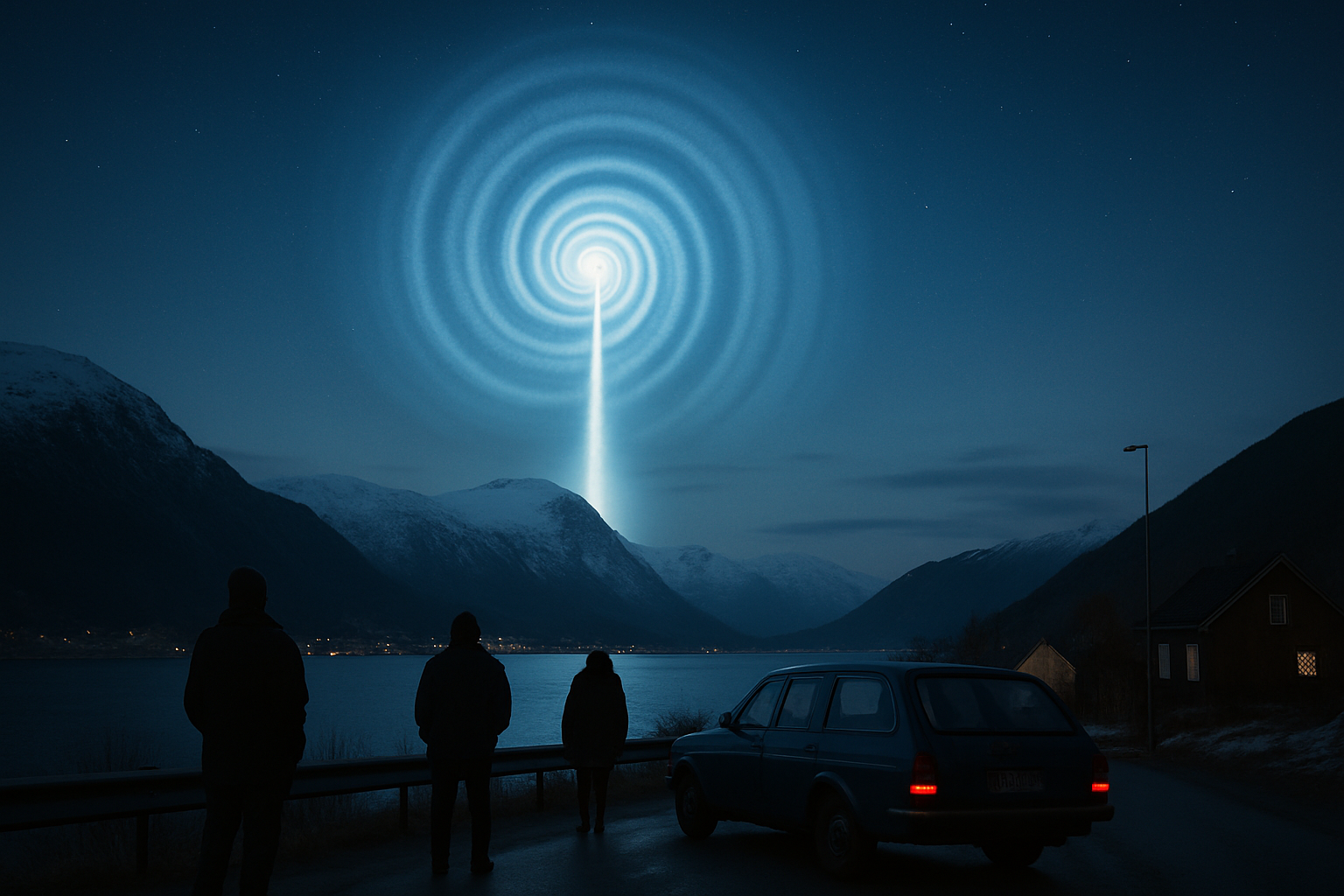
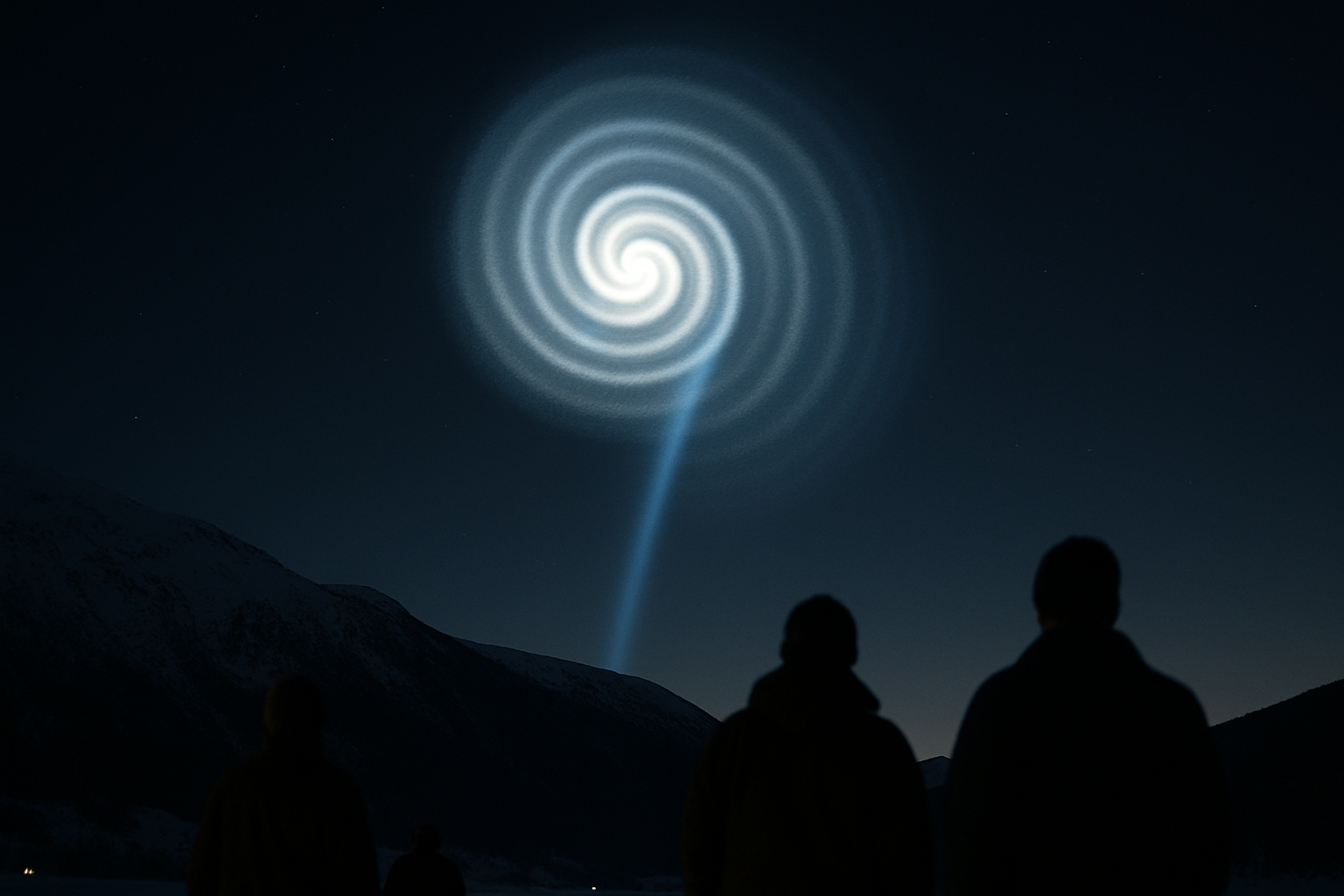
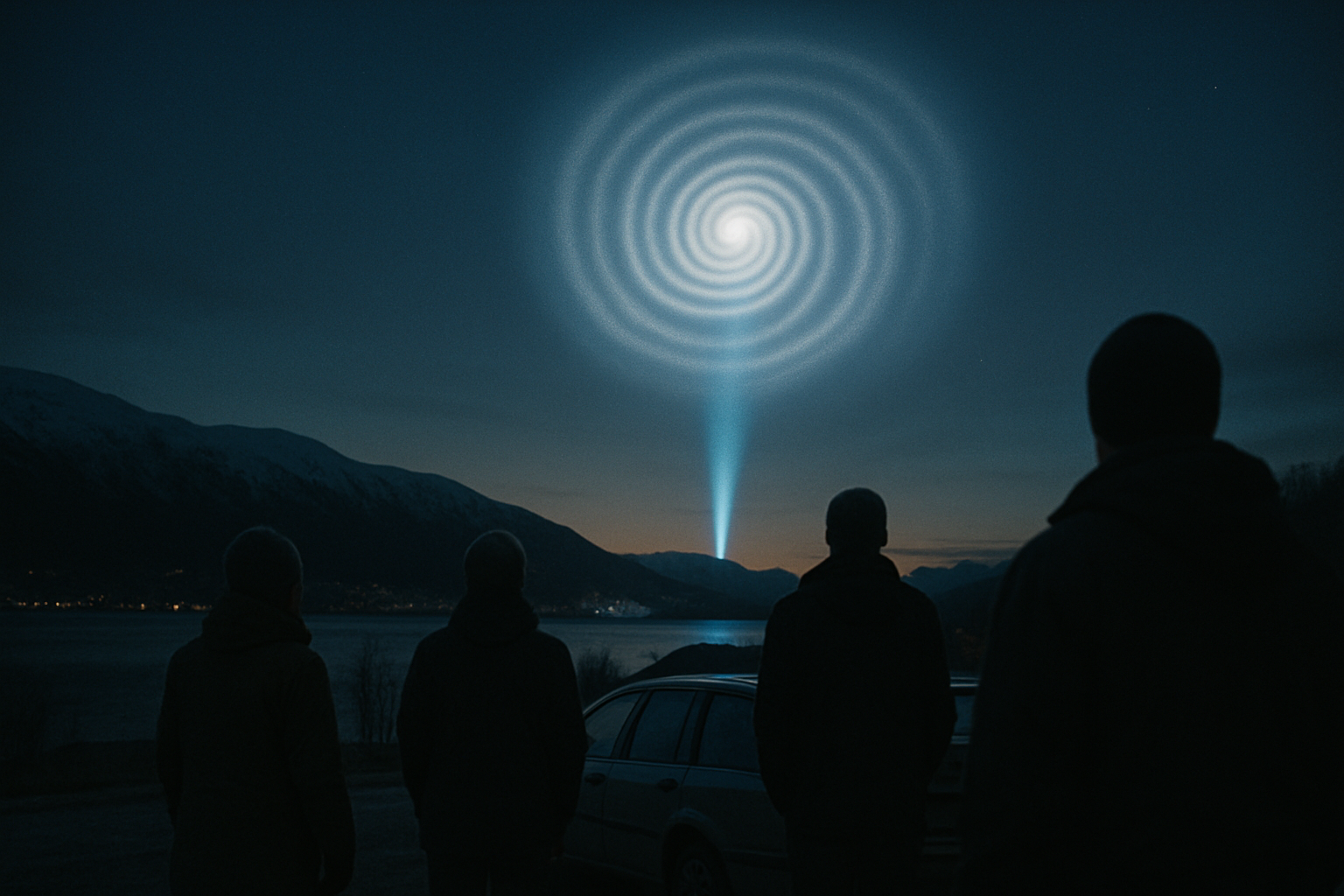
The 2009 Norwegian spiral anomaly was an unusual luminous spiral that appeared in the pre-dawn sky over Northern Norway on the morning of 9 December 2009, lasting about ten minutes and witnessed by thousands of people across the three northernmost counties and the Trøndelag region, as well as parts of Northern Sweden.[1] The display took the form of a blue beam of light, with a greyish spiral emanating from one end; many observers described a blue light that appeared to come from behind a mountain, halt in mid-air and then spiral outward before fading.[1] It was photographed and filmed extensively, and initial speculation ranged from auroral effects to unidentified flying objects.[3] On 10 December 2009 the Russian Defence Ministry acknowledged that a test launch of an RSM-56 Bulava submarine-launched ballistic missile had failed the previous day, and the spiral was widely attributed to that malfunction; the event is consequently regarded as explained.[1][4][2]
Background
The Bulava (RSM-56) is a Russian submarine-launched ballistic missile developed for sea-based nuclear deterrence and intended for the Borei class of strategic submarines.[2][3] By late 2009 the programme had a troubled testing record; press accounts at the time reported that eight of its twelve test launches up to that point had ended in failure, making each new flight a matter of public scrutiny.[2]
Northern Norway lies close to Russian test ranges and submarine operating areas in the White Sea and Barents Sea, and the region's long, dark December mornings provide conditions in which high-altitude rocket exhaust can be lit by sunlight while the ground below remains in darkness.[1][2] A comparable but less dramatic light phenomenon had been reported over Norway in November 2009, and it too was later associated with Russian missile testing.[1]
The event
Shortly before 08:00 local time on 9 December 2009, observers across a wide area of Northern Norway reported a sudden, brilliant light in the still-dark morning sky.[1][3] The phenomenon was visible across all of Trøndelag and the three northern counties of Norway, and was also seen from parts of Northern Sweden.[1]
Appearance
- The display consisted of a blue beam of light with a greyish spiral emanating from one end.[1]
- Witnesses described a blue light that seemed to come from behind a mountain, stop in mid-air and then begin to spiral outward.[1]
- The spiral grew into a large, slowly rotating disc or halo of light, which some compared to a spiral galaxy, before the centre darkened and the whole display faded.[2]
- The event lasted roughly ten minutes.[1]
Witnesses
An eyewitness in Harstad, Nick Banbury, reported seeing the lights between about 07:50 and 08:00 a.m. local time, describing the display as beginning with a green beam of light similar in colour to the aurora, with a rotating spiral at one end.[4] The Norwegian astronomer Knut Jørgen Røed Ødegaard publicly remarked on the exceptionally large area over which the spiral had been observed, underlining that whatever produced it must have occurred at very high altitude.[1] The display was captured on numerous cameras and mobile phones, and the resulting images circulated rapidly in international media.[3][4]
Official explanation
On 10 December 2009, the day after the sighting, the Russian Defence Ministry confirmed that a test of an RSM-56 Bulava missile had taken place on 9 December and had failed, and that this flight—together with a similar event the previous month—had the visual characteristics of failed Bulava launches.[1][4] The missile was reported to have been fired from a submarine in the White Sea, off the northern Russian coast.[2][4]
A ministry spokesman stated that "the missile's first two stages worked as normal, but there was a technical malfunction at the next, third, stage of the trajectory."[1][4] Because the first two stages had performed correctly, the missile reached a high altitude before the failure, where its exhaust could be illuminated by sunlight against the dark morning sky.[2]
Jonathan McDowell, an astrophysicist at the Harvard–Smithsonian Center for Astrophysics, suggested that the unusual light display occurred when the missile's third-stage nozzle was damaged, causing the exhaust to be expelled sideways and sending the missile into a spin; the spinning vehicle then traced out a spiral of luminous propellant.[1][2] This mechanism accounts both for the rotating spiral form and for the way it expanded and then faded as the venting ceased.[2]
Speculation and disputes
Before the Russian announcement, the suddenness and unusual geometry of the display prompted a wide range of interpretations.[3] Some observers initially wondered whether it was an unusually structured display of the aurora borealis, while others suggested a meteor or an unidentified flying object.[3][2]
A smaller body of online commentary advanced more exotic ideas, including suggestions that the spiral was a "wormhole" or was connected to experiments at the Large Hadron Collider; such claims were not supported by the scientific assessments of the event.[1][2] Once the failed Bulava test was disclosed and analysed, the spiral-from-a-spinning-rocket explanation was broadly accepted by astronomers and journalists, and the case is generally treated as resolved rather than disputed.[4][2]
Aftermath and significance
The 2009 Norwegian spiral became one of the most widely shared atmospheric-light events of its era, in part because it was captured on video and reproduced across global news outlets within hours.[3][4] It is frequently cited as a clear example of how an unfamiliar but ultimately mundane technological event—a malfunctioning rocket seen under particular lighting conditions—can produce a spectacle readily mistaken for an unexplained aerial phenomenon.[2]
For the Russian missile programme, the episode was an embarrassment, drawing renewed attention to the Bulava's repeated test failures at a time when it was central to the planned armament of the Borei-class submarines.[2] The event has since been used in popular science and skeptical writing as a case study in identifying and explaining "spiral" sky phenomena, several of which have been recorded elsewhere in connection with rocket launches and fuel venting.[1][2]
Key quotes
“"The missile's first two stages worked as normal, but there was a technical malfunction at the next, third, stage of the trajectory." — Russian Defence Ministry spokesman
“Astrophysicist Jonathan McDowell suggested a damaged third-stage nozzle vented exhaust sideways, sending the missile into a spin that traced out the spiral.
References
- 1.
- 2.
- 3.
- 4.
Similar cases
Scored on agency / year proximity / region / tag overlap — same agency +3, near year +4, same region +2, shared tag ×2.