1976 Tehran UFO incident
Illustrations
AI-generated illustration — not actual footage or evidence; an interpretive depiction based on the documented account
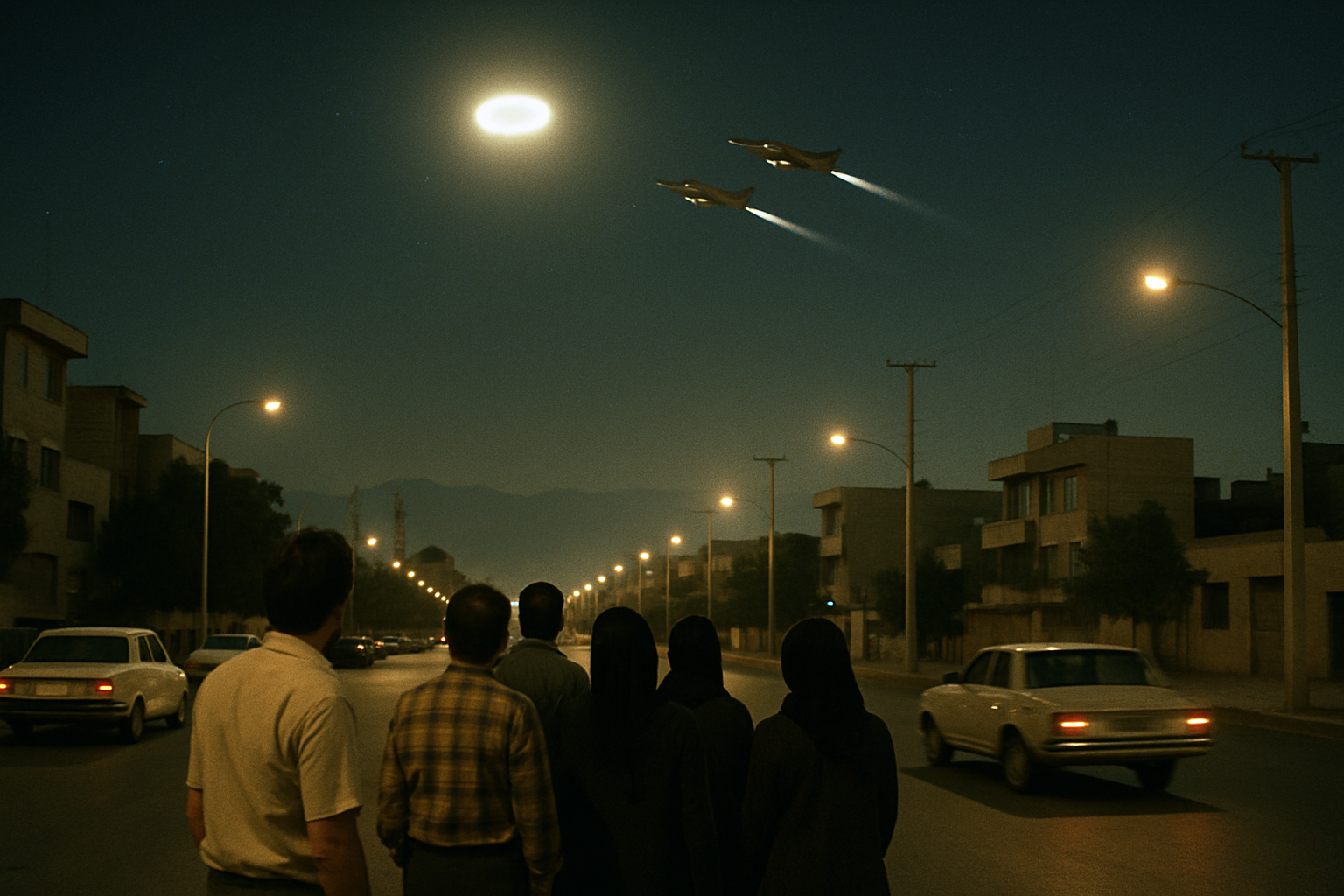
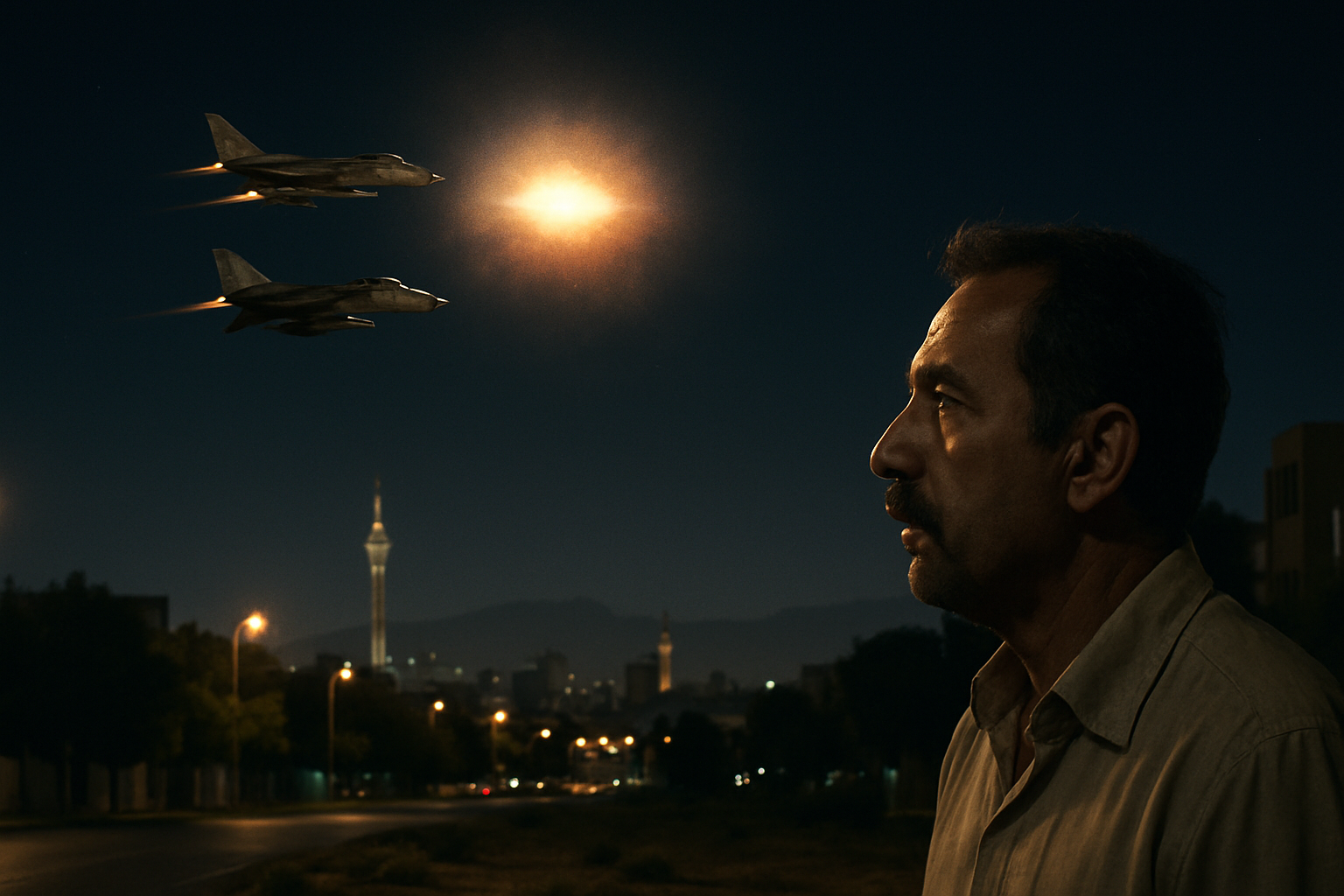
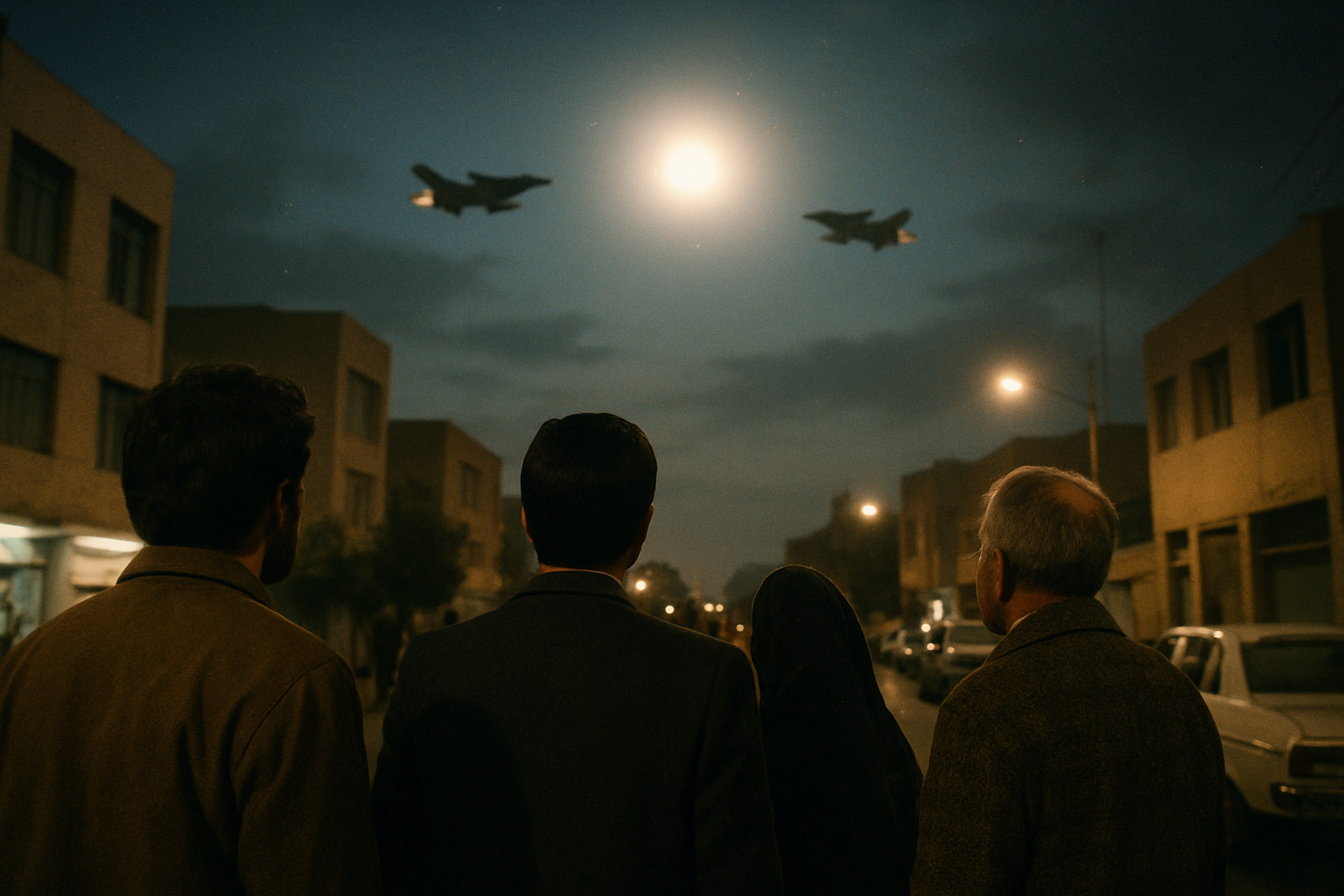
The 1976 Tehran UFO incident was a radar and visual encounter on 19 September 1976 in which two F-4 Phantom II interceptors of the Imperial Iranian Air Force (IIAF) were scrambled to investigate a brightly lit object reported over the Iranian capital, Tehran.[1] The episode began with civilian telephone reports of a luminous object and was relayed by the control tower at Mehrabad Airport; after the tower supervisor on duty observed the object himself, the air force launched the first jet.[1][2] According to the crews, both aircraft suffered failures of instrumentation, communications and — in the second jet — weapons systems as they approached, with the equipment recovering once they moved away; the second pilot, Major Parviz Jafari, also reported a smaller object detaching from the primary one and heading toward his aircraft.[1] The case is unusually well documented because a U.S. Defense Intelligence Agency (DIA) report, distributed to senior American commands and later declassified under the Freedom of Information Act, recorded the events and rated the report as of high value.[2][1] Skeptical analysts, including journalist Philip J. Klass and aerospace writer James Oberg, have argued that the crews first mistook an astronomical body such as the planet Jupiter for a craft and that the reported system failures are explained by equipment malfunction, so the case remains disputed rather than settled.[1]
Background
In 1976 the Imperial Iranian Air Force was one of the best-equipped air arms in the Middle East, operating a large fleet of U.S.-built F-4 Phantom II fighters under the government of the Shah, Mohammad Reza Pahlavi, and maintaining close military ties with the United States.[1] As a result, a U.S. Defense Attaché was stationed in Tehran and routine intelligence channels connected the IIAF to American commands, a detail that proved important to how the incident was later recorded.[2]
The encounter began with reports from the public. In the hours after midnight on 19 September 1976, residents of the Shemiran area of northern Tehran telephoned to report a strange object in the sky, and the calls were passed to the control tower at Mehrabad Airport.[1][2] The tower supervisor, Hossein Pirouzi, initially treated the calls cautiously but, after checking with the tower and looking himself, observed a brilliant object he could not identify, prompting a call to the air force command post.[1][2]
The intercepts
After the object was confirmed from the ground, General Nader Yousefi, the IIAF assistant deputy commander of operations, ordered fighters scrambled from Shahrokhi Air Base near Hamadan, west of Tehran.[1][2]
- First F-4. An F-4 Phantom II flown by Lieutenant Yaddi Nazeri was launched toward the object, which crew members said was visible from a great distance and shone brightly.[1] As the jet closed to within roughly 25 nautical miles, the pilot reported losing his instrumentation and UHF and intercom communications; the systems are said to have returned to normal once he turned away and broke off, and the aircraft returned to base.[1]
- Second F-4. A second Phantom, with Major Parviz Jafari as pilot and Lieutenant Jalal Damirian as weapons officer, was then launched.[1] Jafari obtained a radar lock on the target at about 27 nautical miles, with a radar return he compared in size to that of a large jet such as a tanker aircraft; he described the object as flashing intense red, green, orange and blue lights so bright that he could not make out a solid body.[1][2]
- The smaller object and weapons failure. As Jafari approached, he reported that the object kept its distance, and that a smaller, bright object detached from it and came straight toward his aircraft "almost as if it were a missile."[1] He said he attempted to fire an AIM-9 Sidewinder missile but experienced a sudden loss of power in the weapons control panel and a communications dropout at that moment, so the missile could not be launched; he then maneuvered away and reported the smaller object eventually rejoining the primary object.[1]
The crews also reported a point on the ground where one object appeared to descend, and a nearby airliner was said to have experienced a communications problem at around the same time.[1] The following day, crew members visited the area where an object had seemed to come down; they reported finding no obvious physical traces, but detected a signal in the vicinity that was later attributed to a beacon associated with an aircraft.[1]
Investigation and official documentation
The incident is best known through American documentation. A U.S. Defense Intelligence Agency (DIA) report describing the events was distributed the same period to a wide list of senior recipients, reported to include the White House, the Secretary of State, the Joint Chiefs of Staff, the CIA and the NSA, among military commands.[2][1] The report was later released under the Freedom of Information Act, which is why its contents are publicly known.[2]
An accompanying DIA evaluation rated the report in strongly positive terms. The assessment described it as "an outstanding report" and characterized the case as a classic example meeting the criteria for serious study of the phenomenon; the document listed factors such as multiple credible witnesses on the ground and in the air, a visual sighting corroborated by radar, and reported electromagnetic effects on more than one aircraft.[2][1]
The Iranian side also reviewed the events. Senior IIAF officers interviewed the aircrews, and the participants — including Major Jafari, who later rose to general — were interviewed again in subsequent years, recounting their accounts publicly at conferences and in the media.[1]
Explanations and disputes
Despite the strongly worded contemporary documentation, the cause of the Tehran encounter is disputed, and several conventional explanations have been advanced.[1]
Astronomical misidentification
The U.S. journalist and prominent UFO skeptic Philip J. Klass argued that the crews initially mistook a bright astronomical body — probably the planet Jupiter — for an aircraft, and that subsequent radar and equipment problems were misread as evidence of an intelligent craft.[1] Aerospace writer James Oberg likewise pointed to Jupiter as a plausible source of the initial bright object.[1]
Equipment malfunction
Klass and others contended that the reported failures are better explained by aircraft system problems than by an external effect. Among the points raised:
- Critics noted that not every reported failure was uniform across both jets, and that one aircraft involved had a documented history of electrical problems.[1]
- A radar set operating in a manual mode could, on this view, produce returns that an excited crew might misinterpret.[1]
- The crews were operating in the middle of the night under stress, conditions critics argue are conducive to perceptual error.[1]
The ground signal
Skeptical author Brian Dunning noted that the date fell during active meteor showers — including the Gamma Piscids and the tail of the Eta Draconids — which could account for bright objects seen falling toward the ground, and that the beeping signal detected near the supposed landing site was identified by investigators as an aircraft emergency beacon of a type carried by C-141 transports, which could be triggered by turbulence over the mountains north of Tehran, rather than being evidence of a landed craft.[3][1]
Why it remains disputed
Supporters of an anomalous interpretation emphasize the combination of radar lock, repeated equipment failures on more than one aircraft, and the trained-observer status of the crews, while skeptics emphasize ordinary explanations for each element taken separately.[1][2] Because neither side's case is conclusively established in the public record, the incident is generally treated as unresolved or disputed rather than firmly explained.
Aftermath and significance
The 1976 Tehran incident is frequently cited as one of the most thoroughly documented military UFO encounters, in large part because it left a paper trail in U.S. government channels and a declassified DIA report rather than resting on eyewitness testimony alone.[2][1]
Major Parviz Jafari, the pilot of the second jet, later became one of the most prominent witnesses to discuss the case publicly; after retiring as a general he recounted the encounter at press events and conferences, including a 2007 National Press Club gathering in Washington, D.C., of former officials and pilots calling for renewed official attention to such reports.[1]
The case continues to appear in surveys of aviation-related UFO reports and in discussions of how governments handle such incidents. Its central facts — the scramble of two F-4 Phantoms, the radar lock, the reported weapons and systems failures, and the high evaluation given by the DIA — recur across reference works, even as the underlying explanation remains contested.[1][2]
Key quotes
“The U.S. Defense Intelligence Agency evaluation called the case "an outstanding report" and described it as a classic example meeting the criteria for serious study of the phenomenon.
“Major Jafari described the object as flashing intense red, green, orange and blue lights so bright that he could not make out a solid body.
References
- 1.
- 2.
- 3.
Similar cases
Scored on agency / year proximity / region / tag overlap — same agency +3, near year +4, same region +2, shared tag ×2.