1976 Canary Islands UFO sightings
Illustrations
AI-generated illustration — not actual footage or evidence; an interpretive depiction based on the documented account
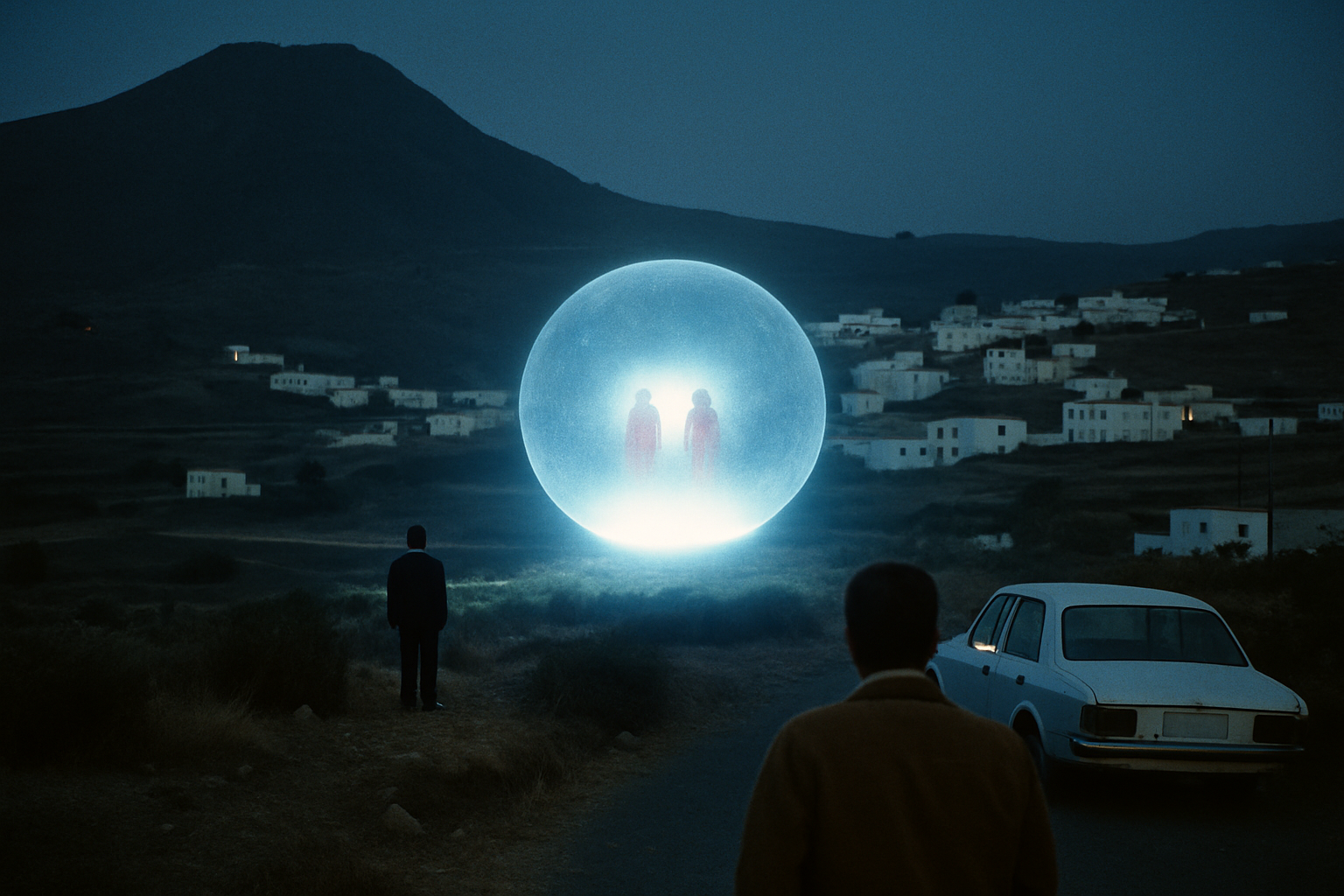
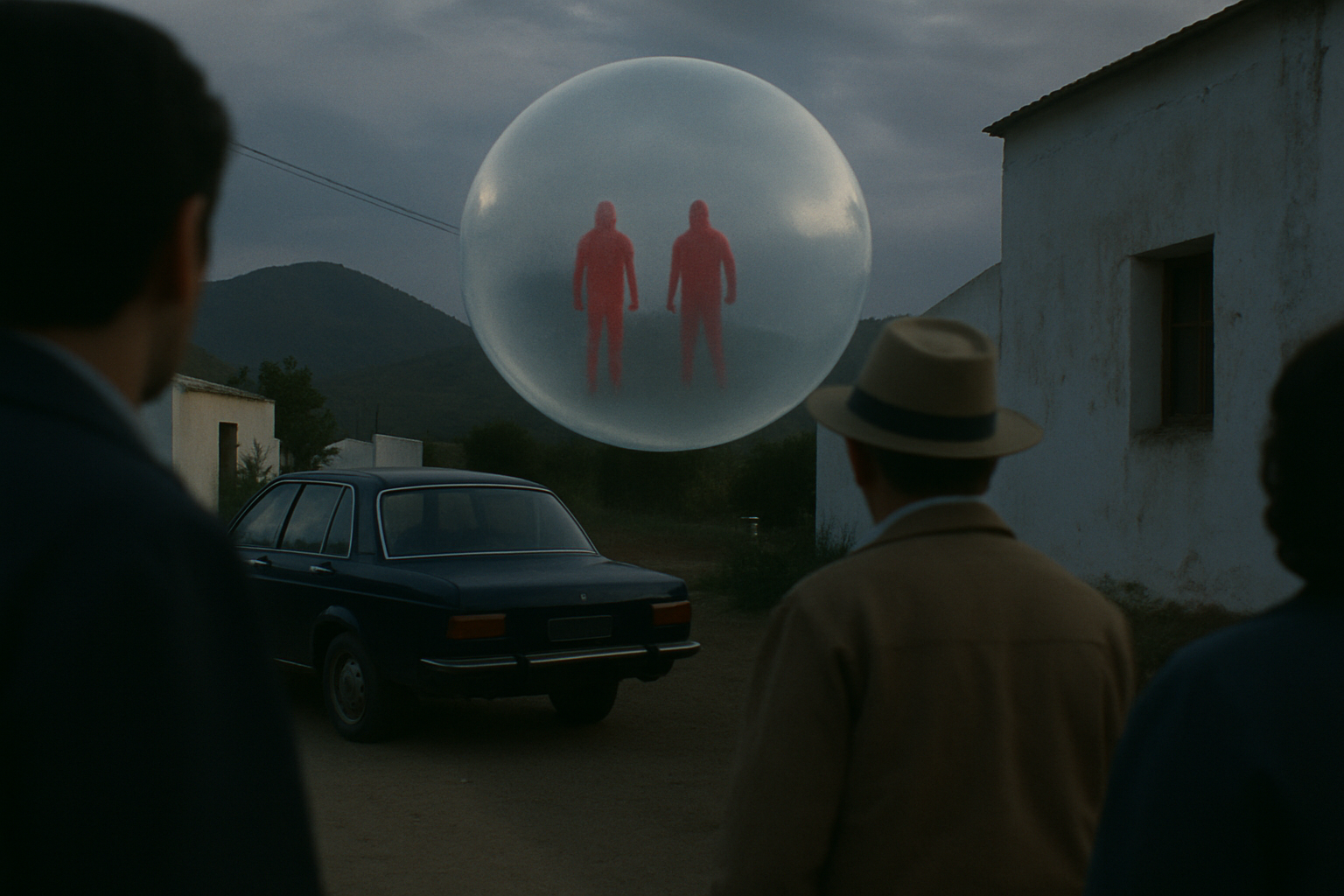
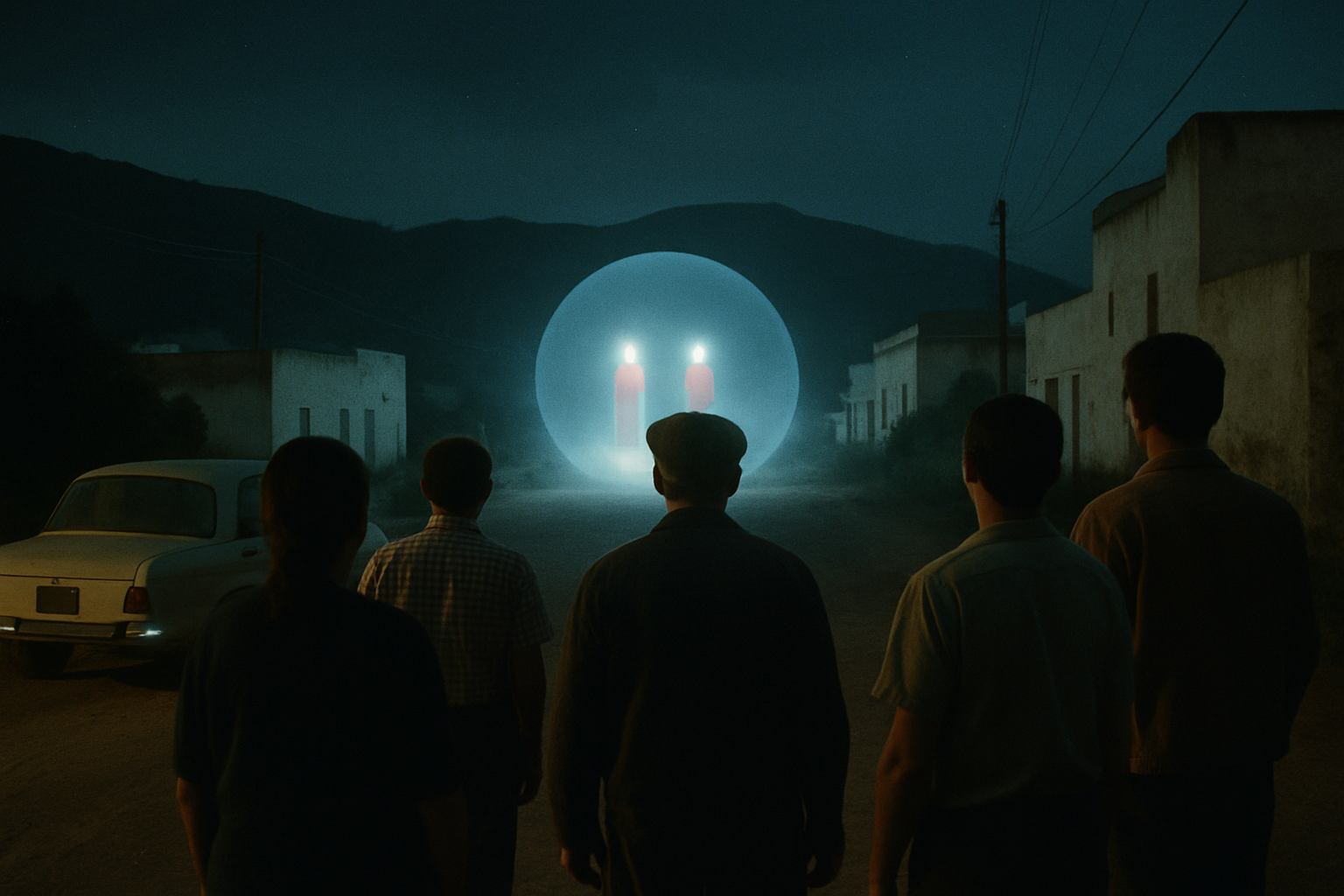
The 1976 Canary Islands UFO sightings refer to a luminous aerial phenomenon reported over Spain's Canary Islands on the night of 22 June 1976.[1][5] The event was witnessed by several hundred people—both civilians and military personnel—across Tenerife, La Palma, La Gomera and Gran Canaria, as well as from a ship at sea, and lasted more than forty minutes.[1][4] Its best-known component was a close-range encounter near Gáldar, in the north-west of Gran Canaria, in which a rural physician, Francisco-Julio Padrón León, and a taxi driver, Francisco Estévez, described a large, nearly transparent sphere hovering close to the ground with two tall, red-clad figures apparently inside it.[5][6] The Spanish Air Force opened a classified investigation file, numbered 760622, which was formally declassified in 1994 and classified the event as an *unidentified aerial phenomenon* (Spanish: *fenómeno aéreo no identificado*, FANI).[6] The file was written by the military judge Antonio Munáiz, who considered the reported occupants dubious.[1] A strongly corroborated conventional explanation holds that the broader sequence of Canary Islands lights was produced by Poseidon missiles test-fired from a United States ballistic-missile submarine in nearby waters; the case is therefore best regarded as disputed rather than unexplained.[2][3]
Background
The Canary Islands (Spanish: *Islas Canarias*) are a Spanish archipelago in the Atlantic Ocean off north-west Africa. During the 1970s the islands were the focus of a series of widely reported luminous sky phenomena, of which the events of 22 June 1976 are the most prominent.[1][5]
- Declassified Spanish Ministry of Defence files record several Canary Islands sightings across the decade, and later analyses group the 1976 case within a wider series sometimes dated to 1974–1979.[2][3]
- The 1976 case stands out for the number and variety of its witnesses, including military personnel and professionals such as a physician, and for the existence of a formal Air Force investigation.[1][6]
- Because of the breadth of testimony, the case has been described in some Spanish-language coverage as one of the most credible in the country's UFO record.[6][5]
The sightings of 22 June 1976
On the evening of 22 June 1976 the luminous phenomenon was reported in stages from several islands and from the sea.[1][5]
- At 21:27 (9:27 p.m.), the crew of the Spanish Navy corvette Atrevida, on patrol off Fuerteventura, reported an intense yellowish-bluish light that rose from the shore and, after going out, developed into a great luminous halo that remained in place for about 40 minutes.[4]
- About three minutes later, at around 21:30, witnesses in the north-west of Gran Canaria, around Gáldar and Agaete, observed a very similar luminous phenomenon in the sky.[4][5]
- The phenomenon was also reported from Tenerife, La Palma and La Gomera, with the overall episode said to have lasted more than forty minutes.[1][4]
The most detailed account came from Dr. Francisco-Julio Padrón León, who was travelling by taxi driven by Francisco Estévez to attend a patient. The two men reported that a very large, luminous but nearly transparent sphere—through which, they said, the stars could be seen—was hovering close to the ground, and that inside it they could make out two tall figures dressed in red.[5][6]
Official investigation
The sightings prompted the Spanish Air Force (*Ejército del Aire*) to open a formal investigation.[6][1]
- The case was recorded as classified file 760622, kept secret for many years and declassified in 1994.[6]
- A military judge, Antonio Munáiz, wrote the report and interviewed witnesses, whose statements were assessed for reliability—ranging from highly credible observers such as professionals and military personnel to accounts the investigators considered unreliable.[1]
- Munáiz found Padrón León's description of figures inside the craft dubious, a caution shared by senior Air Force officers associated with the inquiry.[1]
- The investigation concluded that the episode constituted an unidentified aerial phenomenon (FANI): something unexplained had been observed in the sky, although island radars reportedly registered nothing and no physical or solid object could be confirmed.[6]
Much of the file's content reached the public in 1977, after the journalist and paranormal writer J. J. Benítez obtained a copy of the same report and used it as the basis of a book, and the file was formally declassified in 1994 as part of the Spanish military's wider release of UFO records.[1][6]
Explanations and assessment
Although the Air Force inquiry officially classified the event as a FANI, later analysis strongly favours a conventional cause, so the case is best regarded as disputed rather than unexplained.[2][1]
- The Air Force inquiry classified the event as a FANI and was particularly cautious about the reported occupant sightings, with judge Munáiz deeming them dubious, while not offering a conclusive natural cause at the time.[1]
- The best-corroborated explanation is that the broader series of Canary Islands lights was produced by Poseidon (UGM-73) ballistic missiles test-fired from a United States ballistic-missile submarine (an SSBN-642-class boat) in nearby Atlantic waters during NATO trials; the expanding, glowing clouds of such night launches match the description of the luminous spheres.[2][3]
- This hypothesis is reinforced by astrophysicist Jonathan McDowell (Harvard–Smithsonian Center for Astrophysics), who supplied launch dates and times that coincide almost exactly with the times of the sightings.[2]
- Supporters of an anomalous interpretation still emphasise the large number and quality of witnesses, including military observers and professionals; the occupant report in particular remains contested.[6][5]
While the missile-launch account is now the most strongly evidenced explanation, the case continues to be discussed in Spanish ufological and journalistic literature.[2][6]
Key quotes
“The investigation classified the event as an "unidentified aerial phenomenon" (FANI): something unknown was in the sky, though its solid nature could not be confirmed.
“Dr. Padrón and the taxi driver said they saw a large, nearly transparent sphere hovering close to the ground, with two tall, red-clad figures inside.
References
- 1.
- 2.
- 3.
- 4.
- 5.
- 6.
Similar cases
Scored on agency / year proximity / region / tag overlap — same agency +3, near year +4, same region +2, shared tag ×2.